




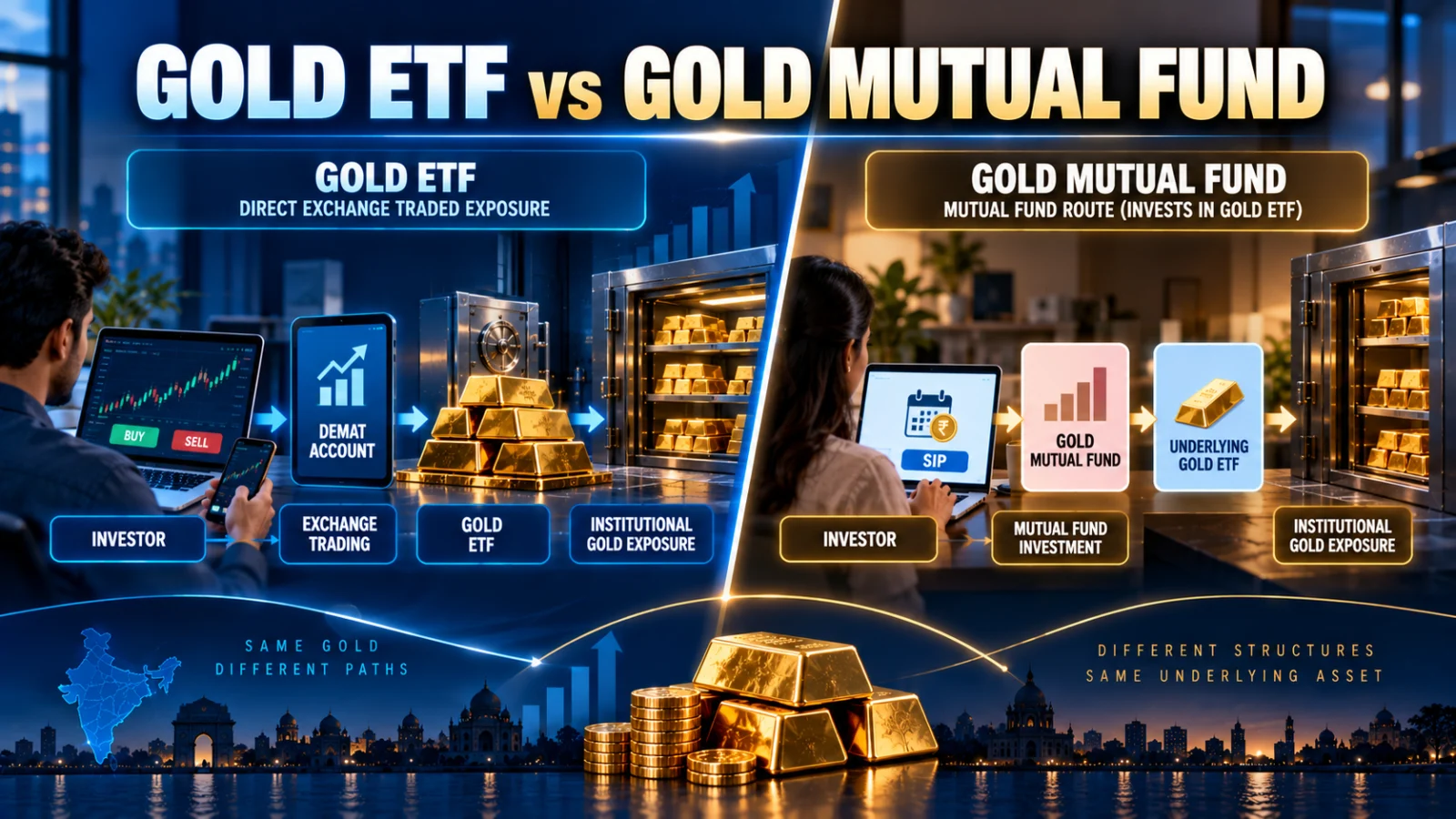
Gold ETF vs gold mutual fund is not mainly a question of which product gives you “better gold.” Both routes can ultimately give an investor exposure to gold, but they place the investor in different transaction, pricing, liquidity and cost structures.
With a Gold ETF, you buy exchange-traded ETF units directly. With a gold mutual fund or Gold ETF Fund of Fund, you buy units of a mutual-fund scheme that in turn invests in an underlying fund or ETF, commonly a Gold ETF.
The useful question is therefore: Do you want direct exchange access to the ETF, or a mutual-fund wrapper around that exposure?
Gold ETF vs gold mutual fund at a glance
| Dimension | Gold ETF | Gold Mutual Fund / Gold FoF |
|---|---|---|
| What you buy | Exchange-traded ETF units | Mutual-fund units in a scheme that invests in another fund or ETF |
| Transaction route | Stock exchange | Mutual-fund purchase and redemption route |
| Demat / trading access | Normally needed for direct exchange buying and selling | Ordinary mutual-fund investing does not require direct exchange trading |
| Pricing | Exchange market price during trading hours | Applicable mutual-fund NAV under scheme transaction rules |
| SIP | Depends on broker or platform automation rather than changing the ETF’s exchange-traded nature | SIP is commonly built directly into the mutual-fund route |
| Liquidity | Execution depends on exchange-market liquidity and available bid/ask prices | Investor redeems with the mutual fund under scheme rules |
| Cost structure | ETF expenses plus brokerage, demat, platform and spread costs where applicable | FoF expenses plus costs embedded in the underlying ETF, and any applicable exit load |
| Tracking | ETF can differ from its reference gold movement because of expenses and implementation | Outcome can reflect both underlying ETF tracking and the FoF’s own expenses, cash and implementation |
| Intraday control | Yes, subject to market trading | No direct intraday exchange execution for ordinary mutual-fund purchase/redemption |
1. The most important difference is the investment path
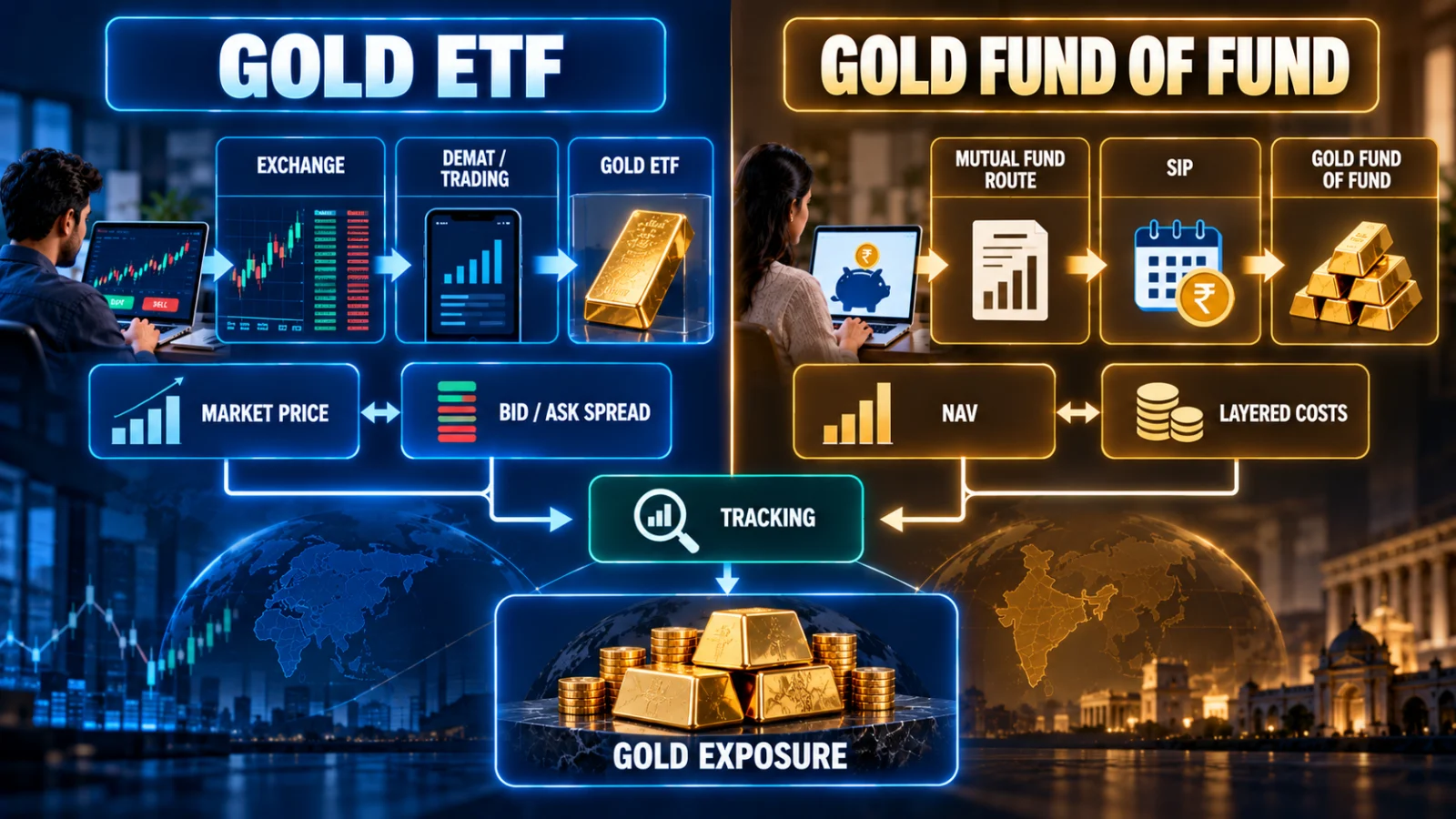
The structures can be represented simply.
Gold ETF: investor → exchange → Gold ETF units → underlying gold exposure.
Gold FoF: investor → mutual-fund scheme → underlying Gold ETF or fund → underlying gold exposure.
That additional mutual-fund layer is why two products seeking similar gold exposure can behave differently for the investor even before investment performance is considered.
2. A Gold ETF is bought through the exchange
SEBI describes ETFs as funds whose units trade on a stock exchange like shares. That means a retail investor buying a Gold ETF directly normally uses stock-market infrastructure such as a trading and demat account.
The execution price is the available market price when the order trades. It should not be assumed that every ETF trade occurs exactly at the fund’s NAV.
This matters because market liquidity and the difference between available buy and sell prices can affect what the investor actually pays or receives.
3. A Gold FoF uses the mutual-fund route
SEBI defines a Fund of Funds as a mutual fund that invests in other mutual funds or ETFs. A gold-focused FoF can therefore give the investor gold exposure by investing in an underlying Gold ETF rather than requiring the investor to buy that ETF directly on the exchange.
The investor owns units of the FoF, not the underlying ETF units directly.
Purchase and redemption operate through mutual-fund transaction rules and applicable NAV rather than through an intraday exchange order placed by the investor.
4. Does a Gold ETF require a demat account?
For normal direct buying and selling of a Gold ETF on an exchange, the investor uses exchange-market infrastructure, which generally means trading and demat access.
A Gold FoF provides a different route. Ordinary mutual-fund purchase and redemption can be performed without the investor directly trading ETF units on the exchange.
This distinction can be important for someone who already has a mutual-fund workflow but does not want to operate through a trading account.
5. SIP convenience is structurally different
Gold FoFs commonly offer SIP facilities as part of the mutual-fund structure. The investor can instruct the fund platform to invest a fixed amount periodically and receive FoF units at the applicable NAV.
An ETF remains an exchange-traded security. Some brokers or investment platforms may offer automated or recurring ETF purchase features, but those platform features do not transform the ETF into a mutual-fund SIP product.
For a reader whose main requirement is a conventional mutual-fund SIP workflow, the FoF route can therefore be operationally simpler.
6. NAV and ETF market price are not the same concept
This is one of the most important distinctions in the comparison.
A Gold ETF has a NAV representing the value of the fund’s underlying portfolio, but the investor normally buys or sells the ETF at the exchange market price available at execution.
A Gold FoF purchase or redemption instead uses the applicable mutual-fund NAV under the scheme’s transaction rules.
That means a comparison based only on NAV can miss the investor’s actual ETF execution price.
7. Bid/ask spread matters for the ETF route
On an exchange, the best available buying price and selling price can differ. That difference is the bid/ask spread.
For an ETF investor, the spread can function as part of the practical transaction cost, particularly when market liquidity is weaker or the order size is large relative to available depth.
A Gold FoF investor does not directly transact against an exchange bid and ask when subscribing or redeeming fund units. That does not mean the FoF is cost-free; its cost structure appears elsewhere.
8. Do not compare only the headline expense ratio
A direct Gold ETF can have fund expenses, while the investor may also face brokerage, demat charges, platform charges and the economic effect of the bid/ask spread depending on the broker and transaction.
A Gold FoF introduces another fund layer. SEBI’s Fund of Funds guidance specifically warns that FoFs can carry higher costs because investors can bear costs associated with the FoF as well as expenses embedded in the underlying fund or ETF.
The correct comparison is therefore not simply “which published TER is lower?” It is the full investor cost stack.
9. FoF layering does not mean the product is automatically bad
The additional layer performs a function: it converts direct ETF exposure into a conventional mutual-fund transaction experience.
For an investor who values SIP convenience, does not want direct exchange execution or does not use a demat workflow, that wrapper can provide operational utility.
But that convenience should be compared with the additional cost layer rather than treated as free.
10. Tracking can differ at more than one layer
A Gold ETF is intended to provide exposure linked to gold, but expenses, cash, valuation timing and portfolio implementation can cause its return to differ from the reference gold movement.
A Gold FoF can introduce another layer because it owns units of the underlying ETF or fund. Its investor outcome can therefore reflect the underlying ETF’s tracking behaviour plus the FoF’s own expenses, cash position and implementation.
TPS does not assign one universal tracking-error number to either structure. Tracking data is scheme-specific and changes over time.
11. Liquidity works differently
Gold ETF liquidity is an exchange-market question. The investor needs an executable market, and the price available can be influenced by trading activity, market makers and the creation/redemption ecosystem.
A Gold FoF investor exits by redeeming units with the fund according to the scheme’s rules. The investor is not waiting to sell those FoF units to another retail buyer on the stock exchange.
That does not mean the FoF offers instant liquidity at any price or time. Redemption timelines, applicable NAV rules and any scheme-specific exit load still matter.
12. Which route gives more execution control?
A direct ETF gives the investor exchange-level execution control. The investor can decide whether to place an order during market hours and can use the market price available at that time.
A FoF provides less intraday execution control because transactions follow the mutual-fund NAV process rather than exchange order execution.
Neither characteristic is inherently superior. Some investors value direct trading control; others prefer not to make intraday execution decisions at all.
13. Taxation should be checked by the actual structure
Current Indian capital-gains rules distinguish listed and unlisted units and can also require analysis under section 50AA.
Under the current general framework reviewed for this article, listed units generally use a 12-month long-term holding threshold, while other unlisted units generally use 24 months, subject to special statutory classification.
Section 50AA’s specified-mutual-fund definition was narrowed from April 2026 to focus on funds with more than 65% debt and money-market exposure, or funds investing at least 65% in those debt-oriented funds.
That is why the article does not use one permanent “Gold ETF and Gold FoF tax rate” statement. Before calculating after-tax return, verify the exact scheme, whether the units are listed or unlisted, the acquisition and sale dates and the current law.
14. Historical returns alone do not tell you which structure fits
If a Gold ETF and a Gold FoF are both ultimately exposed to the same underlying gold market, comparing a short trailing-return table can hide the reason their investor returns differ.
The differences can come from expenses, the FoF wrapper, tracking, exchange execution, cash positions and transaction costs.
Past return ranking also does not tell you whether the reader wants a mutual-fund SIP workflow or direct exchange execution.
15. A practical reader-state decision
If you already use a demat and trading account
Direct Gold ETF ownership may fit naturally if you want exchange execution and are comfortable evaluating liquidity, spreads and order price.
If you want a conventional mutual-fund SIP
A Gold FoF can fit that workflow more naturally because periodic investing is part of the mutual-fund transaction structure.
If keeping costs as transparent as possible is your priority
Compare the entire cost stack. For the ETF, include TER, brokerage, demat or platform charges and bid/ask spread where relevant. For the FoF, include its own expenses, underlying ETF expenses and any applicable exit load.
If intraday price control matters
The ETF route provides exchange execution. The FoF uses applicable NAV and therefore solves a different transaction need.
If you do not want to manage exchange liquidity
The mutual-fund route removes direct retail execution against an exchange bid/ask spread, although the FoF still has its own costs, redemption rules and exposure to the underlying ETF structure.
Gold ETF vs gold mutual fund: which is better?
There is no universal winner.
A Gold ETF and a Gold FoF can both lead toward regulated gold exposure, but the investor interacts with different layers.
The direct ETF route generally fits a reader who wants exchange access, intraday execution control and direct ownership of ETF units. The FoF route generally fits a reader who prefers mutual-fund-style purchase, redemption and SIP convenience without directly trading the ETF.
The decision should therefore be made from the investor’s required workflow and the current full cost, liquidity and tax structure—not from a generic claim that one product is always superior.
Bottom line
The simplest way to understand the choice is to follow the money.
Gold ETF: you buy the ETF directly through the exchange.
Gold FoF: you buy a mutual-fund wrapper that then invests in an underlying fund or ETF.
That one extra layer changes how you invest, what price mechanism you use, how SIPs work, where costs arise, how tracking can accumulate and how you exit. Compare those structural differences first, then verify the current scheme-specific numbers before choosing a product.