







Gold for retirement India planning should begin with one important distinction: gold can support a retirement portfolio, but ordinary gold does not itself generate the recurring income needed to pay monthly expenses. Gold can contribute diversification, market liquidity and long-term wealth-preservation characteristics, but retirement changes the order of the decision. Spending and dependable cash flow come first; gold’s supporting role comes after those needs are understood.
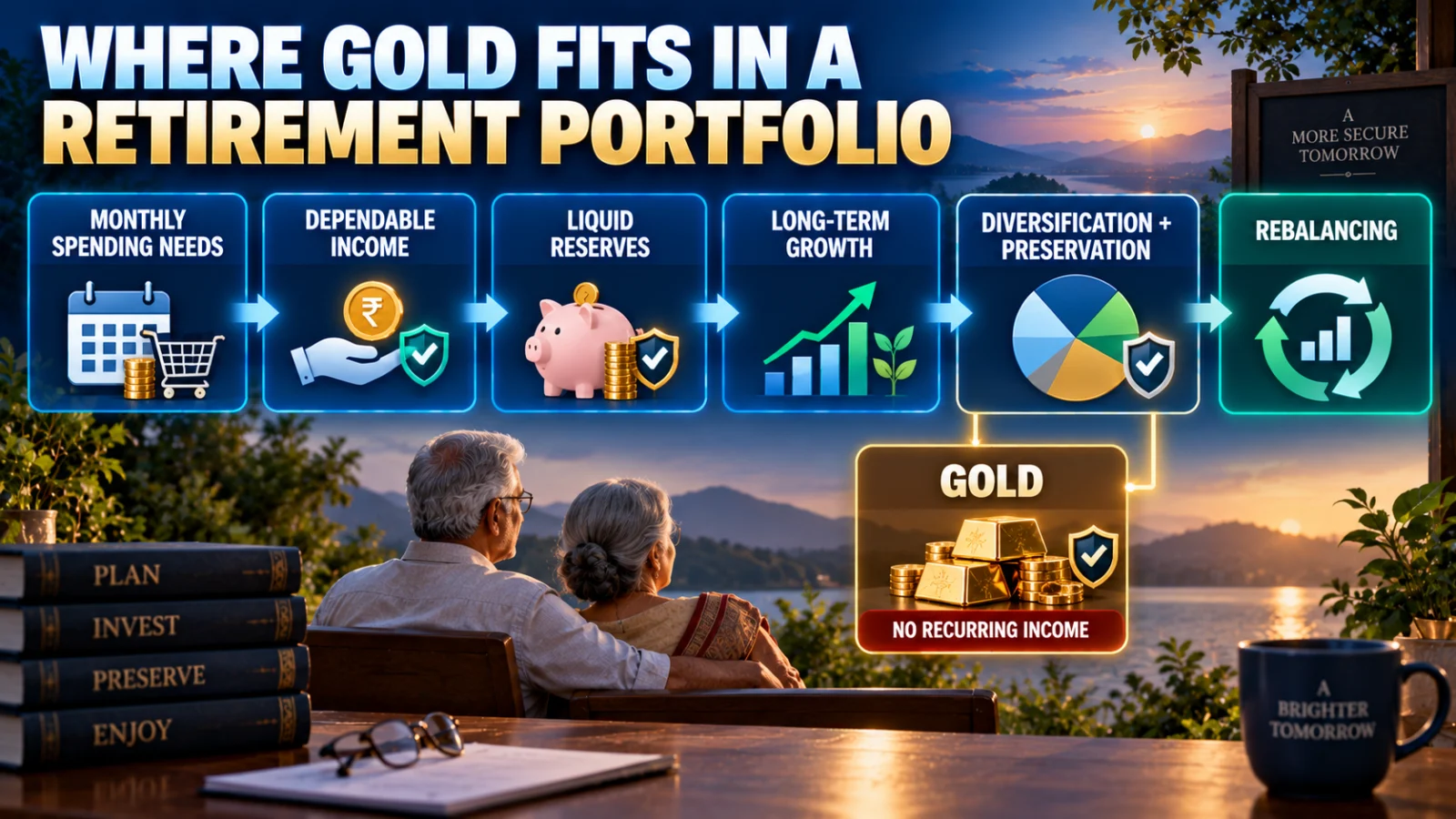
1. Map monthly spending
Estimate the household expenses that must continue after employment income stops, including essential living costs and a realistic allowance for inflation and emergencies.
2. Identify dependable income and liquid reserves
Separate pensions, annuities or other recurring income from assets that may need to be sold. Maintain appropriate accessible assets for near-term spending needs.
3. Preserve long-term growth capacity
Retirement can last for decades, so the portfolio may still need assets capable of supporting purchasing power over a long horizon.
4. Add diversification and preservation assets
Only after the spending and growth structure is understood should the portfolio assess whether gold improves diversification or resilience.
5. Define gold’s supporting role
Use gold for the job evidence supports: diversification, market liquidity and potential long-term preservation, not as a substitute for native recurring income.
6. Maintain the structure
Once the role and target are chosen, use a separate rebalancing policy rather than changing the strategic allocation simply because gold prices moved.
Retirement is a cash-flow problem before it is a gold-allocation problem
Before deciding whether gold belongs in retirement, a household needs to understand how much money must be available for regular spending and what sources can provide it.
SEBI’s retirement-planning material begins with expenses, inflation, retirement duration and the returns available from the retirement corpus. That framing matters because an asset can be valuable without solving the monthly-income problem.
A retiree who needs predictable spending money should therefore distinguish between income, liquidity and wealth preservation. These are related but not interchangeable jobs.
Gold does not generate recurring retirement income
World Gold Council research explicitly identifies the absence of regular cash flow as one of gold’s limitations. Gold does not itself pay interest or dividends.
This is the clearest boundary for a retirement article. A retiree can sell part of a gold holding to raise cash, but that is asset liquidation, not recurring income generation. Each sale reduces the quantity of gold remaining.
By contrast, some retirement assets or arrangements are specifically designed around recurring payments. PFRDA describes annuities as mechanisms intended to provide regular income after retirement. That does not mean an annuity is appropriate for every person; it shows that annuity income and gold serve fundamentally different jobs.
Liquidity is not the same as income
Gold can be highly liquid in deep global markets, particularly through investment forms that can be sold efficiently. Liquidity means an asset can potentially be converted into cash. It does not mean the asset produces cash automatically.
This distinction matters in retirement. A liquid gold holding can provide a source of funds if it is deliberately sold, but a pension, annuity or another income-producing arrangement can provide payments without requiring the household to sell part of the underlying asset each time cash is needed.
The practical liquidity of a retiree’s gold also depends on the form held. Financial gold, bullion and jewellery do not have identical transaction costs, sale mechanics or practical accessibility.
If gold has no income, why hold it at all?
The strongest evidence-based case for gold in retirement is not monthly income. It is the possibility that gold behaves differently from other portfolio assets and therefore contributes diversification and resilience.
World Gold Council’s 2026 strategic-asset research identifies diversification and liquidity as important characteristics of gold. Its India portfolio work also found that gold improved several historical risk-adjusted measures and reduced drawdowns in the hypothetical portfolios it tested.
Those historical results do not prove that gold will always protect a retirement portfolio or that every retiree should own it. They show why gold can have a supporting role even though it produces no regular cash flow.
Retirement still needs long-term growth
Retirement does not automatically mean that every asset should be converted into cash or fixed-income holdings.
A retirement period can last for many years, while inflation can steadily reduce purchasing power. The household therefore has to balance near-term spending stability with longer-term growth and preservation needs.
Gold belongs inside that broader architecture. It should not be evaluated in isolation or treated as a replacement for all growth assets merely because it has performed well during a particular period.
Gold’s retirement role comes after the income floor
A useful retirement sequence is:
- Estimate essential and discretionary spending.
- Identify pensions, annuities or other dependable recurring income.
- Maintain appropriate accessible assets for near-term expenses and emergencies.
- Preserve a long-term growth component where appropriate for longevity and inflation risk.
- Assess whether gold adds useful diversification or preservation characteristics.
- Choose the gold exposure only after the earlier jobs have been defined.
- Maintain the structure through an explicit rebalancing policy.
This order prevents a common category error: treating an asset that can be sold for cash as if it automatically generates retirement income.
There is no universal gold percentage for retirees
The evidence reviewed by TPS does not establish one correct gold allocation for every retiree.
Retirement portfolios can differ dramatically. One household may have a large pension and modest spending needs. Another may depend almost entirely on withdrawals from invested savings. A third may already own significant jewellery, physical gold or inherited gold.
Those households do not have the same cash-flow dependency, liquidity requirement, tax position, longevity risk or capacity to tolerate market fluctuations.
A percentage that appears reasonable in one historical model or adviser rule therefore should not be converted into a universal retirement prescription.
Existing jewellery and physical gold should not be ignored
Indian households may already have material gold exposure before any retirement portfolio allocation is added.
That exposure should at least be inventoried. Otherwise, a household could believe it has very little gold in its financial portfolio while holding substantial gold elsewhere.
But jewellery should not automatically be treated as fully liquid retirement capital. Making charges, stones, design value, sale deductions, sentimental use and the household’s unwillingness to sell can all make jewellery economically different from investment gold.
Selling gold for expenses is a withdrawal, not yield
A retiree may decide to sell gold occasionally to fund a large expense or rebalance the portfolio. That can be a legitimate use of a liquid asset.
However, regularly selling gold to fund monthly expenses is a withdrawal strategy. The sustainability of that strategy depends on the size of the holding, future gold prices, the amount withdrawn and the rest of the retirement portfolio.
TPS therefore cannot treat “sell some gold every month” as equivalent to income generation or as a universally sustainable retirement method.
Do not increase gold just because it recently performed well
Retirement portfolios are especially vulnerable to decisions driven by recent performance because the investor may already be withdrawing money from the portfolio.
A strong gold rally does not, by itself, prove that gold should receive a larger strategic role. The better question is whether the household’s spending, income, liquidity, risk capacity or diversification needs have changed.
Where general gold allocation ends and retirement planning begins
TPS separately explains how to think about choosing a general portfolio gold allocation. That page asks how much exposure fits the overall portfolio.
This retirement page asks a narrower but materially different question: once the portfolio must support spending after employment income stops, what job should gold perform?
After a retirement-specific target has been chosen, TPS’s existing gold allocation and rebalancing guide explains the separate maintenance job of restoring portfolio weights after market movement.
Bottom line
Gold can support retirement, but it should not be mistaken for a retirement-income engine. Its strongest evidence-backed role is as a diversifier and liquid store of market value that may contribute to long-term portfolio resilience.
The retirement sequence should therefore be: understand spending, secure dependable income and accessible reserves, retain appropriate long-term growth, then decide how much diversification and preservation support gold should provide.
No universal retiree gold percentage was established.
Verification note
TPS reviewed World Gold Council’s 2026 strategic-asset research for gold’s diversification, liquidity and cash-flow characteristics, SEBI retirement-planning material for spending, inflation and portfolio considerations, and PFRDA material describing regular retirement-income mechanisms.
Limitations and unresolved facts
Future gold returns, inflation and asset correlations are unknown. Retirement spending, longevity, pension income, medical costs, tax treatment, risk capacity and existing gold holdings vary by household. Gold-product liquidity and costs also differ, so TPS cannot establish a universally correct retirement gold percentage or personalised withdrawal strategy.