






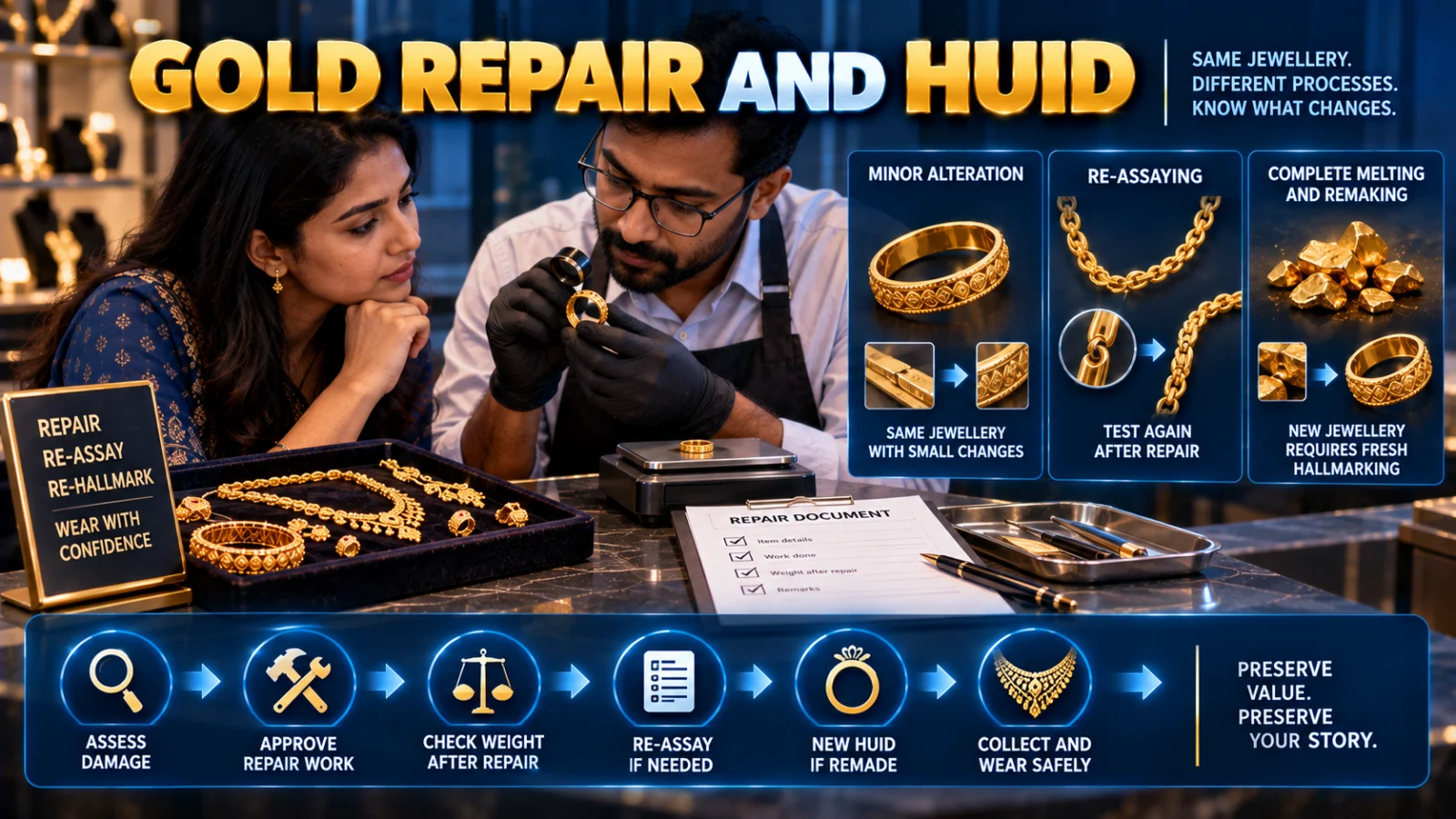
Gold jewellery repair HUID rules depend on what physically happens to the article. A small alteration does not automatically mean the jewellery needs a new HUID, but BIS draws a clear line between limited alteration, larger alteration or damaged hallmarking, and jewellery that is completely melted and remade.
Under the Bureau of Indian Standards Hallmarking Amendment Regulations, alteration in hallmarked jewellery is permitted up to 50% of the jewellery’s weight or 2 grams, whichever is lower, with responsibility for purity remaining with the jeweller. If the alteration goes beyond the permitted limit, BIS says the altered jewellery needs to be re-hallmarked when it is being put through the hallmarking process.
If the amount altered stays within 50% of the jewellery’s weight or 2 grams, whichever is lower, BIS permits the alteration with responsibility for purity on the jeweller.
BIS says jewellery altered beyond the permitted limit needs re-hallmarking when the article is submitted for hallmarking.
The article can be re-hallmarked only after the complete assaying process and only if it conforms to the relevant Indian Standard.
The remade piece is a new jewellery article and BIS says it should receive a new six-digit HUID before sale.
Does every gold jewellery repair require re-hallmarking?
No. BIS specifically permits alteration within a defined limit. The controlling threshold is not simply 2 grams and it is not simply 50% of the article’s weight.
The rule is up to 50% of the weight of the jewellery or up to 2 grams, whichever is lower.
For example, if an article weighs 3 grams, 50% is 1.5 grams. The lower figure is therefore 1.5 grams, not 2 grams. If an article weighs 10 grams, 50% is 5 grams, so the lower figure is 2 grams.
The threshold describes the amount of alteration permitted under the BIS regulation. It does not mean every named repair such as ring resizing, chain soldering or clasp replacement automatically falls inside the limit. The actual amount of material altered matters.
Who is responsible for purity after an allowed alteration?
BIS places responsibility for purity on the jeweller when hallmarked jewellery is altered within the permitted threshold.
This matters because repair can involve adding solder, adding or removing gold, replacing components or otherwise changing the original article. Staying within the alteration threshold does not mean purity stops mattering.
Does BIS update the HUID record after a small alteration?
Current BIS guidance says there is no provision to reflect permitted alterations in the online system.
That means an owner should not assume that the BIS online HUID record will show a later resizing or other small repair simply because the alteration was permitted.
For practical record-keeping, preserve the jeweller’s repair invoice or work record showing what was done to the article.
What if the repair exceeds 2 grams or 50% of the jewellery’s weight?
The wording again matters: the relevant limit is 2 grams or 50% of the article’s weight, whichever is lower.
BIS’s current jeweller FAQ specifically addresses jewellery altered beyond the allowed limit and says that the article needs to be re-hallmarked when the customer wants the altered jewellery hallmarked.
Because the actual limit depends on the article’s original weight and the amount changed, owners should ask the jeweller to quantify how much gold will be added, removed or otherwise altered before the work begins.
What if the existing hallmark or HUID marking is damaged?
BIS separately addresses jewellery where the hallmarked portion has been damaged or erased.
Such an article can be re-hallmarked, but BIS says it must first go through the entire assaying process and can be re-hallmarked only if it conforms to the relevant Indian Standard.
This is different from a minor repair that leaves the hallmark intact and remains within the permitted alteration threshold.
What if you simply return jewellery to the jeweller?
Returning a six-digit-HUID article to the jeweller does not by itself cancel the hallmark.
BIS says the hallmark remains valid when jewellery is returned by the customer after it was sold. The important question is therefore not whether the article physically returned to the shop, but whether it was materially altered, damaged, melted or remade afterward.
What happens if the jewellery is melted and made into a new design?
This is the clearest break from the original article.
If a jeweller melts jewellery carrying an existing six-digit HUID and makes a new jewellery article from that gold, BIS says the new article should be hallmarked with a new six-digit HUID before sale.
The old HUID therefore should not simply be treated as the identity of the newly manufactured piece.
Is the old HUID automatically cancelled when jewellery is melted?
Do not assume that current BIS systems automatically deactivate the old HUID.
BIS’s current jeweller FAQ says that, in the case of melting old jewellery carrying an HUID, the facility to deactivate or disable the old HUID is presently under development.
This is an important current-system limitation. Older guidance has used stronger language about disabling old codes, but TPS is using the current BIS wording rather than treating an unfinished system function as already operational.
Can you take repaired jewellery directly to an A&H Centre for re-hallmarking?
Not as a consumer hallmarking route.
BIS says only registered jewellers can approach Assaying & Hallmarking Centres for hallmarking. Consumers can separately use BIS-recognised A&H Centres for purity testing, but testing and hallmarking are different processes.
If your repaired or remade jewellery needs re-hallmarking, discuss the hallmarking route with a BIS-registered jeweller.
Does a lifetime-valid hallmark survive every future alteration?
BIS consumer guidance says the hallmark is valid for the lifetime of the hallmarked jewellery, but that should not be read as permission to materially change the article without considering the separate alteration and remaking rules.
The distinction is straightforward: the hallmark relates to the article that was assayed and hallmarked. BIS separately regulates later alteration, damage to the marked portion and manufacture of a new article after melting.
Does resizing a gold ring require re-hallmarking?
There is no safe universal yes-or-no answer based only on the word resizing.
A small resizing job may remain within the permitted alteration limit, while a larger size change involving more added or removed gold may exceed it. The relevant facts are the weight of the article and the actual amount altered.
Before approving the repair, ask the jeweller how much material is expected to be added or removed and whether the hallmark area will be affected.
What should you ask before jewellery repair?
Ask whether the original article will remain substantially the same or whether it will be melted and manufactured again.
Ask for the expected amount of gold being added, removed or altered so the BIS threshold can be assessed.
A damaged or erased hallmark creates a different re-assaying and re-hallmarking state.
Ask the registered jeweller before work begins rather than discovering the certification issue after alteration.
If the old jewellery is being melted and remade into a new article, BIS says the new piece should receive a new six-digit HUID before sale.
What should you verify after repair or remaking?
Keep the repair or remaking invoice and check what happened to the physical article.
- If the original article remained within the permitted alteration threshold, preserve the repair record and check that the existing hallmark remains legible where applicable.
- If the hallmarked portion was damaged or erased and the article was re-hallmarked, verify the new hallmark information.
- If the jewellery was melted and remade, verify the new six-digit HUID for the new article.
TPS separately explains ordinary pre-purchase HUID verification in How to Check Gold Purity and HUID in India Before You Buy.
Repair, re-hallmarking and remaking are three different states
| What happened to the jewellery? | BIS consequence |
|---|---|
| Returned to jeweller without material change | The existing six-digit-HUID hallmark remains valid merely because it was returned. |
| Altered within 50% of weight or 2g, whichever is lower | Alteration is permitted, with purity responsibility on the jeweller. |
| Altered beyond the allowed limit | BIS says the altered article needs re-hallmarking when it is to be hallmarked. |
| Hallmarked portion damaged or erased | Full assaying is required before re-hallmarking, subject to conformity. |
| Melted and manufactured into a new article | The new jewellery should receive a new six-digit HUID before sale. |
Direct answer
Gold jewellery repair HUID rules do not require a new HUID after every repair. BIS permits alteration up to 50% of the jewellery’s weight or 2 grams, whichever is lower, with purity responsibility on the jeweller. Larger alteration can require re-hallmarking. If the hallmarked portion is damaged or erased, BIS requires the article to undergo the full assaying process before it can be re-hallmarked.
If the old jewellery is completely melted and made into a new article, BIS says the new jewellery should receive a new six-digit HUID before sale. Current BIS guidance also says the facility for disabling the old HUID after melting is still under development.
Verification note
TPS reviewed the current BIS Jewellers FAQ, the Bureau of Indian Standards Hallmarking Amendment Regulations, BIS consumer hallmarking guidance and current jeweller-operation guidance. The repair decision was separated into permitted alteration, excessive alteration, damaged hallmark and complete melt-and-remake states.
Limitations and unresolved facts
BIS does not provide a consumer-facing table classifying every real-world repair such as ring resizing, soldering, clasp replacement or stone work as automatically inside or outside the permitted threshold. The actual amount and nature of alteration must be known. Current BIS guidance also says old-HUID deactivation after melting is still under development, so TPS does not state that old HUIDs are already automatically cancelled.