







Gold vs equity for long term India wealth-building is not a simple winner-versus-loser question. Equity and gold generate returns through different mechanisms, behave differently during market stress and can play different roles inside a portfolio. Historical leadership also changes with the period and benchmark selected.
Equity
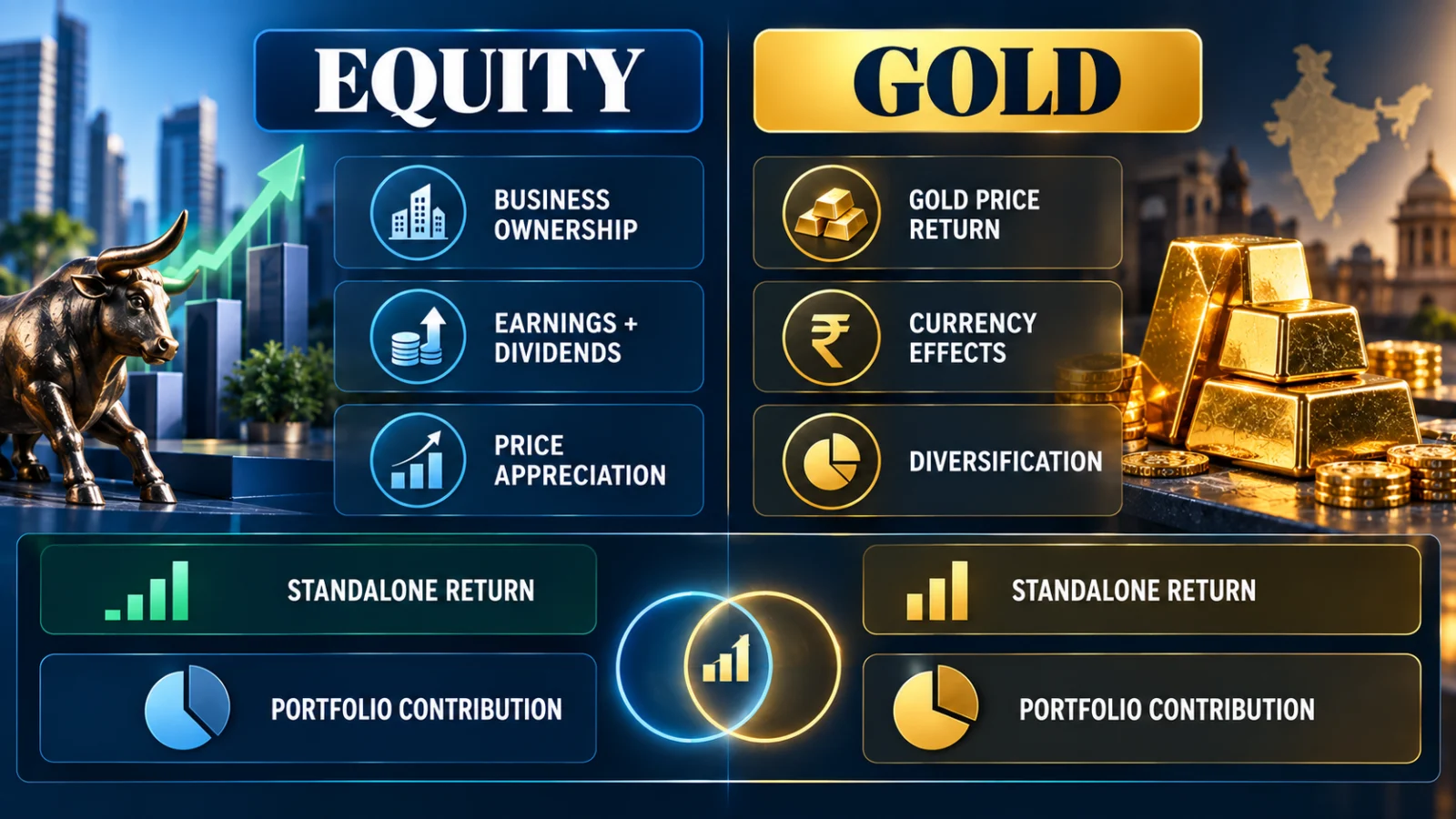
Equity represents ownership in productive businesses. Long-term total return can come from changes in share prices and dividends, with business earnings and economic growth influencing the underlying value creation.
Gold
Gold does not produce corporate earnings or dividends. Its return comes through changes in market price, influenced by investment demand, economic conditions, risk, interest-rate opportunity cost, currency movements and other gold-market forces.
The first mistake: comparing two different return engines as if they were identical
An equity investor owns a share of a business. If businesses grow earnings, reinvest profit, expand and distribute dividends, investors can participate in that economic activity. This does not guarantee positive returns, but it explains why equity has a productive-business return engine.
Gold is different. A bar of gold does not generate earnings, dividends or operating cash flow. Gold can still produce substantial investment returns when its market price rises, but the source of that return is price appreciation rather than corporate production.
That distinction matters because a historical return table alone does not explain what each asset is doing inside a long-term wealth strategy.
Which has historically delivered the higher return in India?
There is no single period-independent winner. Different start dates, end dates and holding periods can produce very different rankings.
Recent long-horizon comparisons have shown periods in which gold strongly outperformed Indian equities. Other rolling-return studies covering much longer histories have found equities leading more frequently or producing higher average returns over many multi-year windows.
These results are not necessarily contradictory. A point-to-point 10-year comparison answers a different question from a rolling 10-year study covering many starting dates.
| Comparison choice | Why it matters |
|---|---|
| Start and end date | A strong gold rally or equity crash near either endpoint can materially change the ranking. |
| Holding period | One-year, five-year, ten-year and twenty-year results can tell different stories. |
| Equity benchmark | A broad diversified index is not the same as a single stock or sector. |
| Price index vs total-return index | Ignoring dividends understates the return received by equity investors. |
| Gold vehicle | Investment gold should not be confused with jewellery carrying making charges, stones and retail costs. |
For equity, total return matters
A fair comparison should include dividends when measuring equity performance. Nifty Indices distinguishes a Total Return Index from a price-only index because the total-return version incorporates dividends from index constituents in addition to price movement.
This matters when comparing equity against gold. Gold-price data already represents the change in gold’s market price. Comparing it against an equity price index that excludes dividends can make the comparison incomplete.
Gold can help a portfolio even when it is not the highest-return asset
One of the most important distinctions in this comparison is the difference between standalone return and portfolio contribution.
An asset does not need to deliver the highest standalone return to improve a diversified portfolio. If it behaves differently from equities during periods of stress, it may reduce overall volatility or drawdowns.
World Gold Council research for India examined a hypothetical INR portfolio over December 2006 to December 2025. The starting portfolio was heavily equity-oriented, with equities and fixed income, and the study tested replacing portions of those holdings with gold.
Within that historical model, gold allocations improved several risk-adjusted measures and reduced drawdowns. That is evidence for a diversification role. It is not proof that gold was the superior standalone wealth asset or that every investor should hold the same tested percentage.
Why gold can behave differently during equity stress
Gold has historically shown periods of low or negative correlation with equities, particularly during several episodes of financial or geopolitical stress. That different behaviour is one reason investors study gold as a diversifier.
However, diversification is not a guarantee that gold will rise every time equities fall. Correlations can change, gold itself can decline and historical crisis performance does not establish a fixed future relationship.
Why recent gold outperformance should not automatically replace equity
A strong recent gold run can make a gold-versus-equity comparison feel obvious. But recent leadership does not establish the next decade’s winner.
Gold and equity respond to different conditions. A period that favours currency weakness, geopolitical risk, falling opportunity costs or investment demand for gold can produce very different relative returns from a period dominated by strong corporate earnings and equity-market expansion.
Switching the conclusion every time one asset leads over a selected recent window is therefore a form of endpoint and recency bias rather than a complete long-term comparison.
The rupee adds another layer for Indian investors
Gold is internationally benchmarked in US dollars but Indian investors experience gold returns in rupees. Currency movements can therefore affect domestic gold performance.
A weaker rupee can increase the INR translation of a dollar gold price, while a stronger rupee can reduce it. This means Indian gold returns may differ from the international dollar return over the same period.
That India-specific currency effect is another reason historical gold-versus-equity comparisons should identify the currency and benchmark being used.
Where gold and equity fit differently
| Dimension | Equity | Gold |
|---|---|---|
| Return engine | Business ownership, earnings growth, valuation change and dividends | Market-price appreciation driven by gold demand, macro conditions, risk and currency effects |
| Cash flow | Companies may distribute dividends | No corporate earnings or dividends |
| Growth participation | Direct participation in productive businesses | Indirect exposure to economic, monetary and investment-demand conditions |
| Equity-crash diversification | Equity itself is the risk asset being diversified | Historically has provided diversification in many stress periods, but not guaranteed |
| Currency sensitivity in India | Depends on the underlying businesses and market exposures | INR gold return can be materially affected by USD/INR translation |
| Historical winner | Depends on period, benchmark, dividends, currency and methodology | |
What the WGC 7.5% to 15% portfolio test does — and does not — show
The World Gold Council tested hypothetical portfolios containing different gold allocations and reported improved risk-adjusted results and lower drawdowns over its historical India sample.
Those tested allocations should not be converted into a universal recommendation. They came from a particular historical period, portfolio construction and modelling framework. The WGC itself notes that hypothetical results and historical performance do not guarantee future outcomes.
The useful conclusion is narrower: in the studied portfolio, gold’s different behaviour improved diversification. That is a portfolio finding, not a personalised allocation prescription.
When a gold-vs-equity comparison becomes misleading
A comparison is incomplete when it uses a price-only equity index but ignores dividends; when it picks one favourable starting date; when jewellery economics are used as a proxy for investment gold; or when a portfolio-diversification result is presented as proof of superior standalone return.
It is also misleading to treat “risk” as one number. Equity drawdown risk, gold price volatility, inflation sensitivity, currency exposure and the risk of failing to meet a long-term growth objective are different problems.
So which one is better for long-term wealth?
The evidence supports a role-based answer rather than a universal winner.
Equity offers ownership in productive businesses and a return engine linked to earnings, valuations and dividends. For investors seeking long-term participation in economic and corporate growth, that characteristic matters.
Gold offers a different return engine and has historically provided useful diversification during many equity-stress periods. Its value in a portfolio can therefore come partly from behaving differently rather than from always producing the highest standalone return.
The question “gold or equity?” is therefore incomplete unless the reader first identifies the objective: long-term growth, diversification, drawdown resilience, purchasing-power protection or some combination of those goals.
TPS does not infer an individual allocation from this evidence. Personal suitability depends on objectives, time horizon, risk capacity, existing assets, liabilities, tax position and the investment vehicle being considered.
Verification note
TPS reviewed World Gold Council India research covering equity-gold portfolio behaviour and drawdowns, SEBI material explaining equity ownership and dividends, and Nifty Indices methodology explaining total-return indices. Current gold-versus-equity comparisons were also reviewed to test whether different time windows produce materially different historical conclusions.
Limitations and unresolved facts
Historical performance does not determine future returns. WGC is a gold-industry body and its portfolio research should be interpreted within its stated assumptions and hypothetical methodology. No universally optimal gold allocation was established. Future equity earnings, gold prices, correlations, inflation, interest rates, currency movements, taxes and investor circumstances can materially change outcomes.