




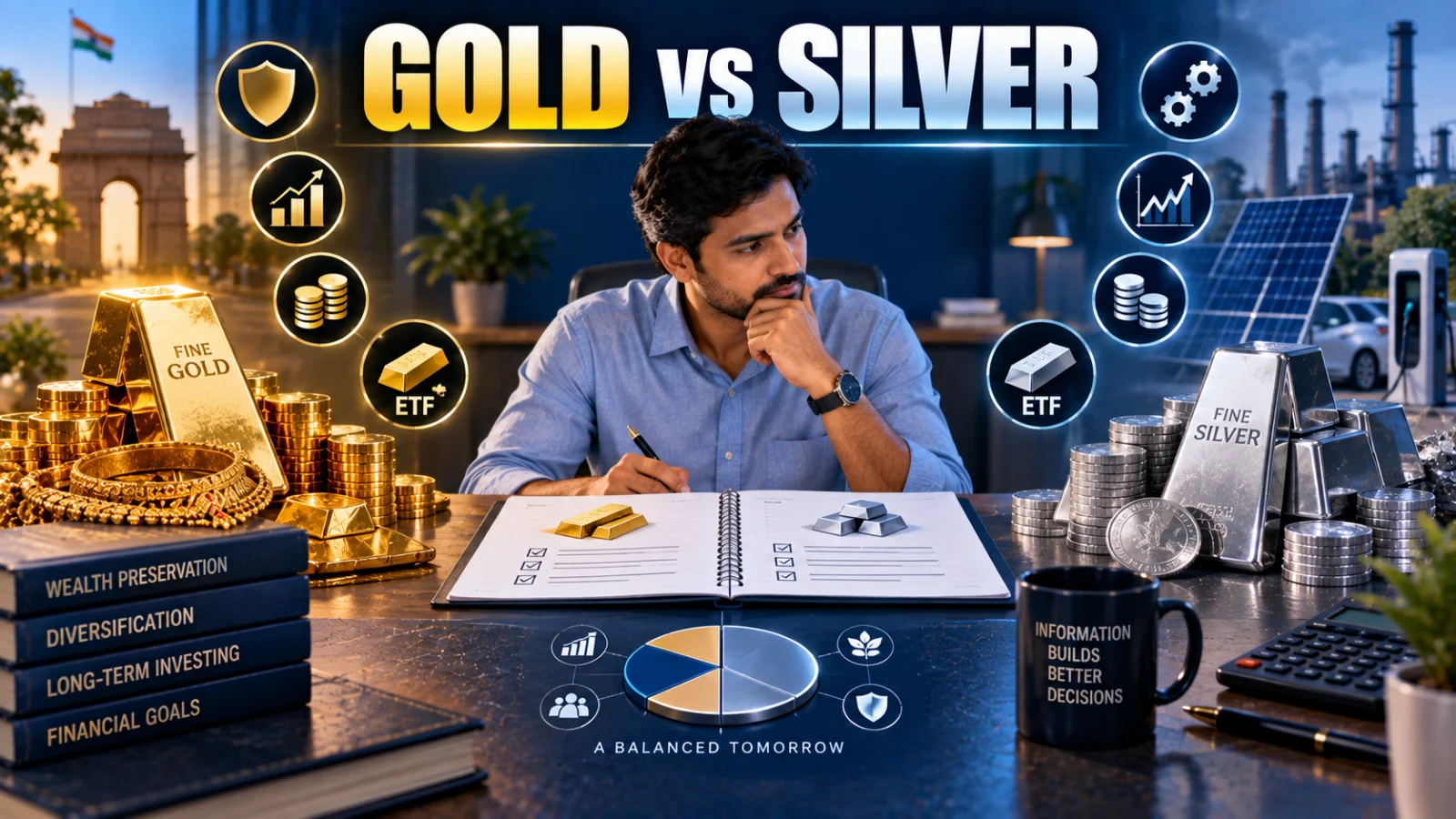
If you are comparing gold vs silver investment India options for the long term, looking only at which metal rose more recently misses the most important difference. Gold and silver are both precious metals, but they do not have the same demand engine, volatility, market depth or portfolio behaviour.
Gold has historically had a deeper global market, lower volatility and a more established role as a defensive financial asset. Silver has much heavier industrial exposure and has historically moved more sharply in both directions. That means silver can participate strongly in precious-metals rallies, but economic and industrial cycles can influence it more directly than gold.
The better question is therefore not “Which metal will go up more?” It is: What job do you want the precious-metals allocation to perform?
| Dimension | Gold | Silver |
|---|---|---|
| Demand structure | Investment, jewellery and central-bank or reserve demand form a more diversified financial demand base | Investment demand plus substantially heavier industrial use |
| Historical volatility | Lower than silver in the long-run evidence reviewed | Materially higher; World Gold Council analysis found roughly twice gold’s volatility over its measured period |
| Global market depth | Deeper and more liquid | Smaller market with wider trading friction in the reviewed global evidence |
| Economic-cycle sensitivity | Influenced strongly by real rates, currency, investment demand and financial stress | Influenced by precious-metal demand plus manufacturing, solar, electronics, automotive and other industrial cycles |
| Stress diversification | Historically more consistent in severe equity-market stress in the reviewed WGC analysis | Can behave more like a higher-beta hybrid between precious metal and industrial commodity |
| Physical storage for equal value | More compact | Much bulkier because substantially more metal is needed for the same rupee exposure |
Gold and silver do not have the same demand engine
Understanding demand is the starting point because it helps explain why the metals can behave differently even when both are labelled precious metals.
Gold demand is spread across investment, jewellery and institutional or central-bank activity. Its financial role is unusually important. Central banks hold gold as a reserve asset, investors use bullion and gold-backed products for diversification, and jewellery demand remains significant in markets including India.
Silver also has investment and jewellery demand, but industrial consumption is much more important to its market. Silver is used in applications including photovoltaics, electronics, automotive systems and other electrical or manufacturing processes.
This industrial exposure gives silver an additional economic engine that gold does not have to the same degree.

Industrial demand does not mean silver must outperform
It is tempting to turn solar, electric vehicles, data centres or AI-related infrastructure into a simple investment conclusion: more technology demand must mean a higher silver price.
The evidence does not support such a guarantee.
The Silver Institute’s 2026 outlook illustrates why. It expects continued structural demand from several technology-intensive applications, but also expects total industrial fabrication to decline modestly in 2026 because photovoltaic manufacturers are using less silver per unit and substituting where possible.
That is an important distinction. A commodity can have strong long-term industrial applications while simultaneously facing efficiency improvements, substitution, recycling and economic-cycle weakness.
For a long-term investor, silver’s industrial exposure should therefore be understood as a source of cyclical sensitivity, not as an automatic bullish signal.
Silver has historically been much more volatile
World Gold Council research published in March 2026 compared long-run behaviour of gold and silver and found silver to be substantially more volatile. In the period measured by WGC, silver’s volatility was roughly twice gold’s.
That statistic should not be treated as a permanent mathematical constant. The exact relationship changes depending on the measurement window and market regime. But the broader evidence is clear: silver has historically experienced larger price swings.
For investors, higher volatility has two sides.
- When precious metals rally strongly, silver can move faster.
- When sentiment, industrial expectations or liquidity reverse, silver can also fall much faster.
Higher volatility is therefore not the same as higher expected return. It means a wider range of potential outcomes.
Why is silver more volatile than gold?
Several structural differences contribute.
First, the silver market is smaller. A given change in investment flows can therefore have a larger effect on price.
Second, silver is exposed to both precious-metals sentiment and industrial demand. Investors may buy it when monetary conditions favour precious metals while manufacturers simultaneously respond to changes in economic activity, technology or input costs.
Third, global trading liquidity is materially deeper in gold. WGC’s 2026 analysis found much larger trading volumes across gold’s OTC, futures and ETF markets and tighter average spreads in the periods it studied.
Smaller market depth plus dual financial and industrial demand can produce more violent repricing when expectations change.
Gold’s market is deeper and more liquid globally
Liquidity matters because an investment is not only about the price direction. It is also about how efficiently large numbers of buyers and sellers can transact.
WGC’s comparative research found that global gold trading is substantially deeper than silver trading across major market channels. It also reported a materially tighter average spread for gold than silver in its intraday analysis.
That does not prove that every Indian Gold ETF will always have better exchange liquidity than every Silver ETF. Fund-level liquidity depends on the particular scheme, market makers, trading activity and current order book.
The structural conclusion is narrower: the underlying global gold market is much larger and deeper.
Gold has historically behaved differently during market stress
Gold is often called a safe-haven asset, but that phrase should not be interpreted as “gold always rises when stocks fall.” It does not.
What matters is historical portfolio behaviour across many stress periods.
WGC’s long-run analysis found that gold has behaved more consistently as a diversifier during severe equity-market drawdowns. Silver’s industrial exposure and higher beta have made its crisis behaviour less consistent.
This is historical evidence, not a forecast. It also comes from a gold-industry research organisation and is primarily based on global market data rather than an India-only portfolio simulation.
The defensible takeaway is therefore: gold has stronger historical evidence for a defensive diversification role, while silver has behaved more cyclically.
Is silver simply leveraged gold?
No.
Silver can sometimes move in the same broad direction as gold and with greater magnitude, which can make it look like a leveraged version of gold during particular periods.
But leverage is not the correct structural description. Silver has its own supply-demand balance, industrial customers, fabrication trends, recycling dynamics and investment flows.
Two metals can respond to the same monetary environment while still reacting differently to manufacturing demand, economic expectations or supply disruptions.
That is why investors should not assume that multiplying a gold thesis automatically creates a silver thesis.
Which has delivered better long-term returns?
There is no permanent winner.
The answer changes with the starting date, ending date, currency and measurement method. A comparison beginning just before a major silver rally can make silver look dominant. Another period can show gold producing the stronger result with substantially lower volatility.
For an Indian investor, return comparisons should use the same:
- starting date,
- ending date,
- INR currency basis,
- price convention, and
- treatment of costs.
RBI publishes historical domestic gold and silver price series that can support a consistent INR comparison. That is preferable to comparing a global US-dollar gold return from one source with an Indian silver return from another.
Even a correctly calculated historical winner still does not establish which metal will outperform next.
Why silver’s lower price per gram is not an investment advantage by itself
Silver is much cheaper than gold per gram, but that does not mean an investor receives more economic exposure for the same money.
If you invest ₹1 lakh, what matters is the percentage movement of the ₹1 lakh exposure after costs—not whether the investment purchased a small number of gold grams or a much larger number of silver grams.
A 10% gain is a 10% gain on the invested amount regardless of the number of grams represented.
Lower unit price can make small physical purchases easier to visualise, but it should not be used as evidence that silver is inherently undervalued or offers greater return potential.
Physical gold vs physical silver: storage changes the comparison
For physical investors, the metals differ sharply in portability.
Gold concentrates much more value into a small amount of metal. Silver requires substantially more weight and volume to represent the same rupee investment.
That means physical silver can create greater storage and handling requirements as the investment grows.
Physical ownership also brings transaction friction. Current CBIC schedules apply GST to relevant gold and silver precious-metal headings, while dealer spreads, purity and resale conditions also matter.
For a serious comparison, the investor should look beyond spot-price charts and include:
- purchase premium or spread,
- applicable tax,
- purity,
- storage or locker cost,
- insurance where relevant, and
- resale spread.
Gold ETFs and Silver ETFs in India
Indian investors do not need to hold physical metal to obtain gold or silver exposure. SEBI’s mutual-fund framework permits regulated Gold ETF and Silver ETF structures, and the regulator maintains valuation and operating requirements for physical gold and silver held by mutual-fund schemes.
That makes ETF implementation possible for both metals, but it does not make the funds identical.
For each actual scheme, compare:
- tracking error and tracking difference,
- expense ratio,
- assets under management,
- exchange trading liquidity,
- bid-ask spread, and
- market price relative to NAV or indicative NAV where available.
An investor choosing silver because of its underlying-market thesis can still receive a poor practical outcome if the chosen ETF has weak trading liquidity or inefficient tracking.
Do gold and silver have the same tax treatment?
Do not assume the metal name alone determines the tax result.
Tax depends on the form in which the investment is held, the acquisition and disposal dates, applicable law and the type of transaction. Physical bullion, ETFs, mutual-fund structures and other products can require different analysis.
Because Indian capital-gains rules can change, current tax treatment should be verified for the exact instrument before investing or selling rather than copied from an older comparison article.
Who might prefer gold’s role?
Gold may better fit a reader whose primary objective for precious metals is:
- lower historical volatility than silver,
- deeper global liquidity,
- a stronger historical record as a portfolio diversifier during severe financial stress, or
- compact physical storage for a given rupee value.
That does not make gold low-risk or guarantee positive returns. Gold can fall, remain flat for extended periods and underperform other assets.
Who might accept silver’s role?
Silver may fit a reader who deliberately wants precious-metals exposure with more sensitivity to industrial and commodity cycles and who can tolerate larger price swings.
The investor should be comfortable with the fact that the same characteristics capable of producing strong upside can also amplify drawdowns.
The investment case should therefore come from accepting silver’s different risk engine—not merely from noticing that silver costs less per gram or recently outperformed gold.
Must you choose only gold or only silver?
No.
The metals can be complementary because their demand structures are not identical. But that does not justify a universal rule such as 70:30, 80:20 or any other fixed allocation.
The appropriate exposure depends on the investor’s broader portfolio, risk capacity, investment horizon, liquidity needs and reason for owning precious metals in the first place.
An investor primarily seeking defensive diversification can reach a different conclusion from an investor deliberately seeking greater commodity-cycle exposure.
Should the gold-silver ratio decide which one to buy?
The gold-silver ratio shows how many units of silver are represented by the price of one unit of gold. It is useful as a historical relative-price indicator.
But a high or low ratio does not by itself prove that one metal is about to outperform.
The ratio can remain far from historical averages for long periods because gold and silver demand conditions, financial markets and industrial cycles change.
TPS therefore treats the ratio as descriptive context, not as a reliable standalone market-timing rule.
A practical gold-versus-silver decision path
1. Define the portfolio job
Decide whether you mainly want defensive diversification, broader precious-metals exposure or greater industrial and commodity-cycle sensitivity.
2. Compare the demand engines
Gold has stronger financial, jewellery and central-bank channels. Silver carries substantially more industrial demand exposure.
3. Check your volatility tolerance
Silver has historically moved much more sharply. Do not choose it merely because higher volatility can sometimes create higher short-period returns.
4. Choose the ownership form
Compare physical bullion and regulated ETF structures based on liquidity, tracking, spreads, storage, tax and operational convenience.
5. Compare returns consistently
Use the same INR dates and methodology rather than cherry-picking whichever horizon makes one metal look superior.
6. Reject guaranteed-winner logic
Neither industrial demand nor historical crisis behaviour can tell you which metal will outperform in the future.
Gold vs silver: what actually differs?
Gold’s stronger case
Deeper liquidity, lower historical volatility, central-bank demand and a more consistent historical defensive-diversification role.
Silver’s stronger distinction
Much greater industrial exposure and higher historical sensitivity to both precious-metals sentiment and economic or commodity cycles.
The wrong comparison
Current price per gram, one-year returns or a single gold-silver-ratio reading.
The better comparison
Portfolio role, risk tolerance, demand structure, implementation cost and ownership vehicle.
Bottom line
The central lesson in gold vs silver investment India is that the metals should not be treated as interchangeable assets with different price tags.
Gold has historically offered a deeper market, lower volatility and more consistent defensive diversification. Silver brings substantially greater industrial sensitivity and historically larger price swings. That can make silver powerful during favourable cycles and painful during reversals.
Neither structure proves which metal will deliver the higher future return.
For a long-term investor, the better sequence is: define the portfolio role first, understand the different demand and risk engines, then choose the metal and investment vehicle that fit that role.