






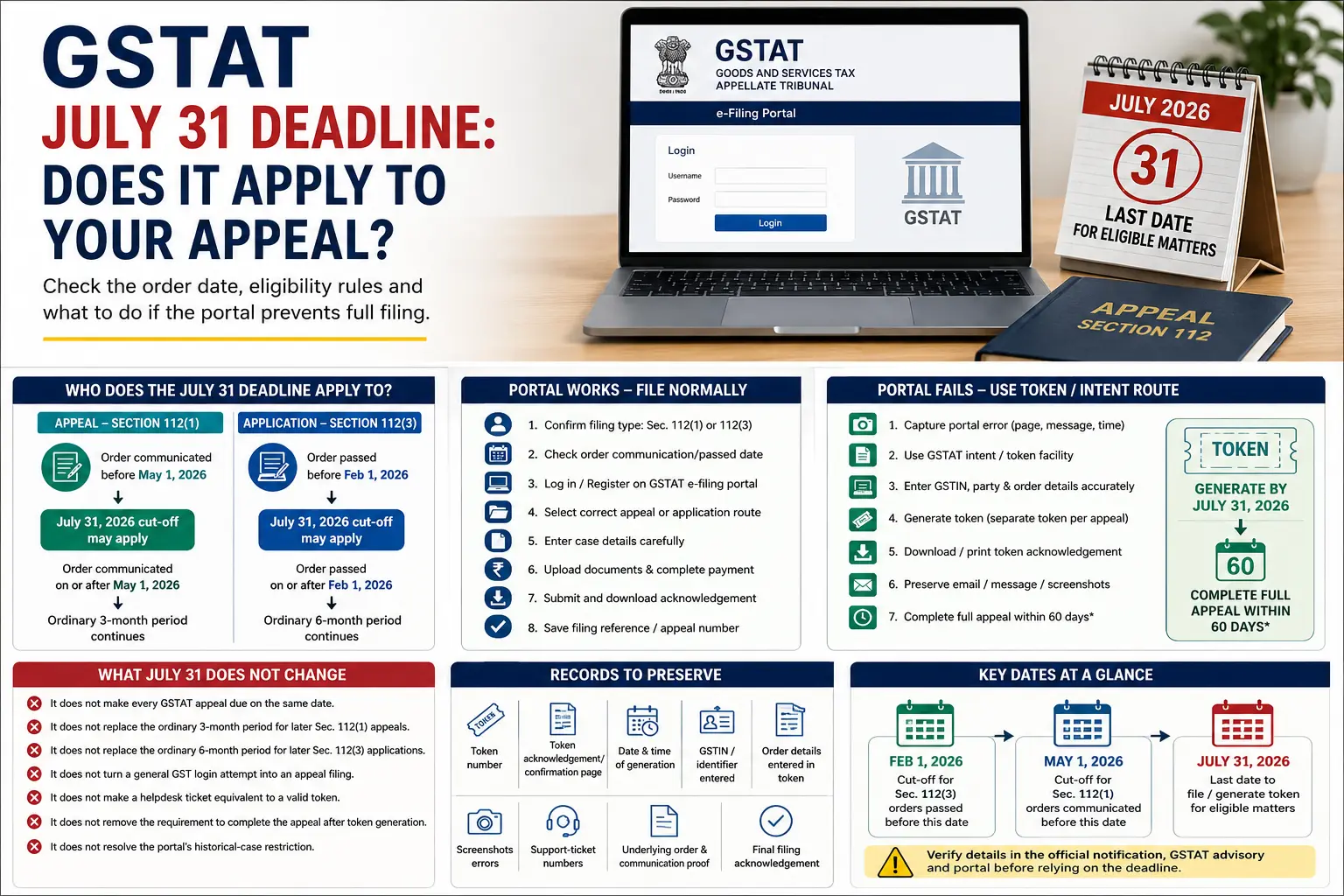
The GSTAT appeal deadline of July 31, 2026 has now passed. Taxpayers who generated a valid GSTAT token on or before that cutoff may still be able to complete the corresponding appeal within 60 days from their individual token-generation date.
The token is conditional relief—not a completed appeal, not a saved draft and not an ordinary helpdesk ticket. If no valid token was generated by the applicable July 31 cutoff, this article should not be read as creating a new post-deadline token route.
July 31 cutoff passed
60 days from token date
Last verified: August 18, 2026
Can you complete a GSTAT appeal after July 31?
Yes, where a valid token was generated on or before July 31 under the official token facility and the applicable 60-day completion period has not expired.
The President of GSTAT clarified during an official taxpayer-services webinar that the 60-day period is counted from the date of token generation. Taxpayers were also advised to generate a separate token for each appeal.
The complete appeal must still be filed within that individual 60-day period. The token does not itself amount to final filing or admission of the appeal.
The token-generation cutoff has passed. If you already generated a token, preserve its acknowledgement, identify its exact generation date and complete the corresponding appeal within the announced 60-day period. Do not assume that a draft, helpdesk complaint or attempted filing made after the cutoff creates the same protection.
In this guide
GSTAT appeal deadline at a glance
- The July 31, 2026 transitional cutoff has passed.
- The deadline applied to specified older Section 112 matters, not every future GSTAT appeal.
- Taxpayers who generated a valid token by the cutoff may complete the corresponding appeal within 60 days from the token-generation date.
- The 60-day period is individual to each token; there is no single completion date for every token holder.
- A separate token was advised for each appeal.
- A token is not a saved draft, support ticket or completed appeal.
- Incorrect or incomplete token details may affect whether the claimed protection is available.
- Final filing must still satisfy applicable document, payment, pre-deposit and portal requirements.
What did the official GSTAT webinar clarify?
The Directorate General of Taxpayer Services, Mumbai published an official account on July 29, 2026 of a July 28 webinar covering GSTAT procedures and recent clarifications.
According to that release, the President of GSTAT explained the token system and advised taxpayers to generate a separate token for each appeal.
He clarified that the 60-day time limit for completing an appeal is counted from the date of token generation.
A GSTAT Technical Member also stated that taxpayers could generate a token by July 31, 2026 and complete the appeal filing within 60 days.
Did the July 31 GSTAT appeal deadline apply to every appeal?
No. The July 31 deadline was a special transitional cutoff for specified older appeals and departmental applications rather than a permanent deadline for every GSTAT appeal.
The first test is the filing route and the date of the underlying order.
| Filing type | Order-date test | Deadline framework to check |
|---|---|---|
| Appeal under Section 112(1) | Was the challenged order communicated before May 1, 2026? | If the notified transitional framework applied, July 31, 2026 was the relevant cutoff. Orders communicated later may fall under the ordinary limitation framework instead. |
| Application under Section 112(3) | Was the relevant order passed before February 1, 2026? | If the notified transitional framework applied, July 31, 2026 was the relevant cutoff. Later orders may fall under the ordinary statutory period instead. |
Two matters handled by the same taxpayer can therefore have different limitation positions.
A filer must confirm the filing type, communication or order date, applicable notification, token status and whether the live portal accepts the case category.
Draft, token, acknowledgement and completed appeal are not the same
| Portal stage | What it means | Post-July-31 position |
|---|---|---|
| Draft created or screen opened | Work may have started, but no prescribed token or completed filing has necessarily been generated. | Do not assume a draft preserved the July 31 cutoff. |
| Helpdesk or incident ticket | Records a technical complaint. | Do not treat it as equivalent to an official token. |
| Valid token generated by July 31 | Records the intention to file using the designated GSTAT mechanism. | May permit completion within 60 days from that token date, subject to the applicable conditions. |
| Token acknowledgement preserved | Evidence of the token ID, date, time and submitted particulars. | Important evidence, but the appeal itself remains incomplete until final filing. |
| Complete appeal filed | Documents, details and applicable filing requirements have been completed through the portal. | Normal filing outcome, subject to scrutiny and procedural requirements. |
| Appeal admitted after scrutiny | The Tribunal has processed the filing beyond initial submission. | Separate from merely generating a token or receiving an acknowledgement. |
How is the GSTAT token’s 60-day period calculated?
The official webinar clarification says the 60 days are counted from the token-generation date.
That means there is no single post-July-31 deadline that applies to every token holder. Record the actual date shown on the acknowledgement and determine the completion deadline from that individual token date.
A token generated earlier in July reaches the end of its 60-day period earlier than a token generated on July 31.
Taxpayers should avoid waiting until the calculated final day. Filing sufficiently before expiry leaves time to address document, payment or portal problems.
Any protection associated with the token depends on completing the appeal within the permitted period and satisfying the requirements applicable to the appeal. Token generation does not remove every other procedural requirement.
What should GSTAT token holders do now?
| Current situation | Practical action | Main caution |
|---|---|---|
| You generated a token by July 31 and have not completed filing | Retrieve the acknowledgement, identify the token-generation date and calculate the individual 60-day completion window. | Do not calculate the period from July 31 unless July 31 was actually your token date. |
| You generated multiple tokens | Track each appeal and its token separately. | Different token dates may produce different completion deadlines. |
| Your appeal is ready | Complete the filing as soon as reasonably possible and preserve the final acknowledgement. | Do not wait merely because some portion of the 60-day period remains. |
| Your token details may be wrong or incomplete | Check GSTAT instructions and seek professional advice promptly. | Do not assume an inaccurate token automatically preserves limitation. |
| You did not generate a token by July 31 | Do not rely on this token facility as though it remains open. Check the legal position applicable to the specific appeal. | Late filing, condonation or another remedy may be case-specific and should not be inferred from this guide. |
| Portal error occurs during completion | Capture timestamped evidence and use the official GSTAT support or incident route while continuing to protect the filing. | A technical support record does not itself replace the required appeal filing. |
| Pre-deposit or coverage is uncertain | Verify the requirement with a qualified GST professional. | Token generation does not cure every filing defect. |
What should an existing GSTAT token holder check?
Confirm the token
Verify that the token was generated through the designated GSTAT facility on or before the applicable July 31 cutoff.
Check the appeal details
Review the GSTIN, party, order number, order date and other particulars recorded against the token.
Track each appeal separately
Do not assume one token protects several appeals where separate tokens were required.
Record the token date
Use the actual token-generation date shown in the acknowledgement when tracking the announced 60-day period.
Preserve the evidence
Save the token ID, acknowledgement, date, time and related confirmation messages.
Complete the appeal promptly
Finish the full filing within the applicable period rather than waiting until the final day.
Does GSTAT token generation settle the pre-deposit requirement?
No general exemption from pre-deposit requirements was established merely because a token was generated.
The official webinar discussed pre-deposit as part of the wider GSTAT procedure, but the token clarification should not be read as removing every payment or filing condition applicable to an appeal.
Existing token holders should therefore:
- verify the pre-deposit applicable to the appeal;
- check whether payment is required before final submission;
- confirm how any existing payment is linked to the appeal;
- preserve payment and portal records.
What should you do if the GSTAT portal fails after July 31?
- Capture the full screen, error message, URL, date and time.
- Record the GSTIN and appeal or order details.
- Preserve the existing token acknowledgement and token-generation date.
- Keep evidence showing the attempted completion of the appeal.
- Use the official incident-report or helpdesk route.
- Preserve emails, ticket numbers and portal responses.
- Continue preparing or attempting the complete filing.
- Do not assume a support ticket automatically extends the individual 60-day period.
- Seek professional advice promptly if the filing window is close to expiry.
Portal statistics or technical acknowledgements do not by themselves establish whether an individual appeal or token satisfies every legal requirement.
Which records should be preserved?
- token ID and acknowledgement;
- token-generation date and time;
- GSTIN or identifier entered;
- underlying order number and date;
- proof of communication date where relevant;
- screenshots of technical errors;
- support-ticket correspondence;
- pre-deposit or payment records;
- documents uploaded during final filing;
- final appeal acknowledgement;
- the calculated 60-day completion date.
The portal restriction and legal deadline are separate questions
Satisfying the requirements associated with the July 31 transitional framework does not automatically prove that a particular filing is valid or that every portal requirement has been satisfied.
Likewise, having generated a token does not itself prove that the final appeal will be accepted after scrutiny.
The legal limitation question, token validity and technical portal-acceptance question should be checked separately.
What the GSTAT appeal deadline does not mean
- It does not make every GSTAT appeal subject to the July 31, 2026 cutoff.
- It does not mean new tokens can still be generated under the expired July 31 facility.
- It does not make a saved draft sufficient.
- It does not make a helpdesk ticket equivalent to a token.
- It does not turn token generation into completed filing.
- It does not allow one token to be assumed to cover every appeal.
- It does not remove the announced 60-day completion condition.
- It does not automatically settle pre-deposit, documents or portal acceptance.
- It does not guarantee acceptance of inaccurate token particulars.
GSTAT appeal deadline: frequently asked questions
Has the July 31, 2026 GSTAT appeal deadline passed?
Yes. July 31, 2026 has passed. The remaining relevance of the token facility is primarily for taxpayers who generated a valid token by that cutoff and still need to complete the corresponding appeal within the announced 60-day period.
Can I generate a new July 31 GSTAT token now?
The July 31 cutoff described in the official token clarification has passed. Do not assume that the old token facility remains available for creating new deadline protection after the cutoff.
Is generating a GSTAT token the same as filing the appeal?
No. A token may preserve the transitional filing position subject to the applicable conditions, but the complete appeal still has to be filed.
When does the 60-day GSTAT token period begin?
The official DGTS/GSTAT webinar clarification says the 60-day period is counted from the token-generation date.
Does every token holder have the same final filing date?
No. Because the period is counted from the individual token-generation date, different token dates can produce different completion deadlines.
Can one GSTAT token cover several appeals?
Taxpayers were advised to generate a separate token for each appeal. Do not assume one token protects multiple appeals.
Is a GSTAT helpdesk ticket enough to preserve the deadline?
Do not assume so. The official clarification specifically discusses the designated token mechanism. A support ticket records a technical complaint but should not automatically be treated as equivalent to a valid token.
What happens if the appeal is not completed within 60 days?
The token’s protection should not be assumed to continue after the announced completion period. If the deadline is at risk or has already passed, obtain advice on the legal remedies available for the specific appeal.
Does the GSTAT token route apply to every matter?
No. Confirm the transitional deadline, filing category, underlying order dates and portal route applicable to the specific matter.
Does token generation remove the GSTAT pre-deposit requirement?
No universal exemption was confirmed merely because a token was generated. Verify the applicable pre-deposit and filing requirements for the specific appeal.
What happens next?
The remaining practical phase of the July 31 token facility concerns taxpayers who generated valid tokens and still need to complete their appeals within their individual 60-day periods.
GSTAT may issue further instructions concerning token defects, portal restrictions, pre-deposit handling, inaccurate particulars or other completion issues.
ThePulseSignal will update this same URL if GSTAT changes or formally clarifies the post-July-31 token procedure or the completion conditions.
Verification and editorial limitation
Confirmed: the Government extended the relevant GSTAT Section 112 filing deadline to July 31, 2026. The official DGTS/GSTAT clarification also stated that taxpayers could generate a token by July 31 and complete the appeal within 60 days from the token-generation date, with a separate token advised for each appeal.
Current status: July 31, 2026 has passed. This article now focuses on taxpayers who generated tokens by the applicable cutoff and are completing their appeals within the announced post-token period.
Still case-specific: coverage of a particular order, individual token validity, calculation of a particular legal deadline, pre-deposit, portal acceptance, document sufficiency, condonation and the consequences of an inaccurate or defective token.
Last verified: August 18, 2026.
Limitation: This guide explains public official material and does not replace professional advice on a specific GST dispute.