







If you are learning how to choose a Gold ETF in India, the first thing to ignore is the temptation to select whichever fund shows the highest recent return. Gold ETFs in the same category are trying to give investors broadly similar gold exposure, so a small difference in trailing return does not by itself tell you which fund is operating more efficiently.
A better selection process asks two separate questions: How efficiently does the fund track its intended gold exposure? And how efficiently can you actually buy or sell its units on the exchange?
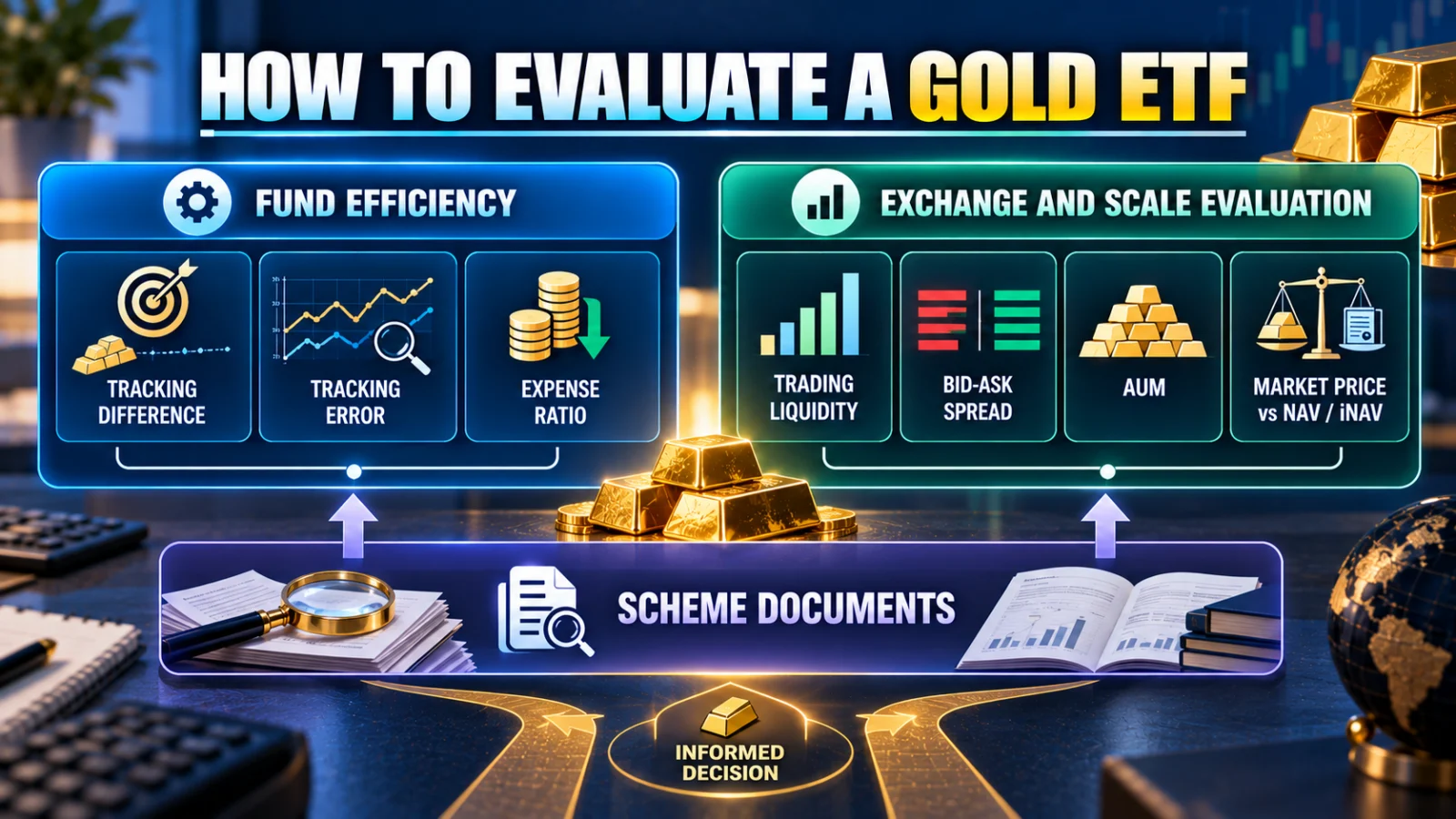
Those questions lead to seven useful metrics: tracking difference, tracking error, expense ratio, trading liquidity, bid-ask spread, assets under management, and market price relative to NAV or indicative NAV. Scheme documentation is then the verification layer that tells you whether you are comparing like with like.
Gold ETF selection in one decision path
Start with tracking quality
Compare tracking difference and tracking error before looking at headline return rankings.
Then check ongoing fund cost
Review the current total expense ratio, but do not treat the lowest TER as an automatic winner.
Then check exchange execution
Look at liquidity, market depth and the live bid-ask spread because ETF units trade on an exchange.
Check what price you are actually paying
Compare the market price with NAV or indicative NAV where current information is available.
Use AUM as supporting context
Fund size can matter, but it should not be used as a substitute for actual exchange liquidity or tracking quality.
Verify everything in current primary disclosures
Use current AMC factsheets, scheme documents, AMFI tracking disclosures and live market information before acting.
Why recent return is a weak way to choose a Gold ETF
For an actively managed equity fund, investors may debate whether a manager created excess return. A Gold ETF has a different job. It is generally trying to provide exposure linked to gold while operating within its scheme mandate.
If gold rises sharply, most Gold ETFs can show strong returns. If gold falls, most can show weak returns. Ranking them only by one-year or six-month return can therefore tell you more about the underlying gold market than about the quality of the ETF itself.
The more useful question is how closely and consistently the ETF delivered the exposure it was designed to provide, after expenses and implementation effects.
Metric 1: Tracking difference
Tracking difference measures the realised return gap between the ETF and its benchmark or reference exposure over a period.
If the benchmark returned one amount and the ETF returned slightly less, that gap is economically important because it shows what the investor actually lost or gained relative to the benchmark after the fund’s real-world implementation.
Expenses are one reason an ETF may lag its benchmark, but they are not the only possible reason. Cash holdings, valuation timing, portfolio implementation and other fund mechanics can also affect the gap.
When comparing Gold ETFs, use the same measurement period and the same primary disclosure source where possible. A one-year figure from one fund should not be compared casually with a three-year figure from another.
Metric 2: Tracking error
Tracking error is different. SEBI’s investor framework describes it as the annualised standard deviation of the daily return difference between the ETF and its underlying index or asset.
In simpler language, tracking error measures how consistent the tracking gap is.
Imagine two ETFs that both end a year somewhat behind their benchmark. One trails by a fairly stable amount throughout the year. The other sometimes tracks closely and sometimes diverges sharply. Their final tracking difference could look similar even though the second fund had much less stable tracking.
That is why TPS treats tracking difference and tracking error as separate metrics rather than interchangeable labels.
Tracking difference vs tracking error
| Metric | What it tells you | Reader question |
|---|---|---|
| Tracking difference | The realised return gap between ETF and benchmark over a period | How much did the ETF actually lag or exceed its reference? |
| Tracking error | The variability of the return gap over time | How consistently did the ETF track its reference? |
Lower tracking error is generally preferable when comparing otherwise similar passive products because it indicates more consistent tracking. But it should still be read alongside tracking difference. A fund can track consistently while still experiencing a persistent return drag.
Metric 3: Expense ratio
The expense ratio is the recurring fund-level cost deducted from scheme assets. In a passive product, lower recurring expenses can help because there is less cost drag between the underlying gold exposure and the investor’s return.
But lowest expense ratio does not automatically mean best Gold ETF.
A very low TER does not compensate for poor tracking or expensive exchange execution. If an ETF has a wider bid-ask spread, thin trading depth or persistent market-price premium, the investor’s practical cost can exceed what the TER alone suggests.
The correct approach is to compare TER after you have established that the funds being considered provide acceptable tracking quality.
Metric 4: Trading liquidity and market depth
Gold ETF units trade on a stock exchange. That means fund quality and exchange trading quality are separate issues.
Trading liquidity describes how readily units can be bought or sold without forcing a material change in execution price.
Trading volume can be useful evidence, but it should not be the only liquidity test. The order book, available quantity near the best quoted prices, market-maker activity and bid-ask spread can all matter when an investor places an order.
A fund can therefore have substantial assets under management while still showing weaker exchange trading at a particular moment. Conversely, a smaller fund may still have reasonable execution if market making and available depth are functioning effectively.
For this reason, TPS does not equate AUM with liquidity.
Metric 5: Bid-ask spread
The bid is the price buyers are currently willing to pay. The ask is the price sellers are currently willing to accept. The difference between them is the bid-ask spread.
For an ETF investor, the spread can act like an immediate transaction cost.
If the best bid is materially below the best ask, an investor crossing that spread may effectively give up value simply to execute the trade. A narrow spread generally indicates more efficient immediate execution, while a wider spread deserves additional scrutiny.
Spreads change during the trading day. A spread quoted in an article several weeks ago is therefore not a reliable substitute for checking current market conditions when you actually trade.
Metric 6: Assets under management
Assets under management, or AUM, tells you the size of the scheme’s asset base.
A larger fund may have advantages of scale and a longer operational footprint, but AUM should be treated as context, not as the final selection rule.
AUM does not directly tell you:
- how tight the ETF’s current bid-ask spread is,
- how much exchange depth exists at your intended order size,
- how closely the ETF has tracked gold, or
- whether its TER is competitive.
Use AUM as one supporting signal alongside the other metrics, not as shorthand for “better ETF.”
Metric 7: Market price versus NAV or iNAV
An ETF has a portfolio value, but the units themselves trade on an exchange at a market price determined by buyers and sellers.
This means the price you pay can differ from the scheme’s NAV.
Where the scheme or exchange provides an indicative NAV, often called iNAV, it can give investors a more current indication of underlying per-unit portfolio value during trading hours. It is still not a guarantee that your order will execute at that value.
Before buying, check whether the ETF is trading at a noticeable premium to the current underlying value. Before selling, check whether it is trading at a noticeable discount.
A temporary premium or discount does not automatically mean the scheme is defective. Market conditions, timing, liquidity and the underlying gold market can affect the relationship. The important point is that investors should know which price they are actually transacting at.
Why scheme documentation is not an eighth metric
The scheme information document, current factsheet, TER disclosure and tracking disclosures are not another score to rank. They are the evidence layer used to verify the seven metrics and understand what the ETF is actually designed to do.
Before choosing a Gold ETF, confirm at least:
- the scheme’s investment objective,
- the gold benchmark or reference it seeks to track,
- its current expense ratio,
- current tracking error and tracking difference disclosures,
- portfolio and cash positioning where disclosed,
- material liquidity or tracking risks, and
- any significant changes to scheme terms.
For tracking metrics, current AMC and AMFI disclosures are more useful than copying an undated ranking table. For live spread and executable price, current exchange or broker market data is more useful than an old article.
Do not copy third-party Gold ETF tables without checking definitions
One reason primary verification matters is that secondary articles can mislabel metrics.
For example, the completed TPS research found a current September 2026 comparison that labelled values around 27% as Gold ETF “tracking error.” That conflicts with the regulatory tracking-error framework reviewed by TPS, under which tracking error is defined as an annualised statistical measure and is normally subject to a much lower regulatory ceiling except in specified unavoidable circumstances.
TPS therefore does not reproduce such numbers as tracking error without reconciling them to the AMC, AMFI or controlling disclosure.
The lesson for readers is broader: never select a fund because a ranking website displays one attractive number without checking what that number actually measures.
A practical Gold ETF selection order
1. Confirm the exposure
Make sure each candidate is genuinely a comparable Gold ETF and check the benchmark and objective in the current scheme documents.
2. Compare tracking difference
Look at how much realised performance differed from the benchmark over comparable periods.
3. Compare tracking error
Check how consistently each ETF tracked its reference rather than using only the final return gap.
4. Compare expense ratios
Among funds with acceptable tracking, lower recurring cost can be an advantage.
5. Check liquidity and depth
Review actual trading conditions rather than assuming a large fund automatically gives the best execution.
6. Check the live bid-ask spread
Avoid treating an ETF with a materially wider current spread as equivalent to one offering tighter execution.
7. Compare market price with NAV or iNAV
Know whether you are buying at a material premium or selling at a material discount.
8. Use AUM as a final context check
Fund size can support the overall assessment, but it should not override weak tracking or poor execution.
What if one ETF wins on one metric but loses on another?
This is normal. The selection process is not designed to create a mathematical winner from one column.
An ETF might have the lowest TER but weaker liquidity. Another might have a larger AUM but a wider spread at the moment you want to trade. A third might have excellent tracking consistency but slightly higher ongoing expenses.
The practical approach is to reject candidates with material weaknesses first, then compare trade-offs among the remaining acceptable funds.
For a long-term investor making relatively small periodic purchases, tiny differences in intraday liquidity may matter differently than they do for someone placing a large one-time order. TPS does not convert those personal circumstances into a universal fund recommendation.
Should you use market orders when liquidity is thin?
The article’s purpose is fund selection rather than order-type advice, but the liquidity analysis has an important implication: an investor should understand the current spread and available prices before sending an order.
A market with weak depth or a wide spread can create execution risk regardless of how attractive the fund’s expense ratio looks on paper.
Investors who are unsure how their order will execute should review their broker’s current order guidance and the live market rather than assuming the displayed last-traded price is the price they will receive.
How often should you re-check a Gold ETF?
You do not need to replace a Gold ETF merely because another fund temporarily reports a slightly lower TER or a slightly better short-period metric.
The more useful maintenance question is whether a material part of the original selection case has changed.
Re-check when there is a meaningful change in the scheme’s expense ratio, tracking behaviour, structure, liquidity, benchmark, material scheme terms or regulatory framework. Live spread and market-price premium or discount should also be checked at the time of any significant purchase or sale.
Which Gold ETF is best in India?
TPS does not assign a permanent winner because the relevant metrics change.
A fund that looks efficient today may later change its TER, tracking quality or trading characteristics. A fund with the largest AUM may not offer the best execution at every moment. A low-cost ETF may not be the most efficient if its tracking and spread are weaker.
The better question is: Which Gold ETF currently gives me acceptable tracking quality, reasonable ongoing cost and efficient execution for the transaction I need to make?
Bottom line
To understand how to choose a Gold ETF in India, stop treating Gold ETFs like a leaderboard of recent returns.
First compare tracking difference and tracking error. Then compare TER. After that, examine the exchange itself: liquidity, depth and bid-ask spread. Check whether the market price is reasonable relative to NAV or iNAV. Finally, use AUM as supporting context and verify the entire comparison from current scheme and regulatory disclosures.
The best selection system is therefore not “buy the fund that ranked first this month.” It is a repeatable audit of tracking quality + fund cost + execution quality.