





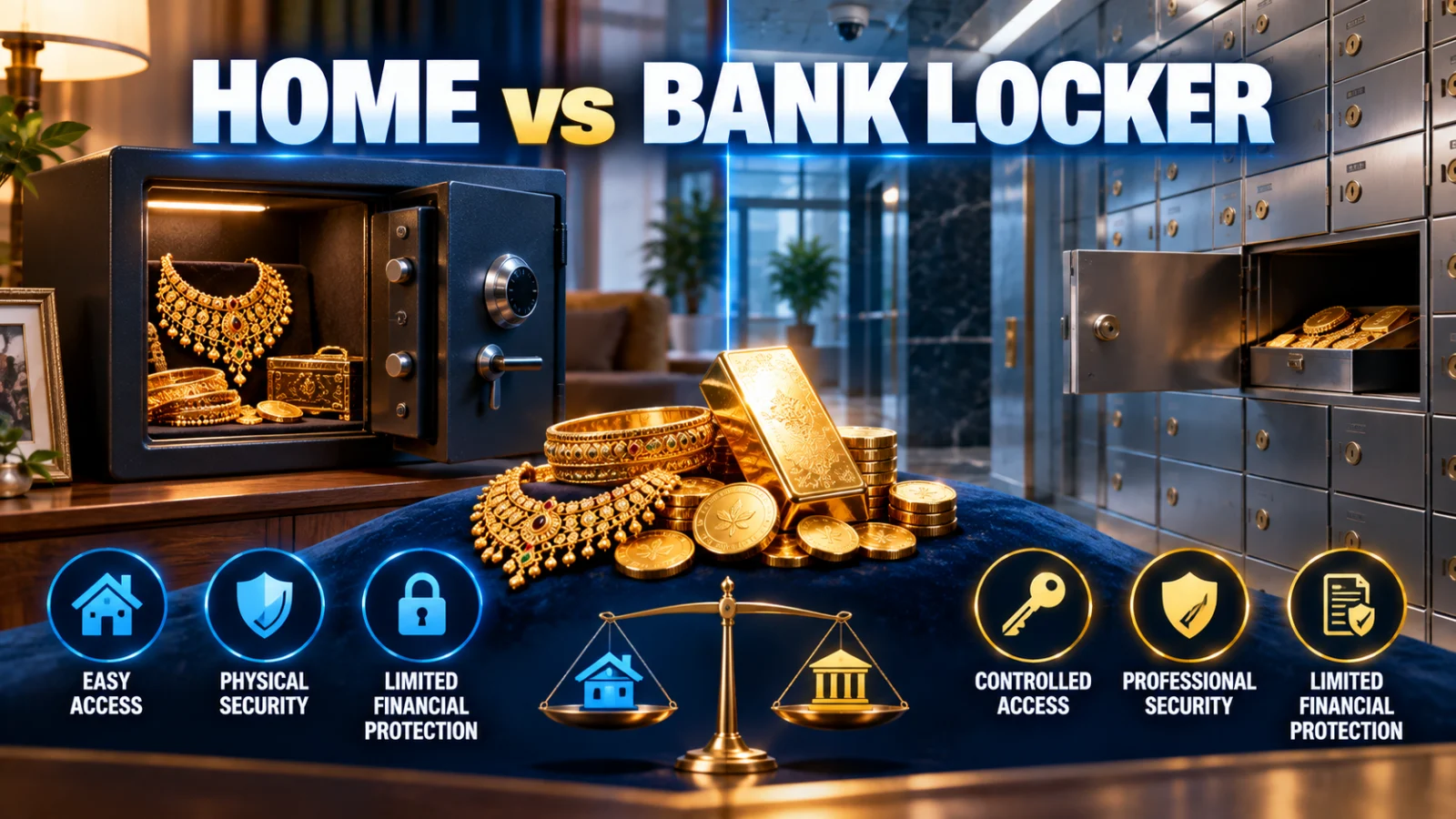
How to store gold safely in India is not a simple choice between “home is risky” and “bank locker is safe.” The two options shift different risks. Home storage gives immediate access and control, while a bank locker moves valuable gold outside the residence into a regulated security environment. But a locker does not transfer the full financial risk of the gold to the bank.
The right choice depends on how often you need the gold, how much value is concentrated in one place, the security of your home, the bank’s access conditions, the gap between the gold’s value and the bank’s legal liability, whether separate insurance is available, and whether your ownership and nomination records are in order.
Home vs bank locker: start with the job the storage must do
Use frequently: jewellery worn often may need faster access, which can make secure home storage more practical if household security is appropriate.
Use rarely: high-value jewellery, coins or bars that are accessed infrequently may fit a bank locker better if removing concentrated valuables from the home meaningfully reduces burglary exposure.
High value: compare the actual market value of the gold with the bank’s limited liability and any separate insurance before assuming a locker has fully protected the asset.
Family continuity: whichever route you choose, keep documentation and nomination or succession arrangements current so the gold remains identifiable and accessible if the owner dies or becomes unable to manage it.
What protection does a bank locker actually provide?
Reserve Bank of India rules require banks to maintain appropriate security around safe-deposit locker systems, control access, keep relevant records and follow prescribed procedures for locker agreements, nomination and access after death.
However, a bank locker is a custody facility, not an unlimited guarantee of the market value stored inside it.
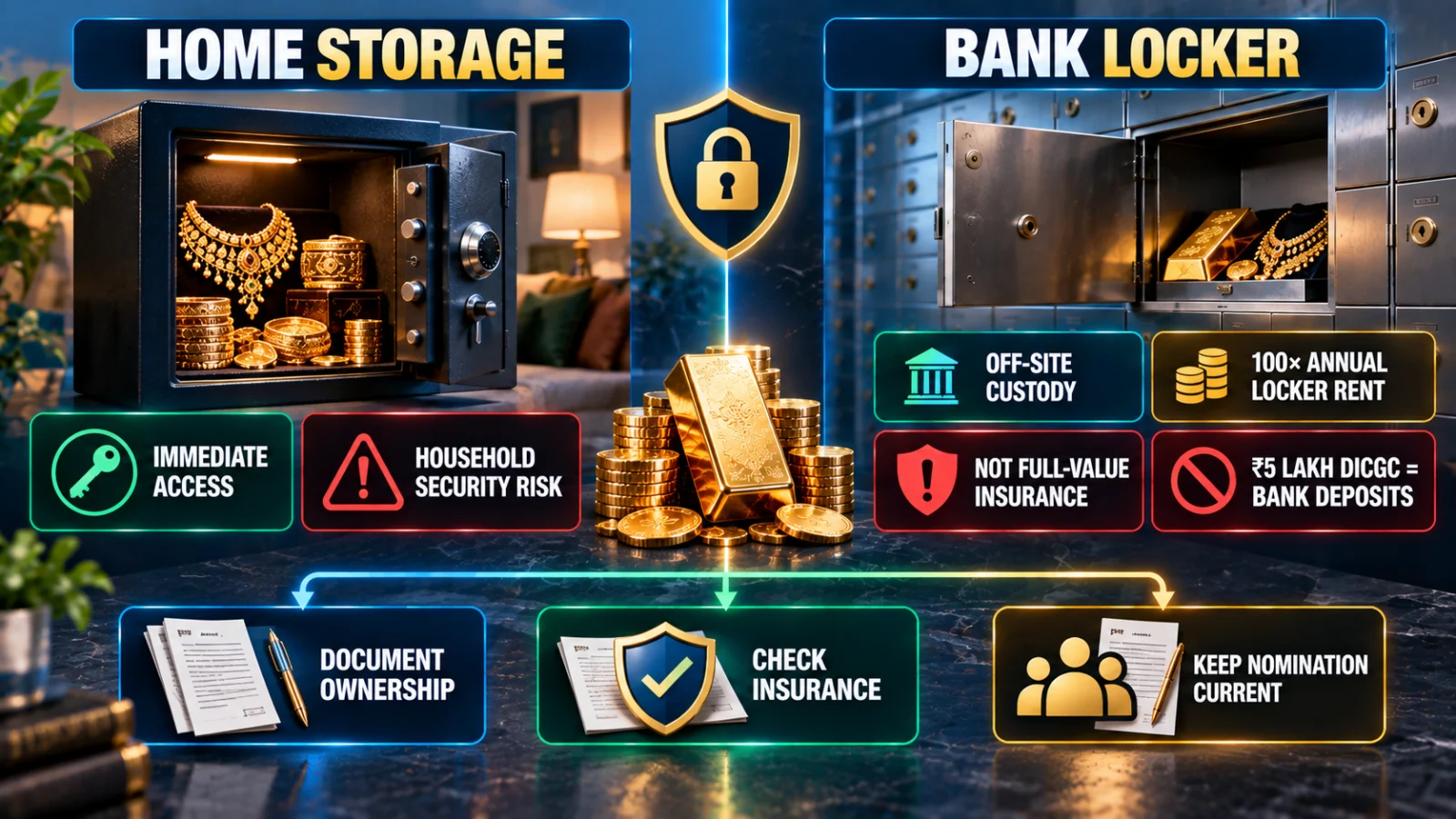
A BANK LOCKER DOES NOT HAVE A UNIVERSAL ₹5 LAKH COMPENSATION LIMIT. UNDER RBI’S CURRENT FRAMEWORK, LIABILITY FOR SPECIFIED BANK-ATTRIBUTABLE LOSSES IS CAPPED AT 100 TIMES THE PREVAILING ANNUAL LOCKER RENT. THE ₹5 LAKH DICGC LIMIT APPLIES TO ELIGIBLE BANK DEPOSITS, NOT GOLD OR JEWELLERY INSIDE A LOCKER.
This distinction matters because the 100-times-rent formula can produce very different amounts depending on the locker rent. For example, if annual rent were ₹3,000, 100 times that rent would be ₹3 lakh. If annual rent were ₹5,000, the same formula would produce ₹5 lakh. If annual rent were ₹10,000, it would produce ₹10 lakh. These are examples of the formula, not universal compensation amounts.
When does the RBI liability cap apply?
RBI’s revised locker framework places responsibility on banks in specified cases where loss of locker contents is attributable to the bank’s negligence or deficiency, including employee fraud. In those circumstances, the liability is capped at 100 times the prevailing annual locker rent.
That does not mean the bank must compensate every loss from every cause.
RBI also states that banks are not liable for losses arising from certain natural calamities or Acts of God, such as earthquake, flood, lightning and thunderstorm, or where loss results solely from the customer’s own fault or negligence. Banks are still expected to exercise due care over their premises and locker systems.
Why ₹5 lakh deposit insurance is different
The commonly quoted ₹5 lakh figure comes from the Deposit Insurance and Credit Guarantee Corporation framework for eligible bank deposits. It covers deposits such as savings, current, fixed and recurring deposits within the applicable DICGC rules.
Jewellery, coins, bullion, documents or other valuables placed inside a bank locker are not bank deposits simply because they are kept inside bank premises.
So DICGC’s ₹5 lakh deposit-insurance limit should not be used as the answer to “how much will the bank pay if my locker gold is lost?”
Does the bank know or insure what is inside the locker?
No automatic full-value contents insurance should be assumed.
RBI’s locker framework recognises that banks do not maintain an inventory of the contents placed in or removed from an individual customer’s locker. The bank therefore does not know the exact quantity, description or value of your jewellery, coins or bars simply because you use its locker facility.
RBI also states that banks should not directly or indirectly offer locker-content insurance products to locker hirers as though the locker itself came with contents cover.
If you want insurance for stored jewellery or bullion, evaluate a separate policy and read the exact wording. Coverage can depend on declared items, valuation, storage location, security requirements, exclusions and claim documentation. Do not assume a policy that protects jewellery at home automatically covers the same jewellery in a bank locker, or vice versa.
When home storage can make sense
Home storage can be practical when the gold is used frequently and the household has appropriate physical security. The biggest advantage is access: you do not need to visit a bank branch during operating hours each time the jewellery is needed.
But convenience transfers more of the physical-security burden to the household. Burglary, fire, coercion, accidental loss, unauthorised family access and the visibility of the storage location all become household risks.
The decision should therefore depend on the actual home-security environment rather than on the assumption that a home safe is automatically sufficient.
When a bank locker can make sense
A bank locker can be useful for gold that is valuable, accessed infrequently and unnecessary for day-to-day use. Moving a concentrated store of valuables outside the home can reduce the amount exposed to a residential burglary.
The trade-off is reduced access convenience, annual rent, branch availability and limited financial liability if a covered loss occurs.
The strongest reason to use a locker is therefore physical custody separation, not an assumption that the bank has insured every rupee of the gold’s value.
A practical storage decision
Keep at home when: access is frequent, the quantity or value is manageable, household security is appropriate and any desired insurance actually covers the storage arrangement.
Consider a locker when: the gold is high-value, rarely used, concentrated in one household and moving it off-site materially reduces residential theft exposure.
Consider splitting custody when: some jewellery is regularly used while other items, coins or bars are rarely accessed. A split arrangement can reduce access friction without concentrating every item in one location, but it is not a universal rule.
Do not decide from security alone: compare access, rent, the 100-times-rent liability cap, insurance, documentation and succession arrangements together.
What records should you keep for physical gold?
Custody is easier to prove and manage when the gold is documented before anything goes wrong.
- Keep available purchase invoices and receipts.
- Preserve clear photographs and descriptions of important pieces.
- Record weight and purity information where available.
- Keep hallmark and HUID details for applicable hallmarked jewellery.
- Preserve valuation reports when they are obtained for insurance or estate purposes.
- Keep insurance documents and renewal records.
- Keep copies of key records separately from the location where the gold itself is stored.
The goal is not to create an unofficial bank inventory. It is to make it easier for the owner, family, insurer or lawful claimant to establish what was owned and how it was described.
Why locker nomination matters
RBI requires banks to offer nomination facilities for lockers. Keeping the nomination current can simplify the bank’s access process after the locker hirer’s death.
RBI’s framework provides procedures for giving access to nominees or survivors and says that, subject to the prescribed proof and identification requirements, claims should generally be settled within a period not exceeding 15 days from receipt of the claim.
But nomination should not be described as a substitute for every succession issue. Allowing a nominee to access the locker does not necessarily extinguish the rights of legal heirs or determine final beneficial ownership where an estate dispute exists.
Should all your gold be kept in one place?
There is no universal rule requiring all physical gold to be stored together.
For some households, frequently used jewellery and rarely accessed investment gold have different custody needs. Separating them can reduce inconvenience and concentration risk. For another household, maintaining multiple custody locations may create unnecessary complexity.
The decision should follow the actual use pattern, value, security environment, insurance terms and succession plan rather than a fixed formula.
Home storage vs bank locker: what really changes?
| Decision factor | Home storage | Bank locker |
|---|---|---|
| Access | Immediate, subject to household control | Usually limited by branch access and locker procedures |
| Residential theft exposure | Gold remains inside the home | Gold is physically separated from the residence |
| Bank liability | Not applicable | Limited under RBI rules; specified bank-attributable losses are capped at 100 times annual locker rent |
| Automatic full-value insurance | No | No |
| Recurring cost | Depends on security and insurance arrangements | Annual locker rent and possible separate insurance |
| Succession planning | Household and estate arrangements control access | Bank nomination and deceased-customer procedures are relevant |
What should you check before choosing?
- How often will you need the gold?
- How much value would be concentrated at home?
- What physical security does the residence actually have?
- What is the current annual locker rent?
- What does 100 times that rent equal?
- How does that amount compare with the gold’s approximate value?
- What losses, locations and items does any insurance policy actually cover?
- Are invoices, photographs, weights, purity and valuation records preserved separately?
- Is the bank-locker nomination current?
- Would a split-custody arrangement better match frequently used and rarely used items?
Bottom line
There is no single storage option that is safest for every physical-gold owner.
Home storage provides convenience and direct control but leaves more physical-security responsibility with the household. A bank locker can reduce residential theft exposure and provides a regulated custody environment, but it is not automatic full-value insurance.
The most important liability point is also easy to misunderstand: RBI’s current locker framework uses a cap of 100 times the prevailing annual locker rent for specified bank-attributable losses. There is no universal ₹5 lakh locker-compensation limit.
Choose the storage route only after comparing access, value concentration, physical security, the liability gap, independent insurance, documentation and nomination or succession arrangements together.