






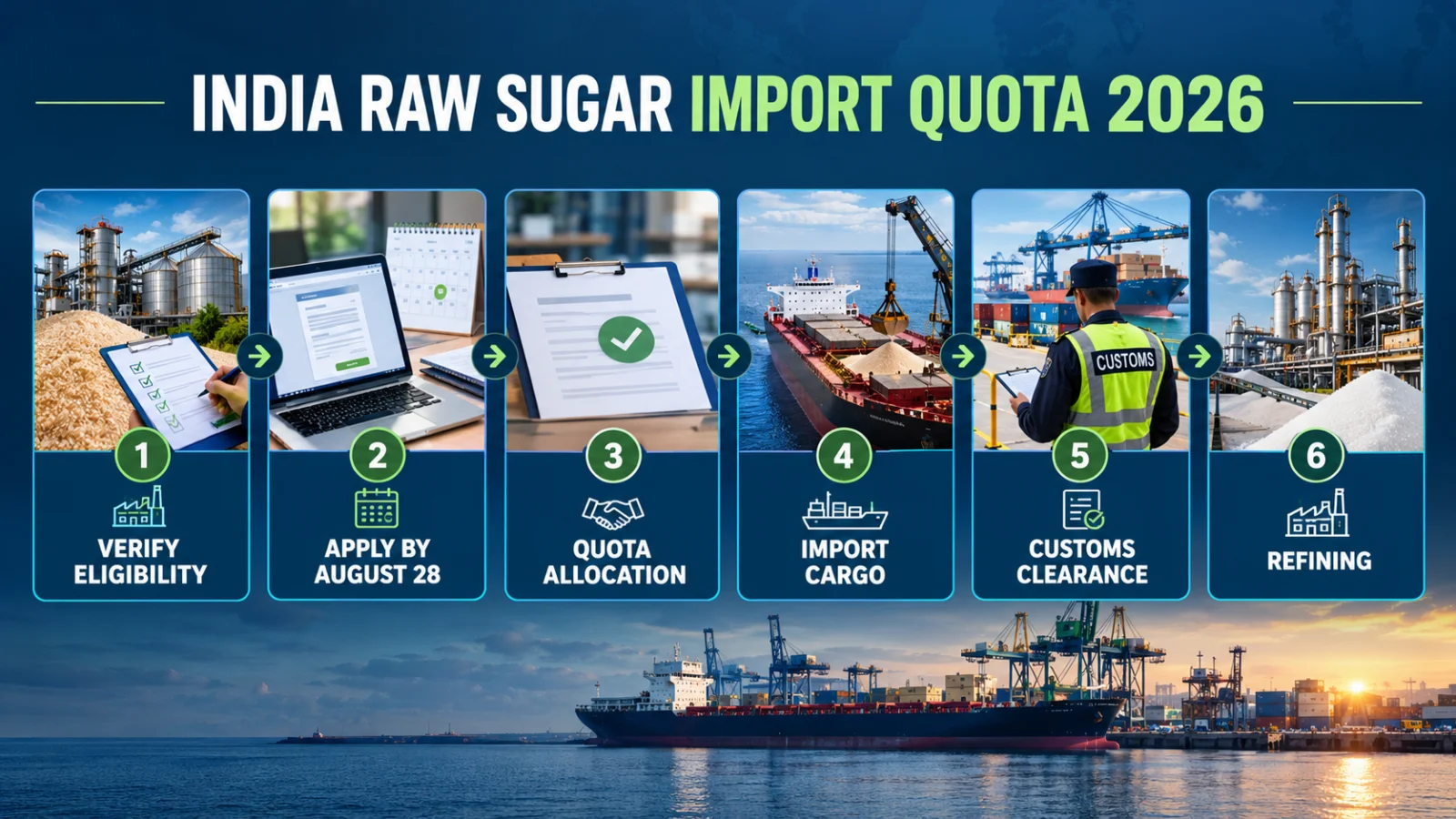
The September 7, 2026 application window for India’s balance raw-sugar TRQ is closed. The separate extended window for eligible SION E-52 Advance Authorisation holders seeking one-time conversion to the TRQ scheme also ended on September 7.
As of September 11, 2026, no later general extension, reopening or public final allocation result has been identified in the current DGFT/APEDA material reviewed. The immediate reader question is therefore whether a submitted application counted, what DGFT status appears next, whether any balance quota remained for the relevant batch, and what deadlines apply if authorisation is issued.
Direct answer: if you submitted within the published September 7 window, preserve your DGFT acknowledgement and application reference and monitor the official portal for scrutiny, allocation or rejection status. If you did not submit by September 7, portal accessibility by itself does not establish a valid late-filing route; a further DGFT notice, relaxation or explicit applicant instruction would be needed.
Is the raw sugar TRQ application window still open?
Not under the currently published general timeline.
DGFT Public Notice No. 28/2026-2027 opened fresh applications for the balance quantity for seven days from its September 1 publication. That published seven-day period ended on September 7.
DGFT Public Notice No. 29/2026-27 separately provided an extended window from September 3 through September 7, both days inclusive, for one-time conversion of eligible Advance Authorisations under SION E-52 to the TRQ scheme.
No later general extension or reopening beyond September 7 was identified in the current public-notice material checked through September 11.
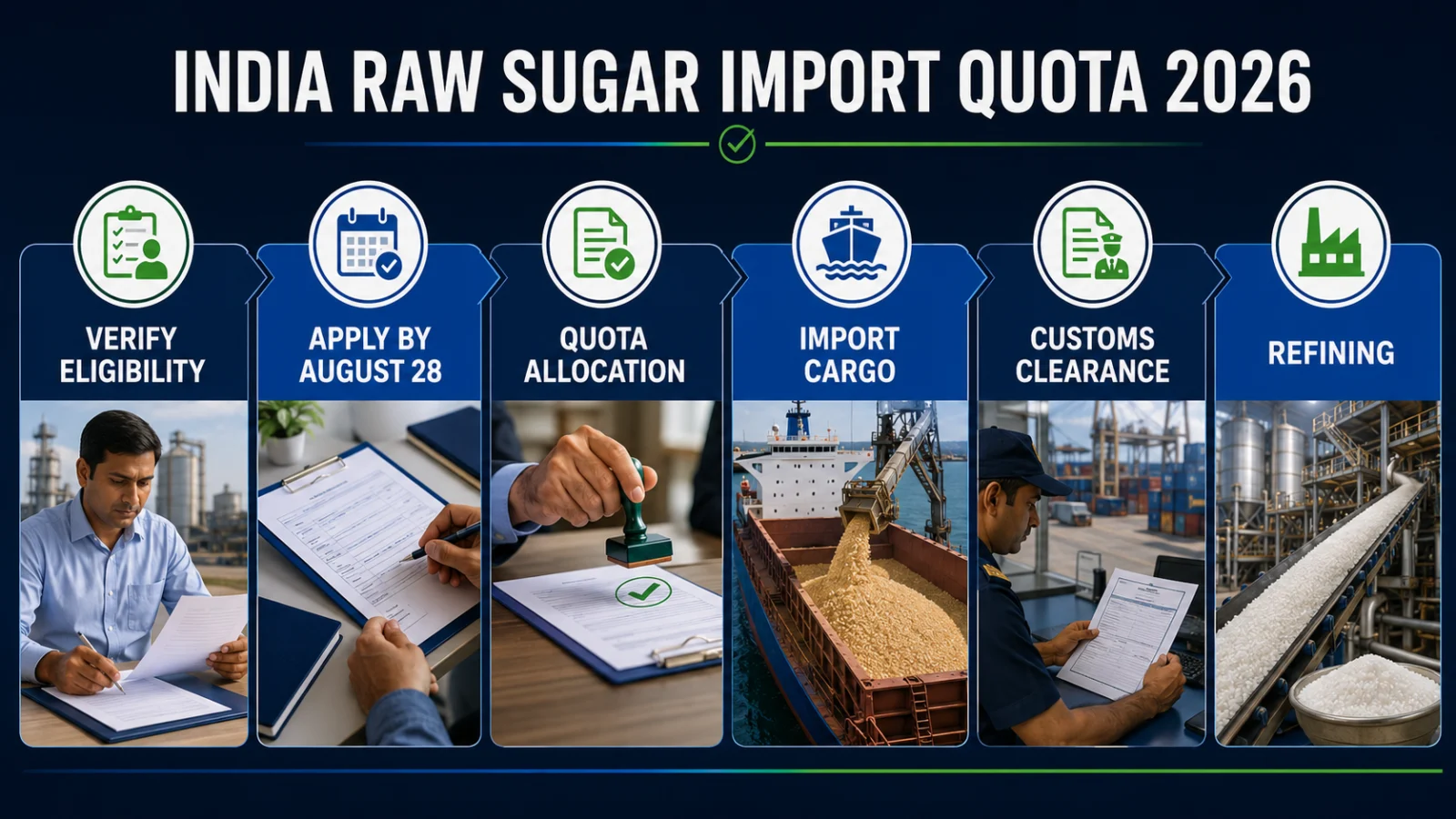
What should you do if you already submitted a balance-TRQ application?
- Preserve the successful submission acknowledgement and application reference generated by DGFT.
- Check the DGFT portal status rather than assuming submission means allocation.
- Watch for scrutiny, allocation or rejection because applications remain subject to eligibility and DGFT processing.
- Do not assume the original 2,02,550 MT balance was still available when you filed. The balance was being reduced through daily allocation batches.
- If authorisation is issued, calculate the next compliance clocks from the actual authorisation date rather than from September 7.
Has DGFT published the final balance-quota allocation?
No public final allocation result for the reopened 2,02,550 MT balance was identified in the official material reviewed through September 11.
Applicant-specific scrutiny, allocation and rejection outcomes may therefore appear in the DGFT portal or direct communication before a consolidated public result is visible.
A successful application acknowledgement proves submission, not allocation. Applicants should rely on their actual DGFT status and any authorisation issued to them.
How much of the balance quota is still available?
The exact current unallocated quantity is not established by the public evidence reviewed.
DGFT recorded that 7,97,450 MT had been allocated from the original 10,00,000 MT raw-sugar TRQ, leaving 2,02,550 MT when Public Notice No. 28 was issued.
That 2,02,550 MT figure was the starting balance for the reopened allocation process, not a guaranteed live balance after the daily batches were processed.
Public Notice No. 28 uses daily batches. Eligible applications can therefore reduce the remaining quota as DGFT processes each batch.
How did DGFT process applications during the reopened window?
Public Notice No. 28 introduced a daily processing mechanism for the balance quota.
- Applications received up to 5:30 PM on a day are grouped into that day’s batch.
- The batch is processed on the following working day, subject to scrutiny and eligibility.
- Applications received after 5:30 PM move into the next batch under the published processing mechanism.
- If eligible demand in a batch exceeds the quantity still available, allocation is made on a pro-rata basis within that batch.
- Applications received after the quota has already been fully exhausted are not considered for allocation.
I submitted on September 7 after 5:30 PM — did it count?
The notice uses 5:30 PM as a daily batching cut-off, while September 7 is identified as the final day of the published application window.
The public evidence reviewed does not safely establish that every September 7 submission after 5:30 PM must be treated as valid or invalid merely from the clock time.
If you received a successful DGFT submission acknowledgement on September 7, preserve it and rely on the application status shown by DGFT. Do not infer allocation from successful form submission alone.
What if the DGFT portal is still accessible after September 7?
Portal accessibility by itself is not proof of a valid late application opportunity.
A login page, open form or technically accessible menu can remain available for operational reasons. The published deadline and any subsequent DGFT notice or explicit portal instruction control whether a new application can validly enter the scheme.
No general late-filing, correction, appeal or reopened application route beyond September 7 was identified in the current public-notice evidence checked through September 11.
What happened to the 2,02,550 MT balance?
DGFT Public Notice No. 28 was issued after applications covering 7,97,450 MT had been received and allocated under the earlier process from the total 10,00,000 MT TRQ.
The remaining 2,02,550 MT was then offered through the reopened balance-allocation process.
Because allocation was processed daily and could become pro-rata where demand exceeded the remaining quantity, applicants should now focus on their actual DGFT allocation result rather than the original published balance.
Is the balance quota first come, first served?
Not in a simple continuous first-come-first-served sense.
The published process groups applications into daily batches. If the eligible quantity requested within the relevant batch is greater than the quota still available, the remaining quantity is distributed on a pro-rata basis among eligible applicants in that batch.
Once the quota has been fully exhausted or allocated, applications received in later batches are not considered for allocation.
What should SION E-52 Advance Authorisation applicants track now?
The separate one-time AA-to-TRQ conversion window under Public Notice No. 29/2026-27 ran from September 3 through September 7, 2026, both days inclusive.
That submission window is closed under the published notice, and no later general extension was identified through September 11.
Applicants who submitted within the window should preserve their acknowledgement and monitor their DGFT application status. Conversion cases also remain subject to the applicable conditions under Public Notice No. 27, its corrigendum and the Customs/IGST procedure.
Do not merge the two routes: an application for allocation from the balance raw-sugar TRQ under Public Notice No. 28 and a one-time SION E-52 Advance Authorisation conversion under Public Notice No. 29 are related but legally distinct processes.
What happens if DGFT issues TRQ authorisation?
The post-authorisation requirements remain important even though the application window has closed.
- LC or confirmed contracts: submit Letter of Credit or confirmed-contract details to DGFT within 15 days of obtaining TRQ authorisation.
- Unused allocation: eligible unutilised quantity may be surrendered within 15 days of authorisation subject to the published payment equivalent to 0.5% of the CIF value surrendered.
- Own refining facility: imported raw sugar must be processed at the TRQ holder’s own functional facility.
- Conversion requirement: for every 1.05 kg of imported raw sugar, 1 kg of refined sugar must be produced and sold domestically under the prescribed framework.
The applicant-specific authorisation date controls the relevant 15-day clocks. September 7 should not be substituted for that date.
Does October 15 still matter?
Yes. DGFT’s TRQ framework gives allocation preference to applicants undertaking to complete imports by October 15, 2026.
October 15 is an import-completion preference within the scheme. It was not the application deadline and remains distinct from the September 7 filing window.
Does October 31 still matter?
Yes. The Customs duty-exemption framework for the raw-sugar TRQ remains effective through October 31, 2026, subject to the applicable notification conditions.
That date is separate from the consignment-specific processing-and-domestic-sale requirement created by the corrigendum.
What is the Bill of Entry two-month rule?
The corrigendum requires raw sugar imported under the scheme to be processed into white or refined sugar and the resulting refined sugar to be sold in the domestic market within a period not exceeding two months from the date of filing the relevant Bill of Entry.
This is a consignment-specific clock. Compliance teams should calculate it from the actual Bill of Entry date rather than using October 31 or another common calendar date as a substitute.
What about IGST for AA-to-TRQ conversion?
CBIC Circular No. 37/2026-Cus dated August 27 prescribes the Customs-side procedure for payment of IGST that had been exempted on raw sugar already imported under an Advance Authorisation and subsequently proposed for conversion into the TRQ framework.
Applicants using the one-time conversion route therefore need to follow both the DGFT conversion requirements and the applicable Customs/IGST procedure.
What if you missed September 7?
No later general extension, reopening or blanket late-filing route was identified in the current DGFT/APEDA public-notice material checked through September 11.
Do not submit or rely on a late application merely because a portal screen remains accessible. A new DGFT public notice, corrigendum, relaxation or explicit applicant-specific instruction would be needed to establish another valid filing opportunity.
What should applicants monitor next?
- DGFT portal scrutiny and allocation status for submitted balance-TRQ applications.
- Any communication that an application was not considered because the quota had already been exhausted.
- Any pro-rata allocation where demand exceeded the remaining balance within a batch.
- AA-to-TRQ conversion decisions for applications submitted by September 7.
- Any new DGFT notice changing, relaxing or reopening the timeline.
- The actual TRQ authorisation date for 15-day post-authorisation obligations.
- October 15, 2026, the next verified common scheme checkpoint tied to the import-completion preference.
- October 31 Customs duty-exemption validity.
- The two-month processing-and-domestic-sale clock from each relevant Bill of Entry.
Official and supporting sources
- APEDA / Department of Commerce — current DGFT public-notice listing.
- Gazette reproduction — Public Notice No. 28/2026-2027.
- Gazette reproduction — Public Notice No. 29/2026-27.
- Directorate General of Foreign Trade.
- CBIC Circular No. 37/2026-Cus reproduction — AA-to-TRQ IGST procedure.
- Reuters — fresh applications for remaining raw-sugar quota.
How this was verified
ThePulseSignal checked the current APEDA/Department of Commerce DGFT public-notice listing, Public Notice No. 28/2026-2027 governing the balance 2,02,550 MT, Public Notice No. 29/2026-27 governing the extended SION E-52 AA-to-TRQ conversion window, the DGFT portal, Customs/IGST guidance and supporting reporting.
The evidence checked through September 11 establishes that the published September 7 application windows are closed. It does not establish a later general reopening, a public final balance-allocation result, the exact quota quantity still unallocated or applicant-specific outcomes.
Last verified: September 11, 2026.
Limitations and unresolved facts
- The final quantity allocated from the reopened 2,02,550 MT balance has not been established from the current public evidence reviewed.
- The exact quantity, if any, still unallocated is not publicly established in the reviewed material.
- Applicant-specific DGFT scrutiny, validation, allocation and rejection states are not publicly visible.
- The public evidence reviewed does not establish a general late-filing, correction or appeal route after September 7.
- The 5:30 PM rule establishes daily batching, but an individual September 7 application’s validity cannot be determined solely from its submission time without the DGFT acknowledgement/status.
- The actual TRQ authorisation date determines applicant-specific 15-day compliance clocks.
- The relevant Bill of Entry filing date determines the two-month processing-and-domestic-sale deadline for each consignment.
- AA-to-TRQ conversion cases remain subject to separate DGFT and Customs/IGST requirements.
Frequently asked questions
Can I submit a new balance-TRQ application now?
No general new application window is established by the currently published notices. Public Notice No. 28 provided seven days from September 1, ending September 7, unless DGFT issues a further valid extension, reopening or relaxation.
I submitted by September 7. Does that mean I received quota?
No. Submission and allocation are different states. DGFT still applies eligibility scrutiny, daily batching, available-balance limits and pro-rata allocation where relevant.
Has DGFT published the final allocation of the reopened balance?
No public final allocation result for the reopened 2,02,550 MT balance was identified in the material reviewed through September 11. Check the DGFT portal for applicant-specific status.
How much quota was available when the reopened process began?
DGFT recorded 7,97,450 MT as already allocated from the 10 lakh MT TRQ, leaving 2,02,550 MT for the reopened balance-allocation process.
What if I submitted after 5:30 PM on September 7?
The 5:30 PM rule controls daily batch grouping. Preserve your successful submission acknowledgement and check DGFT’s application status; the reviewed evidence does not justify declaring an individual September 7 application valid or invalid from the time alone.
Is the SION E-52 AA conversion window still open?
No. The published extended window ran from September 3 through September 7, both days inclusive. No later general extension was identified in the current public-notice evidence checked through September 11.
What is the next common scheme checkpoint?
October 15, 2026 is the next verified common checkpoint identified in the TRQ framework because allocation preference is tied to applicants undertaking to complete imports by that date. Applicant-specific authorisation and compliance deadlines can arise earlier.
Does the end of the September 7 application window end all compliance deadlines?
No. Successful applicants may still face authorisation-based 15-day requirements, October 15 import preference, October 31 Customs validity and the separate two-month Bill-of-Entry processing-and-sale requirement.