







The Indian Standard Time compliance rules require covered organisations to look beyond whether a screen, server or application simply displays UTC+5:30. The final Legal Metrology (Indian Standard Time) Rules, 2026 create a framework around authorised timing sources, synchronisation, traceability, resilience and auditable evidence. For an IT, network, cybersecurity or compliance team, the practical question is therefore not just “does this system show IST?” but “where does its time come from, can that source be traced to an authorised reference, and can the organisation demonstrate that the timing path remains reliable?”
The Rules were notified in August 2026 and provide a transition period before commencement. That makes the current task a preparation and verification exercise rather than a reason to redesign infrastructure blindly. Some implementation details are still pending, so organisations should distinguish requirements that are already confirmed from questions that still need sector-specific or official clarification.
What changed under the Indian Standard Time compliance rules?
India has long used Indian Standard Time as its civil time reference. The new framework changes the compliance question for organisations because it formally addresses how IST is generated, disseminated, synchronised and traced for legal, administrative, official and time-dependent uses.
The Rules introduce the concept of an Authorised Timing Source. They also establish specific synchronisation duties for government and public institutions and identify critical sectors such as telecommunications, financial services, energy and data centres. Government explanatory material additionally highlights environments such as banking and payments, transport, power systems, computer networks and official records where precise timestamps can have operational or legal significance.
This means a timezone setting and a timing source are two different things. A machine may display the correct IST offset while obtaining its clock from a source that has not been shown to meet the required authorisation or traceability conditions.
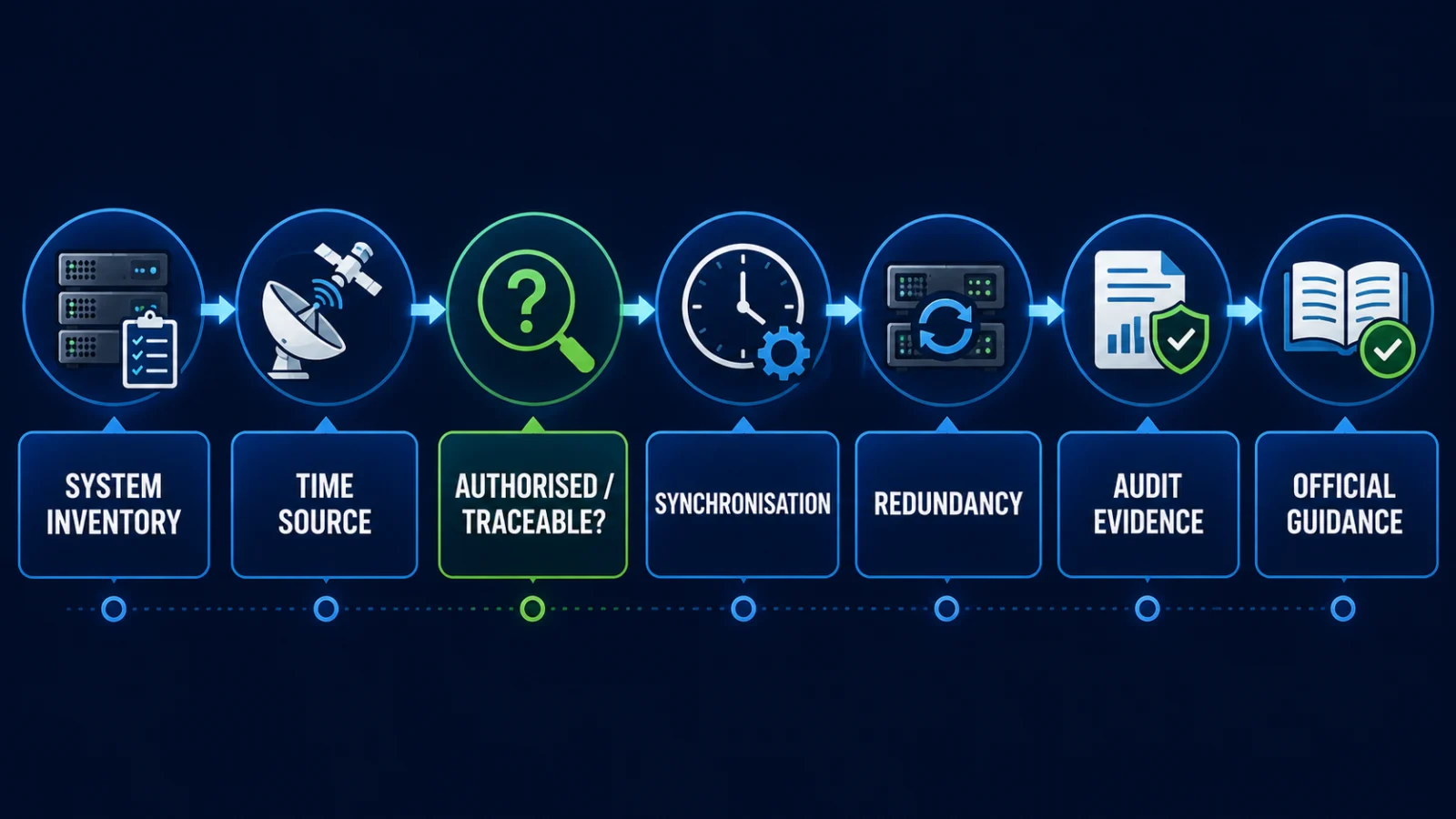
First check: which systems actually depend on trustworthy time?
Start with an inventory of systems where the sequence, timestamp or synchronisation of events matters. Examples can include authentication infrastructure, transaction systems, payment records, telecom equipment, network logs, data-centre infrastructure, industrial control environments, power systems, transport systems, security monitoring, databases, distributed applications and government records.
The purpose of this inventory is not to assume that every clock in an organisation has identical obligations. It is to identify systems where incorrect, inconsistent or untraceable time could affect legal records, transactions, security investigations, distributed processing or regulated operations.
IST compliance decision path
Does the application, device, platform or infrastructure depend on timestamps, event ordering or synchronised clocks?
Is it operated by a government or public institution, or within a critical or highly time-dependent sector such as telecom, financial services, energy or a data centre?
Document whether the system currently obtains time from an internal source, a public NTP service, GPS/GNSS, a network appliance, a cloud platform, a carrier source or another reference.
Do not treat the fact that a source produces the correct time as proof that it meets an authorised-source or traceability requirement under the final framework.
Check how dependent systems synchronise, whether alternate references exist and what happens if a primary source becomes unavailable, spoofed, jammed or unreliable.
Keep records that can show the timing source, system configuration, deviations, monitoring and traceability decisions used by the organisation.
Where the Rules do not yet provide enough implementation detail, obtain the current controlling guidance from the relevant regulator or legal/compliance authority instead of assuming an existing configuration is acceptable.
Is displaying IST enough?
No. Displaying IST is not, by itself, evidence that a covered time-dependent system satisfies the new framework. A system configured to the Asia/Kolkata timezone can still obtain its underlying time from another source. The Rules make the timing reference, synchronisation path and traceability important parts of the compliance question.
For this reason, an organisation should document both the timezone presentation and the underlying timing source. The former controls how a timestamp is displayed to a user; the latter controls what reference the machine actually trusts when establishing time.
What is an authorised timing source?
The Rules define an Authorised Timing Source within the new Legal Metrology framework rather than treating every publicly available time server as automatically equivalent. The reviewed framework links authorisation to technical, operational, security, traceability and compliance requirements.
Government material identifies India’s National Physical Laboratory infrastructure, Regional Reference Standard Laboratories, NavIC-based timing infrastructure, NIC and other authorised mechanisms as parts of the domestic timing ecosystem. The exact production endpoints, access conditions and any future authorised commercial services should be checked against current official guidance before implementation.
Does every organisation have to install NavIC hardware?
No blanket requirement reviewed by TPS says every organisation must purchase NavIC hardware. NavIC is part of India’s timing-distribution architecture, but the framework also recognises authorised timing sources more broadly. Procurement decisions should therefore follow the actual technical and sector requirements rather than an assumption that all organisations need the same receiver or appliance.
This distinction matters because unnecessary hardware procurement could solve the wrong problem. The compliance task is to establish an acceptable, traceable and resilient timing path for the systems that fall within the applicable requirements.
Where do NTP and PTP fit?
Network Time Protocol and Precision Time Protocol are mechanisms used to distribute and synchronise time across systems. Government work on India’s traceable IST infrastructure has included precision network synchronisation, including a PTP-based White Rabbit demonstration for critical infrastructure.
That does not mean every system requires the same protocol. NTP may be appropriate for many conventional computing environments, while higher-precision environments can use PTP or specialised infrastructure. What matters for the new compliance framework is not merely the protocol name but the complete chain: the reference source, authorisation or traceability where required, distribution architecture, resilience and evidence.
Can you keep using a public or foreign NTP source?
Do not assume that an existing public or foreign timing service will satisfy a requirement for authorised and traceable IST. The fact that a server returns an accurate timestamp is not the same as demonstrating that it is an authorised source under the Indian framework.
Before replacing an existing service, however, check the final implementation guidance for the systems and sector involved. Production endpoints and access details for the new domestic infrastructure remain an important unresolved implementation area. TPS does not have evidence supporting a blanket claim that all foreign NTP services are already prohibited for every organisational use.
What about systems that store UTC internally?
This remains one of the important unresolved implementation questions. Modern applications frequently store timestamps internally in UTC and convert them to a local timezone for presentation. The final Rules contain broad language around use, display and recording of time references, but the reviewed evidence does not justify a blanket statement that every existing UTC-storage design is compliant or non-compliant.
Organisations with distributed applications, databases, security logs or cross-border platforms should therefore identify this architecture explicitly during their review. Do not change a mature UTC-based design purely on assumption; obtain current sector, legal or implementation guidance on how the final Rules apply to internal storage, interoperability and displayed official records.
Why redundancy and cybersecurity matter
Reliable time is a cybersecurity control as well as an operational dependency. Authentication systems, certificates, transaction ordering, distributed databases, incident logs and forensic timelines can all be affected when clocks diverge or a trusted timing source is manipulated.
The final framework addresses resilience and security around synchronisation. For relevant systems, organisations should review whether they depend on a single timing reference, whether they can detect abnormal drift, and what happens if the main source is unavailable or suspected of spoofing, jamming or compromise.
The correct architecture will vary by system. TPS is not asserting that every organisation needs identical redundancy. The practical requirement is to identify the dependency and compare the current design with the obligations that apply to that organisation and sector.
What evidence should an organisation preserve?
The Rules make traceability and auditability important, although a universal audit template or cadence was not established in the reviewed evidence. A sensible preparation record can therefore include the system inventory, current timing source, synchronisation method, configuration ownership, source traceability evidence, monitoring for deviations, resilience arrangements and any unresolved compliance decisions referred for formal guidance.
This is not a substitute for an eventual regulator-prescribed audit format. It is a way to avoid reaching the implementation period without knowing which systems depend on which source or why a particular architecture was considered acceptable.
When do the new IST Rules start?
The final framework states that the Rules commence after a 180-day period from publication in the Official Gazette. The identified Gazette record was published on August 29, 2026. TPS is preserving the statutory wording rather than asserting a precise legal commencement date because the current reviewed sources do not provide an explicit regulator-issued calendar date resolving the counting interpretation.
For planning purposes, organisations should treat the transition as a limited preparation window and watch for an official commencement clarification, authorised-source publication and sector-specific instructions before the period expires.
What should your organisation do now?
Do not begin with hardware procurement. Begin with evidence. Identify time-dependent systems, document their current sources and synchronisation methods, determine whether the organisation falls within an expressly covered or critical context, and identify where authorisation, traceability, resilience or audit evidence is currently missing.
Then separate confirmed gaps from unresolved questions. A system with an undocumented public timing dependency presents a different problem from a database whose internal UTC architecture may need legal interpretation. The first can be investigated immediately; the second should be tracked until authoritative implementation guidance provides a safe answer.
What remains unresolved
TPS did not find final evidence establishing universal production NTP or PTP endpoint details, a single audit frequency or audit template, sector-by-sector accuracy thresholds, a blanket rule for backend UTC storage, or a universal requirement to purchase NavIC hardware. These points should remain labelled as unresolved until controlling guidance appears.
How this was verified
TPS reconciled the final Legal Metrology (Indian Standard Time) Rules, 2026 with the Department of Consumer Affairs explanation of the transition and reviewed current government material on India’s traceable IST dissemination infrastructure. The article separates confirmed legal and technical requirements from implementation details that have not yet been established by the reviewed official evidence.