




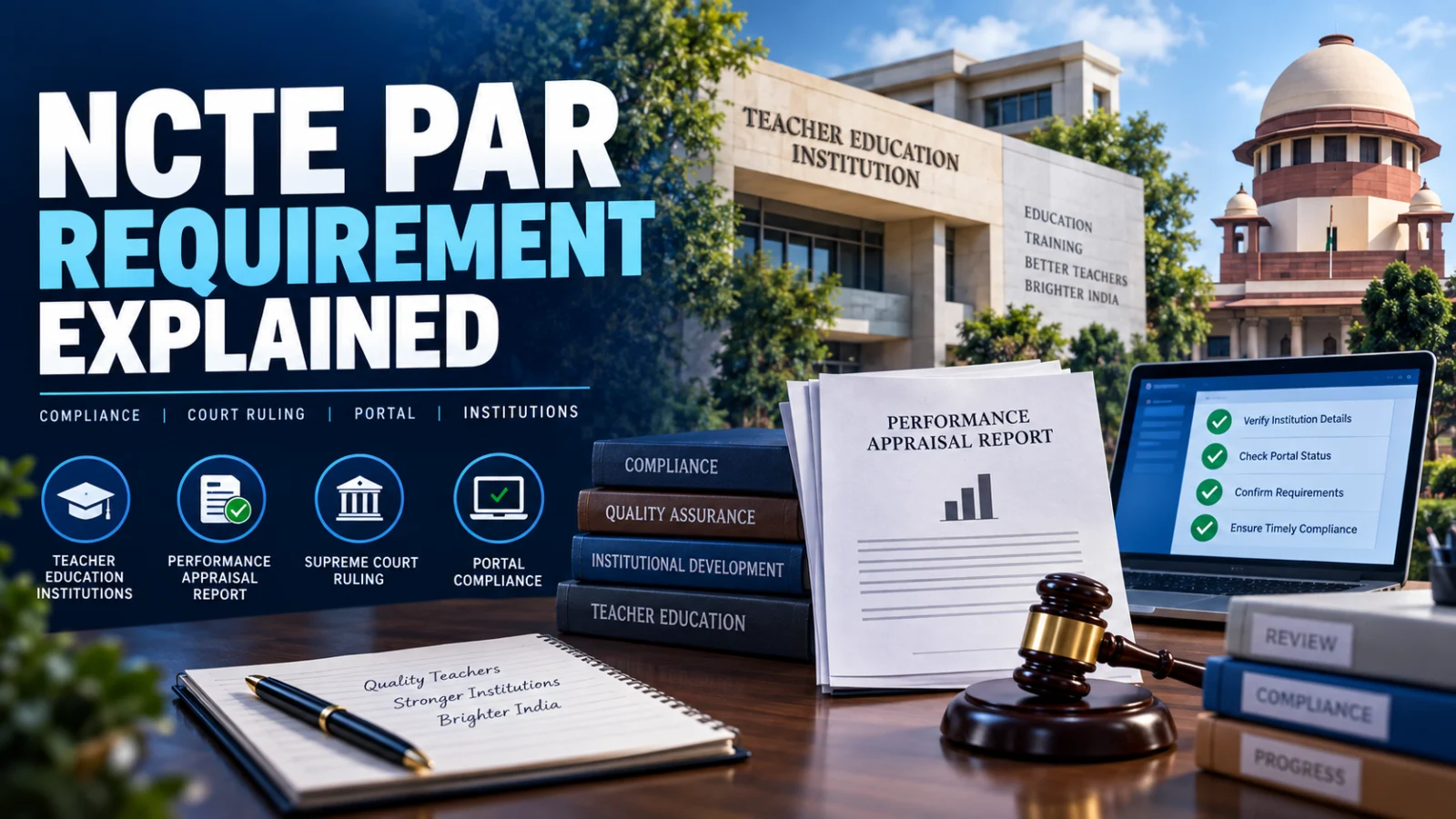
The NCTE Performance Appraisal Report remains a valid regulatory requirement for recognised Teacher Education Institutions after the Supreme Court’s September 3, 2026 ruling. The Court upheld the authority of the National Council for Teacher Education and its Executive Committee to require recognised TEIs to submit Performance Appraisal Reports and set aside the Delhi High Court judgment that had invalidated the challenged PAR notice.
That ruling settles the legal-authority question, but it does not mean a new September 2026 filing deadline automatically opened. The current NCTE PAR portal reviewed by ThePulseSignal shows an earlier filing period for academic sessions 2021-22 and 2022-23 that ran from May 7 to June 17, 2026. That visible window is already closed.
The Supreme Court has confirmed that NCTE and its Executive Committee can require recognised TEIs to submit PARs.
The visible filing window reviewed by TPS ended on June 17, 2026.
No new future PAR filing date was established in the reviewed Supreme Court judgment or current NCTE material.
What did the Supreme Court change?
The dispute concerned NCTE’s power to operate an annual Performance Appraisal Report mechanism for recognised Teacher Education Institutions. A Delhi High Court ruling had set aside the challenged September 2019 PAR notice. The Supreme Court has now reversed that outcome and recognised sufficient statutory authority for NCTE and its Executive Committee to call for PAR submissions as part of NCTE’s regulatory and accountability functions.
The practical distinction is important: the Court confirmed NCTE’s power to require the report. It did not itself announce the next academic-session filing window, reopen the PAR portal or create a new September deadline.
Is the NCTE Performance Appraisal Report mandatory?
For recognised Teacher Education Institutions covered by NCTE’s regulatory framework, the reviewed official material supports an annual PAR obligation. NCTE recognition conditions also refer to submission of a Performance Appraisal Report at the end of each academic year along with annual accounts audited by a Chartered Accountant.
Institutions should still apply the requirement through the current NCTE notice and portal for the relevant academic session. A continuing regulatory power does not mean every historic or future PAR cycle uses identical dates, documents, fees or submission mechanics.
Does a TEI need to file a PAR immediately after the ruling?
Not merely because the Supreme Court judgment was issued. TPS found no evidence that the September 3 ruling itself created a fresh submission period. The current portal reviewed on September 4 continued to display the earlier May 7-June 17, 2026 filing window for the 2021-22 and 2022-23 academic sessions.
A recognised TEI should therefore verify whether NCTE has issued a new public notice for its applicable session rather than treating the court judgment as a filing-date notification.
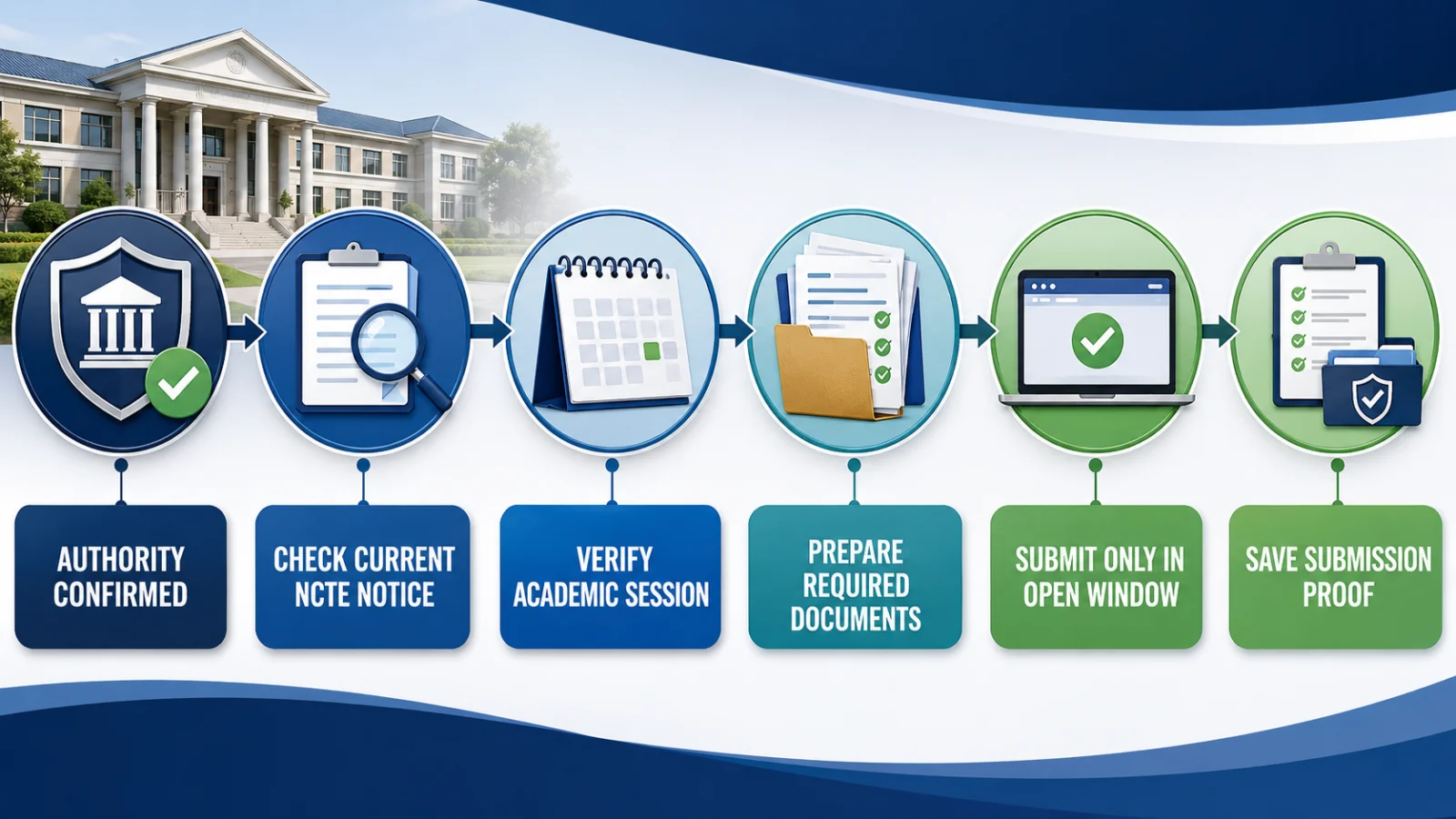
What should a recognised TEI check now?
Confirm that the institution and relevant teacher-education programme are recognised under the applicable NCTE framework.
Check which academic year or years the current NCTE PAR notice covers.
Verify the opening and closing dates on the current official NCTE PAR portal or public notice.
Review the current instructions, authorisation requirements, affidavit or certificate formats and other listed uploads.
Check the applicable requirement for annual accounts audited by a Chartered Accountant.
Preserve the acknowledgement, payment record and other available proof after a valid submission.
What documents can the PAR process require?
The NCTE PAR materials reviewed by TPS provide institution-facing instructions and supporting formats that can include an authorisation letter, affidavit, affiliating-body certificate, specimen PAR and other upload requirements. Official recognition conditions also refer to audited annual accounts.
These materials should be treated as the current published framework, not as a guarantee that the next PAR cycle will be identical. Institutions should recheck the document list when NCTE announces the next applicable filing period.
Can NCTE take action if a recognised TEI does not comply?
NCTE’s official framework links institutional compliance to its regulatory powers, including action under Section 17 where legally applicable. That does not mean recognition is automatically withdrawn the moment a PAR is missed. The consequence in an individual case depends on the controlling notice, the institution’s circumstances, any notice or opportunity to respond, and the procedure NCTE actually follows.
What the ruling does not mean
- It does not establish a new September 2026 PAR deadline.
- It does not prove that the PAR portal is currently open.
- It does not mean every future PAR cycle will use the same documents, dates or fee structure.
- It does not establish automatic recognition withdrawal for every filing failure.
- It does not create the PAR mechanism for the first time; the litigation concerned NCTE’s authority to require and operate it.
What happens next?
The next operational milestone is an NCTE notice or portal update identifying the next applicable PAR academic session and filing window. That notice, rather than the September 3 judgment alone, should control the institution’s next submission deadline and current procedural requirements.
Verification method
TPS reviewed the Supreme Court judgment identification and ruling outcome, the current NCTE PAR portal, and NCTE regulatory materials describing annual PAR and institutional reporting requirements. The legal-authority decision was then separated from the current portal and deadline state so that a court ruling was not incorrectly presented as a new filing-window announcement.
Limitations and unresolved facts
No future NCTE PAR filing deadline was established in the reviewed material as of September 4, 2026. The next academic-session window, any revised processing fee, final upload list and future enforcement instructions remain subject to later NCTE notices. Institutions should verify the current official PAR portal and applicable NCTE notice before filing.