





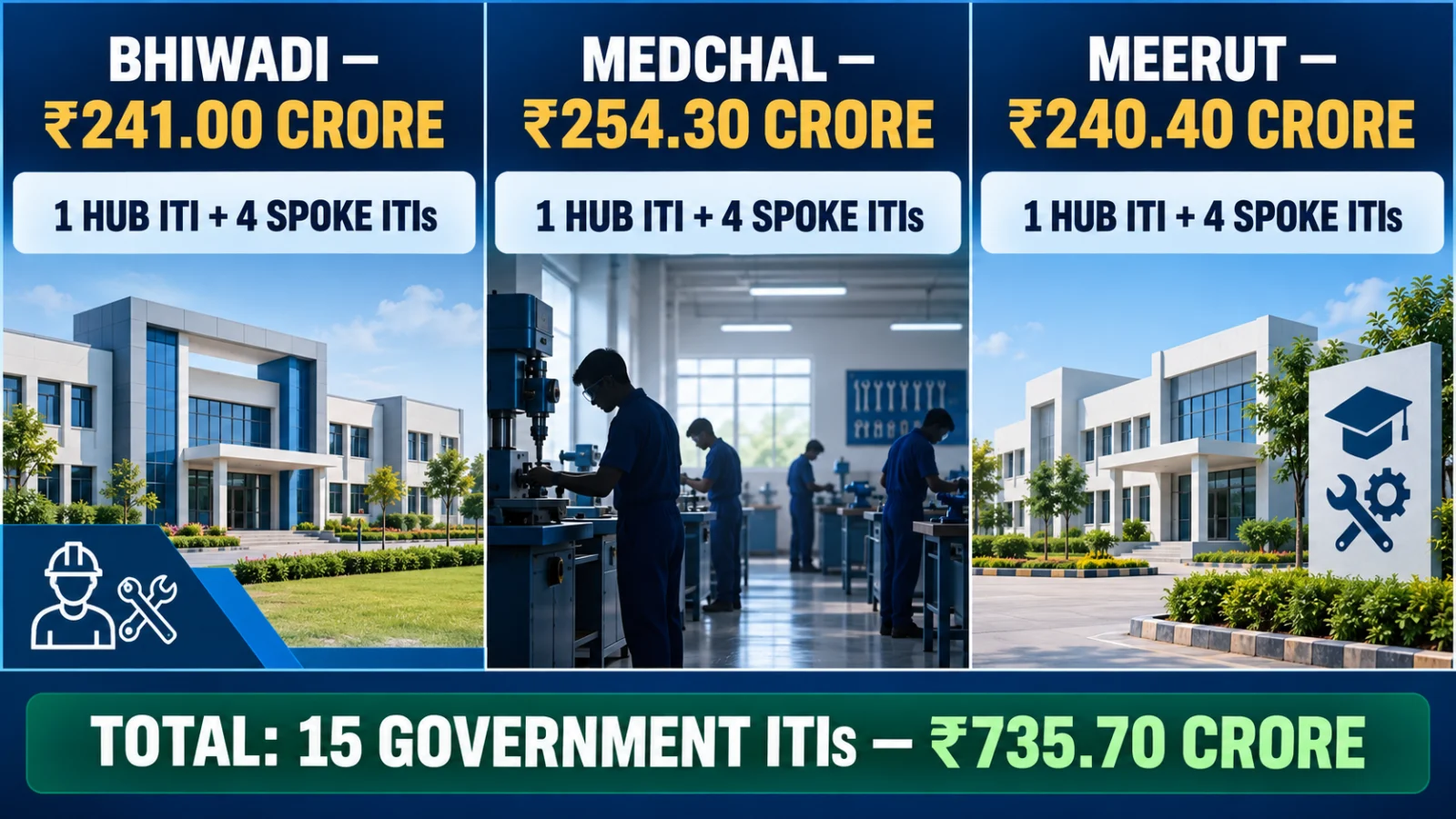
The PM-SETU ITI list 2026 has expanded with three newly approved clusters covering 15 Government ITIs. The 5th National Steering Committee under PM-SETU approved Strategic Investment Plans worth a combined ₹735.70 crore for the Bhiwadi cluster in Rajasthan, the Medchal cluster in Telangana and the Meerut cluster in Uttar Pradesh.
Current answer: the September 8 approval covers 15 named Government ITIs across three Hub-and-Spoke clusters. The approved project outlay is ₹241 crore for Bhiwadi, ₹254.30 crore for Medchal and ₹240.40 crore for Meerut. Approval supports future infrastructure, trade and training upgrades, but it does not mean new courses, seats or admissions are already live at every ITI.
Which 15 ITIs are included in the PM-SETU approval?
Rajasthan — Bhiwadi cluster: Hub: Government ITI Bhiwadi. Spokes: Government ITI Alwar, Government ITI Neemrana, Government ITI Tijara and Government ITI Kishangarh Bas.
Telangana — Medchal cluster: Hub: Government ITI Medchal. Spokes: Government ITI Alwal, Government ITI Shameerpet, Government ITI Kukunoorpally and Government ITI Siddipet.
Uttar Pradesh — Meerut cluster: Hub: Government ITI Saket, Meerut. Spokes: Government ITI Ghaziabad, Government ITI Hapur, Government ITI Gautam Buddha Nagar and Government ITI Baghpat.
How is the ₹735.70 crore split across the three PM-SETU clusters?
| Cluster | State | Approved project outlay | Partner / SIP submitter |
|---|---|---|---|
| Bhiwadi | Rajasthan | ₹241.00 crore | H.G. Infra Engineering Ltd. |
| Medchal | Telangana | ₹254.30 crore | Zen Technologies Ltd. |
| Meerut | Uttar Pradesh | ₹240.40 crore | National Skill Development Corporation |
What has actually been approved under PM-SETU?
The Strategic Investment Plans cover broad modernisation of the selected ITI clusters. The approved plans include infrastructure improvement, upgrading existing trades, introducing new long- and short-term courses and strengthening the operating capacity of the participating institutes.
The important distinction is that approval is not the same as completed implementation. The ₹735.70 crore figure is the approved project outlay for the three plans; it should not be described as money already spent or proof that all 15 ITIs have completed their upgrades.
Has implementation started at Bhiwadi?
Yes. Bhiwadi has moved beyond plan approval into a formal implementation step. Rajasthan, H.G. Infra Engineering and the Ministry entered into the relevant Shareholders’ Agreement, marking commencement of implementation activity for the Bhiwadi cluster.
TPS did not establish an equivalent formal implementation commencement for the Medchal and Meerut clusters in the evidence reviewed. Their plans are approved, but their exact current execution stage should not be assumed to match Bhiwadi.
Does this mean new PM-SETU courses or seats are open now?
No such immediate student-facing change has been established. TPS did not recover an ITI-by-ITI list of new trades or courses, new seat capacity, changed admission rules or opening dates linked to the September 8 approval.
Students should therefore treat the current development as an approved investment and implementation milestone, not as an admission notification.
What should students at these 15 ITIs do now?
Students and prospective trainees can first verify whether their ITI is in one of the three approved clusters. They should then monitor the relevant ITI, state skill department and PM-SETU or Ministry notices for concrete implementation changes such as new trades, upgraded labs, admission changes, trainer programmes, apprenticeship arrangements or revised seat capacity.
Until those notices appear, students should not assume that their existing course, examination, eligibility or admission process has changed.
What changed nationally under PM-SETU?
Before this decision, six Strategic Investment Plans had already been approved across earlier PM-SETU clusters. The three September 8 approvals raise the sanctioned total to ₹2,171 crore across nine approved ITI clusters.
This does not represent the full list of all Government ITIs identified under PM-SETU. The national scheme is much larger, and many institutions may still be at earlier stages such as identification, partner selection, RFP or SIP preparation.
Why Hub and Spoke status matters
Each newly approved cluster has one Hub ITI and four Spoke ITIs. The cluster model is intended to concentrate planning and industry partnership at Hub level while extending infrastructure, training and industry-linked benefits across the Spoke institutes.
For readers, Hub or Spoke status confirms inclusion in the approved cluster, but it does not by itself establish the exact course, equipment, funding or implementation schedule for an individual ITI.
What remains unresolved?
- The exact new long-term and short-term courses planned for each ITI.
- Whether seat capacity will change and by how much.
- When student admissions will reflect the approved plans.
- Procurement, civil-work and equipment-installation schedules.
- Formal implementation commencement for Medchal and Meerut comparable with the confirmed Bhiwadi step.
- Trainer recruitment or upskilling timelines.
- ITI-specific apprenticeship or placement arrangements.
What happens next?
The next useful evidence will come from implementation orders, SPV or Shareholders’ Agreement milestones, procurement and civil-work activity, trade or course announcements, trainer upgrades and any changes to seats or admissions.
TPS will update the relevant current-state coverage when those changes become verifiable rather than assuming that the Strategic Investment Plan approval has already produced student-facing changes.
Verification note: ThePulseSignal reconciled the September 8 PM-SETU approval with the earlier approved-cluster state and current implementation reporting to verify all three new clusters, the 15 named ITIs, project outlays and partner mapping. Detailed course, seat and admission changes remain unconfirmed.