




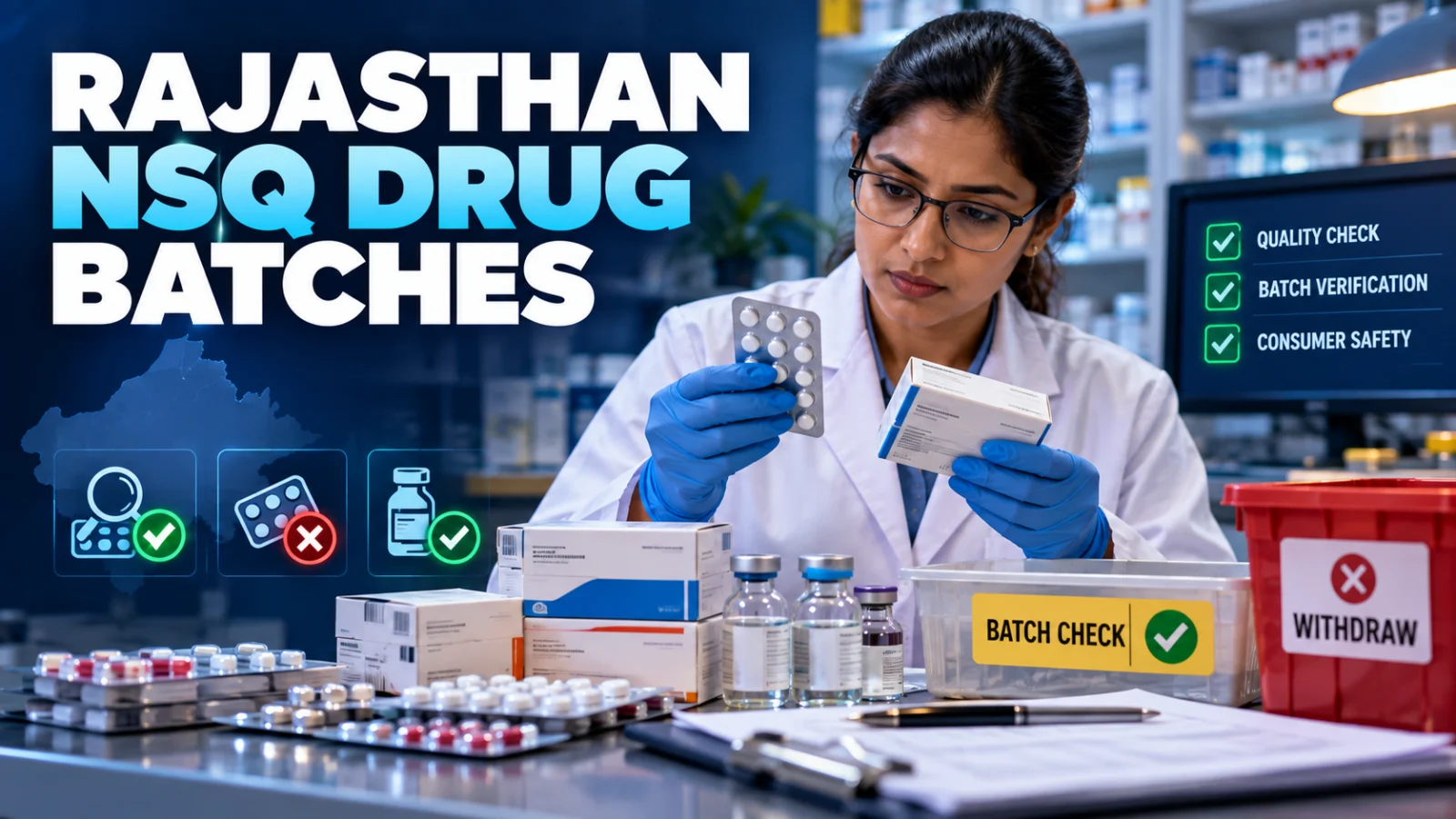
Rajasthan NSQ drug batches are under a new quality-control action after the state Drug Control system listed Order No. 3266 dated September 7, 2026 for medicines declared Not of Standard Quality during the August 16–31 testing period.
Current reporting says 10 affected batches were directed to be withdrawn or removed from circulation. However, ThePulseSignal has not yet recovered the complete official Order 3266 batch table. That means patients, pharmacies and hospitals should not assume that every batch of a named medicine, or every product made by a named manufacturer, is affected.
Direct answer: Rajasthan has an official NSQ order covering the current drug-quality action, and credible reporting identifies 10 affected batches. Until the exact batch table is recovered, the safest action is to verify the medicine name, strength, manufacturer and batch number against the controlling Rajasthan Drug Control notice before treating a pack as affected.
What has Rajasthan officially confirmed?
Rajasthan’s official Health Department letters system lists Order No. 3266 dated September 7, 2026 under Drug Control. The entry describes it as details of drugs declared Not of Standard Quality for the period from August 16 to August 31, 2026.
This primary-source index confirms that the state issued a formal NSQ order covering that testing period. The complete row-level attachment or PDF containing the exact affected batch details was not accessible during TPS’s current review.
What is currently reported about the 10 batches?
Current reporting says Rajasthan ordered the removal of 10 affected batches from circulation after quality testing. The reported medicine categories include B-complex products, calcium and Vitamin D3 formulations, telmisartan-amlodipine, bilastine, amoxicillin-clavulanate, ofloxacin-ornidazole, ondansetron injection, dexamethasone injection and bupivacaine injection.
The reporting also names manufacturers including Jackson Laboratories, Salus Pharmaceuticals, Digital Vision, KLM Laboratories, PIL Pharmaceuticals, Gats Biotech, Gnosis Pharmaceuticals, SVP Life Sciences, Oscar Remedies and Themis Medicare.
Those names should not be read as a blanket recall of every medicine made by those companies. Drug-quality actions of this kind are typically tied to specific tested batches, and TPS does not yet have the controlling Order 3266 table needed to map every reported product to its exact batch number, strength and manufacturer row.
Does NSQ mean every pack of that medicine is unsafe?
No. Not of Standard Quality, or NSQ, is a quality-testing classification applied to a tested sample or batch. It does not by itself establish that every batch of the same generic medicine, every strength, every pack sold under a brand, or every product from the manufacturer has the same quality failure.
The exact reason a batch failed may also differ. A batch can fail one or more applicable quality specifications, but TPS has not recovered the Order 3266 table showing the row-specific test result for these 10 reported batches.
How should you check a medicine you already have?
1. Keep the medicine pack
Do not discard the strip, bottle, vial, carton or label before checking it. The packaging normally carries the product name, strength, manufacturer and batch or lot identifier needed for comparison.
2. Find the batch number
Look for the batch or lot number printed on the primary pack or outer carton. Do not rely only on the generic medicine name.
3. Check the strength and dosage form
Two products with the same active ingredient can have different strengths or dosage forms. Match the exact product rather than only the ingredient name.
4. Check the manufacturer
Manufacturer identity matters because the same medicine can be produced by multiple companies. A reported company name does not mean all of its products are affected.
5. Verify against the official batch list
Use the controlling Rajasthan Drug Control order when the complete table is available. TPS will update this same article when the exact Order 3266 batch rows are recovered.
6. Ask a pharmacist or healthcare professional if treatment is involved
Do not stop or replace a prescribed medicine solely because a generic name appears in media coverage. Verify whether your exact batch is affected and seek appropriate professional guidance when treatment continuity matters.
What should pharmacies and hospitals do?
Current reporting says district drug-control officers were directed to remove affected batches from availability and prevent their consumption. Pharmacies, hospitals and distributors should therefore identify stock by the exact batch information in the controlling order rather than removing every pack of a medicine or every product from a manufacturer based only on a news headline.
Where a potentially matching batch is found, preserve the pack and procurement records and follow the applicable instructions from Rajasthan Drug Control, the supplier, manufacturer or other competent authority.
Should patients stop taking these medicines immediately?
Do not make that decision from the generic medicine name alone. The present evidence supports a batch-specific quality action, not a blanket statement that every supply of the listed medicine types is affected.
If you have one of the reported medicine types, check the batch number and other pack details. If the medicine is prescribed and there is uncertainty about whether your pack is affected, contact the dispensing pharmacy or an appropriate healthcare professional before changing treatment, unless controlling official guidance says otherwise.
Is this a nationwide recall?
The controlling evidence reviewed by TPS is a Rajasthan Drug Control action. TPS has not established a nationwide withdrawal of every product or all batches corresponding to the reported medicine names.
A later CDSCO alert, another state action or a manufacturer-level recall could change that answer. If such evidence appears, it should be added to this same article where it concerns the same batch-specific reader job.
Why the exact batch table matters
A drug-quality withdrawal becomes actionable only when a reader can distinguish an affected batch from unaffected stock. Publishing only medicine or manufacturer names can create two opposite errors: someone may wrongly stop using an unaffected medicine, or someone holding an affected batch may fail to recognise it because the exact identification details are missing.
For that reason, TPS is keeping the current evidence boundary explicit. The existence of Order 3266 and its NSQ testing period are officially established. The reported 10-batch withdrawal is supported by current reporting. The complete product-strength-batch-manufacturer table remains unresolved.
What happens next?
TPS will update this same URL when the direct Order 3266 PDF or another authoritative Rajasthan source exposing the full table becomes accessible. The next update should add the exact drug name, strength, manufacturer, batch number and any other row-specific quality details that the official order provides.
The same page should also be updated if Rajasthan expands or corrects the withdrawal, CDSCO lists the same batches in a national alert, or a manufacturer or regulator issues a confirmed batch-specific clarification.
Verification note
ThePulseSignal checked Rajasthan Health Department’s official Drug Control letters index, which lists Order No. 3266 dated September 7, 2026 for drugs declared Not of Standard Quality during August 16–31. TPS also reviewed current reporting describing withdrawal of 10 affected batches and the reported medicine and manufacturer set. The direct Order 3266 batch table was not accessible during this review, so exact batch identifiers are not presented as confirmed.
Limitations and unresolved facts
The complete Order 3266 PDF or row-level table was not recovered. Exact batch numbers, product strengths, manufacturing and expiry dates, manufacturer-to-product mapping, row-specific NSQ test failures and the full distribution footprint therefore remain unresolved. The reported medicine and manufacturer names must not be interpreted as evidence that all their batches or products are affected.