





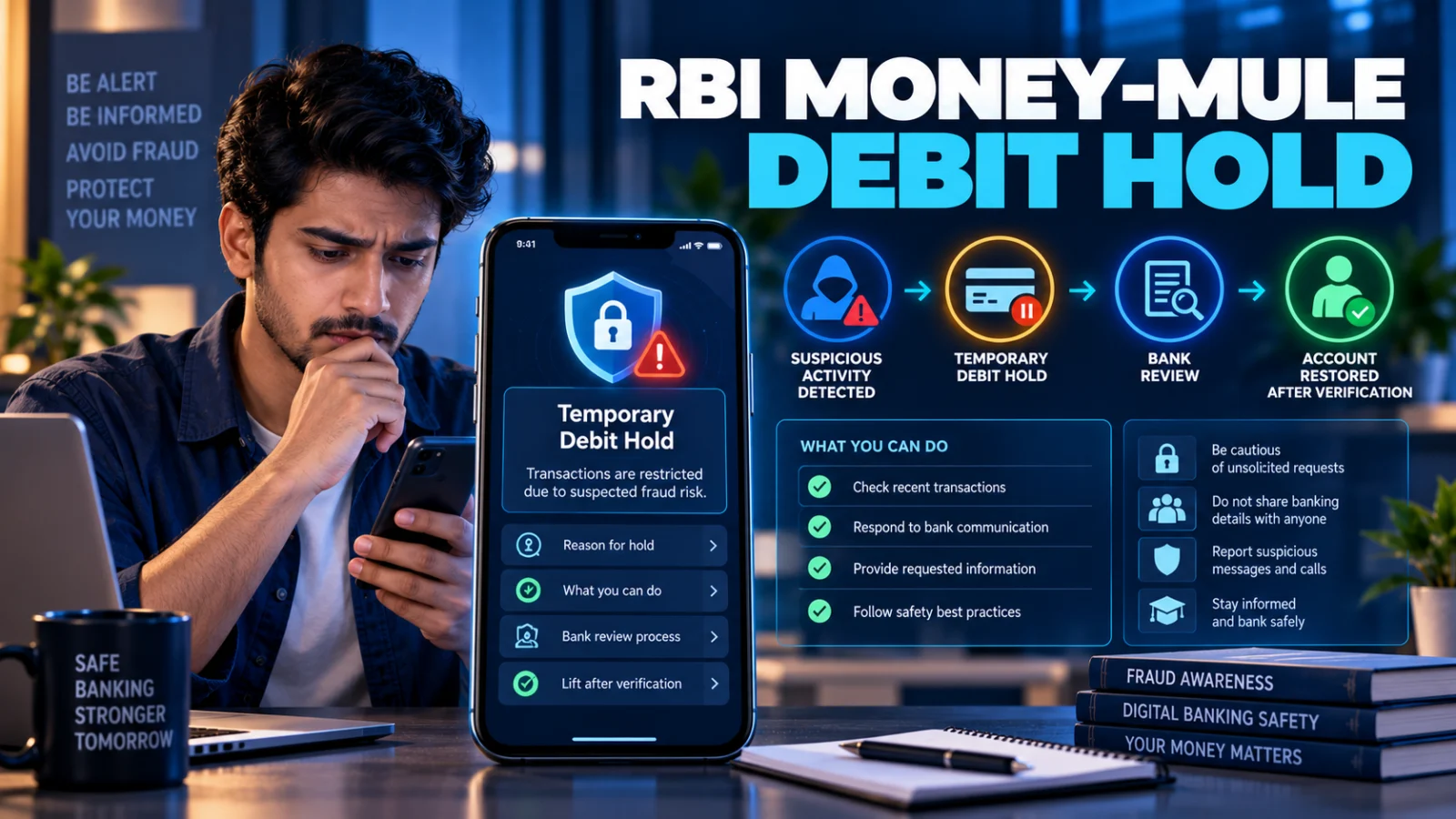
The Reserve Bank of India has proposed a new process for temporary debit holds on money or accounts suspected of being linked to money-mule activity or cyber-enabled financial fraud. The key point for bank customers is that the RBI money mule debit hold framework published in September 2026 is still a draft. It should not be read as a final rule that automatically freezes every suspicious account for 60 days.
Direct answer: RBI has opened consultation on draft KYC amendments that would standardise how covered banks can place temporary debit restrictions in suspected money-mule and cyber-fraud cases. The proposal includes customer-response and bank-review stages, but the final directions have not yet been issued. Existing account restrictions may also be based on other legal or law-enforcement instructions and should not automatically be attributed to this draft.
What RBI changed in September 2026
RBI issued draft amendments to its Know Your Customer directions after the Supreme Court directed the regulator to prepare a standard operating procedure for dealing with money-mule accounts and bank accounts linked to cyber fraud. RBI invited comments on the draft through 2 October 2026 before final directions are issued.
The proposal is important because money-mule investigations can affect people who receive or transfer funds that banks or investigators believe are connected to a fraud chain. A standard process could make the sequence of detection, temporary restriction, customer explanation, bank review and possible law-enforcement referral clearer than an open-ended or inconsistently applied restriction.
Is a new 60-day bank-account freeze already in force?
No. The September document is a draft consultation. Current reporting on the draft describes an overall framework in which a temporary debit hold may continue for up to 60 days in specified circumstances, but that does not mean every account suspected of money-mule activity must automatically be frozen for 60 days.
The final RBI directions may retain, revise or clarify the proposed timelines and conditions. Until those directions are issued, readers should distinguish between what RBI has proposed and the legal or operational basis for an account restriction that already exists today.
Does the ₹1,000 figure mean every larger transaction can be frozen?
No. Current reporting on the draft describes the ₹1,000 threshold in the context of transactions first identified by a bank’s monitoring systems as suspicious. It should not be interpreted as a blanket rule under which every payment or receipt of ₹1,000 or more becomes eligible for an automatic freeze.
The relevant question is not simply the transaction amount. The proposed process is tied to suspected money-mule or cyber-fraud activity and the bank’s detection and review process.
What is a temporary debit hold?
A debit hold restricts outgoing use of the affected amount or account for a period while the suspected fraud link is examined. It is different from saying the money has been permanently confiscated. It is also important to distinguish an amount-specific restriction from an account-level restriction, because the scope and consequence for the customer can be very different.
Detailed reporting on the RBI draft indicates that the proposed framework gives banks a structured route to restrict debits, obtain the customer’s explanation and decide whether the suspicion has been satisfactorily resolved or requires further referral.
What opportunity does the customer get to explain?
Current reporting on the draft says an affected customer would get an opportunity to submit an explanation within the proposed process, with a reported 20-day period for doing so. The bank would then have a further decision period after receiving that explanation.
These timings are part of the draft framework and must not be treated as final statutory promises until RBI issues the final directions. They also may not govern an existing restriction imposed under a police, court or other competent-authority instruction.
If your account is already restricted, identify the controlling process first
1. Ask the bank what exactly is restricted
Request written confirmation of whether the restriction applies to a specific amount, all debit transactions or the entire account.
2. Ask who originated the restriction
Find out whether the bank imposed it through its own fraud-monitoring process or whether it is acting on an instruction from police, a cybercrime authority, a court or another competent authority.
3. Request the available reference and reason
Ask for the complaint, case, reference or internal communication details the bank is permitted to provide. Do not assume the September RBI draft is the controlling authority for an older or already-active restriction.
4. Preserve transaction evidence
Keep bank statements, invoices, payment records, correspondence, identity documents and any material that explains why the disputed funds entered or left the account.
5. Use the route that matches the actual authority
If the issue is a bank decision, use the bank’s grievance process and any applicable RBI complaint route. If police, a cybercrime authority or a court controls the restriction, the appropriate response may instead require communication with that authority or legal assistance.
Why the draft matters even before it becomes final
The proposal tries to resolve a genuine tension. Banks and law-enforcement agencies need to interrupt cyber-fraud fund flows quickly, but innocent customers can suffer serious consequences when their accounts or legitimate funds are caught in those chains. Recent court disputes have also highlighted questions about whether suspicion alone is enough to support broad account restrictions under the existing framework.
That makes the customer-notification, explanation, review and release mechanisms as important as the bank’s ability to act quickly. TPS’s interpretation is that the most useful way to read this draft is as a proposed procedural safeguard as well as a fraud-control measure, not simply as a new freezing power.
Can the public comment on the proposal?
Yes. RBI’s consultation runs through 2 October 2026. The consultation is relevant not only to banks and compliance teams but also to people concerned about how suspected money-mule accounts are identified, how customers are notified, how legitimate funds are protected and how wrongful restrictions are reviewed.
What happens next
After the consultation period, RBI is expected to consider the feedback and issue final amendment directions for the covered categories of regulated entities. The final wording may change the proposed thresholds, timelines, customer-response process, review mechanics or implementation dates.
This page should therefore be treated as a lifecycle article. The same URL should be updated when RBI publishes the final directions or materially changes the proposed process, rather than creating another page for the same reader question.
Verification note
TPS reviewed the RBI press release announcing the draft consultation together with the completed R&D evidence concerning the court context and reported draft mechanics. The confirmed fact is that RBI has issued a draft and opened consultation; detailed operating mechanics remain proposed until the final directions are issued.