





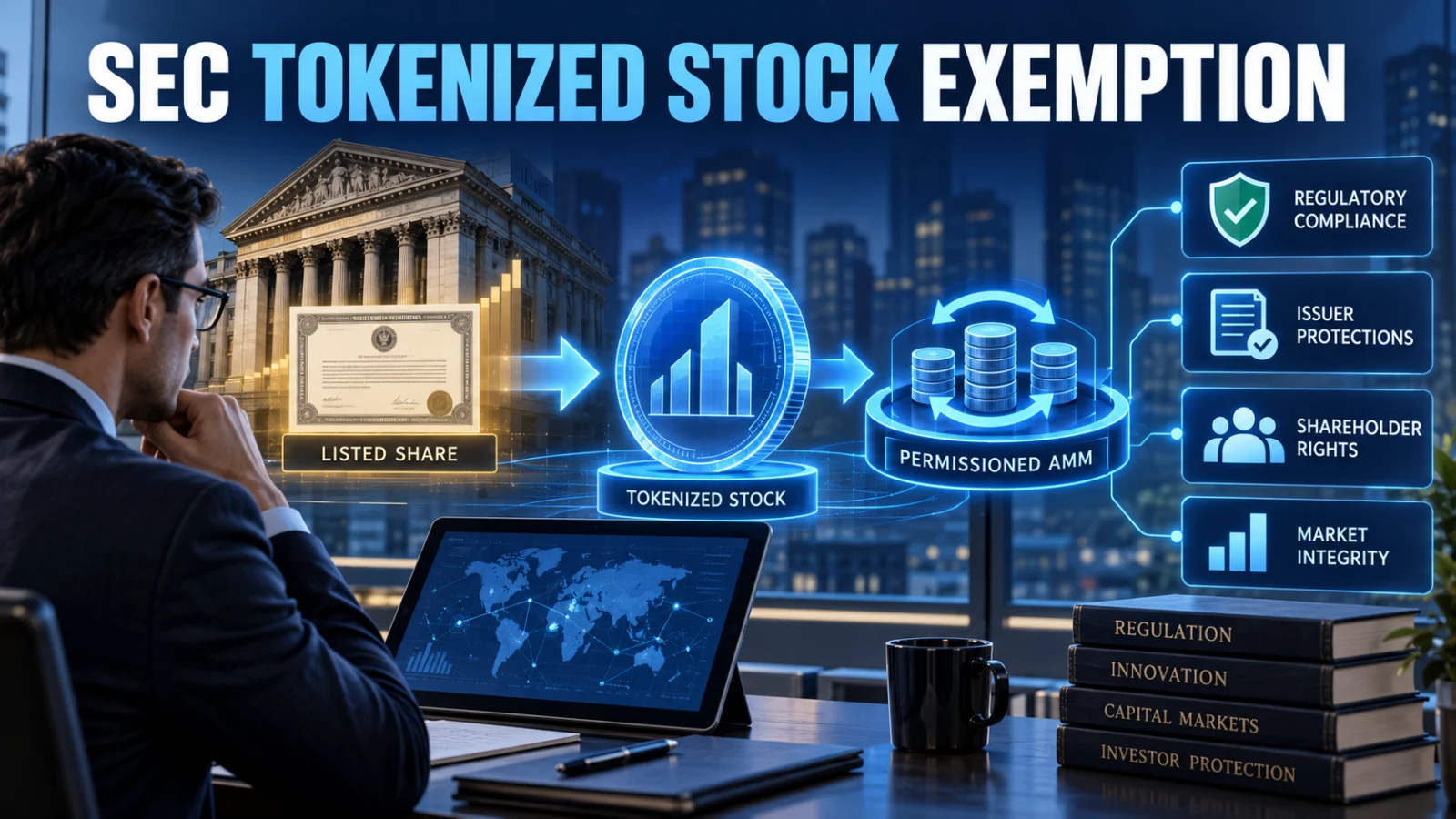
The SEC Tokenized Stock Innovation Exemption creates a temporary, conditional path for qualifying venues to facilitate trading in certain tokenized U.S.-listed stocks without being treated as an exchange under the normal Exchange Act definition, while also giving certain liquidity providers conditional relief from the definition of dealer. The order is significant, but it is much narrower than a general approval of tokenized-stock trading.
The controlling document is SEC Release No. 34-106402, File No. 4-927, issued on September 17, 2026. It establishes specific requirements for Tokenized Securities Venues, or TSVs, and for the tokenized NMS stocks that can trade through permissioned automated-market-maker liquidity pools.
What the SEC Innovation Exemption actually changes
The SEC granted two related forms of temporary conditional relief. First, a qualifying TSV can receive relief from the Exchange Act definition of an exchange while operating within the conditions of the order. Second, certain liquidity providers supplying tokenized NMS stock to an AMM liquidity pool with proprietary capital can receive conditional relief from the definition of dealer.
This does not remove federal securities-law obligations generally. It creates a bounded regulatory pathway for specified activity that satisfies the order’s conditions. The SEC also retains authority to modify the duration or other aspects of the exemptions.
What counts as tokenized NMS stock under the order
The order covers an NMS stock that has been tokenized by or on behalf of the issuer, or a security tokenized by an unaffiliated third party. The token must represent the relevant security rather than merely providing synthetic economic exposure to it.
The SEC specifically distinguishes qualifying Tokenized NMS Stock from third-party crypto assets that represent their own securities and provide synthetic exposure to another security, such as a tokenized linked security or tokenized security-based swap. Rights and warrants are also outside the eligible definition used for this exemption.
That distinction matters because the order should not be summarized as permission for every product marketed as a tokenized stock.
The venue itself must meet strict conditions
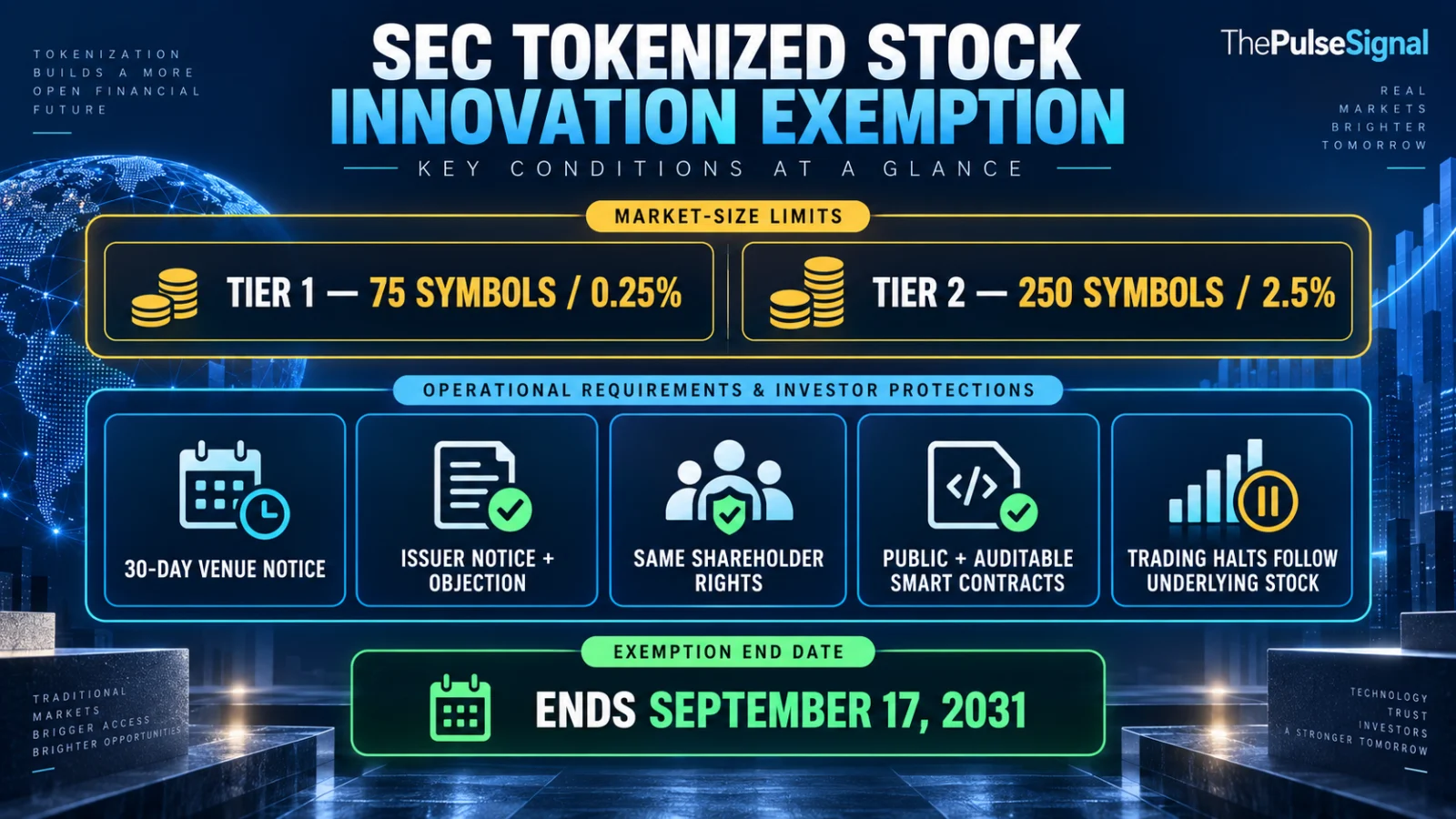
A TSV relying on the exemption must be a U.S. person. Its distributed-ledger applications, including the smart contracts used by the venue, must be auditable and public and must be deployed on a public, permissionless distributed ledger.
The trading environment can still be permissioned: access to the AMM liquidity pools can be restricted to qualifying participants even though the underlying distributed ledger is public and permissionless.
Before operating under the exemption, a TSV must publish a public notice describing its operations. The order requires that notice to be published at least 30 calendar days before the TSV begins operating. Within one business day after publishing the notice, the TSV must notify the SEC that it intends to operate under the exemption and provide contact and notice-location information.
Issuer notice can block an unaffiliated third-party token
When a tokenized NMS stock is created by a third party that is unaffiliated with the issuer of the underlying stock, the TSV must give written notice to that issuer before making the token available for trading.
Trading cannot begin until at least 30 calendar days after the issuer receives that notice. The issuer has an opportunity to object within that period. The exemption therefore does not give an unaffiliated tokenizer an unrestricted right to place a company’s stock into a TSV trading pool regardless of the issuer’s position.
Token holders must receive equivalent shareholder rights
A TSV must verify that a tokenized NMS stock provides holders the same rights and privileges as traditional NMS stock of an equivalent class. The SEC order describes this as including the same underlying company interest, dividend rights, voting rights and residual-asset rights upon liquidation.
This is another important boundary between the SEC framework and products that merely track the price of a stock. The exemption is built around tokenized securities that preserve the economic and governance rights of the equivalent traditional share class.
The SEC imposed symbol and trading-volume limits
The Innovation Exemption is deliberately constrained by both the number of securities a TSV may trade and the volume represented by those securities.
| SEC tier | Maximum symbols | Maximum share-volume level |
|---|---|---|
| Tier 1 Tokenized NMS Stock | 75 symbols | 0.25% of prior-month average daily share volume in the relevant NMS stock |
| Tier 2 Tokenized NMS Stock | 250 symbols | 2.5% of prior-month average daily share volume in the relevant NMS stock |
The SEC ties these calculations to reported trading in the underlying NMS stocks and requires affiliated TSV activity to be considered when calculating relevant limits. These caps are one reason the order is better understood as a controlled market-structure experiment than as unrestricted authorization for onchain trading of the entire U.S. equity market.
Trading halts must follow the underlying stock
A TSV must stop trading a tokenized NMS stock at the same time trading stops in the underlying NMS stock on its primary listing exchange. That includes halts or suspensions in the underlying security.
The requirement is intended to prevent the tokenized version from continuing to trade while the ordinary listed security is unavailable for price discovery because of a halt, suspension, material-news event or similar stoppage.
The exemption is not a primary-offering shortcut
The order does not create a separate route for unregistered primary issuance. Offers and sales of Tokenized NMS Stock still must be registered under the Securities Act or conducted under an available registration exemption, and the TSV exemption does not authorize initial offerings through the venue merely because the security has been tokenized.
For readers evaluating what changed, the useful distinction is therefore between secondary trading infrastructure and the separate legal requirements that govern issuance of securities.
What the liquidity-provider relief means
The second part of the order addresses certain firms that supply tokenized NMS stock to an AMM liquidity pool using proprietary capital. Those firms may engage in activities that otherwise can be indicators of dealer activity, including quoting prices or committing capital.
The SEC grants qualifying firms temporary conditional relief from the Exchange Act definition of dealer for the covered activity. That should not be read as a general exemption from broker-dealer law for every crypto or tokenized-securities business. The relief applies only within the scope and conditions specified by the order.
How long the exemptions last
The controlling SEC order states that the exemptions are effective from September 17, 2026 until September 17, 2031. It also says the Commission may modify the length or another aspect of the exemptions if it determines a change is appropriate under its Exchange Act authority.
The SEC press release describes the relief as temporary and says the exemptions are set to expire five years after publication. For the operative date boundary, TPS is using the explicit dates stated in the order itself: September 17, 2026 through September 17, 2031.
Public comment is open, but TPS did not verify a fixed closing date
The SEC is soliciting public comment on the exemption, including whether the TSV framework should be modified, whether it should eventually become permanent and whether its limits are appropriate. The SEC’s File No. 4-927 page currently provides a mechanism to submit and view comments.
However, the SEC materials reviewed for this article do not state a fixed comment-closing date. TPS therefore does not assign one. Readers or market participants planning to submit comments should verify the current SEC docket before relying on any deadline reported elsewhere.
What this does not mean for investors
- It does not mean every token carrying a stock ticker is now an SEC-authorized tokenized share.
- It does not remove securities-law requirements outside the specific exemptions granted by the order.
- It does not permit synthetic stock exposure to be treated automatically as qualifying Tokenized NMS Stock.
- It does not eliminate issuer rights, trading-halt requirements, public disclosures or volume limits.
- It does not make the temporary framework permanent.
Why the order matters
The SEC has moved from discussing tokenized securities as a developing market structure to establishing a concrete pathway under which qualifying onchain venues can operate. The important story is not simply that tokenized stocks have been ‘allowed.’ The order defines a controlled environment with limits on eligible products, venue structure, issuer participation, shareholder rights, trading volumes, smart-contract transparency, market halts and public disclosure.
For market participants, the practical question is now whether a particular TSV, tokenized stock or liquidity provider actually satisfies those conditions. For issuers, the order creates a formal notice-and-objection mechanism when an unaffiliated third party tokenizes their stock. For investors, the strongest verification question is whether the token represents an eligible security with equivalent shareholder rights rather than synthetic exposure carrying only the economic appearance of a stock.
What happens next
The exemption is already effective under the dates stated in the SEC order, but actual TSV operation requires satisfaction of the order’s conditions, including advance notice. The Commission is also gathering public comments and can later modify the relief. TPS will treat a material SEC modification, permanent replacement framework, significant implementation guidance or verified TSV launch under the exemption as a same-canonical update trigger unless it creates a genuinely different reader job.