






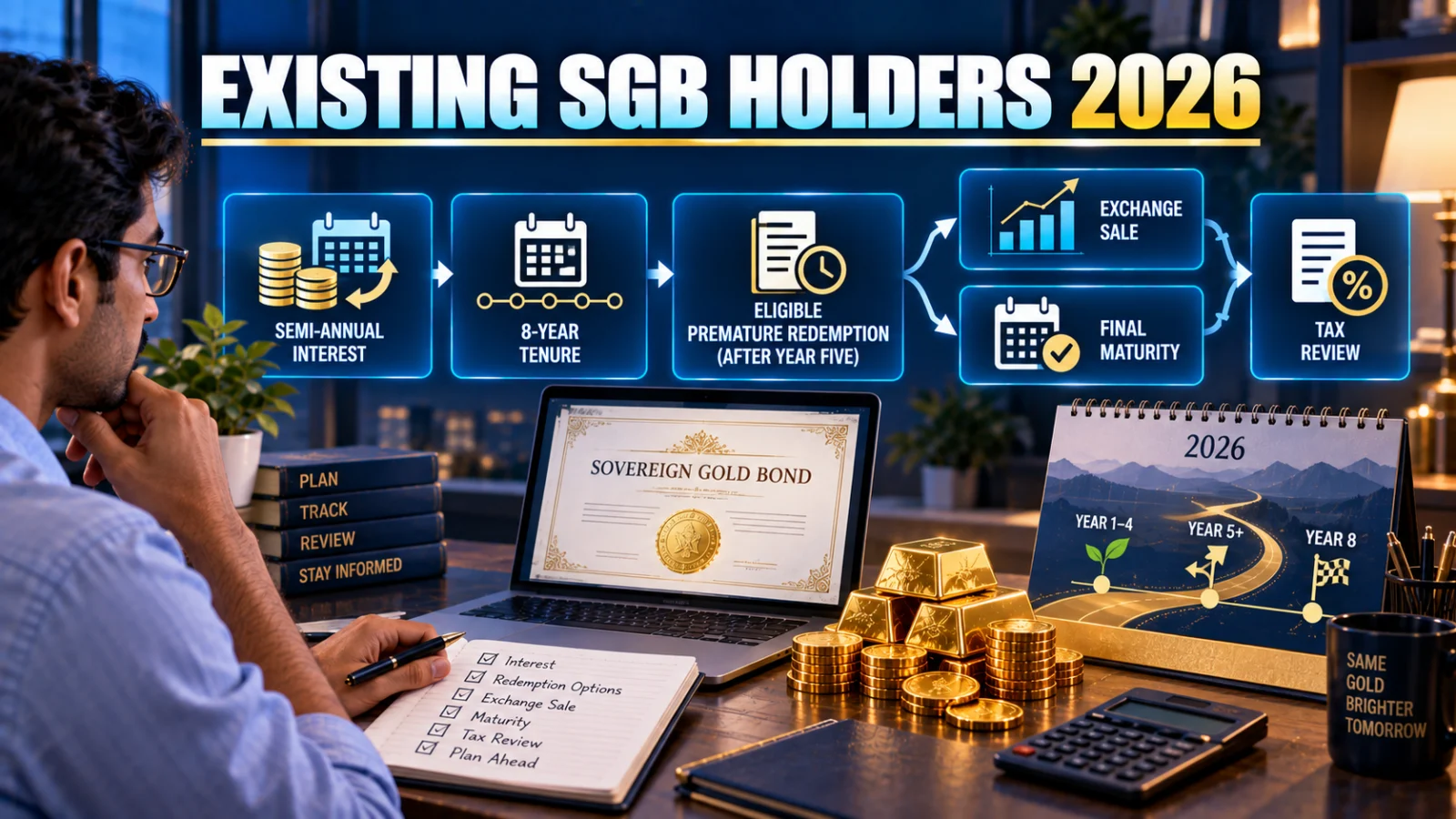
If you already own a Sovereign Gold Bond, the important question in 2026 is not simply whether SGBs are still available. Outstanding bonds are still moving through their normal lifecycle: interest payments, holding periods, RBI premature-redemption windows, exchange trading, final maturity and transmission after a holder’s death.
The biggest practical change for Sovereign Gold Bonds existing holders is that these routes should no longer be treated as interchangeable. The operational process differs, the price you receive can differ, and from 1 April 2026 the capital-gains exemption is materially narrower than the old blanket shorthand that SGB redemption by an individual is tax-free.
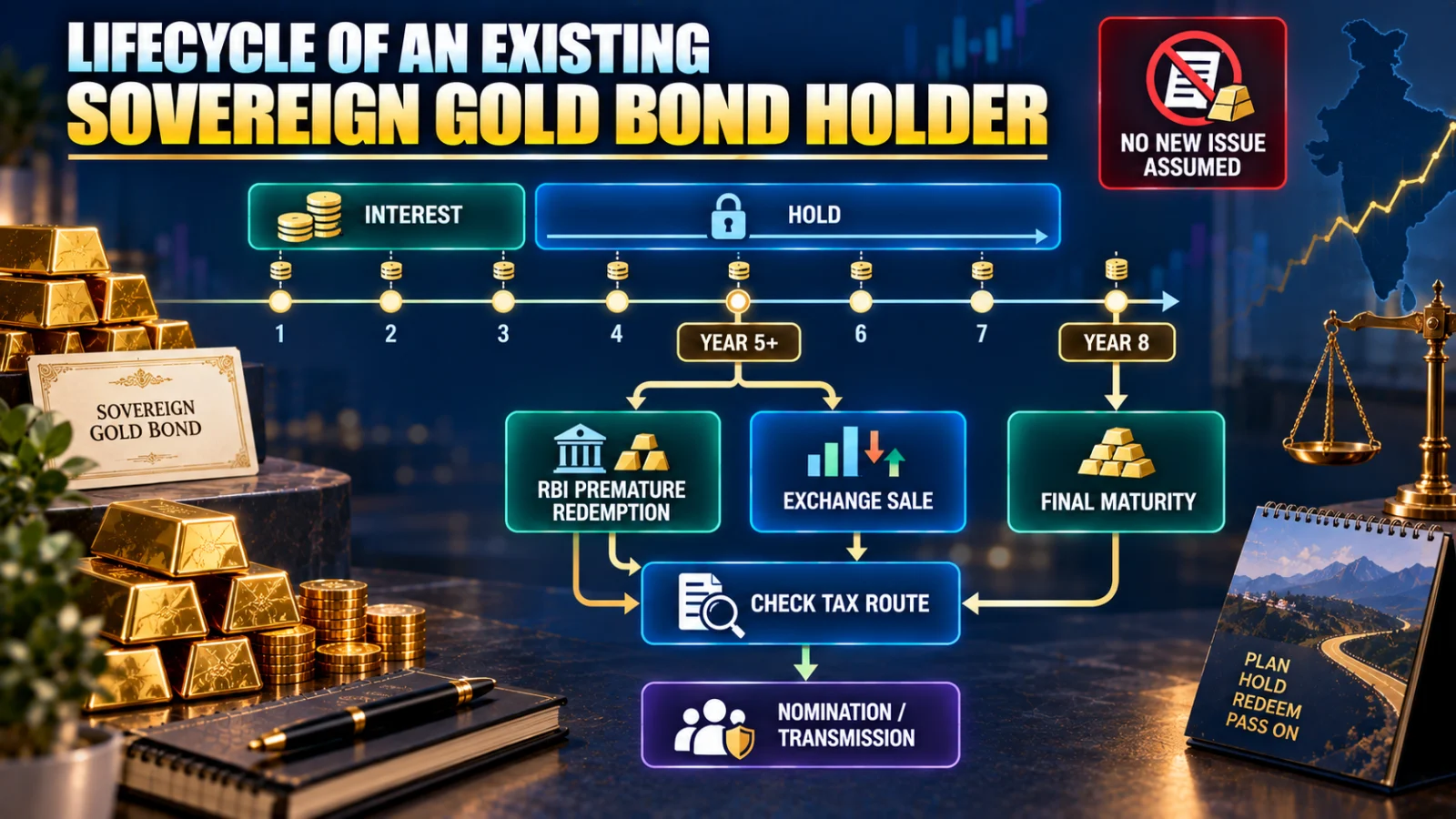
There is also an important boundary: RBI continuing to process outstanding SGB redemptions does not mean a new SGB subscription tranche is currently open. A fresh issue should only be treated as available when the Government or RBI publishes an actual new-issue announcement.
Existing SGB holder decision path
1. Identify your exact tranche
Confirm the issue date, maturity date, coupon terms, holding form and whether you subscribed at original issue or acquired the bond later.
2. Decide whether you are simply continuing to hold
If no exit is needed, the bond continues through its issue-specific interest and maturity schedule subject to the applicable terms.
3. Check RBI premature-redemption eligibility
Premature RBI redemption is generally available only after the fifth year and only on eligible interest-payment dates through the prescribed process.
4. Compare the exchange-sale route separately
A demat-held tradable SGB can potentially be sold on the exchange before maturity, but the transaction uses the market price and available liquidity rather than RBI’s redemption mechanism.
5. Check the tax result before choosing an exit
From 1 April 2026, original subscription and holding until final maturity matter for the statutory capital-gains exemption. Premature RBI redemption and secondary-market acquisition require separate tax analysis.
6. Prepare for maturity or transmission
Keep bank, demat and nomination details current and preserve acquisition records needed for servicing, transfer and tax.
What is still active about Sovereign Gold Bonds in 2026?
Outstanding SGBs remain active government securities even if no fresh subscription issue is currently being offered. RBI continues to publish premature-redemption calendars, tranche-specific redemption notices and final-redemption information for bonds issued in earlier years.
That distinction matters because a reader searching for “SGB 2026” can mean two very different things:
- Existing-holder servicing: interest, premature redemption, exchange sale, maturity or transmission of an outstanding bond.
- New subscription: a new Government SGB issue accepting applications.
This article covers the first job only. It does not state that a new SGB issue is open unless an official Government or RBI announcement establishes that separately.
1. Start with your exact SGB tranche
SGB rules are governed by the scheme framework and the terms of the relevant issue. Before deciding what to do, identify the series or tranche, issue date, maturity date, coupon rate, number of units and the form in which you hold the security.
Also establish how you acquired it. This became especially important after the 2026 tax change because an individual who subscribed at original issue and continuously holds until maturity can be treated differently from someone who bought the same SGB later in the secondary market.
Do not rely only on a broker’s abbreviated instrument name. Keep the issue or holding statement, contract note if bought on exchange, demat records and any RBI or receiving-office communication that identifies the security.
2. How SGB interest works while you hold
SGBs pay an issue-specific fixed rate of interest on the nominal value under the applicable tranche terms. Many later SGB series carry a fixed rate of 2.50% per annum, generally paid half-yearly, but holders should verify the notification for their own tranche rather than applying one coupon rate to every historical SGB.
The interest component is separate from any gain or loss caused by the gold-linked redemption value or an exchange sale.
Interest is also separate from the capital-gains question discussed later. Do not assume that because a maturity redemption may qualify for a capital-gains exemption, the periodic interest itself receives the same treatment.
3. The normal SGB maturity is eight years
The standard SGB structure has an eight-year tenor. If you continue holding until the final maturity date, RBI processes redemption according to the applicable scheme and tranche rules.
The exact maturity date should be checked against the original issue details rather than calculated casually from the calendar year alone.
Holders should make sure the bank or account details connected to the security remain usable before a maturity event. Operational handling can differ according to whether the bond is held through a bank, Stock Holding Corporation of India, post office, recognised stock exchange route or demat account.
4. Premature RBI redemption begins only after year five
One of the most misunderstood SGB rules is the five-year exit facility.
Completing five years does not convert the bond into an anytime-withdrawal product. Under the RBI framework, premature redemption is permitted only after the fifth year and on an eligible interest-payment date, using the applicable request process and submission window.
RBI continues to publish calendars and tranche-specific notices identifying which outstanding bonds become eligible.
If your SGB has crossed five years, check the current RBI calendar for the exact series rather than assuming that a redemption request can be made on any trading day.
How RBI premature-redemption price is determined
RBI does not use the exchange’s last traded price to determine its official SGB redemption value.
Under the SGB framework, the redemption price is linked to the prescribed average closing price of 999-purity gold published by the India Bullion and Jewellers Association for the relevant preceding business days specified by the scheme or notice.
RBI therefore publishes a rupee redemption value per SGB unit for the eligible tranche.
That price is an official redemption value under the Government-security mechanism. It is not a recommendation that the holder should exit.
5. Exchange sale is a different exit route
If an SGB is held in tradable form and is available on a recognised stock exchange, a holder may be able to sell it in the secondary market instead of waiting for RBI premature redemption or final maturity.
An exchange sale is a market transaction. The price comes from actual buyers and sellers, so it can differ from both the underlying gold-linked value and the amount RBI would calculate for an official redemption event.
Liquidity can also vary by SGB series. Some tranches may trade infrequently or with a wider difference between the best available buy and sell prices.
Before selling, check the current market price, available quantity and spread. Do not assume the displayed last traded price is automatically available for the full quantity you want to sell.
RBI redemption versus exchange sale
| Route | When it can happen | How price is determined | Main issue to verify |
|---|---|---|---|
| Continue holding | Until a later eligible exit or maturity | No exit price yet | Interest, maturity date and holder records |
| RBI premature redemption | After year five on eligible interest-payment dates | RBI-prescribed gold-price averaging method | Eligibility window and 2026 tax consequence |
| Exchange sale | When the security is tradable and a market exists | Exchange market price | Liquidity, spread, sale price and capital-gains treatment |
| Final maturity | At the end of the tranche’s normal tenor | RBI maturity-redemption mechanism | Acquisition route and eligibility for the current tax exemption |
6. The 2026 SGB tax change matters before you choose an exit
This is the part where older articles can now be materially misleading.
From 1 April 2026, the capital-gains exemption on SGB redemption is restricted under the current Income Tax framework to an individual who subscribed to the Sovereign Gold Bond at original issue and continuously holds it until redemption on maturity.
That means the older simplified sentence “SGB redemption is tax-free for individuals” should not be used without qualification.
| Holder / exit route | Current capital-gains exemption position after 1 April 2026 |
|---|---|
| Individual original subscriber who continuously holds until final maturity | Qualifying maturity redemption can receive the statutory exemption, subject to the current conditions |
| Original subscriber using RBI premature redemption after year five | The maturity-redemption exemption does not apply |
| Person who acquired the SGB in the secondary market and later receives RBI redemption | The original-issue maturity exemption does not apply |
| Holder who sells the SGB on exchange | The maturity-redemption exemption does not apply; the sale requires normal capital-gains analysis under the current law |
The precise tax calculation outside the exemption can depend on the acquisition date, cost, holding period, taxpayer status and the law applicable to the transaction. TPS does not calculate an individual holder’s tax liability in this article.
If you need the broader gold-tax framework, TPS also covers it separately at Gold tax in India.
Why acquisition route now matters so much
Two investors can hold units of the same SGB series but have different tax outcomes because one subscribed directly at issue and the other bought later on the exchange.
For the current maturity exemption, the holder should therefore preserve evidence showing whether the SGB was acquired at original issue and whether the holding remained continuous until maturity.
Useful records can include the original subscription confirmation, certificate or demat credit, contract notes for any secondary-market purchase, account statements and later redemption or sale documentation.
7. Should an eligible holder take premature redemption?
Eligibility does not automatically mean redemption is the correct decision.
An existing holder may compare several factors:
- whether cash is actually needed,
- the current RBI redemption value,
- the live secondary-market price and liquidity,
- remaining coupon payments,
- time left until final maturity, and
- the tax consequence of leaving before maturity.
There is no universal answer. A holder who needs liquidity can face a different decision from an original subscriber who does not need the money and is close to a potentially qualifying final maturity.
The 2026 tax rule makes this comparison more important because premature RBI redemption and final maturity are no longer safely treated as equivalent tax events.
8. What happens if you simply hold until maturity?
If you continue holding, the SGB remains subject to its tranche terms until final redemption. Interest continues according to the issue conditions until the applicable final stage.
Closer to maturity, verify:
- the exact maturity date,
- the number of units shown in your records,
- your current bank and demat details where applicable,
- nomination information, and
- whether your acquisition history supports the current maturity exemption.
Do not wait until after maturity to discover that the bank account or identity details attached to an old holding need correction.
9. What if the SGB holder dies?
SGBs include nomination and transmission mechanisms under the Government Securities framework. The practical process depends on the holding form and whether a valid nominee or other succession documentation exists.
Operational transmission to a nominee or successor should not automatically be treated as a universal ruling on ultimate beneficial ownership. Estate rights can depend on the will and applicable succession law.
For a deceased holder, preserve the bond records, nomination details, death documentation and the acquisition history because the successor may also need those records for future servicing or tax analysis.
10. What if your SGB was bought in the secondary market?
Secondary-market SGBs can provide exposure to an outstanding Government bond without participating in its original issue, but the buyer inherits the remaining lifecycle of that particular tranche rather than receiving a new eight-year term.
Check the original issue and maturity dates before buying or evaluating an existing position.
The 2026 tax rule is particularly important here: a secondary-market buyer should not assume that holding the bond until RBI redeems it creates the same exemption available to an eligible individual original subscriber held continuously to maturity.
Exchange acquisition cost and transaction records therefore need to be preserved.
11. Is there a new SGB issue in 2026?
RBI processing premature or final redemption of older SGB tranches is not evidence that a fresh subscription window is open.
TPS did not verify a current new-issue announcement in the RBI material reviewed for this article. Readers should not treat old subscription pages, bank product pages or redemption news as proof of a new tranche.
If the Government or RBI announces a fresh issue later, that becomes a separate prospective-buyer question and should be assessed from the new official notification.
What records should an existing holder keep?
For a long-lived product such as SGB, recordkeeping matters because tax and servicing decisions can occur many years after the original investment.
Keep:
- the series or tranche identification,
- original subscription evidence or secondary-market contract note,
- issue and maturity dates,
- demat or certificate records,
- interest credits where needed for tax records,
- nomination details,
- premature-redemption request and payment records if used, and
- exchange sale or final-redemption documentation.
A practical check before any SGB exit
Identify
Confirm the exact tranche, acquisition route, units and maturity date.
Check eligibility
If considering RBI premature redemption, verify the current RBI calendar and request window.
Compare routes
Separate RBI redemption from exchange sale and check the actual price and liquidity available under each route.
Check tax
Determine whether you are an original subscriber, whether the holding has remained continuous and whether the planned exit is final maturity, premature RBI redemption or market sale.
Check records
Make sure bank, demat, nomination and acquisition documentation are current and available.
Then decide
Choose based on your liquidity need, remaining holding period, market conditions and verified tax consequence rather than simply because an RBI redemption window has opened.
Bottom line
For Sovereign Gold Bonds existing holders, 2026 is primarily a servicing and decision year, not proof of a fresh subscription cycle.
The SGB lifecycle has several distinct branches: receive the issue-specific interest and keep holding, use an eligible RBI premature-redemption window after year five, sell a tradable bond on exchange, continue to final maturity, or complete nomination and transmission if the holder dies.
The most important current distinction is tax. From 1 April 2026, the capital-gains exemption is restricted to an eligible individual who subscribed at original issue and continuously holds the bond to final maturity. Premature RBI redemption, secondary-market acquisition and exchange sale should not be placed under the old blanket tax-free description.
Before acting, identify the tranche, acquisition route and exit route first. Those three facts determine which RBI process, market mechanics and tax rules you actually need to verify.