







Gold tax in India is not determined only by how much the gold price has risen. The tax outcome can change depending on whether you own physical gold, a listed Gold ETF, a gold mutual fund or fund of funds, or a Sovereign Gold Bond, as well as how long you held it and how you exit.
That means two investors can earn a similar gross gold return but keep different amounts after tax. Under the current 2026 framework, the most important questions are: What exactly do you own? Is it listed or unlisted? How long have you held it? Does a special exemption apply? And are you selling, redeeming or holding to maturity?
Gold tax in India: the current comparison
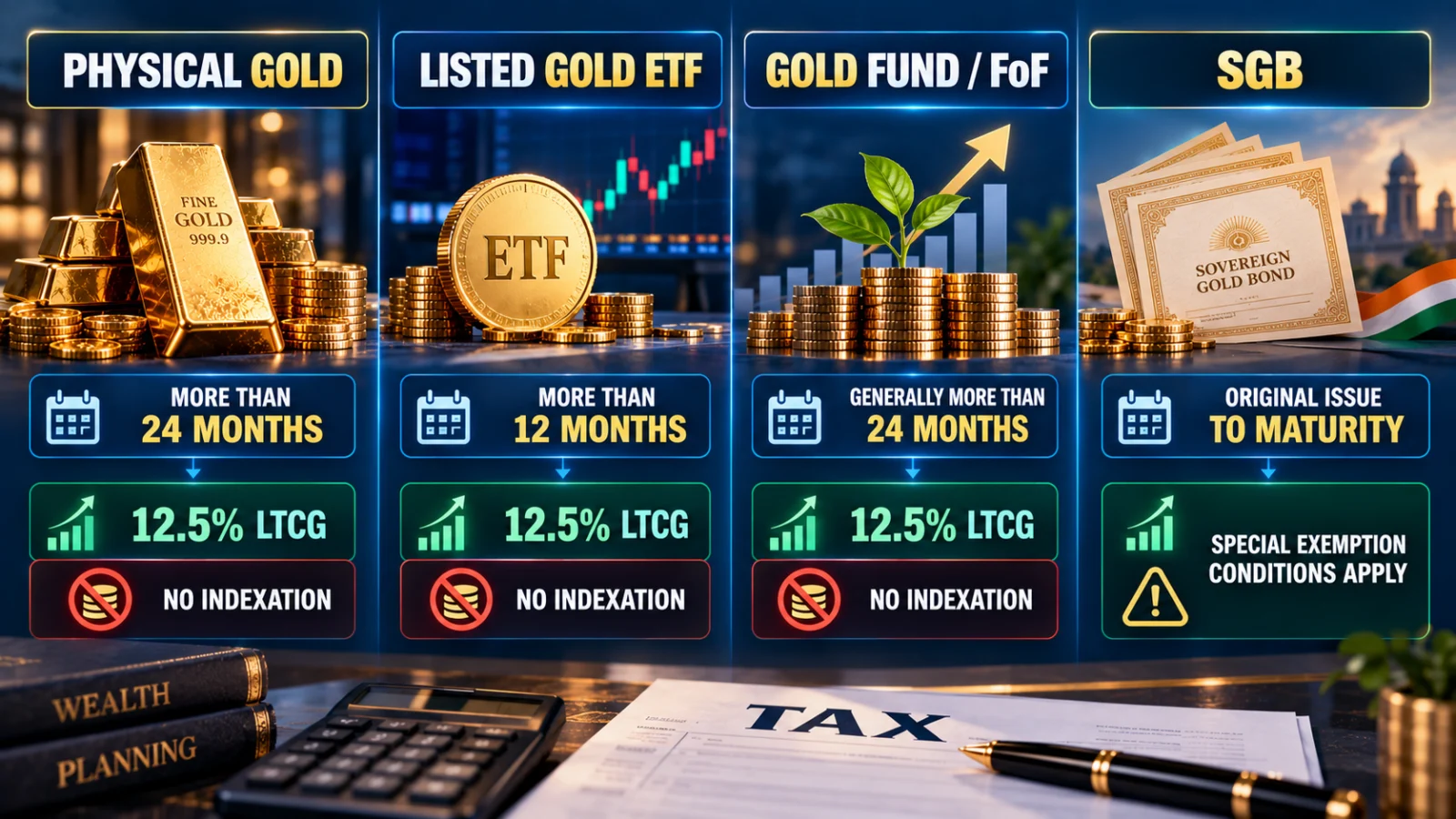
| Gold route | When it generally becomes long-term | Broad current treatment |
|---|---|---|
| Physical gold, including jewellery, coins and bars | More than 24 months | Long-term capital gains are generally taxed at 12.5% without indexation; shorter holdings generally fall under applicable normal rates. |
| Listed Gold ETF units | More than 12 months | Long-term capital gains are generally taxed at 12.5% without indexation; shorter holdings generally fall under applicable normal rates. |
| Conventional unlisted gold mutual fund or Gold ETF FoF units not caught by Section 50AA | Generally more than 24 months | Long-term capital gains are generally taxed at 12.5% without indexation; shorter holdings generally fall under applicable normal rates. |
| SGB held by an individual from original issue continuously until maturity | Special route | Qualifying capital gain on maturity redemption is exempt under the current special rule. |
| SGB bought in the secondary market or exited before maturity | Depends on the actual transaction route | The special maturity exemption does not apply; the disposal must be tested under the applicable capital-gain rules. |
These are broad current classifications for the reader decision. Final tax can still depend on taxpayer status, losses or set-offs, surcharge, cess, acquisition history and other facts.
How is physical gold taxed?
For physical gold such as jewellery, coins and bars, the current long-term holding threshold is generally more than 24 months.
If the holding period does not cross that threshold, the gain is generally treated as short-term and taxed at the taxpayer’s applicable normal rate. If it is long-term, the current general capital-gain framework applies a 12.5% rate without indexation.
This is an important change from older explanations that still refer to the former longer holding period or older indexation-based treatment. A current sale should be tested under the law that applies to that transfer, not an outdated gold-tax table.
Does physical gold still get indexation?
Under the current general framework for gold, long-term gains are taxed at 12.5% without indexation. The special transition relief retained for certain land or building cases should not be treated as a general physical-gold indexation option.
So if you are comparing a current physical-gold sale with an older article that says “20% with indexation,” verify the current transfer-date rules before relying on it.
How is a listed Gold ETF taxed?
A listed Gold ETF has a different holding-period clock from physical gold.
Under the current listed-security framework, listed Gold ETF units generally become long-term after more than 12 months. Long-term gains are generally taxed at 12.5% without indexation, while a shorter holding is generally taxed at the applicable normal rate.
This shorter long-term threshold can change the after-tax comparison between a listed Gold ETF and physical gold even when both provide exposure to the same underlying metal.
Does the ₹1.25 lakh equity LTCG exemption apply to Gold ETFs?
Do not assume it does merely because a Gold ETF trades on an exchange.
The special Section 112A framework and its equity-oriented long-term capital-gain threshold apply to specified equity-oriented assets. A Gold ETF is not automatically entitled to that equity-specific exemption simply because its long-term rate is also 12.5%.
This is one of the easiest tax comparisons to get wrong: same headline LTCG rate does not mean same tax section, exemption or asset classification.
How are gold mutual funds and Gold ETF FoFs taxed?
This area requires particular care because older explanations can now be stale.
From 1 April 2026, Section 50AA’s definition of a specified mutual fund was narrowed toward funds investing predominantly in debt and money-market instruments, including funds investing predominantly in such debt-oriented funds.
That means an ordinary gold fund or Gold ETF FoF should not automatically be treated under the old broad rule merely because it is a non-equity fund. The actual scheme structure must be checked against the current Section 50AA definition.
For a conventional unlisted gold-fund or Gold ETF FoF that is not caught by Section 50AA, the general long-term threshold is typically more than 24 months. A holding at or below that threshold is generally short-term.
TPS explains the structural difference between these products separately in Gold ETF vs Gold Mutual Fund in India: Which Structure Are You Actually Buying?. For tax, the critical distinction is that a listed ETF and an unlisted FoF can have different long-term clocks.
Why old Section 50AA articles can now mislead gold investors
From April 2023, many non-equity mutual-fund discussions focused on Section 50AA and slab-rate taxation. That historical explanation should not simply be copied into a 2026 gold-tax article.
The current definition effective from 1 April 2026 is narrower. The correct process is therefore:
- identify the exact scheme;
- check whether the units are listed or unlisted;
- check whether the scheme falls within the current Section 50AA definition;
- then apply the relevant holding-period and capital-gain rules.
Tax classification should follow the current legal structure, not the product’s marketing label alone.
How are Sovereign Gold Bonds taxed after the 2026 change?
SGBs require a separate test because the current law contains a special capital-gain exemption with specific conditions.
From 1 April 2026, the special exemption at maturity applies where an individual subscribed to the SGB at original issue and held it continuously until maturity.
That means the statement “SGB maturity is tax-free” is now incomplete unless those conditions are checked.
Original subscriber who holds until maturity
If an individual subscribed at the original issue and continuously holds the SGB until maturity, the qualifying capital gain on that maturity redemption is exempt under the current rule.
Secondary-market buyer
If an investor buys the SGB later on the secondary market, the special maturity exemption does not apply under the amended rule, even if that investor eventually holds the security until maturity.
Premature redemption
If the original subscriber exits through a permitted premature redemption before maturity, the current special maturity exemption does not apply because continuous holding until maturity is one of the conditions.
The taxable outcome must then be determined from the actual transaction and applicable capital-gain rules rather than assuming every SGB exit receives the same treatment.
SGB interest and SGB capital gain are different tax questions
The SGB capital-gain exemption at qualifying maturity should not be confused with the periodic interest paid on the bond.
SGB interest remains a separate income component under the product’s current tax framework. An exempt qualifying maturity gain does not make the periodic interest automatically tax-free.
When comparing SGBs with other gold routes, keep these two streams separate: interest income and capital gain or redemption gain.
What happens with inherited or gifted gold?
Inheritance or qualifying gift situations can carry forward important history from the previous owner.
For capital-gain computation on a later sale, Income Tax Department guidance allows the previous owner’s cost and holding period to become relevant in specified inheritance or gift routes. That means the recipient does not necessarily start with a fresh acquisition clock or today’s market value merely because ownership changed without a purchase.
However, the tax treatment of receiving a gift is a separate question from the later capital gain and can depend on the relationship between the parties and other statutory conditions. This article does not attempt to replace a taxpayer-specific gift-tax analysis.
GST on buying gold is not the same as capital-gains tax
Purchase-time GST and later income-tax on a capital gain are different layers.
A jewellery purchase can include GST and other transaction costs at the time of purchase. Capital-gains tax becomes relevant when a taxable gain is realised on a later transfer or redemption.
Do not combine them into one percentage or assume purchase GST determines the later capital-gain rate.
Why the same gold return can produce a different after-tax result
Suppose two gold investments experience the same percentage increase in underlying value. The after-tax outcome can still differ because the investor may cross the long-term threshold earlier in one vehicle than another or qualify for a special exemption in one route but not another.
That is why the correct comparison is not only:
Purchase value → sale value → gross return.
For a real investment comparison, the sequence is:
Gold vehicle → acquisition date and route → holding period → tax classification → disposal or redemption route → taxable gain → after-tax proceeds.
TPS covers the broader return calculation separately in How to Calculate Gold Returns in India: CAGR, Inflation, Costs and Tax. This page owns the tax classification that feeds that calculation.
Current decision checklist
- Physical gold: check whether the holding exceeded 24 months.
- Gold ETF: confirm that the units are listed and check the 12-month threshold.
- Gold fund or FoF: confirm whether the scheme is listed or unlisted and whether current Section 50AA applies.
- SGB: identify whether you subscribed at original issue, bought on the secondary market, are selling on exchange, redeeming early or holding to maturity.
- Gift or inheritance: establish the previous owner’s cost and holding history where the law requires it.
- Final liability: account for taxpayer-specific facts such as losses, slab rate, surcharge, cess and residential status before treating a broad comparison rate as your actual payable tax.
Bottom line
Gold tax in India depends on how you own the gold, how long you hold it and how you exit.
Under the current 2026 framework, physical gold generally uses a 24-month long-term threshold, listed Gold ETFs generally use a 12-month threshold, and conventional unlisted gold funds or FoFs not caught by current Section 50AA generally use a 24-month threshold.
SGBs are the important special case: the current maturity exemption is no longer a blanket rule. It depends on an individual subscribing at original issue and holding continuously until maturity.
So when comparing gold investments, do not stop at the gross return. First identify the legal route, then calculate what remains after the tax rules that actually apply to that route.