




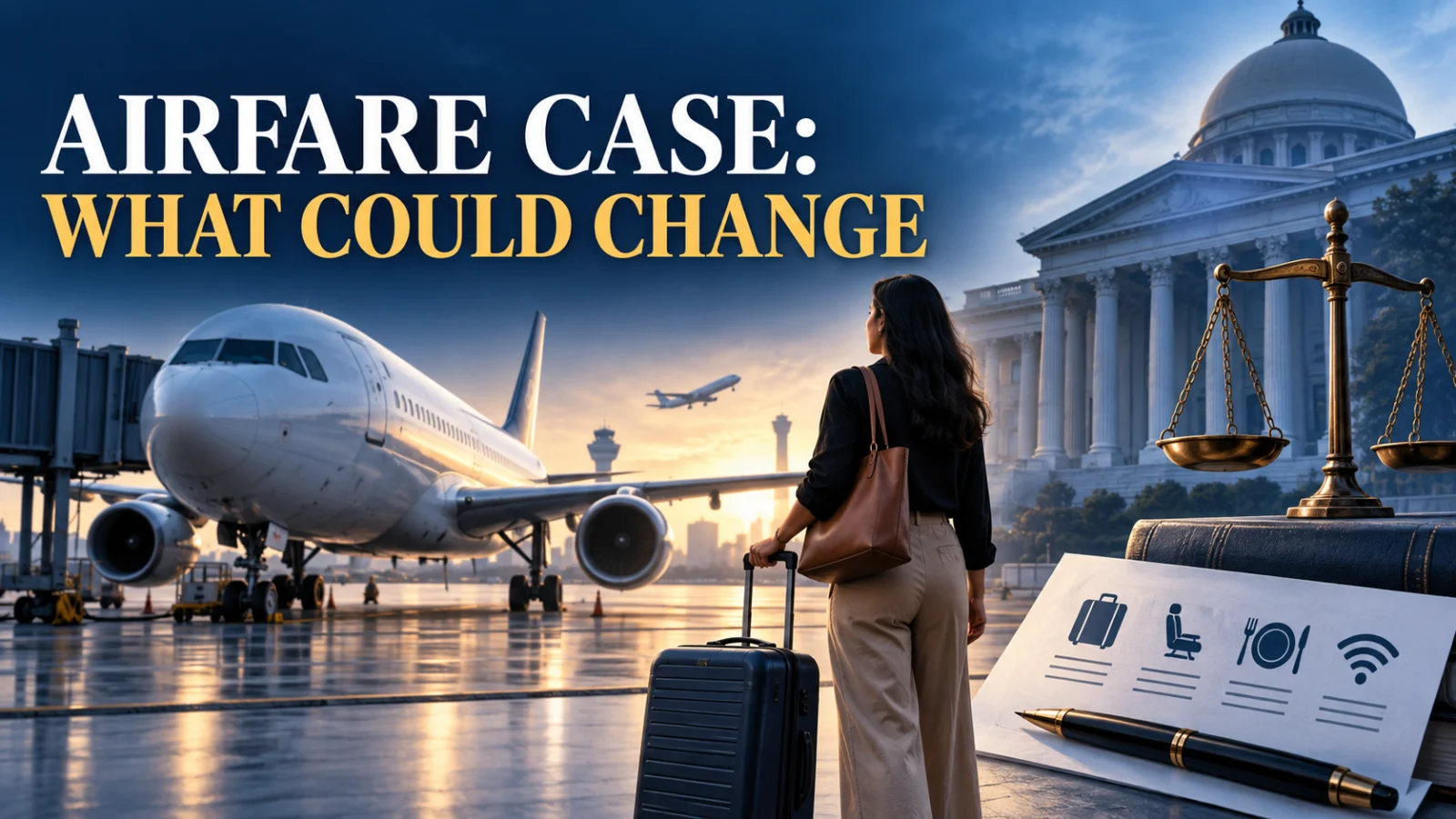
The Supreme Court airfare case 2026 has not yet produced a verified nationwide fare cap, new baggage entitlement or binding restriction on airline ancillary charges. The case is important because it sits at the centre of a broader question: how far can the government and aviation regulator control airline pricing, and what legal framework must exist before those controls become binding?
For passengers, the most important distinction is between what the Court is considering and what the law currently requires. Courtroom observations, government assurances and draft rules can signal where policy is moving, but they do not automatically create a new passenger right.
Current status of the Supreme Court airfare case
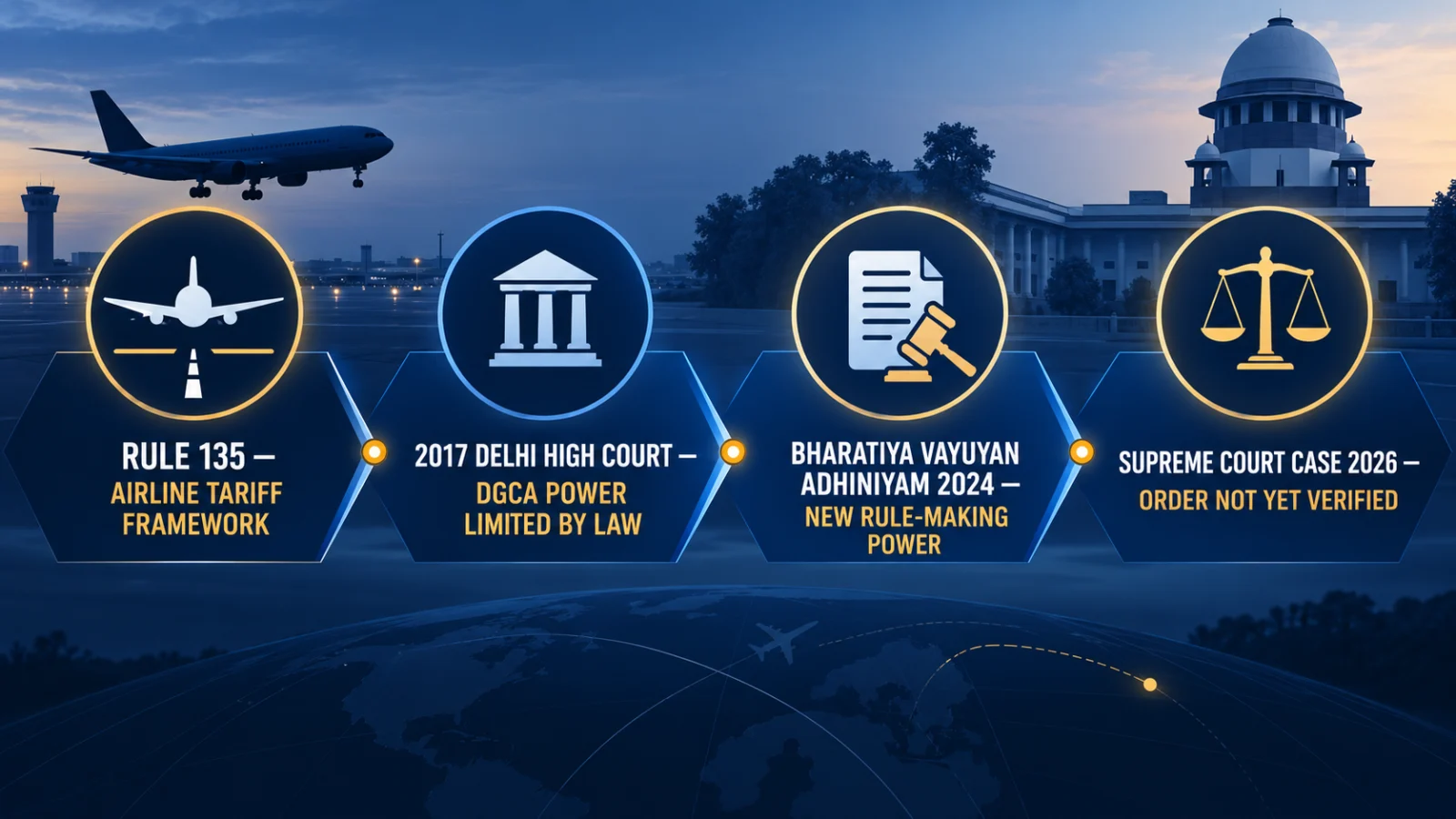
W.P.(C) No. 1124/2025, S. Laxminarayanan v. Union of India & Ors., concerns unpredictable airfares and airline ancillary charges. The matter was listed for September 7, 2026. As of the latest evidence reviewed for this article, TPS has not verified a September 7 operative order that imposes a general airfare ceiling, fixes baggage charges, bans dynamic pricing or creates a new nationwide passenger entitlement.
What is the Supreme Court being asked to examine?
The litigation challenges the existing position in which airline fares can fluctuate significantly according to commercial factors while passengers can also face additional charges for services outside the base fare. The petition has raised concerns around unpredictable pricing, ancillary fees and the adequacy of the regulatory framework protecting passengers.
The case therefore has two connected questions. The first is whether the current system gives regulators enough power to intervene when airline tariffs become excessive, predatory or otherwise problematic. The second is whether the government must create clearer rules for fares and ancillary charges under the newer aviation law.
Does India currently have a general airfare cap?
No general permanent nationwide fare cap was established in the evidence reviewed for this article. India’s historical airfare framework has largely allowed airlines to establish their own tariffs, subject to statutory requirements and regulatory oversight.
Under Rule 135 of the Aircraft Rules, 1937, airlines establish tariffs after considering factors such as operating costs, service characteristics, reasonable profit and prevailing tariffs. Airlines are also required to publish their tariffs.
That does not mean the regulator is powerless. The same framework has allowed DGCA intervention where the authority is satisfied that a tariff is excessive or predatory or that an airline has engaged in oligopolistic practice. The important legal point is that regulatory intervention must rest on the authority granted by the governing law and rules.
Why the 2017 Delhi High Court baggage case matters
A key historical case for understanding the current dispute is the Delhi High Court’s 2017 decision in Federation of Indian Airlines v. Directorate General of Civil Aviation.
That litigation concerned regulatory limits on excess-baggage charges. The Court treated baggage charges as part of airline tariff and economic regulation. It held that DGCA could not simply fix those charges through the circular challenged in that case without sufficient legal authority and satisfaction of the statutory framework governing tariff intervention.
At the same time, the judgment did not erase the regulator’s targeted power under Rule 135. It recognised that intervention could still occur where the conditions for excessive, predatory or oligopolistic pricing were legally established.
This is directly relevant to the current Supreme Court case. The issue is not merely whether high fares or baggage fees feel unfair; it is also which authority has the legal power to control them, through which instrument and under what conditions.
What changed with the Bharatiya Vayuyan Adhiniyam, 2024?
The Bharatiya Vayuyan Adhiniyam, 2024 creates a newer statutory framework for civil aviation. One important feature is its rule-making power for the economic regulation of civil aviation and air transport, including approval, disapproval or revision of operators’ tariffs.
This matters because the government can now build a more explicit rules framework around tariff regulation under the new Act. The current Supreme Court proceedings have repeatedly intersected with the government’s work on those rules.
How did the current Supreme Court case reach this point?
The case has developed over several hearings rather than through one final verdict.
November 2025: Supreme Court seeks responses
The Supreme Court issued notice in the PIL challenging unpredictable airfare pricing and ancillary charges and sought responses from the government and aviation authorities.
January 2026: Court flags fare spikes
The Court publicly expressed concern over sharp ticket-price increases around major travel periods and events. Those observations showed judicial concern but did not themselves establish a permanent fare ceiling.
February 2026: government says issue is under consideration
An official Supreme Court order recorded the Union government’s position that the issue was receiving serious attention from the Ministry of Civil Aviation and that further deliberation was taking place.
May 2026: rules still being prepared
The Court recorded that rules under the Bharatiya Vayuyan Adhiniyam, 2024 were being prepared. The petitioner also raised the question of how the previous aviation rules would operate during the transition.
July 2026: Centre says rules have been framed
The Centre subsequently told the Court that airfare-related rules had been framed and would be placed before the appropriate process. The Court sought the relevant material.
August 2026: draft rules reviewed
The Court then considered the developing rules framework. The government sought additional time to finalise the rules. Reporting from that hearing also recorded strong judicial remarks about airline compliance with government directions, but those remarks should not be confused with a final passenger-rights judgment.
September 7, 2026: current hearing checkpoint
The matter was listed again for September 7. At the time of this article’s final source review, TPS had not verified an operative September 7 order changing the national fare or ancillary-charge rules.
What does this mean for airline passengers today?
Passengers should not assume that the Supreme Court case has already created a right to a capped ticket price, a fixed baggage charge or a refund of every high-priced ticket.
The current legal position remains more nuanced:
- Airlines operate within a tariff framework rather than a permanent universal fare ceiling.
- DGCA has regulatory and monitoring powers, but economic intervention must be grounded in valid statutory authority and applicable rules.
- Existing fare and ancillary-charge disputes do not automatically become unlawful merely because the current Supreme Court case is pending.
- A new passenger right will depend on the actual wording of an operative Supreme Court order, final government rules or subsequent regulator guidance.
Could the Supreme Court itself impose a fare cap?
The Court can issue directions within the case before it, but TPS cannot predict the form of any eventual order. The final outcome could range from procedural directions to the government, to scrutiny of the new rules, to a more substantive judgment on the adequacy of the passenger-protection framework.
Until the operative text is available, it would be unsafe to claim that a fare ceiling, ancillary-fee cap or mandatory pricing formula is coming.
What could change if final aviation rules are issued?
The most important future questions are not simply whether rules exist, but what they actually require. TPS will look for provisions covering:
- how airline tariffs must be published or disclosed;
- whether particular ancillary charges are regulated;
- whether baggage charges receive specific treatment;
- whether government or DGCA can approve, reject or revise tariffs;
- what evidence is required before regulatory intervention;
- whether any new passenger-facing remedy is created;
- which authority enforces the rules;
- when the rules become effective.
How is this different from the competition-law case involving IndiGo?
A separate competition-law track has also examined airline-market conduct involving InterGlobe Aviation, the operator of IndiGo. The Competition Commission of India has handled that matter under competition law.
That case should not be treated as controlling the Supreme Court airfare PIL. Competition law asks different questions about market power and anti-competitive conduct, while the Supreme Court case and aviation rules concern the statutory framework governing fares, ancillary charges and aviation regulation.
The two tracks are useful together only as evidence that airline pricing is being examined through more than one legal route.
Why this case matters even before a final verdict
The current case connects three layers that are often reported separately: India’s historically market-driven airfare framework, judicial limits on how regulators can impose economic controls, and the government’s new rule-making authority under the Bharatiya Vayuyan Adhiniyam, 2024.
That is why the eventual outcome could matter beyond one court hearing. A meaningful order or final rules could clarify not only whether fares are monitored, but how and when the government can intervene in airline pricing and additional passenger charges.
What would make this article materially change?
This page should be updated immediately if an official source establishes any of the following:
- a Supreme Court direction requiring a specific fare or ancillary-charge rule;
- a final judgment deciding the substantive airfare-regulation dispute;
- a new fare disclosure or pricing requirement;
- a restriction or ceiling on a specific ancillary charge;
- a new baggage entitlement or fee rule;
- final rules under the Bharatiya Vayuyan Adhiniyam, 2024;
- an effective date or implementation order from MoCA or DGCA.
Verification note
ThePulseSignal reviewed the current Supreme Court cause-list position, prior Supreme Court orders in the litigation, the historical Rule 135 tariff framework, the 2017 Delhi High Court baggage-tariff judgment, provisions of the Bharatiya Vayuyan Adhiniyam, 2024, and current reporting on the government’s rule-making submissions. These sources establish the legal and regulatory chain, but they do not establish a new September 7 passenger entitlement without an operative order or final rule.
Limitations and unresolved facts
TPS had not verified the final outcome of the September 7 hearing at the time of the last source check. The exact final aviation-rule text, effective date, any specific fare-control mechanism, ancillary-charge limits, baggage-right changes and enforcement provisions therefore remain unresolved. Judicial observations and government statements cited in this article should not be treated as substitutes for the operative Supreme Court order or formally notified rules.