






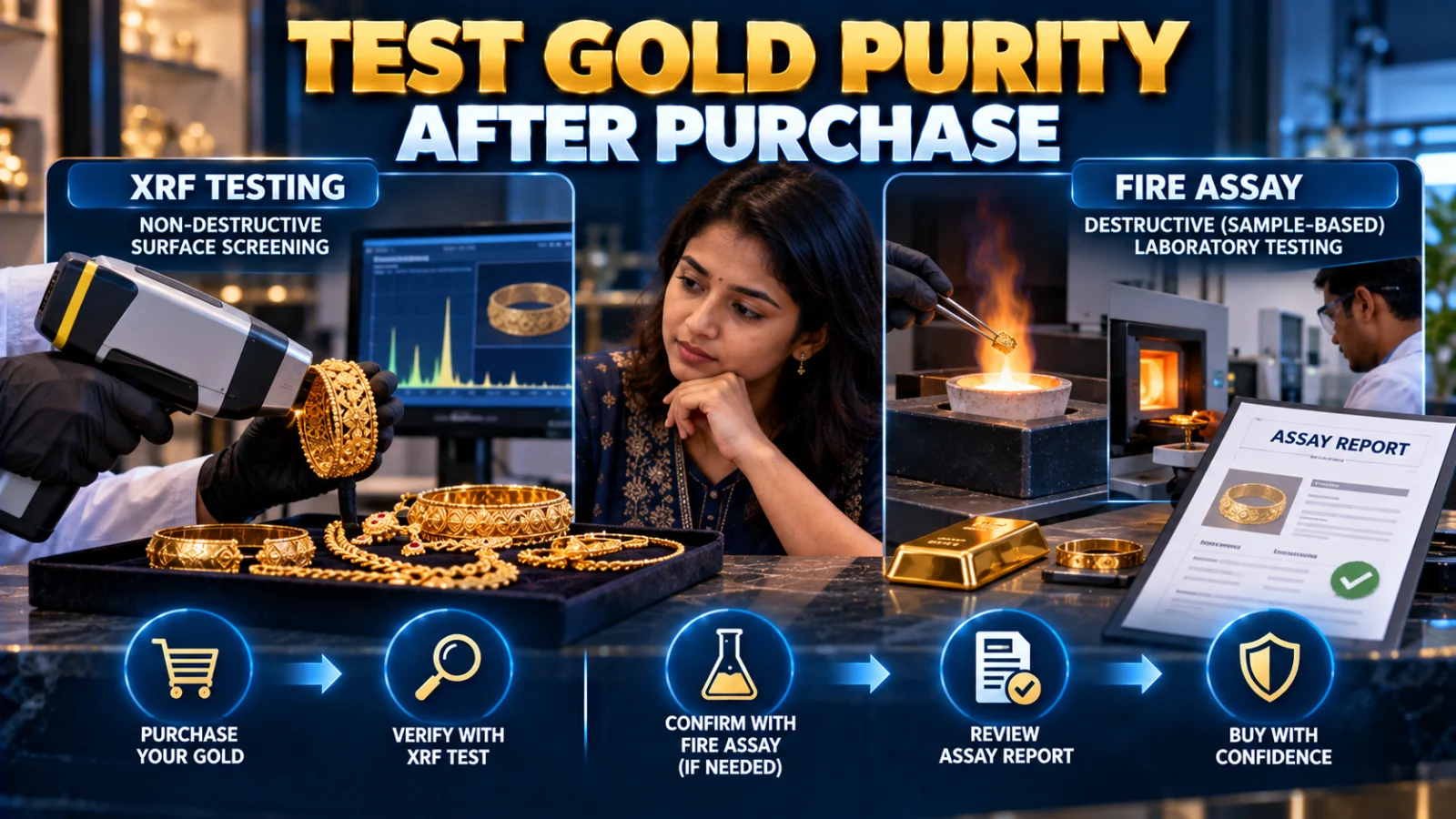
How to test gold purity after purchase in India depends on what evidence you actually need. If you already own jewellery and doubt its purity, BIS provides a consumer-testing route through recognised Assaying & Hallmarking Centres.
The key distinction is that XRF and fire assay do not prove the same thing. BIS describes XRF as a non-destructive preliminary method that measures the gold content of the surface. Fire assay requires destructive sampling, but BIS treats it as the stronger method for determining gold content.
If hallmarked jewellery is confirmed below its marked purity, BIS also provides a compensation and complaint route. That makes post-purchase testing a different reader job from simply checking a HUID before buying.
Ask the recognised A&H Centre about XRF screening. Treat the result as surface-based preliminary evidence, not a full bulk-purity certificate.
Ask about fire assay, understand how the sample will be taken and give consent only after the likely damage and procedure are explained.
Preserve the article, purchase evidence and assay report, approach the selling jeweller and use the BIS complaint route if needed.
Can you test gold after you already bought it?
Yes. BIS says consumers may approach a BIS-recognised Assaying & Hallmarking Centre to have jewellery or a sample tested for purity.
This is useful when you already own the jewellery and want independent evidence rather than relying only on the seller’s statement, visual appearance or a pre-purchase hallmark check.
How to find a BIS-recognised gold testing centre
BIS maintains a list of recognised Assaying & Hallmarking Centres. Use the current BIS list rather than assuming that any jewellery shop, XRF machine or private laboratory is part of the recognised consumer-testing network.
Before travelling, confirm that the centre is currently recognised and ask what consumer-testing services it offers for your type of article.
Testing jewellery is not the same as getting it hallmarked
A consumer can approach a recognised A&H Centre for testing. That does not mean a consumer can directly have old jewellery hallmarked in the same way a registered jeweller can.
BIS separates consumer purity testing from the hallmarking process used by registered jewellers. This article concerns independent testing after purchase or ownership, not applying a new hallmark to old jewellery.
What does an XRF gold test actually tell you?
X-ray fluorescence, or XRF, is useful because it is fast and non-destructive. But BIS’s consumer-testing guideline makes an important limitation explicit: XRF determines the gold content of the surface.
That means an XRF reading may not represent the average purity throughout the whole article. Surface composition can be affected by plating, solder, repairs, different components or construction.
BIS therefore treats XRF as a preliminary method, not as the same level of evidence as fire assay.
Can you ask for XRF only?
Under BIS’s published consumer-testing guideline, an XRF-only report can be issued if the consumer wants one. The limitation must be clear.
BIS says such a report should state that XRF measures surface gold content and that the result may vary by plus or minus 5 parts per thousand. The same guideline says a purity certificate cannot be issued on the basis of XRF alone.
That distinction matters in a dispute. An XRF result can be useful screening evidence, but it should not automatically be treated as equivalent to a fire-assay determination.
XRF vs fire assay: what is the practical difference?
| Question | XRF | Fire assay |
|---|---|---|
| Does it damage the jewellery? | Normally non-destructive. | Requires destructive sampling. |
| What does it measure? | Surface composition. | Gold content of the tested sample. |
| How should TPS describe it? | Preliminary screening evidence. | Stronger reference determination used in the BIS testing framework. |
| Can XRF alone establish the same purity certificate? | No under the reviewed BIS consumer-testing guideline. | The BIS procedure uses fire assay for the stronger purity determination. |
Will fire assay destroy your whole jewellery piece?
No, the BIS procedure does not require the entire ornament to be destroyed.
Fire assay is called destructive because a physical sample is removed and consumed or altered during testing. BIS’s guideline says sampling should be done with minimum damage to the article.
The centre should explain the proposed sampling method and obtain the consumer’s consent before proceeding.
For sentimental, antique, hollow, delicate or high-value jewellery, that decision matters. If you do not accept the sampling risk, you can choose to stop at non-destructive screening, while understanding that the evidence will be weaker.
What should happen when you submit jewellery for testing?
BIS’s consumer-testing guideline sets out an evidence-preserving process. The jewellery should be weighed in the consumer’s presence, identified and tagged before testing.
The process is designed so the consumer can connect the tested article to the resulting report. After the procedure, the jewellery and relevant remnants or cornets are handled according to the published testing workflow.
Keep the jewellery, invoice or cash memo if available, HUID details for hallmarked jewellery and photographs.
Confirm the centre’s current recognition and ask about consumer testing before visiting.
Understand what the XRF result can and cannot prove before deciding whether stronger evidence is necessary.
Ask where the sample will be taken and what visible effect the procedure may have on your article.
Keep the report with the article’s identifying information, photograph and weight where provided under the BIS procedure.
If a hallmarked article is confirmed below its marked fineness, preserve the complete evidence set for redress.
Use the applicable BIS compensation and complaint channels rather than relying only on an informal verbal dispute.
What should the assay report contain?
Under BIS’s published consumer-testing procedure, the test report is an important part of the evidence trail. For fire-assay testing, the guideline specifies inclusion of identifying details including the photograph and weight of the jewellery.
Keep the original report with the invoice, HUID information and any communication with the jeweller. If a dispute develops, preserving the connection between the physical article and the test result becomes important.
What if the jewellery is hollow, wax-filled or contains mixed materials?
Some jewellery cannot be interpreted as though it were one uniform solid alloy.
BIS’s guideline recognises that an article can involve features such as hollow construction, filling or other composition issues that should be noted by the A&H Centre where relevant.
This is another reason a single surface reading should not automatically be treated as proof of the average purity of every part of the article.
What if hallmarked jewellery tests below its marked purity?
BIS provides a consumer compensation route for qualifying hallmarked precious-metal articles that do not conform to the declared fineness.
Its consumer guidance describes compensation as two times the amount of the shortage in purity calculated for the weight of the article, plus the testing charges.
The compensation amount therefore depends on the actual article, weight, marked purity and measured shortage. TPS does not publish a fabricated fixed compensation amount.
Who is responsible for the compensation?
BIS guidance places responsibility on the registered jeweller who sold the hallmarked article for shortage in purity or fineness under the applicable framework.
A consumer whose hallmarked jewellery is retested at a BIS-recognised A&H Centre and found below the declared purity can approach the jeweller. If the dispute is not resolved, BIS’s complaint process can be used.
How to complain to BIS about low-purity hallmarked jewellery
BIS provides several complaint channels, including the BIS CARE app, its online complaint or eBIS route, email at complaints@bis.gov.in and the relevant BIS grievance mechanism.
A complaint does not guarantee a particular outcome. BIS may investigate the relevant jeweller, article, hallmarking and testing evidence before the matter is resolved.
What should you preserve before making a complaint?
Keep the complained-about article safe and avoid unnecessary alteration after testing.
Preserve purchase proof where available.
Record the identifying information of a hallmarked article.
Keep the independent test result and article-identification details.
Preserve clear images before and after destructive sampling where relevant.
Keep written correspondence relating to the purity dispute or compensation request.
Can old, inherited or unhallmarked jewellery be tested?
Yes. BIS has published a consumer-testing procedure for old gold jewellery through recognised A&H Centres.
Testing can tell you about the measured purity of the article or sample even when the jewellery was inherited or bought long ago.
However, an unhallmarked article that tests below what someone expected does not automatically receive the same compensation protection as a qualifying hallmarked article sold with a declared fineness.
Does low purity in unhallmarked jewellery create the same BIS compensation claim?
Do not assume so.
The compensation route reviewed by TPS relates to a precious-metal article sold bearing the relevant BIS Standard Mark or hallmark and found not to conform to the declared purity.
Independent testing of old or unhallmarked jewellery can establish evidence about purity, but it does not by itself create the same hallmarked-sale compensation claim.
How much does BIS-recognised gold testing cost?
TPS found a conflict across current BIS materials and is not treating one number as a universal fee.
One BIS hallmarking FAQ states a ₹200 charge for consumer fire-assay testing of hallmarked jewellery. A revised BIS guideline for testing old consumer gold states ₹45 per article with a minimum ₹200 per lot. The current high-level Consumer Protection page simply describes consumer testing as chargeable.
These references may apply to different testing contexts. Confirm the current charge directly with the BIS-recognised A&H Centre before submitting jewellery.
Is a jeweller’s private XRF reading enough for a serious dispute?
A private XRF reading can be useful as an initial clue, but it is not the strongest independent route when the objective is a formal purity dispute.
If you need evidence suitable for a BIS-linked complaint or compensation process, use a BIS-recognised A&H Centre and preserve the formal report.
How is this different from checking HUID before buying?
HUID verification and independent physical testing answer different questions.
Before purchase, HUID helps a buyer verify the hallmark identity and declared purity information. TPS covers that separately in How to Check Gold Purity and HUID in India Before You Buy.
After purchase, if you doubt whether the physical article actually matches the declared purity, you need an evidence route such as recognised testing and, where appropriate, fire assay.
Direct answer
To independently test gold purity after purchase in India, use a BIS-recognised Assaying & Hallmarking Centre. XRF is non-destructive and useful for preliminary screening, but BIS says it measures surface gold content and may not represent average purity. Fire assay requires destructive sampling but provides the stronger purity determination in the BIS testing framework.
If a hallmarked article is confirmed below its marked purity, preserve the jewellery, invoice or cash memo where available, HUID details and assay report. Approach the selling jeweller and use the BIS complaint route if necessary.
Verification note
TPS reviewed BIS’s current Consumer Protection guidance, the BIS consumer-testing procedure for old gold jewellery, hallmarking and A&H Centre FAQs, the recognised-centre route and BIS consumer complaint and compensation guidance. TPS also reconciled the differing fee figures currently exposed across BIS materials instead of presenting one as universally applicable.
Limitations and unresolved facts
The exact sampling method and cosmetic impact can depend on the article’s construction, solder, repairs, filling and mixed components. Current BIS materials expose different consumer-testing fee formulations for different contexts, so the applicable fee should be confirmed with the selected recognised A&H Centre. A test result or complaint does not guarantee a particular compensation outcome, and unhallmarked jewellery does not automatically receive the same compensation protection as qualifying hallmarked jewellery.