






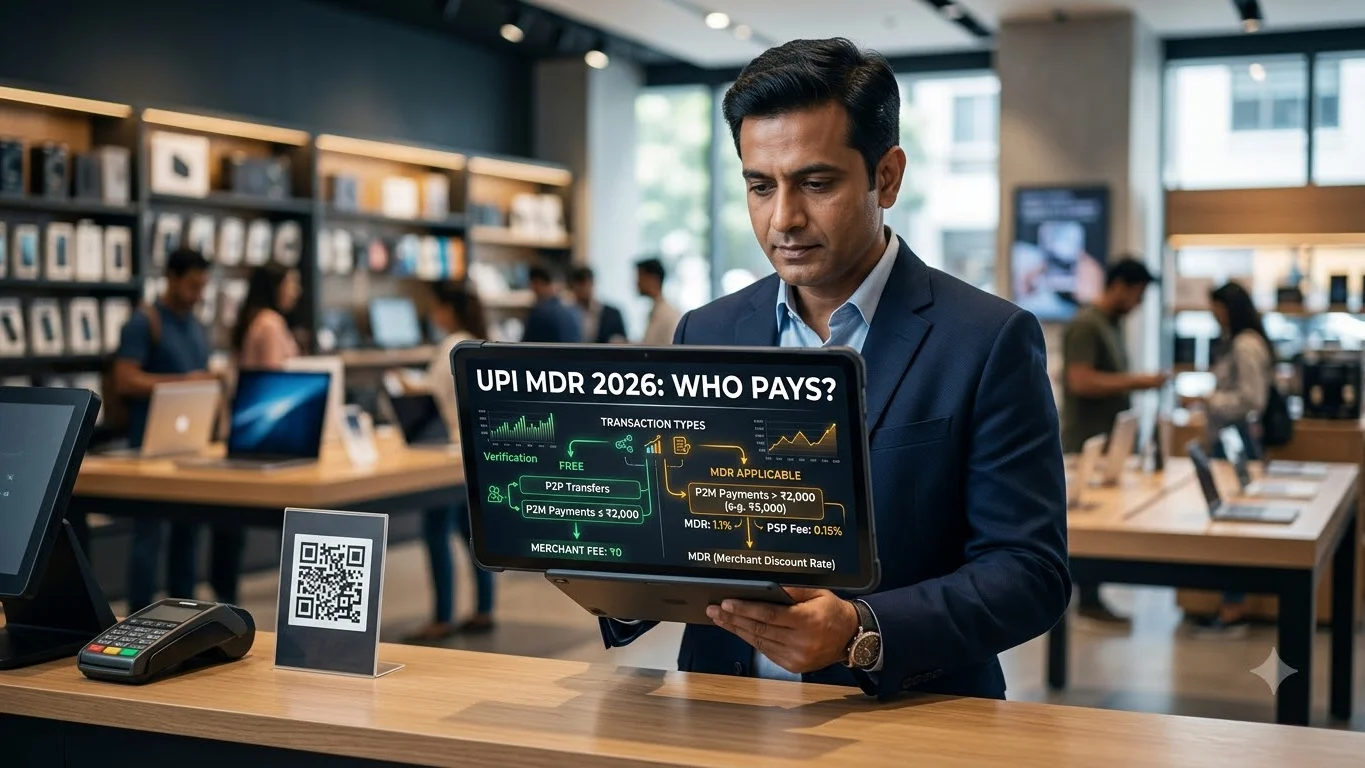
UPI MDR 2026 now has a defined higher-value merchant framework. Person-to-person UPI remains free regardless of amount, person-to-merchant payments up to ₹2,000 remain free, and protected small merchants continue to receive zero-MDR treatment. For ordinary eligible P2M transactions above ₹2,000, the announced MDR is 0.4%.
Direct answer
Customers do not pay the new UPI MDR. MDR is a merchant-payment ecosystem charge. Banks have been advised to prevent merchants from passing it to customers, and UPI apps are prohibited from imposing platform or hidden fees on individuals.
Effective date evidence
The Finance Ministry’s September 15 release establishes the rates and exemptions but does not itself state the implementation date. Reuters reports that the NPCI framework takes effect on October 15, 2026.
Free regardless of the amount transferred.
Zero MDR.
0.4% MDR, subject to the applicable exemptions and caps.
MDR capped at ₹300 per transaction.
Who actually pays UPI MDR in 2026?
The new framework applies MDR to specified person-to-merchant transactions above ₹2,000. It does not impose MDR on ordinary person-to-person transfers, and it does not make the customer the party responsible for the merchant discount rate.
The Ministry of Finance says MDR is distributed within the payment ecosystem, including banks, payment service providers and UPI application providers. It is not a government tax or a customer charge.
For customers, the practical answer is simple: sending money through P2P UPI remains free, and customers should not be charged MDR when paying a merchant.
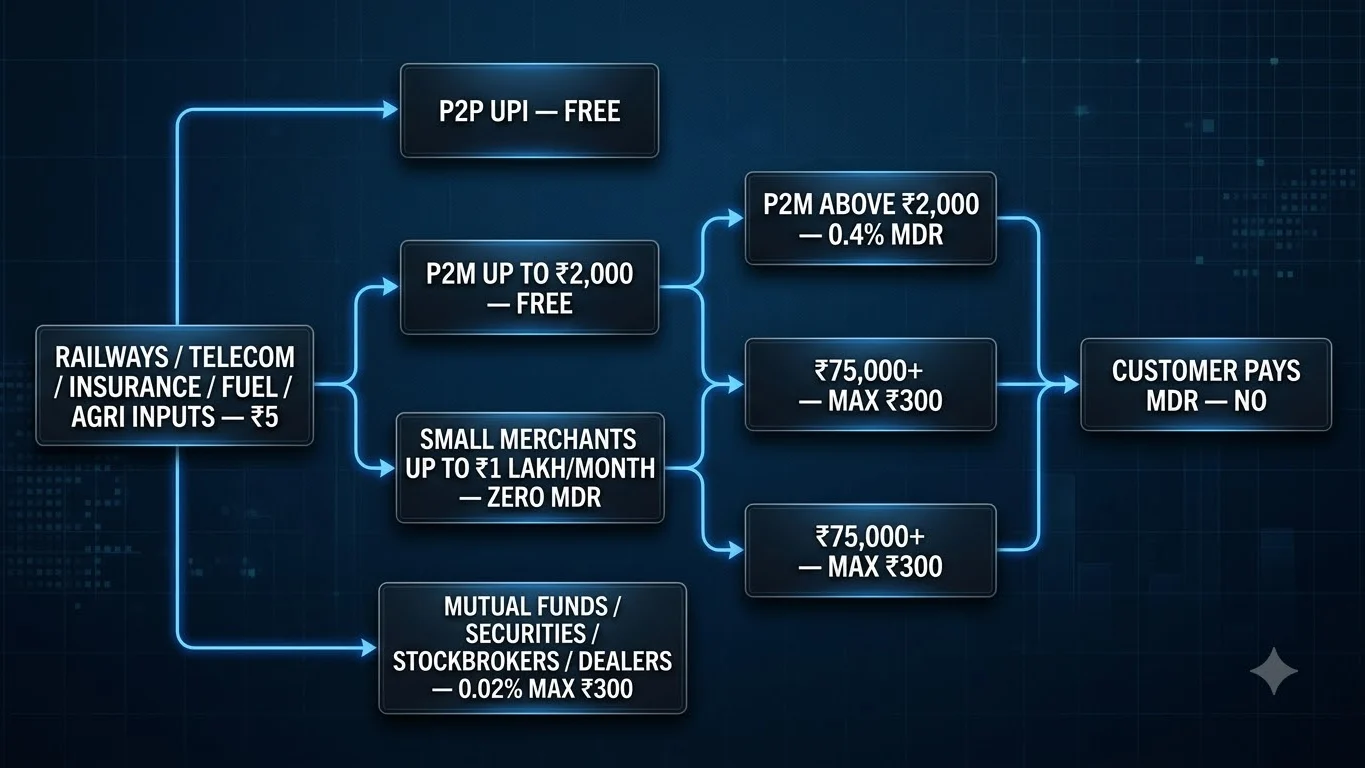
UPI MDR 2026 rates at a glance
| Transaction or merchant type | Current MDR framework | Who is protected? |
|---|---|---|
| Person-to-person UPI | Zero MDR regardless of transaction value | Individuals sending or receiving P2P transfers |
| Person-to-merchant payment up to ₹2,000 | Zero MDR | Merchant transaction remains outside MDR |
| Protected small merchant under P2PM QR category | Zero MDR on transactions when the merchant receives up to ₹1 lakh per month through qualifying UPI QR payments | Street vendors, neighbourhood shops and other qualifying small merchants |
| Ordinary eligible P2M transaction above ₹2,000 | 0.4% | MDR is merchant-side; customer must not be made to pay it |
| Transaction of ₹75,000 or more | 0.4%, capped at ₹300 per transaction | Cap limits the merchant-side MDR |
| Railways, telecom, insurance, fuel and agricultural inputs above ₹2,000 | Flat ₹5 MDR per transaction | Special essential/thin-margin sector treatment |
| Mutual funds, securities, stockbrokers and dealers | 0.02%, capped at ₹300 per transaction | Lower capital-market MDR treatment |
Does every merchant payment above ₹2,000 attract 0.4%?
No. The 0.4% rate is the ordinary higher-value P2M rate, but the framework contains important exceptions.
Small merchants receiving up to ₹1 lakh per month through UPI QR payments under the P2PM category continue to receive zero-MDR treatment. Essential and thin-margin sectors have a separate ₹5 flat rate, while specified capital-market transactions use a 0.02% rate capped at ₹300.
Merchants therefore need to identify their transaction type and applicable merchant category before assuming that 0.4% applies.
How does the small-merchant ₹1 lakh exemption work?
The Finance Ministry says small merchants, including street vendors, receiving up to ₹1 lakh per month through UPI QR codes under the P2PM category will continue to enjoy zero MDR on all such transactions.
This is different from the separate ₹2,000 transaction-value protection. A merchant may therefore need to consider both the transaction amount and whether the merchant falls inside the protected small-merchant framework.
What happens when a normal merchant receives more than ₹2,000?
For an ordinary eligible P2M transaction above ₹2,000, the announced MDR is 0.4%.
For example, if a transaction is ₹10,000 and no special merchant category or exemption applies, 0.4% is ₹40. The customer should still pay only the purchase amount; the MDR belongs within the merchant payment ecosystem.
For transactions of ₹75,000 or more, the MDR is capped at ₹300 per transaction. That means the percentage calculation cannot push the applicable MDR above the ₹300 cap for those transactions.
Which sectors pay only ₹5?
Transactions above ₹2,000 in specified essential and thin-margin sectors — including railways, telecommunications, insurance, fuel and agricultural inputs — attract a flat MDR of ₹5 per transaction.
This special rate replaces the ordinary 0.4% calculation for transactions covered by that sector treatment.
What is the MDR for mutual funds and securities?
Payments relating to mutual funds, securities, stockbrokers and dealers attract MDR of 0.02%, capped at ₹300 per transaction.
Merchants and financial intermediaries should still verify how their acquiring bank or payment provider classifies the transaction before relying on a particular merchant category.
Can a merchant pass UPI MDR to the customer?
The Finance Ministry says customers will not pay MDR. Banks have been advised to ensure merchants do not pass the MDR charge on to customers, while UPI application providers are prohibited from imposing platform fees or hidden charges on individuals.
This means a merchant should not simply add the applicable MDR percentage as a separate UPI fee to the customer’s bill.
Can Merchants Charge Extra for UPI? covers the separate reader question of merchant-added customer surcharges.
Are P2P UPI transfers still free above ₹2,000?
Yes. The ₹2,000 merchant threshold does not apply to person-to-person transfers. The Ministry says P2P UPI remains completely free irrespective of the amount transferred, with no transaction fee, platform fee or other charge for individuals sending or receiving money through UPI.
Bank and NPCI transaction limits can still restrict the maximum amount that may be transferred in particular categories, but those risk-management limits are different from MDR charging thresholds.
How many UPI merchant transactions will actually pay MDR?
The Government estimates that MDR will apply to only about 4% of merchant transactions. Approximately 96% of P2M transactions are expected to remain unaffected because they fall below ₹2,000 or within the protected small-merchant framework.
That is why the introduction of a higher-value MDR does not mean that 0.4% will suddenly apply to every UPI payment.
When does the new UPI MDR framework start?
October 15, 2026 is the reported effective date for the NPCI framework. Reuters reports that the higher-value merchant MDR takes effect from that date.
Evidence boundary: the September 15 Finance Ministry release confirms the rates, merchant exemptions, caps and customer protections but does not state the implementation date in its published text. TPS therefore treats October 15 as NPCI/reporting-confirmed rather than a date stated in the Ministry release itself.
What changed from the September 14 Gazette?
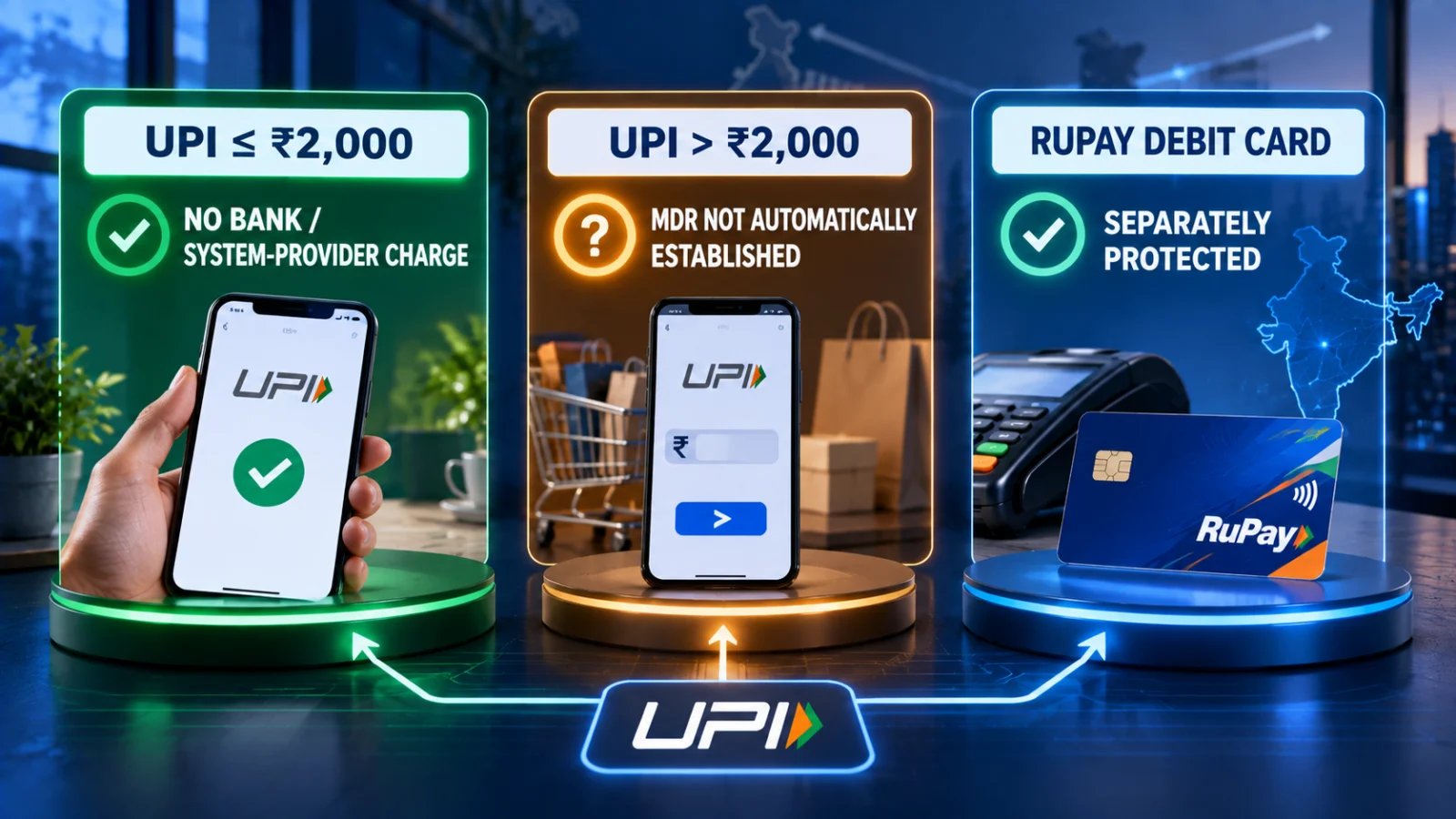
Gazette notification S.O. 5067(E) established the controlling no-charge protection for UPI transactions up to ₹2,000 and separately protected RuPay-powered debit-card payments. By itself, that notification did not specify the MDR percentage, higher-value merchant categories or implementation framework.
The Finance Ministry’s September 15 framework now supplies those missing operational details for UPI merchant payments: the ordinary 0.4% rate above ₹2,000, special merchant treatments, the ₹300 cap, small-merchant protection and the rule that customers must not bear MDR.
What about RuPay debit cards?
S.O. 5067(E) separately specifies debit cards powered by RuPay as a protected electronic payment mode. The September 15 UPI framework should not be used to rewrite the separate RuPay debit-card rule as though the two payment rails have identical pricing provisions.
What should a merchant check before October 15?
- Confirm whether the payment is P2P or P2M.
- If it is P2M, check whether the transaction is ₹2,000 or less.
- Check whether the merchant qualifies for the small-merchant P2PM QR zero-MDR protection.
- Check whether the transaction belongs to an essential-sector or capital-market category with a special rate.
- For ordinary eligible P2M transactions above ₹2,000, confirm the acquiring bank or payment provider’s implementation of the 0.4% MDR and ₹300 cap.
- Do not pass the merchant MDR to the customer as a separate UPI charge.
Verification
ThePulseSignal checked the Ministry of Finance release published by PIB on September 15, 2026, which confirms the UPI MDR rates, merchant exemptions, sector-specific rates, ₹300 cap and customer protections. The September 14 Gazette remains controlling evidence for the ₹2,000 no-charge boundary and RuPay debit-card protection. Reuters reporting was used for the October 15 implementation date because the Ministry release itself does not state that date.
Last verified: September 16, 2026.
Limitations and unresolved facts
- The Finance Ministry’s September 15 release does not itself state the October 15 implementation date; that date is supported by Reuters reporting on the NPCI framework.
- Merchant classification and operational billing can depend on the acquiring bank, payment provider and NPCI implementation rules.
- The public Ministry release does not resolve every edge case involving mixed merchant categories, refunds, reversals or specialised payment flows.
- Future NPCI, RBI, bank or acquirer instructions may add operational detail before implementation.
Bottom line
UPI MDR 2026 is no longer an unresolved higher-value pricing proposal. P2P remains free, P2M payments up to ₹2,000 remain free, protected small merchants remain at zero MDR, and ordinary eligible merchant payments above ₹2,000 carry 0.4% MDR with a ₹300 cap for transactions of ₹75,000 and above. Special essential sectors pay ₹5 and specified capital-market payments use 0.02% capped at ₹300. Customers must not be made to pay the MDR.