






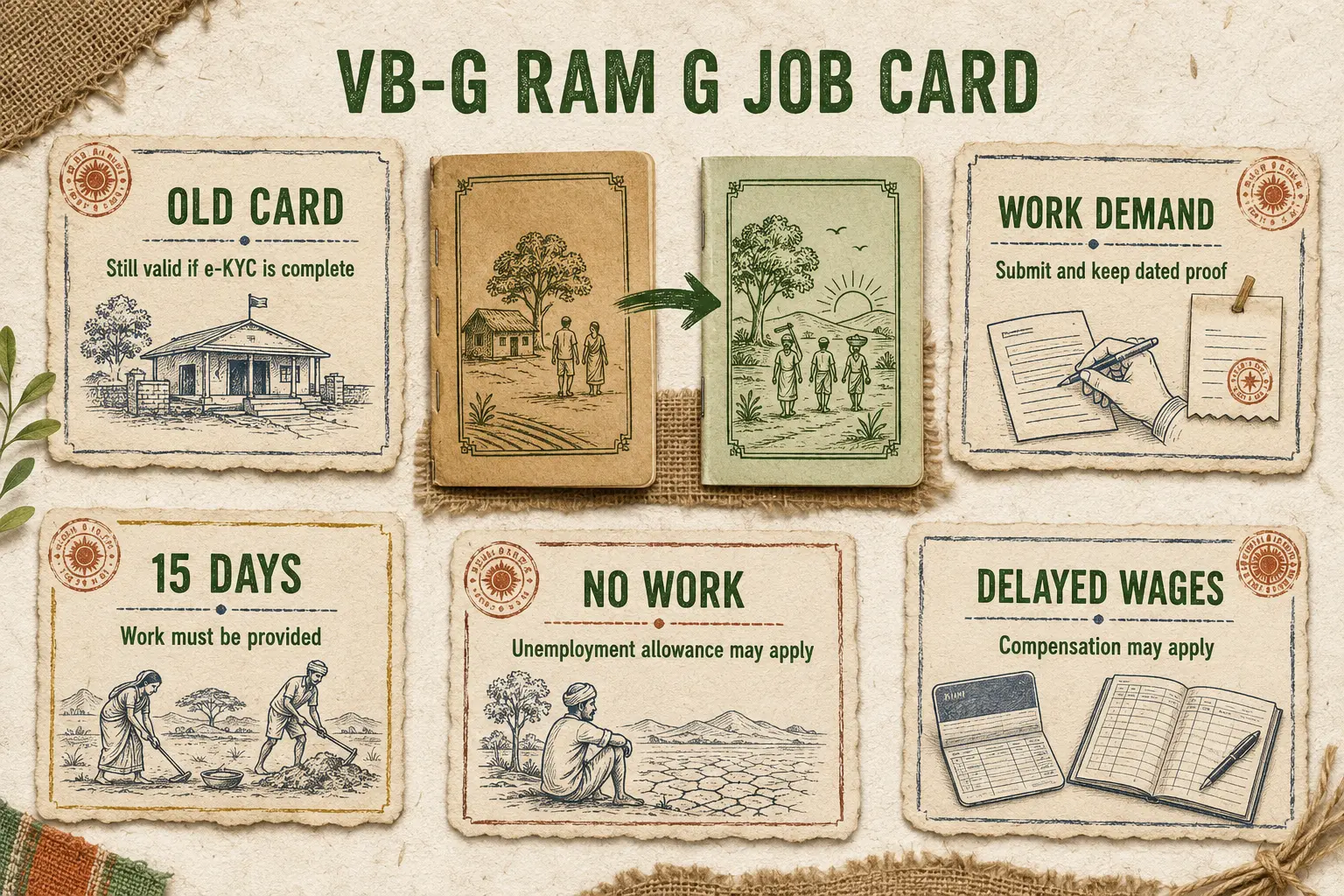
VB G RAM G job card rules allow existing e-KYC-verified MGNREGA cards to remain valid until new Gramin Rozgar Guarantee Cards are issued. Workers must not be denied employment merely because e-KYC is still pending.
The new law, which replaced MGNREGA nationwide from July 1, 2026, guarantees up to 125 days of unskilled wage employment per eligible rural household in a financial year—but workers still need to demand work through the prescribed process.
The central verdict
Your old MGNREGA job card does not become useless merely because the law changed.
Where e-KYC is complete, the old card remains valid until the new Gramin Rozgar Guarantee Card is issued. Where e-KYC is pending, the government says employment must not be denied merely for that reason.
To claim the employment guarantee, an adult household member should submit a demand for work and preserve dated proof of that demand.
In this guide
- What changed on July 1
- Is the old job card valid?
- What if e-KYC is pending?
- How to register without a job card
- How to demand work
- The 15-day work rule
- Unemployment allowance
- Wage deadlines and compensation
- Peak-season pause
- Ongoing works and new works
- Attendance and exceptions
- Frequently asked questions
What changed when VB-G RAM G replaced MGNREGA?
The Viksit Bharat–Guarantee for Rozgar and Ajeevika Mission (Gramin) Act, 2025 came into force across rural India on July 1, 2026.
MGNREGA, 2005 stood repealed from the same date.
The new framework raises the statutory employment guarantee from 100 days to 125 days in a financial year for every eligible rural household whose adult members volunteer to undertake unskilled manual work.
| Worker issue | Earlier MGNREGA framework | VB-G RAM G position |
|---|---|---|
| Annual employment guarantee | 100 days per eligible rural household | 125 days per eligible rural household |
| Existing job card | MGNREGA job card | e-KYC-verified card remains valid until the new card is issued |
| Work-demand deadline | Work to be provided within the prescribed period | Work must be provided within 15 days of application |
| No work provided | Unemployment allowance framework | Unemployment allowance remains a statutory entitlement |
| Wage deadline | Time-bound payment framework | Weekly or within a fortnight after muster-roll closure |
| Delayed wages | Delay-compensation mechanism | 0.05% of unpaid wages per day after the specified delay |
VB G RAM G job card: is the old MGNREGA card still valid?
Yes, where the worker’s e-KYC has been completed.
The official FAQ says existing MGNREGA job cards and workers with completed e-KYC continue to remain valid until new Gramin Rozgar Guarantee Cards are issued.
Workers should preserve:
- the old job card;
- the job-card number;
- e-KYC acknowledgement or status evidence;
- bank or post-office account details used for wage payment;
- past muster-roll and wage-payment records;
- proof of any current work demand.
Keep it until the replacement card is officially issued and the worker record is confirmed.
VB G RAM G job card rules when e-KYC is pending
The government says workers must not be denied employment merely because e-KYC is pending.
State governments are expected to continue field-level facilitation for completing e-KYC.
This does not mean e-KYC can be ignored indefinitely. It means pending verification alone should not erase the right to submit a work demand or justify an automatic denial.
If a worker is refused work only because e-KYC is pending, preserve:
- the date and place of the refusal;
- the name or designation of the official contacted;
- the work-demand application or receipt;
- the current e-KYC status;
- any written message or portal screenshot.
How to register for a VB G RAM G job card
A rural household without a MGNREGA job card may apply through the concerned Gram Panchayat.
An adult member can submit the names, ages and address details of household members for issuance of a Gramin Rozgar Guarantee Card.
The exact local documentation process may be set through State rules and field instructions. Ask the Gram Panchayat for a dated acknowledgement of the registration request.
How a VB G RAM G job card household can demand work
Adult members may demand employment through the Gram Panchayat.
The official FAQ says applications may be made:
- orally;
- in writing using the same Form 6 used earlier;
- through a digital platform;
- to the Gram Panchayat;
- to the Programme Officer; or
- to another authorised person.
The 15-day clock depends on the application date. A worker who has no dated receipt may face difficulty proving when the entitlement began.
VB G RAM G job card holders: when must work be provided?
Employment must be provided within 15 days from the date of the application.
The household should keep:
- a dated application receipt;
- the work-demand reference number;
- the name of the receiving office;
- any digital acknowledgement;
- the date on which work was offered;
- the worksite and reporting instructions.
What if work is not provided within 15 days?
The worker becomes entitled to unemployment allowance, subject to the Act and applicable procedure.
The official FAQ states that the State Government must pay at least:
- one-fourth of the notified wage rate for the first 30 days during the financial year; and
- one-half of the notified wage rate for the remaining period.
Unemployment allowance is linked to failure to provide work after a valid demand. It is not the same as wage-delay compensation.
| Problem | Possible entitlement | Evidence to preserve |
|---|---|---|
| No work within 15 days of demand | Unemployment allowance | Dated work-demand application and proof no work was offered |
| Work completed but wages unpaid after the permitted period | Delay compensation | Muster-roll closure date, attendance and unpaid wage record |
VB G RAM G job card wages: when must payment arrive?
Wages must be paid weekly or, in any case, no later than a fortnight after closure of the muster roll.
Payment continues through Direct Benefit Transfer into the worker’s bank or post-office account.
If wages are not paid within 15 days from muster-roll closure, the worker is entitled to delay compensation at 0.05% of unpaid wages per day of delay.
Revised VB-G RAM G wage rates were notified on June 30, 2026 and took effect from July 1, 2026. The Ministry of Rural Development said no notified daily wage under the new schedule is below ₹300, while the applicable rate still varies by State or Union Territory.
Can work stop during peak agricultural seasons?
Yes. State governments may notify peak agricultural periods, such as sowing and harvesting seasons, during which works under the Act are not undertaken.
The detailed official explainer describes an aggregated pause of up to 60 days.
This means the 125-day annual guarantee should not be interpreted as a promise that work will be offered during every part of the year.
Workers should check:
- whether the State has issued a seasonal-pause notification;
- the exact start and end dates;
- whether a submitted work demand falls within that period;
- what local instructions apply before and after the pause.
What happens to ongoing MGNREGA works?
Ongoing MGNREGA works existing when the new Act commenced may continue under the VB-G RAM G framework.
The government says these works should be migrated and prioritised for completion.
Where ongoing works are insufficient to meet employment demand, new works consistent with Schedule I of the new Act may be opened.
How is attendance recorded?
The official FAQ says attendance is captured through a face-authentication-based mechanism.
It also provides for exception handling in genuine cases such as:
- poor or unavailable network connectivity;
- technical problems;
- device-related failures; or
- other exceptional circumstances covered by government guidelines.
A technical failure should not simply disappear from the worker record. The worker or worksite supervisor should preserve the date, worksite, attendance evidence and error details.
What facilities and distance protections apply?
Worksites must provide safe drinking water, shade for children and rest periods, and a first-aid box.
As far as possible, employment should be provided within five kilometres of the applicant’s village.
If work is provided farther away but within the block, the worker is entitled to an additional 10% of the wage rate for transport and living expenses.
Who handles registration and implementation?
Gram Panchayat
Registers households, receives work applications, executes works, maintains records and prepares village plans.
Programme Officer
A block-level officer, not below Block Development Officer rank, handles programme functions and work-demand administration.
District Programme Coordinator
The District Collector or equivalent designated officer coordinates implementation at district level.
State Government
Frames the State scheme, supports e-KYC facilitation and pays unemployment allowance where applicable.
What remains subject to rules or local implementation?
All States and Union Territories had notified their respective VB-G RAM G schemes and started implementation by July 2026.
At the Central level, draft rules covering several implementation areas had also been published for consultation, including:
- transitional provisions;
- normative-allocation parameters;
- administrative expenditure;
- grievance redressal;
- wage and unemployment-allowance payment procedures;
- treatment of excess expenditure;
- arrangements for Union Territories without legislatures.
Workers and field administrators should therefore distinguish the national statutory baseline from the latest State or Union Territory scheme, local Gram Panchayat procedure and any subsequently finalised Central rule.
What did competitor coverage already explain?
The reviewed competitor sample already covered several large policy changes:
- replacement of MGNREGA from July 1;
- the increase from 100 to 125 days;
- the ₹95,692.31 crore Central allocation;
- the 60-day peak-season pause;
- the new Centre–State funding pattern;
- job-card continuity during transition.
ThePulseSignal therefore does not claim those facts were missed.
The contribution of this guide is narrower: it puts the worker’s immediate questions in one place—card validity, pending e-KYC, work demand, the 15-day clock, unemployment allowance, wage-delay compensation and what proof to preserve.
VB G RAM G job card: frequently asked questions
Is my old MGNREGA job card still valid under VB G RAM G?
Yes. Under the VB G RAM G job card transition, an e-KYC-complete MGNREGA card remains valid until the new Gramin Rozgar Guarantee Card is issued.
Can work be denied because e-KYC is pending?
The official transition notice says employment must not be denied merely because e-KYC is pending.
How many days of work are guaranteed?
Up to 125 days in a financial year for every eligible rural household whose adult members volunteer for unskilled manual work.
How do I demand work?
Apply orally, in writing using Form 6, or digitally through the Gram Panchayat, Programme Officer or another authorised person.
How quickly must work be provided?
Within 15 days from the date of application.
What if work is not provided?
Unemployment allowance may become payable if the valid demand is not met within 15 days.
When must wages be paid?
Weekly or no later than a fortnight after closure of the muster roll.
What compensation applies to delayed wages?
0.05% of unpaid wages per day after the prescribed delay, according to the official FAQ.
Do ongoing MGNREGA works stop?
No. Works existing at commencement may continue under the new framework.
Can work pause during sowing or harvesting?
Yes. States may notify peak agricultural periods during which works are paused.
Official sources
- India Code — VB-G RAM G Act, 2025
- PIB commencement and transition release
- Official VB-G RAM G frequently asked questions
- Official detailed explainer
- June 30 revised VB-G RAM G wage-rate notification
- July 21 nationwide implementation update
- July 28 implementation and employment-generation update
Verification and editorial limitation
Confirmed: Nationwide commencement from July 1, repeal of MGNREGA, 125-day household guarantee, old e-KYC-verified card continuity, no denial solely for pending e-KYC, 15-day work rule, unemployment allowance, wage deadline and delay compensation.
Confirmed: Ongoing works may continue, new works may be opened where needed and State governments may notify peak-season pauses.
Wage-rate update: Revised VB-G RAM G wage rates were notified on June 30, 2026 with effect from July 1, 2026. No notified daily wage under that schedule is below ₹300, while the applicable amount varies by State or Union Territory.
Implementation update: All States and Union Territories had notified their respective schemes and started implementation by July 2026. Local card replacement, grievance handling, attendance exception processing and field-level procedures can still vary.
Last verified: August 18, 2026.
Limitation: This guide explains the national baseline. A worker should preserve local applications and records and check the latest State or Union Territory scheme and Gram Panchayat instructions for local procedures.