







Gold is not inherently a good or bad investment. It becomes a poor fit when the financial job you need an asset to perform does not match what gold can reliably provide.
That distinction matters because investors often begin with the asset — “Should I buy gold?” — instead of beginning with the requirement. If the goal needs regular cash flow, a known amount of money on a fixed date, low short-term price risk or more diversification when gold exposure is already high, gold may not be the right tool for that particular job.
The useful question is therefore not whether gold is universally good. It is: what must this money do, and does gold actually provide that property?
When gold may be a bad investment for the job
1. You need regular income from the asset
Gold itself does not generate regular native cash flow. Your return depends primarily on changes in the market value of the gold you hold.
That makes gold a poor fit when the main requirement is predictable recurring income from the asset itself.
There is an important product distinction: a Sovereign Gold Bond can pay contractual interest because it is a bond issued under a specific scheme. That interest comes from the bond contract, not because gold itself produces yield.
2. You need the money on a short, fixed horizon
Gold can usually be sold, but being able to sell an asset is not the same as knowing what price you will receive when you must sell it.
World Gold Council research acknowledges that gold can experience substantial price variation. SEBI investor guidance separately stresses matching investment choices to the period for which money can remain invested and avoiding unsuitable volatility when funds may be needed soon.
If a near-term obligation cannot tolerate a lower market value on the required date, gold may not fit that job.
3. You require certainty of principal or a known future amount
Market-priced gold does not provide a contractual guarantee that your investment will be worth at least the amount you paid when you need the money.
That does not make gold unsafe in every sense. It means the asset does not provide the same property as an instrument whose terms explicitly guarantee a maturity amount or principal under specified conditions.
If the goal cannot tolerate uncertainty in the future value, gold may be the wrong match.
4. You already have too much gold exposure
Gold is often discussed as a diversifier, but diversification does not mean that adding more of the same asset is always beneficial.
If gold has already become a large part of your portfolio — whether because you deliberately bought it or because its price rose sharply — another purchase can increase concentration rather than improve diversification.
The relevant question then becomes whether you need to rebalance, not whether gold is an attractive asset in isolation.
5. You have not secured basic emergency liquidity first
SEBI investor education advises people to account for emergency needs before committing money to investments. That matters because emergency money has a different job from long-term investment capital.
Gold may be saleable, but an emergency reserve is normally expected to be available without forcing you to accept an inconvenient market price, transaction process or product-specific redemption condition at the moment cash is needed.
If money may be required for foreseeable emergencies, first ask whether the reserve itself is adequate before treating gold as the answer.
6. You are buying mainly because of FOMO
A rising price can make an asset feel safer precisely when the investor is taking more entry-point risk.
“Gold has gone up, so I need to buy before I miss it” is not a financial goal, allocation policy or evidence-based reason by itself. The opposite shortcut — “gold has risen, so it must fall next” — is also a forecast.
If your reason to buy disappears when the recent rally is removed from the story, the decision may be driven more by momentum and herd behaviour than by portfolio need.
7. You are using the wrong form of gold for the job
“Gold” is not one product. Jewellery, coins, bars, Gold ETFs, Sovereign Gold Bonds and digital-gold offerings can have very different costs, rights, liquidity characteristics, tax treatment, counterparty exposure and regulatory status.
For example, jewellery can include making charges and resale deductions that matter when the purpose is purely investment. SEBI has also cautioned that unregulated digital-gold products can expose buyers to counterparty and operational risks outside the securities-market investor-protection framework.
An asset can therefore be broadly suitable while a particular form of that asset is a poor fit for the intended job.
Gold’s lack of regular income needs one important distinction
One of the most common statements about gold is that it “does not pay income.” That is broadly correct for gold itself, but the wording becomes misleading if different financial products are mixed together.
Physical gold and ordinary market exposure do not generate native yield merely because gold exists. A Sovereign Gold Bond, however, can include contractual interest paid under the bond terms. The cash flow comes from the bond obligation, not from the underlying gold producing earnings.
This distinction matters because an investor who needs income should assess the actual instrument and contractual source of that income rather than assume all gold exposure behaves identically.
Liquidity is not the same as price certainty
Gold is often described as a liquid asset. That can be true in the sense that active markets and established buyers exist. But liquidity answers “Can I convert this to cash?” It does not answer “Will I receive the exact amount I need on the exact date I need it?”
If a goal has a fixed near-term liability, price variability matters even when selling is easy. The relevant risk is being forced to sell after a decline or at a time when the chosen product has an inconvenient exit condition.
More diversification does not mean more gold forever
Gold’s portfolio case is often based partly on diversification. But diversification is about the relationship among holdings, not maximising the weight of every diversifying asset.
Once gold becomes a large concentration, another gold purchase can work against the reason it was introduced in the first place.
That is why suitability should be assessed at portfolio level rather than by looking at gold’s historical qualities in isolation.
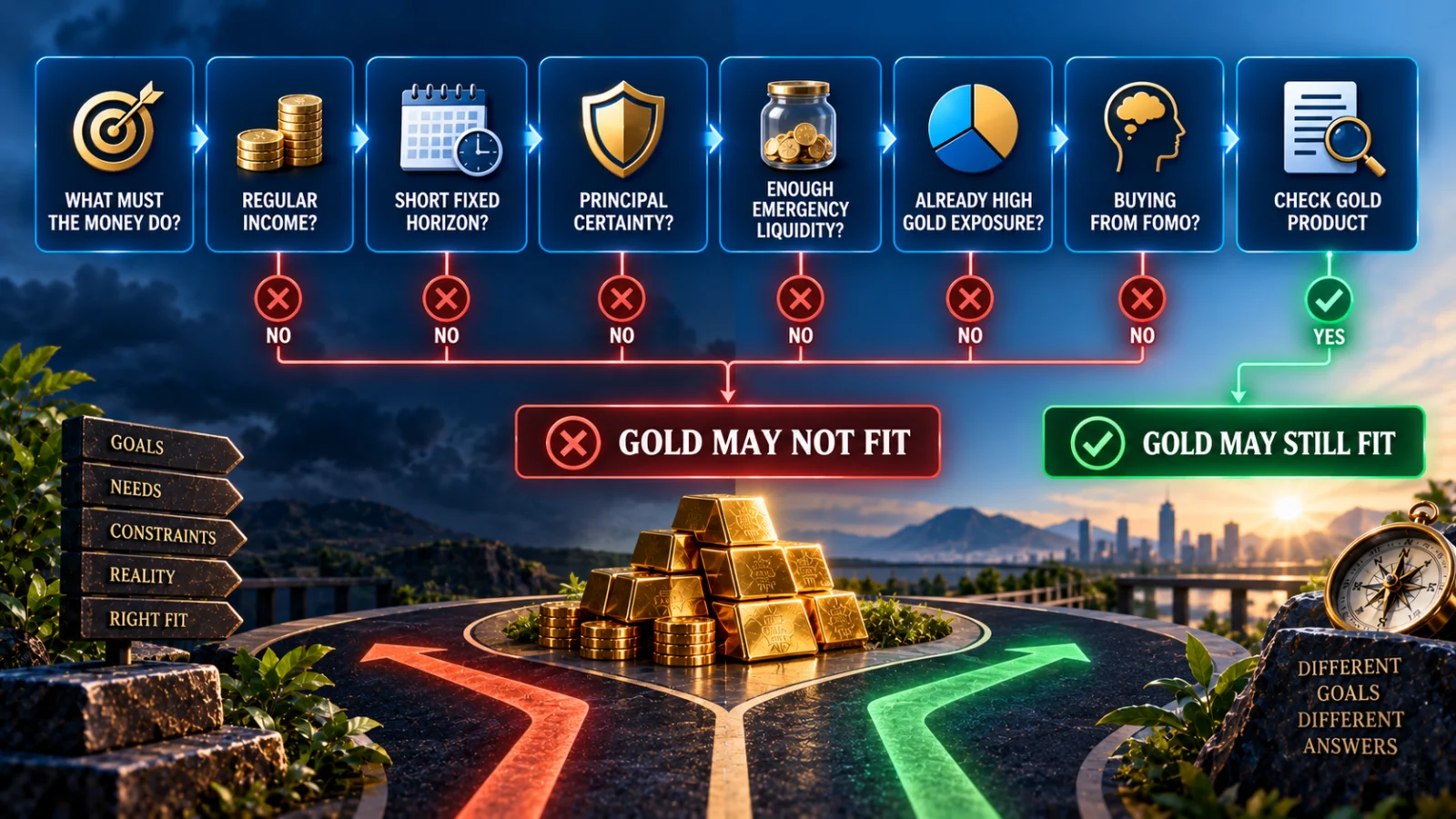
A simple test before choosing gold
1. What must this money do?
Income, long-term diversification, emergency availability, capital certainty, short-term spending or something else?
2. Does the goal have a fixed date?
If yes, decide how much market-value uncertainty the goal can tolerate at that date.
3. Do you need recurring cash flow?
If yes, identify whether the chosen instrument actually produces contractual income rather than relying on selling units or gold.
4. How much gold exposure do you already have?
If the portfolio is already heavily exposed, the next step may be to hold or rebalance rather than add.
5. Is emergency liquidity already covered?
If not, separate the emergency-fund job from the long-term investment job.
6. Would you still want the investment if gold had not recently rallied?
If not, FOMO may be doing more work than your financial plan.
7. Does the chosen gold product fit the purpose?
Check costs, liquidity, contractual rights, regulation, tax treatment and counterparty structure before treating all forms of gold as interchangeable.
When gold can still fit despite these risks
None of these situations means gold has no place in a portfolio. An investor can recognise that gold produces no native income, can be volatile and can experience weak multi-year periods while still using it for a different job such as diversification or long-term wealth preservation.
The key is matching the asset to the objective. A characteristic is only a disadvantage when it conflicts with something the investor actually requires.
What this article cannot decide for you
There is no evidence-backed universal percentage of gold that is right for every investor, no guaranteed future return and no single asset that automatically replaces gold whenever one of these seven conditions applies.
If gold fails your test because you need income, certainty, short-horizon stability, emergency availability or a different diversification profile, the next step is to compare regulated assets designed to provide that missing property. The answer depends on the specific goal and constraints.
Verification note
TPS reviewed World Gold Council material describing gold’s risks, volatility, portfolio role and lack of regular native cash flow, and cross-checked the decision framework against SEBI investor guidance on goals, horizon, risk, diversification and emergency planning. RBI material was used to preserve the Sovereign Gold Bond interest exception, and SEBI’s digital-gold caution was used to distinguish product-level regulatory risk from gold itself.