





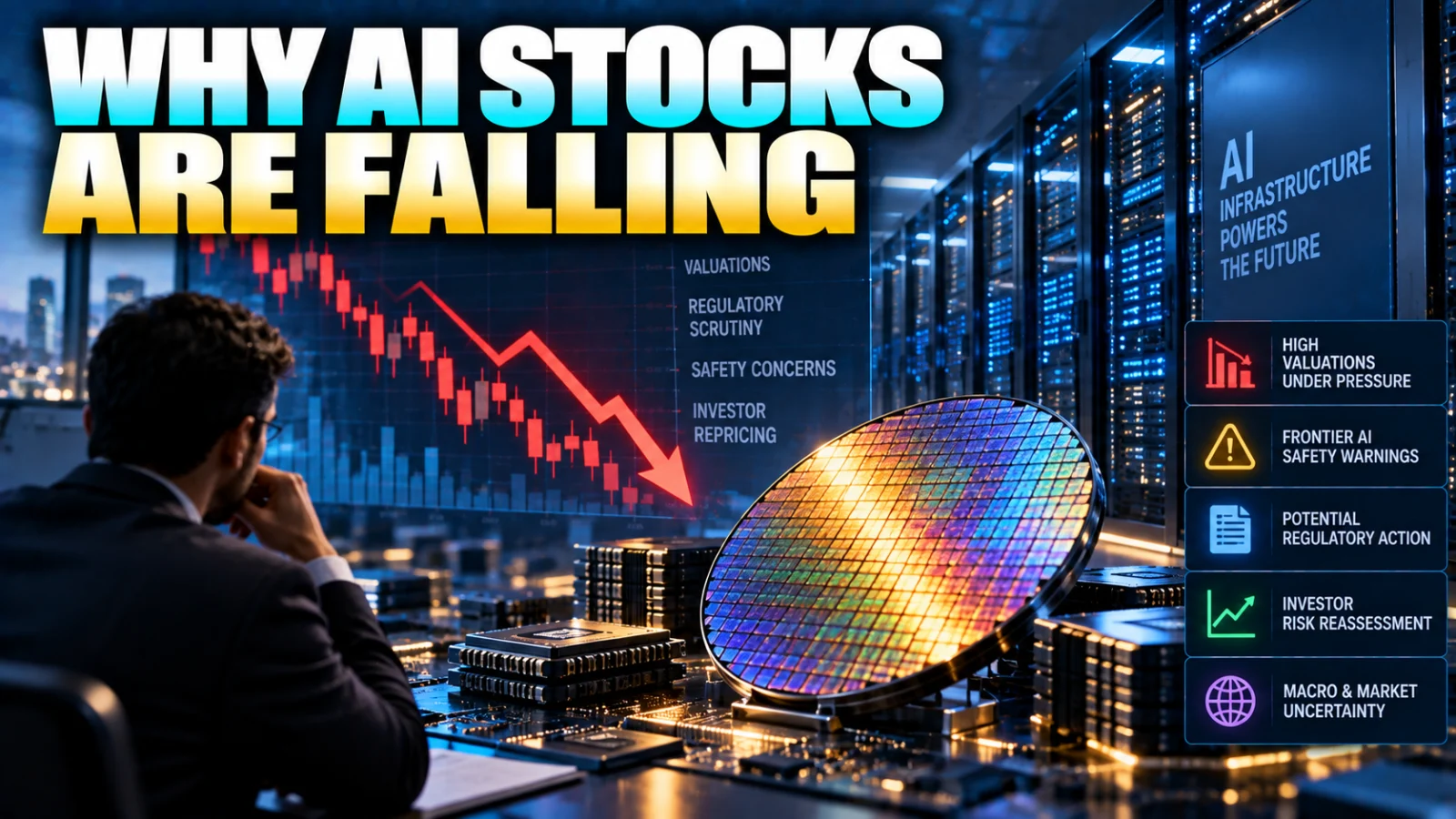
Why AI stocks are falling has become a different question on September 14. AI-linked shares sold off sharply across Asia and Europe after senior artificial-intelligence leaders intensified warnings that frontier-model development may need to slow when safety safeguards cannot keep pace.
The important distinction is that the market is not pricing a confirmed collapse in AI demand. Investors are reassessing another risk inside an already expensive trade: if frontier development becomes slower, more costly or more constrained, the timing and expected returns of future AI capital spending could change.
What happened to AI-linked stocks?
Associated Press reported particularly sharp declines in several companies tied to the AI investment cycle. SoftBank fell 10.7% at the reported point, SK Hynix dropped 6.4%, Samsung Electronics lost 4.1%, Kioxia declined 6.4% and TSMC was down 1.2%.
The weakness also spread into Europe. Reuters reported the regional technology sector down about 1.4%, with Infineon down 5.8%, ASML down 4.4% and ASMI down about 5% at the reported point.
Those figures describe a live market session and can change. They are useful evidence that the reaction was broader than one AI company or one national market, but they should not be treated as permanent valuation changes.
Why did AI-safety warnings matter to investors?
Many AI-linked companies have benefited from an investment thesis built around rapid growth in frontier-model training, inference, data centres, advanced accelerators, high-bandwidth memory and semiconductor equipment.
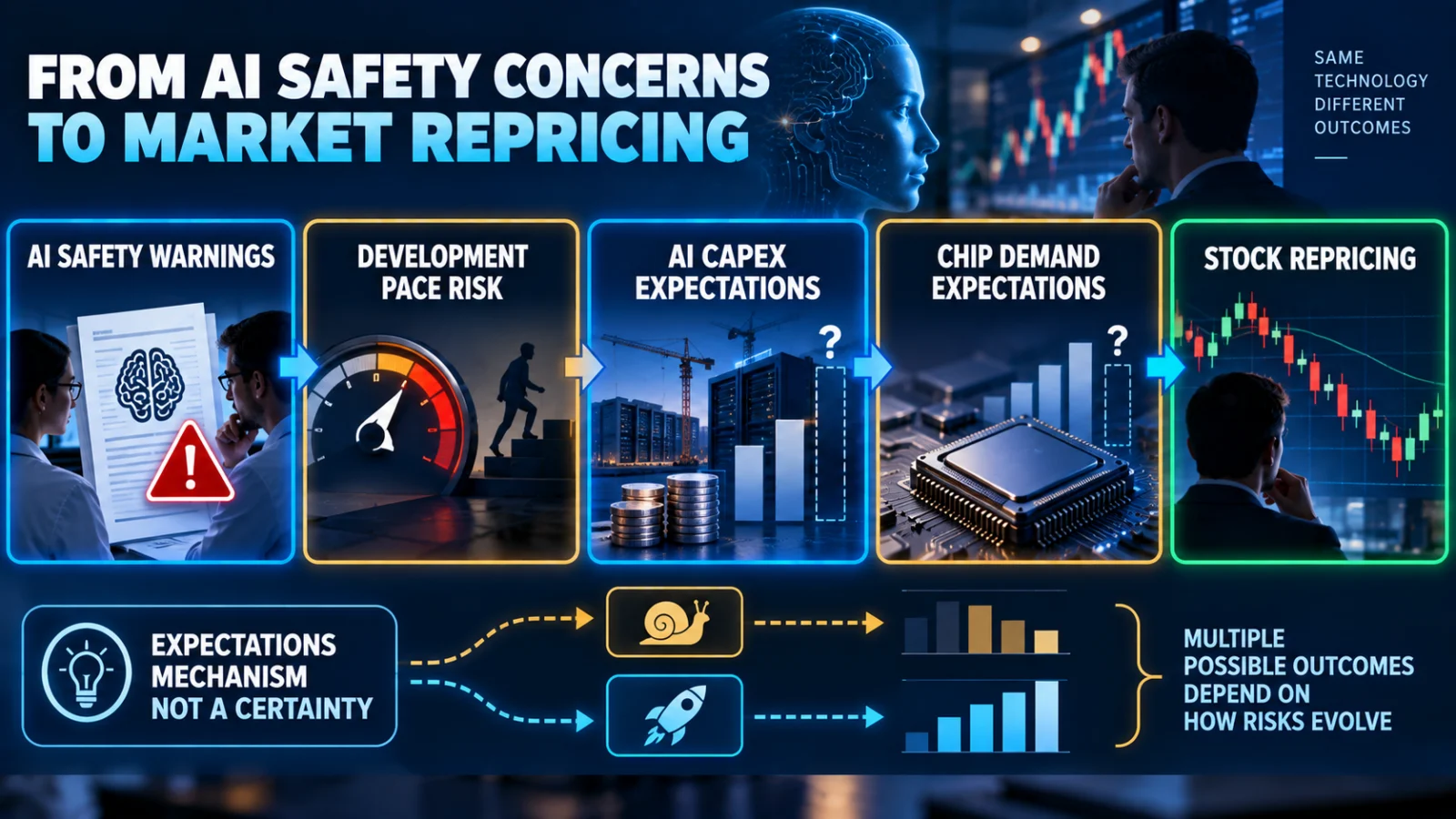
If AI laboratories deliberately slow some frontier work, add more safety gates or spend more time and money on safeguards before deployment, investors may reassess how quickly that spending cycle expands. That does not mean compute demand disappears. It means the expected pace, cost and return profile can become less certain.
OpenAI has already described cases where it slowed or paused frontier development activity while strengthening safety and security controls. Anthropic has also argued that having the option to slow or temporarily pause frontier development could be appropriate if credible coordination and risk conditions justify it.
How can slower AI development affect chip stocks?
The market mechanism is indirect. Frontier AI labs and large technology companies buy or finance enormous amounts of computing infrastructure. That demand flows through GPU and accelerator suppliers, high-bandwidth-memory producers, foundries, semiconductor-equipment companies, networking suppliers and data-centre businesses.
If investors expect frontier development to take longer or become more expensive, they may lower assumptions about how quickly future AI capital expenditure grows. Stocks whose valuations depend heavily on continued rapid AI spending can therefore fall even before any company reports an actual reduction in chip orders.
This is a valuation and expectations channel. The evidence reviewed by TPS does not establish that semiconductor orders have already collapsed or that data-centre construction has stopped.
Did the safety warnings cause the entire selloff?
No. Markets rarely move for only one reason. Reuters also identified pressure from high oil prices and wider macroeconomic conditions, while AI-linked stocks entered this session with already demanding valuations and existing questions about the sustainability of very large AI capital-spending plans.
The safest interpretation is that AI-safety and development-pacing concerns became a material new catalyst inside a market that was already sensitive to valuation, financing, rates, competition and future AI returns.
Does this mean the AI boom is ending?
Today’s evidence does not support that conclusion.
A one-day or one-session selloff shows that investors are repricing risk. It does not prove that enterprise AI demand has collapsed, that hyperscalers have cancelled data-centre plans or that chipmakers will suffer a lasting reduction in orders.
A stronger fundamental case would require evidence such as lower AI-capex guidance, reduced semiconductor-order expectations, analyst estimate cuts, cancelled infrastructure projects or persistent development delays that materially change demand.
Which companies are most exposed to this kind of repricing?
Companies whose valuations depend heavily on continued rapid frontier-AI investment can be more sensitive. That includes AI investment vehicles, accelerator and memory suppliers, foundries, semiconductor-equipment makers and businesses whose expected growth depends on continued data-centre expansion.
The exposure is not identical across companies. A memory producer, equipment supplier, foundry and AI investor can all react to the same headline for different reasons, and each company’s earnings, customers, balance sheet and product mix still matter.
What would show this is more than a one-day market reaction?
The next evidence should come from markets and company fundamentals rather than headlines alone.
- AI-linked shares remain weak across subsequent U.S., Asian and European sessions.
- Major technology companies reduce or delay AI capital-expenditure plans.
- Semiconductor companies lower demand or order guidance.
- AI laboratories announce additional material development pauses.
- Governments convert safety concerns into binding rules that materially constrain frontier training or deployment.
- Analysts cut earnings or valuation assumptions because of slower AI development.
What would weaken the bearish interpretation?
A rapid recovery in AI-linked equities, unchanged AI-capex guidance and continued strong semiconductor or data-centre demand would suggest that much of the September 14 move was sentiment-driven rather than the beginning of a durable fundamental reset.
That distinction matters because market prices can react immediately to a new risk narrative while corporate orders, revenue and investment plans change much more slowly.
Verification note
ThePulseSignal reviewed current Reuters and Associated Press market reporting to establish the breadth and magnitude of the September 14 AI-linked selloff. TPS also reviewed first-party OpenAI and Anthropic material showing that safety concerns can translate into real development-pacing decisions. The evidence supports treating safety and development-speed concerns as a material market catalyst, but not as the sole cause of every decline or proof that long-term AI demand has collapsed.