






India’s reported fuel export-duty rates from September 16, 2026 are ₹0.50 per litre for petrol, ₹20 per litre for diesel and ₹15 per litre for aviation turbine fuel.
These are levies on petroleum products exported from India. Current reporting says domestic petrol and diesel excise-duty rates were not changed by this revision, so the export-duty cut does not by itself establish a lower pump price for motorists.
Reported September 16 rates: Petrol ₹0.50/litre, diesel ₹20/litre and ATF ₹15/litre.
Evidence boundary: multiple current reports attribute these rates to Finance Ministry notifications, but TPS has not yet recovered the controlling September 16 CBIC, Finance Ministry or Gazette notification.
- What are the current reported export-duty rates?
- What changed from September 1?
- What changed in the diesel levy?
- Does this change petrol and diesel pump prices?
- Export duty vs domestic taxes
- Why are these duties revised frequently?
- Does the duty change prove a fuel shortage?
- What does this mean for exporters and refiners?
- Does the ATF export duty determine airfares?
- What should readers check now?
- Verification method
- Limitations
What are the current reported petrol, diesel and ATF export duties?
Reuters, Business Standard, The Economic Times and other current financial-news reports say the revised export levies took effect from September 16, 2026.
| Product | Reported export levy | Reported effective date |
|---|---|---|
| Petrol | ₹0.50 per litre | September 16, 2026 |
| Diesel | ₹20 per litre | September 16, 2026 |
| Aviation turbine fuel | ₹15 per litre | September 16, 2026 |
These are currently reported export-levy rates. TPS has not yet recovered the controlling September 16 government notification, so exporters should verify the official order before using these figures for compliance.
What changed from the September 1 rates?
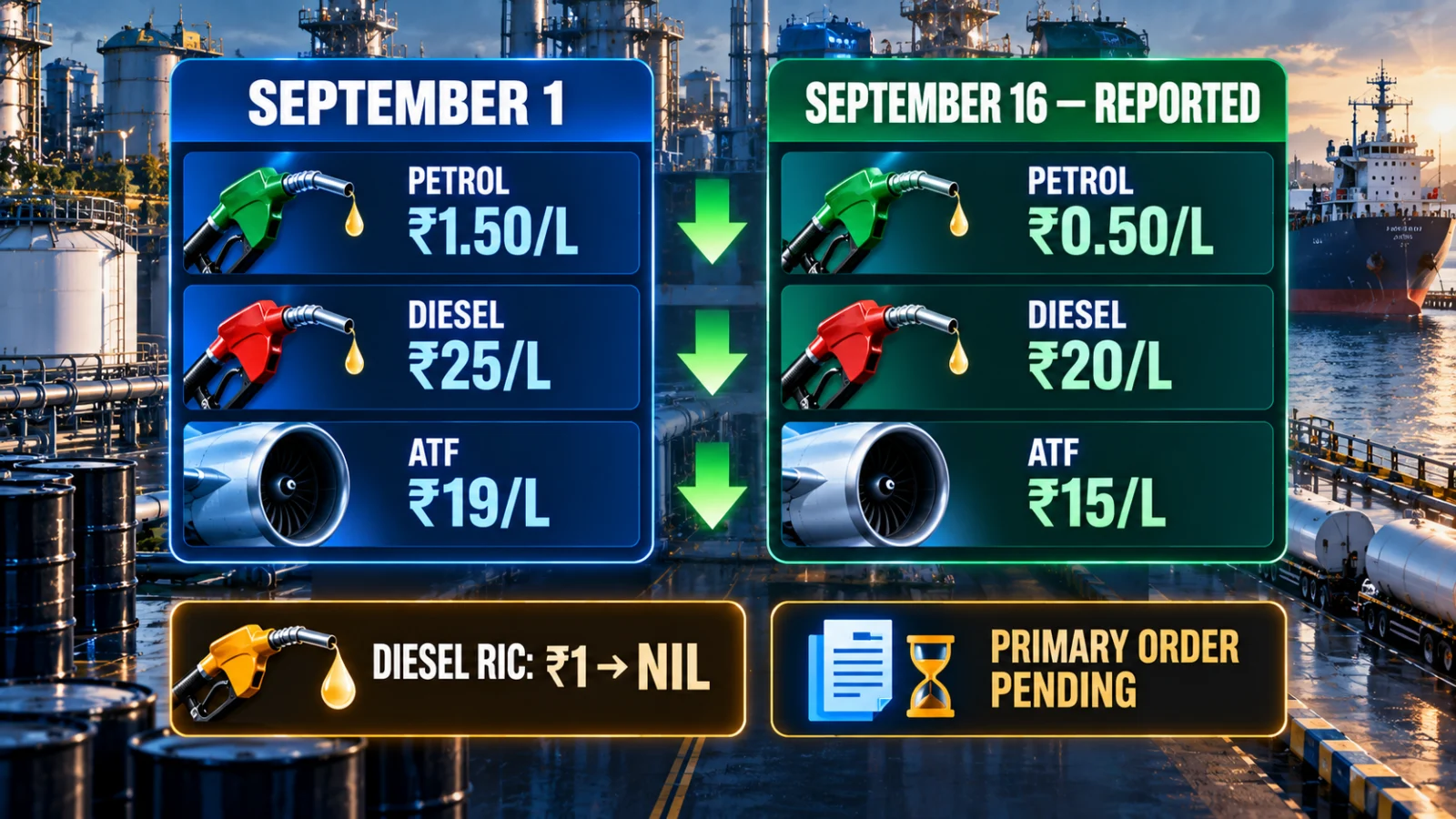
The reported September 16 revision reduces the export levy on all three products compared with the September 1 state.
| Product | September 1 rate | September 16 reported rate | Change |
|---|---|---|---|
| Petrol | ₹1.50/litre | ₹0.50/litre | Reduced by ₹1/litre |
| Diesel | ₹25/litre total | ₹20/litre | Reduced by ₹5/litre |
| ATF | ₹19/litre | ₹15/litre | Reduced by ₹4/litre |
PPAC’s public export-duty table still showed September 1 as its latest listed effective row when checked on September 17, even though the PPAC page itself showed a September 16 update date. That is why the newer September 16 figures remain presented here as reported rates rather than independently verified PPAC table values.
What changed in the diesel export levy?
Current reporting says diesel’s export levy is now ₹20 per litre. The Economic Times reports the new composition as ₹20 per litre of SAED with Road and Infrastructure Cess at nil.
The prior September 1 PPAC state showed ₹24 per litre SAED plus ₹1 per litre additional excise duty, for a total of ₹25 per litre. The current reported state therefore reduces the total diesel levy by ₹5 per litre.
Will this change petrol and diesel prices at Indian pumps?
Not automatically. Export duty and domestic retail fuel taxation are separate.
Current reporting on the September 16 revision says existing excise-duty rates on petrol and diesel cleared for domestic consumption were unchanged.
Domestic pump prices can instead be influenced by international crude and product prices, the rupee-dollar exchange rate, refining and transport costs, central excise duty, state VAT and oil-marketing-company pricing decisions.
Safer conclusion: a lower export levy by itself does not prove that the price displayed at a local petrol station will fall.
How is export duty different from domestic excise duty and VAT?
| Charge | Where it applies | Directly relevant to |
|---|---|---|
| Fuel export duty | Covered petrol, diesel or ATF exported from India | Exporters and refiners |
| Domestic central excise | Applicable domestic petroleum clearances | Domestic fuel tax structure |
| State VAT | Retail fuel sales in the relevant state or territory | Motorists and other domestic buyers |
| Retail pump price | Final price displayed at the fuel station | Consumers |
PPAC publishes domestic central-excise information separately from the export-duty table. A change in the export levy should therefore not be treated as proof that domestic excise duty or state VAT changed at the same time.
Why does the government keep revising these export duties?
India has been reviewing petroleum export levies periodically as international crude-oil prices, petroleum-product prices and refinery margins change.
Current reporting describes the September 16 revision as part of the regular fortnightly review. A rate from one review should therefore not automatically be treated as permanent.
Does the export-duty revision prove India has a petrol or diesel shortage?
No. An export levy is a policy tool affecting exports; it is not evidence by itself that India has a nationwide fuel shortage.
A shortage claim would require separate evidence such as official supply warnings, widespread station outages, rationing, refinery disruption or confirmed logistics failures.
What does the September 16 revision mean for exporters and refiners?
If the reported September 16 rates match the controlling government notification, the per-litre export-tax burden is lower for petrol, diesel and ATF than under the September 1 rates.
The commercial effect on an individual refiner still depends on export volumes, international product prices, export margins, domestic demand, production levels, shipping costs and contractual commitments. The levy change alone does not establish how much any particular refiner will export or earn.
Will the ₹15 ATF export duty change airline fares?
No direct airfare effect can be inferred from this export levy alone.
Domestic airfares depend on domestic ATF prices and taxes, airport charges, route demand, capacity, currency movements, aircraft utilisation and airline pricing decisions. A levy on exported ATF is not the same as a tax change on fuel supplied to an airline for domestic operations.
What should readers check now?
- Check the latest government or PPAC rate state.
The September 16 figures are strongly corroborated by current reporting, but the controlling notification has not yet been recovered by TPS. - Identify which tax a headline refers to.
Separate fuel-export levies from domestic central excise duty and state VAT. - Check local pump prices independently.
Do not infer a retail-price change from an export-duty headline. - Check actual fuel availability separately.
Use official supply information and local conditions rather than treating the tax change as proof of shortage. - Recheck at the next levy review.
The export-duty rates can change again during the government’s recurring review cycle.
Verification method
Method used: ThePulseSignal reviewed PPAC’s public export-duty table on September 17, 2026 and compared it with Reuters, Business Standard and The Economic Times reporting on the September 16 revision. PPAC still displayed September 1 as its latest listed rate row, while the current reports consistently described petrol at ₹0.50 per litre, diesel at ₹20 per litre and ATF at ₹15 per litre from September 16.
Sources reviewed
Last verified: September 17, 2026.
Limitations and unresolved facts
The controlling September 16 CBIC, Finance Ministry or Gazette notification has not yet been recovered by TPS.
- The exact notification number and statutory wording remain unresolved.
- PPAC’s public rate table still showed September 1 as the latest listed effective row when checked on September 17.
- A later export-duty decision can supersede the reported September 16 rates.
- The article does not predict future petrol or diesel pump prices.
- It does not establish the commercial effect on any individual refinery.
- It does not prove a nationwide fuel shortage.
- State VAT varies by jurisdiction.
- ATF export duty does not determine airline fares by itself.
Frequently asked questions
What is the current reported petrol export duty?
Current reports say ₹0.50 per litre from September 16, 2026.
What is the current reported diesel export duty?
Current reports say ₹20 per litre from September 16, with SAED at ₹20 and Road and Infrastructure Cess reported at nil.
What is the current reported ATF export duty?
Current reports say ₹15 per litre from September 16, 2026.
Did petrol tax at Indian pumps fall to ₹0.50?
No. The ₹0.50 figure refers to the reported export levy on petrol. It is not the tax charged directly at domestic petrol pumps.
Did the September 16 revision reduce pump prices?
The export-duty revision itself does not establish a domestic pump-price reduction.
Can these rates change again?
Yes. The government has been reviewing these export levies periodically, so readers should check the latest official rate state before relying on an older figure.