






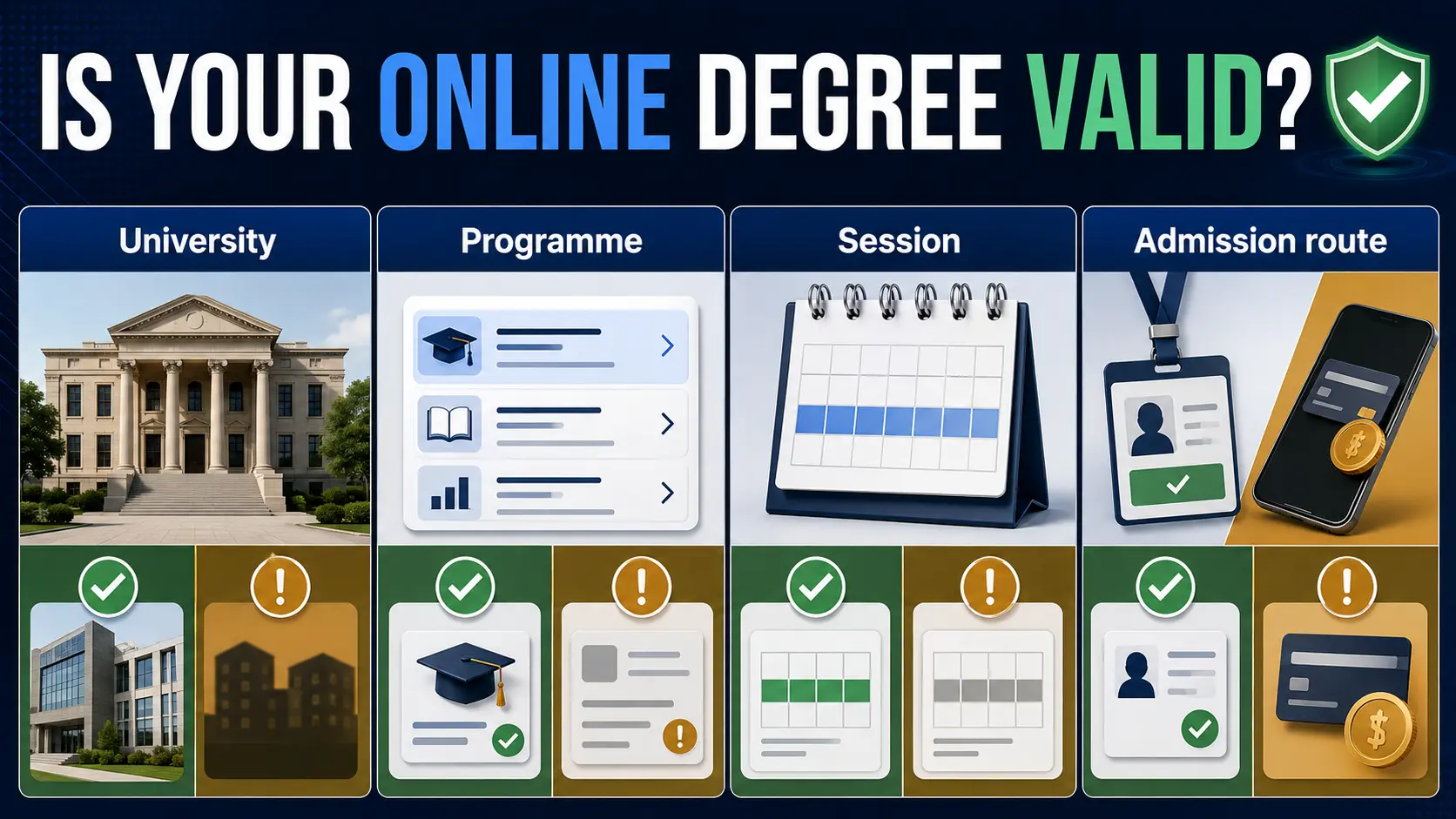
A UGC approved online degree cannot be verified by checking only the university’s name, logo or general UGC status. Students should confirm the degree-awarding institution, exact online or ODL programme, relevant academic session and enrolment route before paying an EdTech platform, counsellor or study centre.
The Ministry of Education has warned that EdTech advertisements may use the name of a recognised university while offering degrees or diplomas through impermissible franchise arrangements. This creates a serious admission risk: the university may be genuine, but the advertised programme, intake or private-provider arrangement may still lack UGC recognition.
How to verify a UGC approved online degree
Check the institution in UGC’s university records, confirm that the exact programme and learning mode appear in the UGC-DEB list for the correct academic session, create the required DEB-ID, and obtain admission confirmation directly from the university rather than relying only on an EdTech advertisement.
August 2026 admission warning
The Education Ministry’s August 5 parliamentary reply confirms that UGC has noticed EdTech advertisements involving recognised or entitled institutions. UGC says franchise arrangements for ODL or online programmes are not permissible and students must verify programme recognition on the UGC-DEB portal.
- An HEI must retain complete ownership of its ODL or online programme.
- A university cannot offer such programmes through a franchise arrangement with a private service provider.
- Students must verify the exact programme and session on UGC-DEB.
- A DEB-ID is mandatory for enrolment in ODL or online programmes.
- UGC’s February 2026 register lists 32 fake universities.
- The Ministry has not publicly named the EdTech companies or universities under examination in the cited reply.
- No automatic refund, migration or retrospective validation process has been announced.
- No dedicated EdTech-franchise complaint form was identified.
- A university logo, authorisation letter or counsellor message does not by itself prove programme recognition.
Table of contents
What exactly did UGC warn about?
The August 5, 2026 Ministry of Education reply says UGC has noticed advertisements by EdTech companies offering degree and diploma programmes in ODL or online mode in association with recognised or entitled higher-education institutions.
The official position is not that every technology-provider relationship is illegal. The concern is an arrangement where a private provider acts as a franchise or independently offers, admits students to, or presents itself as the provider of a university qualification.
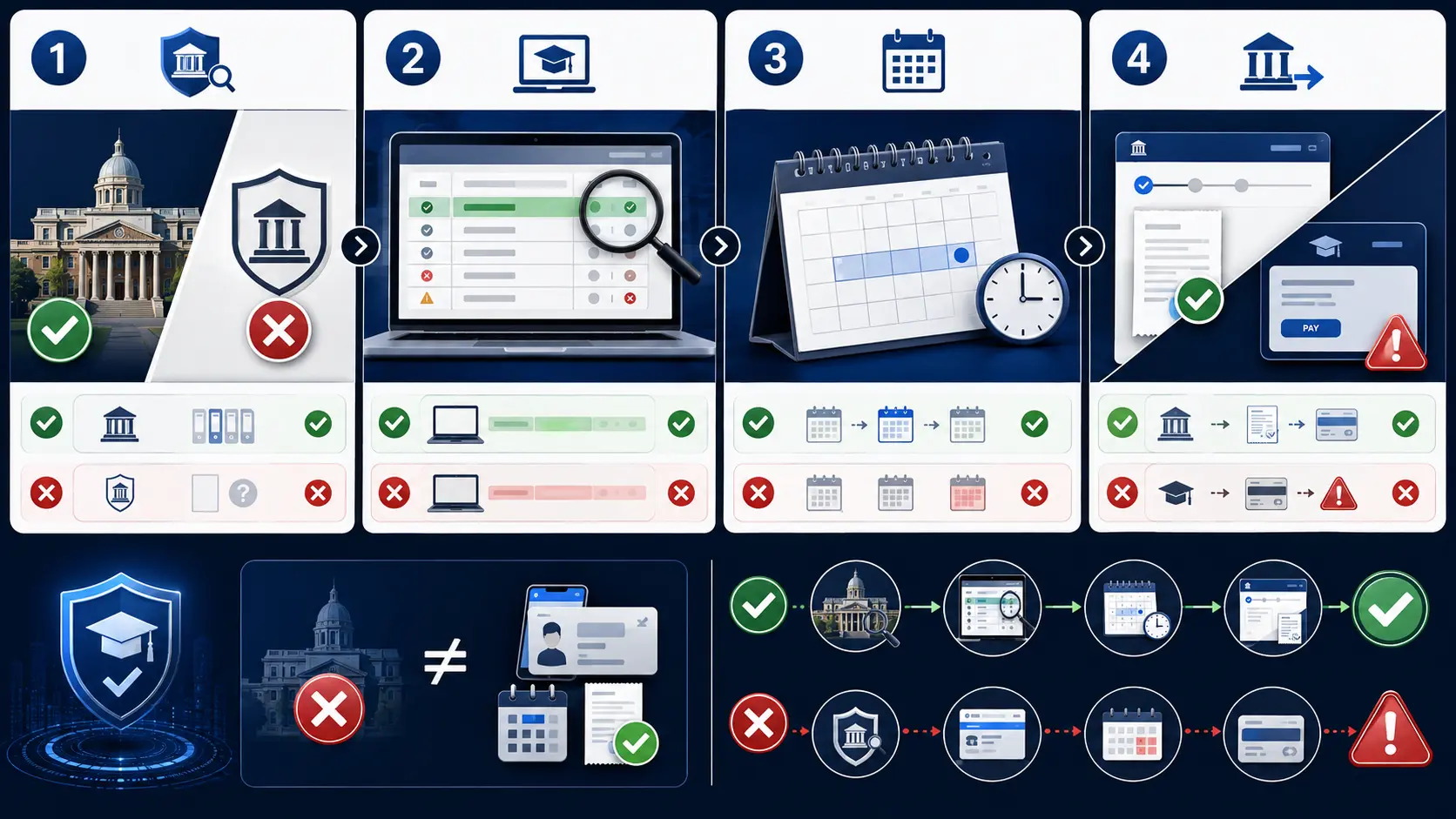
A recognised university’s name does not prove that every course, admission session, learning centre or EdTech enrolment arrangement using that name is recognised.
Four checks for a UGC approved online degree
University identity
Confirm the legal degree-awarding institution in UGC’s official university records. Do not rely only on the name displayed in an advertisement.
Exact programme
Search UGC-DEB for the exact MBA, BBA, BCA, MCA, MA or other programme and confirm the correct learning mode.
Academic session
Check whether recognition or entitlement covers the intended admission year or session. An older listing does not automatically cover August 2026.
Enrolment route
Confirm that the application, payment and final registration are controlled and acknowledged by the university—not only by an EdTech counsellor or local centre.
These advertising claims are not equivalent
| Claim shown to the student | What it may establish | What still needs verification |
|---|---|---|
| “The university is UGC recognised” | The institution may have legal university status | The exact online programme, mode and session |
| “The university offers online courses” | The university may offer some recognised online programmes | Whether this specific course is listed |
| “Official university partner” | A commercial or technology relationship may exist | Whether the provider may admit students or collect fees for the qualification |
| “Industry-recognised certificate” | An employer or company may value the training | Whether it is a UGC-recognised degree or diploma |
| “Not on the fake-university list” | The name was not found in that warning register | Actual university recognition and programme entitlement |
| “NAAC accredited” | The institution may hold an accreditation grade | Degree-awarding authority and online-programme entitlement |
Why DEB-ID and the admission session matter
UGC-DEB states that a valid DEB-ID is mandatory for enrolment in ODL or online programmes. The DEB-ID is generated through the official admission system using the student’s ABC ID and identity details.
The admission page currently displays September 15, 2026 as the last date for admitting learners in ODL or online programmes for the August 2026 session. A deadline shown on the portal does not, however, make every advertised programme valid. Students must still check the programme list and session.
If a counsellor tells a student that DEB-ID is unnecessary, that the university will “manage it later,” or that an older approval automatically covers the current intake, the student should pause and confirm directly with UGC-DEB and the university.
When is an EdTech company a service provider, and when is it acting like a franchise?
UGC-DEB’s FAQ says an HEI must offer its programme under complete ownership and cannot use a private service provider through a franchise arrangement.
The available official sources do not say that every software, marketing or technology-support contract is prohibited. The practical question is who controls the academic programme and the admission.
Lower-risk indicators
- The university’s official website lists the programme and session.
- The university issues the application and enrolment number.
- Fees are paid through a university-authorised process.
- The university confirms the EdTech platform’s limited role.
- The student receives direct access to the university grievance system.
Warning indicators
- The EdTech company alone promises admission or degree issuance.
- The programme cannot be found in the UGC-DEB list.
- A local centre collects fees without direct university confirmation.
- The counsellor avoids naming the admission session or entitlement record.
- The student is told that recognition can be “updated later.”
Which programmes need extra caution?
UGC-DEB identifies several disciplines that cannot ordinarily be offered through ODL or online mode, including engineering, medicine and allied health disciplines, pharmacy, nursing, dental, architecture, law, agriculture, hotel management and other listed practical or regulated fields. M.Phil. and Ph.D. programmes are also prohibited through these modes.
Students should not assume that general UGC recognition is enough for a professionally regulated qualification. They may also need to verify the relevant regulator, such as the appropriate council or statutory body for that discipline.
“Valid for all government jobs” or “accepted everywhere” is too broad unless the exact programme, mode, session and any professional-regulator requirements have been checked.
Before paying for a UGC approved online degree
- Screenshot of the advertisement and programme page.
- Name of the legal degree-awarding university.
- UGC-DEB programme-list record for the correct session.
- DEB-ID instructions and confirmation.
- University application or registration number.
- Written explanation of the EdTech provider’s role.
- Fee recipient, payment page and receipt.
- Refund and cancellation terms.
- Counsellor messages, emails and claimed authorisation letters.
- Professional-regulator approval where applicable.
A UGC approved online degree should leave a verifiable university record, not only an EdTech receipt or counsellor message.
Where possible, contact the university through the email or telephone number published on its official website—not only through the contact details supplied by the EdTech salesperson.
What if you have already paid or enrolled?
First, obtain written confirmation from the university that your name, programme, mode, session and enrolment number appear in its records. Then check the same programme and session on UGC-DEB.
If there is a mismatch, preserve all evidence and submit a written grievance to the university and relevant official authorities. The August 5 reply confirms that UGC may act on complaints, but the reviewed sources do not establish a dedicated EdTech-franchise complaint form.
No official source reviewed guarantees an automatic refund, migration to another programme or retrospective validation. Those outcomes may depend on the payment recipient, contract, university action, consumer remedies and any later UGC direction.
Official verification links
- UGC university records
- UGC fake-university register
- UGC-DEB recognised and entitled programme list
- UGC-DEB admission and DEB-ID page
- UGC-DEB official FAQs
Related ThePulseSignal verification guides
Official NOTTO app registration guide
A public-service verification guide showing how to distinguish an official registration workflow from misleading alternatives.
India forced labour import ban explained
An evidence-led regulatory explainer separating an official inquiry framework from an immediate blanket ban.
How this was verified
ThePulseSignal reviewed the Ministry of Education’s August 5, 2026 parliamentary reply titled “Misleading EdTech platforms and fake Universities,” which confirms the EdTech-franchise warning, the programme-verification requirement and the February 2026 count of 32 fake universities.
The current UGC-DEB FAQ was checked for the complete-ownership and no-franchising rule. The UGC-DEB programme list was checked to confirm that recognition records are programme-, mode- and session-specific. The DEB-ID admission page was checked for the current August 2026 admission deadline and mandatory DEB-ID workflow.
The live UGC fake-university register was checked separately. General university recognition, programme entitlement, academic-session coverage, DEB-ID and enrolment route were treated as distinct verification layers.
Last verified: August 5, 2026, approximately 11:46 PM IST.
Limitations and unresolved facts
- The Ministry’s reply does not name the EdTech companies or universities involved in the cited advertisements.
- No verified count of affected students or fees collected was provided.
- No dedicated EdTech-franchise complaint form was identified.
- No automatic refund, migration or retrospective-validation rule was found.
- The article does not determine the status of any specific university, programme or platform without checking the current official records.
- Professional-regulator rules may create additional requirements beyond UGC-DEB recognition.
Frequently asked questions
Is every degree from a UGC-recognised university valid online?
No. The exact programme, learning mode and academic session must also be recognised or entitled under the applicable UGC-DEB record.
Can an EdTech company enrol students for a university degree?
A private provider cannot offer the programme through an impermissible franchise arrangement. The university must retain complete ownership and control of the programme and admission.
Does a university logo prove that the online degree is approved?
No. Verify the university, programme, mode, session and admission route in official records.
Is DEB-ID mandatory?
UGC-DEB states that a valid DEB-ID is mandatory for enrolment in ODL or online programmes.
Does absence from the fake-university list prove recognition?
No. The institution must still appear in the relevant recognised-university records, and the exact programme and session must be verified separately.
Are online degrees valid for government jobs?
A recognised online or ODL award may be valid, but acceptance can depend on the exact programme, session, recruitment rules and any applicable professional regulator.
Can a previous-year UGC-DEB approval be used for August 2026 admission?
Do not assume so. Verify that the current programme listing covers the intended academic session.
Can students automatically get a refund if the programme is unrecognised?
No automatic refund rule was identified in the reviewed sources. Preserve all records and pursue written grievances and applicable consumer or regulatory remedies.