






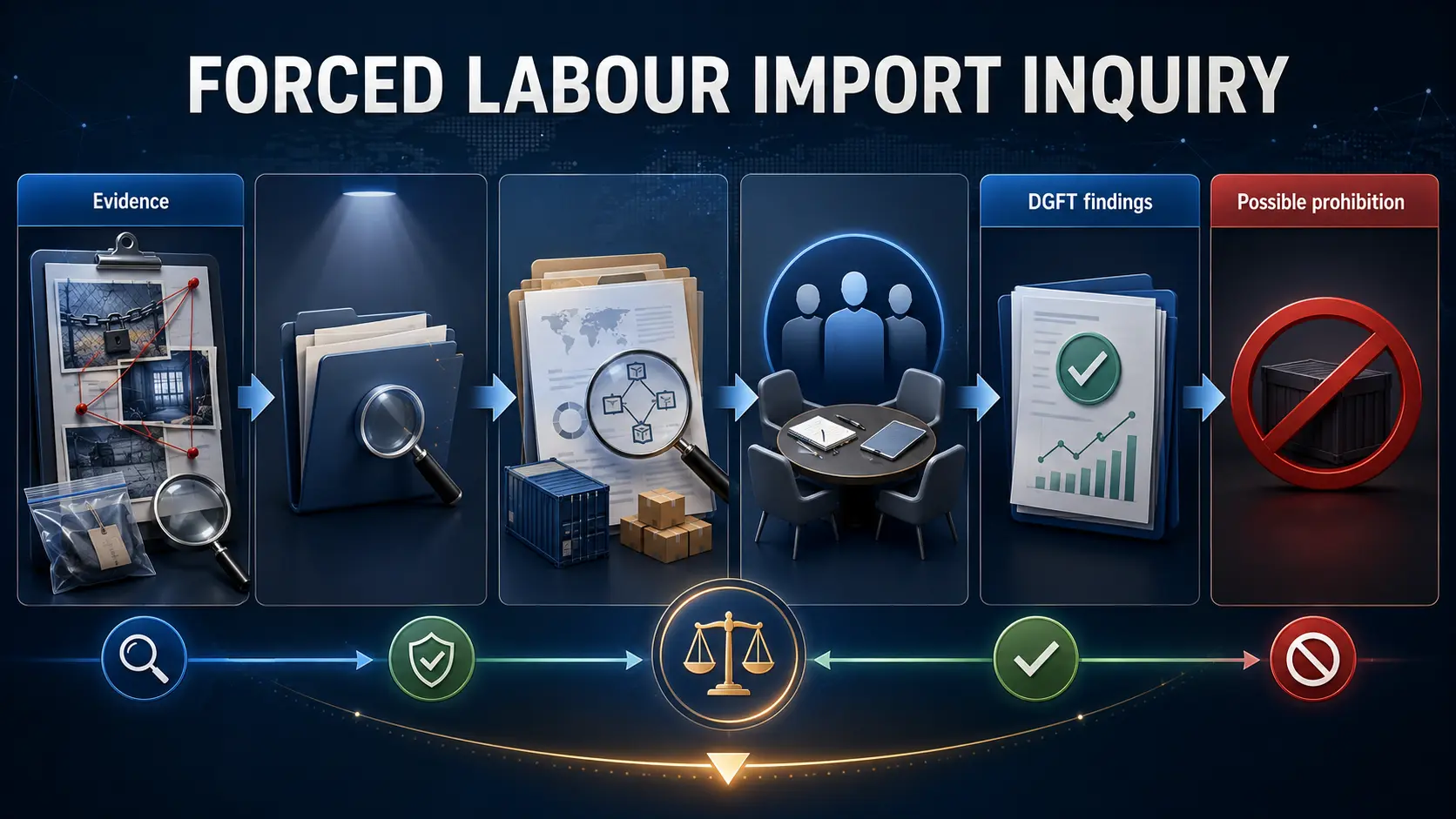
The India forced labour import ban framework allows the Central Government to prohibit specific imported goods after a DGFT inquiry finds credible evidence that they were produced wholly or partly using forced labour. The framework does not mean that every product facing an allegation is automatically banned, and it does not create a confirmed public complaint portal or fixed inquiry timeline.
The main reader problem is the difference between a legal power, an inquiry and an actual product prohibition. Importers, brands and supply-chain teams need to know what DGFT may investigate, what evidence it may seek, who can be questioned and what remains unresolved before any specific goods are prohibited.
What the India forced labour import ban framework does
DGFT Notification No. 23/2026-27 created the policy power to prohibit goods produced wholly or partly using forced labour. Public Notice No. 21/2026-27 inserted Paragraph 2.50A into the Handbook of Procedures and created the inquiry mechanism used to determine whether particular imported goods fall within that power.
Policy and inquiry procedure are confirmed
The policy provision and Paragraph 2.50A inquiry procedure are officially notified. No specific product, supplier, facility, company or country-wide prohibition is established merely by these two documents.
- DGFT may initiate an inquiry on its own or after receiving information or a complaint supported by credible material.
- The inquiry may cover goods produced wholly or partly using forced labour.
- DGFT may seek information from importers, exporters, manufacturers and other persons or authorities.
- DGFT may consult ministries, agencies, stakeholders and domestic or international expert bodies.
- DGFT may recommend prohibition of the goods to the Central Government after completing its findings report.
- No dedicated public filing form or forced-labour complaint portal has been identified.
- No inquiry deadline, response period or standard of proof is stated.
- No automatic ban arises from an allegation, media report or private audit alone.
- No published rule defines whether a future prohibition will be product-, supplier-, facility-, company- or country-specific.
- The ordinary DGFT Quality Complaints and Trade Disputes portal is not confirmed as the Paragraph 2.50A filing route.
Table of contents
What changed in the India forced labour import ban framework?
The India forced labour import ban is built on two linked DGFT instruments.
DGFT Notification No. 23/2026-27 inserted a new policy provision allowing the Central Government to prohibit imports of goods produced or manufactured wholly or partly using forced labour.
Public Notice No. 21/2026-27 then inserted Paragraph 2.50A into the Handbook of Procedures 2023. That paragraph gives DGFT the procedural authority to examine whether imported goods were produced wholly or partly using forced labour and to recommend appropriate action to the Central Government.
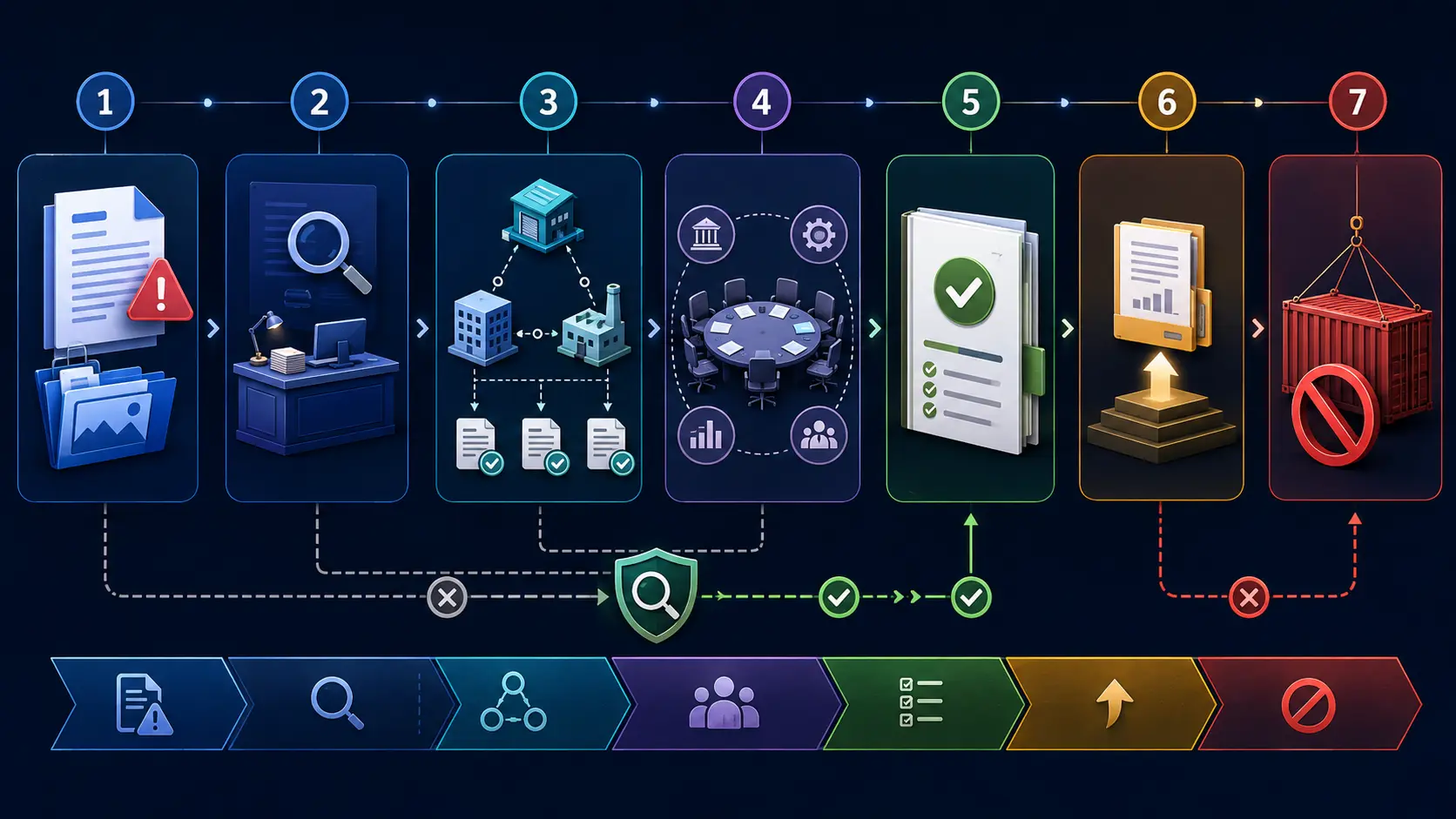
Do not describe this as an immediate blanket ban on every product linked to a forced-labour allegation. The current framework creates a power and an inquiry process; a prohibition still requires government action concerning the goods in question.
What does “forced labour” mean under the policy?
The policy adopts the forced-labour concept used in the International Labour Organization’s Forced Labour Convention framework: work or service exacted from a person under the threat of a penalty and for which that person has not offered voluntarily.
The policy reaches goods produced or manufactured wholly or partly using forced labour. That wording means the inquiry is not necessarily limited to the final assembly stage. Inputs, components, processing or another part of the production chain may become relevant where supported by evidence.
The phrase “wholly or partly” makes upstream traceability important. An importer may need evidence extending beyond the immediate supplier where risk exists in raw materials, subcontracting, processing or component sourcing.
How can DGFT start a forced-labour inquiry?
Suo motu action
DGFT may begin an inquiry on its own initiative without waiting for a private complaint.
Information or complaint
DGFT may act after receiving information or a complaint supported by credible material.
Document requests
DGFT may seek information, documents or clarifications from importers, exporters, manufacturers or another relevant person or authority.
Government consultation
Relevant ministries, departments, agencies and stakeholders may be consulted.
Technical input
DGFT may obtain information or expert input from domestic or international organisations, governmental authorities or expert bodies.
Findings and recommendation
DGFT prepares a report and may recommend appropriate action, including prohibition of imports of the goods concerned.
What evidence may matter in an inquiry?
Paragraph 2.50A does not prescribe a closed evidence list. It gives DGFT broad power to request information, documents and clarifications considered necessary.
Supply-chain records
Supplier identities, factory locations, purchase records, subcontractor details, bills of material and origin information may become relevant.
Labour and production evidence
Employment records, recruitment practices, wage records, worker testimony, audit findings or official investigations may be examined where relevant.
External technical material
DGFT may seek material from government bodies, international organisations or expert institutions.
The procedure does not say that a private social-compliance audit automatically proves or disproves forced labour. Such material may form part of a larger evidentiary record, but DGFT retains the inquiry role.
When can the India forced labour import ban actually apply?
| Stage | What is established | What is not yet established |
|---|---|---|
| Allegation or report | Information exists | No automatic prohibition |
| DGFT inquiry begins | DGFT is examining credible material | No final finding yet |
| DGFT findings report | DGFT records its conclusion on the goods under inquiry | A recommendation is not necessarily the final prohibition instrument |
| Central Government action | Specific goods may be prohibited under the foreign-trade legal framework | The scope depends on the actual government measure issued |
The India forced labour import ban will operate through the wording of any future prohibition instrument. That instrument will be crucial. It should identify the goods and legal scope actually covered. Until such an instrument is issued, it is unsafe to infer a ban against an entire product category, supplier, company or country.
Is the DGFT QCTD portal the complaint route?
The DGFT Quality Complaints and Trade Disputes portal handles commercial and quality disputes between Indian and foreign importers or exporters, including poor quality, non-supply, partial supply, non-payment and delivery disputes.
That QCTD system is reconciliatory in nature. Paragraph 2.50A is a separate government inquiry into whether imported goods were produced using forced labour.
No official source reviewed confirms that submitting a QCTD complaint automatically initiates a Paragraph 2.50A inquiry. Readers should not use the ordinary trade-dispute portal as a confirmed forced-labour filing route unless DGFT publishes a specific instruction.
How should businesses prepare for the India forced labour import ban?
Map the full supply chain
Identify direct suppliers, factories, subcontractors, processors and material sources for higher-risk goods.
Preserve origin and production evidence
Keep contracts, purchase orders, supplier declarations, factory records, audits and traceability documents organised and retrievable.
Strengthen contract rights
Use clauses requiring truthful labour-practice disclosures, document access, audit cooperation, subcontractor transparency and corrective action.
Create an escalation process
Define who will respond if DGFT seeks records and how legal, procurement, compliance and logistics teams will coordinate.
Forced-labour import due-diligence checklist
- Identify goods and inputs with elevated labour-risk exposure.
- Map production beyond the immediate exporter.
- Record factory names, addresses and ownership where practicable.
- Require suppliers to disclose subcontracting and material sourcing.
- Retain invoices, shipping records and production evidence.
- Check whether audit coverage includes recruitment, coercion, debt, document retention and freedom to leave employment.
- Document how adverse findings were investigated and remediated.
- Prepare a single response file for any DGFT information request.
- Track future DGFT notifications identifying prohibited goods.
The most durable compliance value is not a one-time supplier declaration. It is a traceable evidence system showing what the importer knew, what it checked, how it addressed risk and whether the records extend to the part of the production chain where the alleged forced labour occurred.
Official DGFT resources
- DGFT notification register
- DGFT public notices
- DGFT Public Notice No. 21/2026-27 and Paragraph 2.50A
- DGFT Quality Complaints and Trade Disputes page
Related ThePulseSignal guides
India’s e-commerce export framework explained
A separate DGFT explainer covering export-only inventory, seller payments, returns and Exporter-on-Record compliance.
ANF-9A Exporter-on-Record registration guide
A procedural guide to the application fields, documents, warehouses and declarations required under ANF-9A.
How this was verified
ThePulseSignal reviewed DGFT Notification No. 23/2026-27 for the policy power to prohibit imports of goods produced wholly or partly using forced labour. DGFT Public Notice No. 21/2026-27 and both pages of its official PDF were reviewed to verify Paragraph 2.50A, including inquiry initiation, information requests, stakeholder consultation, expert inputs, findings and recommendations.
The DGFT Quality Complaints and Trade Disputes page, its official FAQ document and Chapter 8 material were checked to determine whether QCTD is the confirmed forced-labour complaint route. Those sources describe commercial and quality disputes and do not establish automatic initiation of a Paragraph 2.50A inquiry.
The current DGFT notification and public-notice registers were treated as the controlling live sources. The third-party reproduction supplied by the reader was used only to locate and cross-check the official DGFT PDF.
Last verified: August 5, 2026, approximately 10:07 PM IST.
Limitations and unresolved facts
- No dedicated complaint form, filing email or public forced-labour portal was identified.
- The procedure does not specify who has standing to complain or whether anonymous information is accepted.
- No inquiry deadline, importer response period or formal standard of proof is stated.
- No rule reviewed explains interim Customs detention while an inquiry is pending.
- The procedure does not say whether the findings report will be published.
- No appeal, review or reconsideration route is expressly stated in Paragraph 2.50A.
- The scope of any future prohibition will depend on the wording of the specific government measure.
- No specific goods were identified as prohibited solely by the two framework documents reviewed for this article.
Frequently asked questions
Has India banned all goods linked to forced labour?
No. The India forced labour import ban is not a blanket ban. India has created a policy power and inquiry procedure through which specific goods may be prohibited after examination and government action.
Can DGFT begin an inquiry without a complaint?
Yes. Paragraph 2.50A allows DGFT to act suo motu.
What must support a complaint or information?
The procedure says it must be supported by credible material, but it does not prescribe a closed evidence list.
Can DGFT ask an importer for documents?
Yes. DGFT may seek information, documents or clarifications from importers, exporters, manufacturers or another relevant person or authority.
Does the rule cover goods made partly using forced labour?
Yes. The framework expressly covers goods produced wholly or partly using forced labour.
Is the QCTD portal the confirmed filing route?
No. The official QCTD materials describe commercial and quality disputes. They do not confirm that a QCTD filing initiates a Paragraph 2.50A forced-labour inquiry.
Is there a fixed inquiry timeline?
No fixed timeline was identified in Paragraph 2.50A.
What should importers do before any specific ban is issued?
Map suppliers and production locations, preserve traceability evidence, strengthen contract rights and prepare to respond quickly to a DGFT information request.