






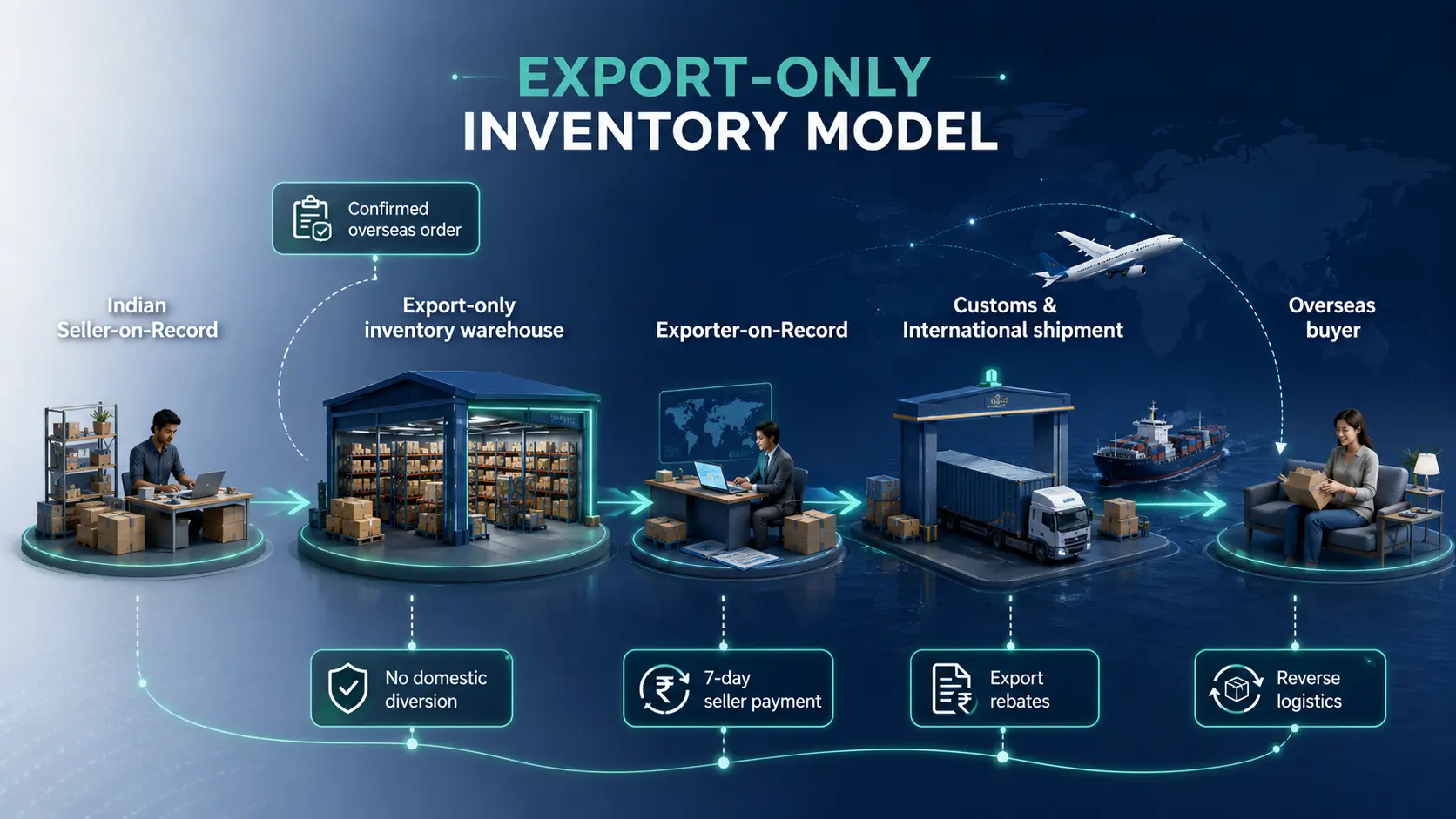
India’s e-commerce export framework now allows a DGFT-registered Exporter-on-Record to buy and hold Indian-origin goods for confirmed overseas orders under a controlled export-only model. The framework does not create a general permission for domestic inventory-led e-commerce and does not remove IEC, GST, Customs, FEMA, ITC(HS), export-control or destination-country compliance requirements.
The practical confusion is not whether the policy exists, but how far it goes. Sellers, platforms and compliance teams need to know who owns the goods, when title may pass, who must pay the seller, what happens to returns, how export benefits are shared and which operational details remain unresolved.
E-commerce export framework: what changed
DGFT Notification No. 27/2026-27 created the policy framework. Public Notice No. 25/2026-27 operationalised registration, inventory control, seller visibility, payments, reverse logistics, certification and dispute handling through the Handbook of Procedures and ANF-9A.
Operational position on August 5, 2026
The framework took immediate effect on August 5, 2026. ANF-9A presently instructs applicants to submit the completed application and supporting documents through the DGFT email route stated in the form.
- A registered Exporter-on-Record may hold eligible Indian-origin goods as export-only inventory.
- Inventory must be linked to confirmed overseas orders.
- Seller payment must be completed within seven days after acceptance or deemed acceptance.
- Returned export inventory cannot be diverted to domestic sale under this framework.
- A dedicated online ANF-9A module was not established in the reviewed official material.
- The framework does not prove that any named platform has completed onboarding.
- No separate framework-specific CBIC or RBI implementation instrument was identified during the recorded check.
- Product-specific Customs, GST and destination-country rules remain separate.
Table of contents
What changed in India’s e-commerce export framework?
DGFT inserted a new inventory-based cross-border e-commerce facilitation framework into Chapter 9 of the Foreign Trade Policy and added a corresponding operating procedure to the Handbook of Procedures.
The e-commerce export framework allows an eligible e-commerce entity to conduct export-only inventory operations through a registered Exporter-on-Record. The Exporter-on-Record may purchase qualifying goods from Indian Sellers-on-Record, hold those goods as separately identified export inventory and sell them to buyers outside India.
The phrase “inventory-based e-commerce” can be misleading when read without the export-only condition. This is not a blanket permission for foreign-funded platforms to own inventory for domestic B2C sales.
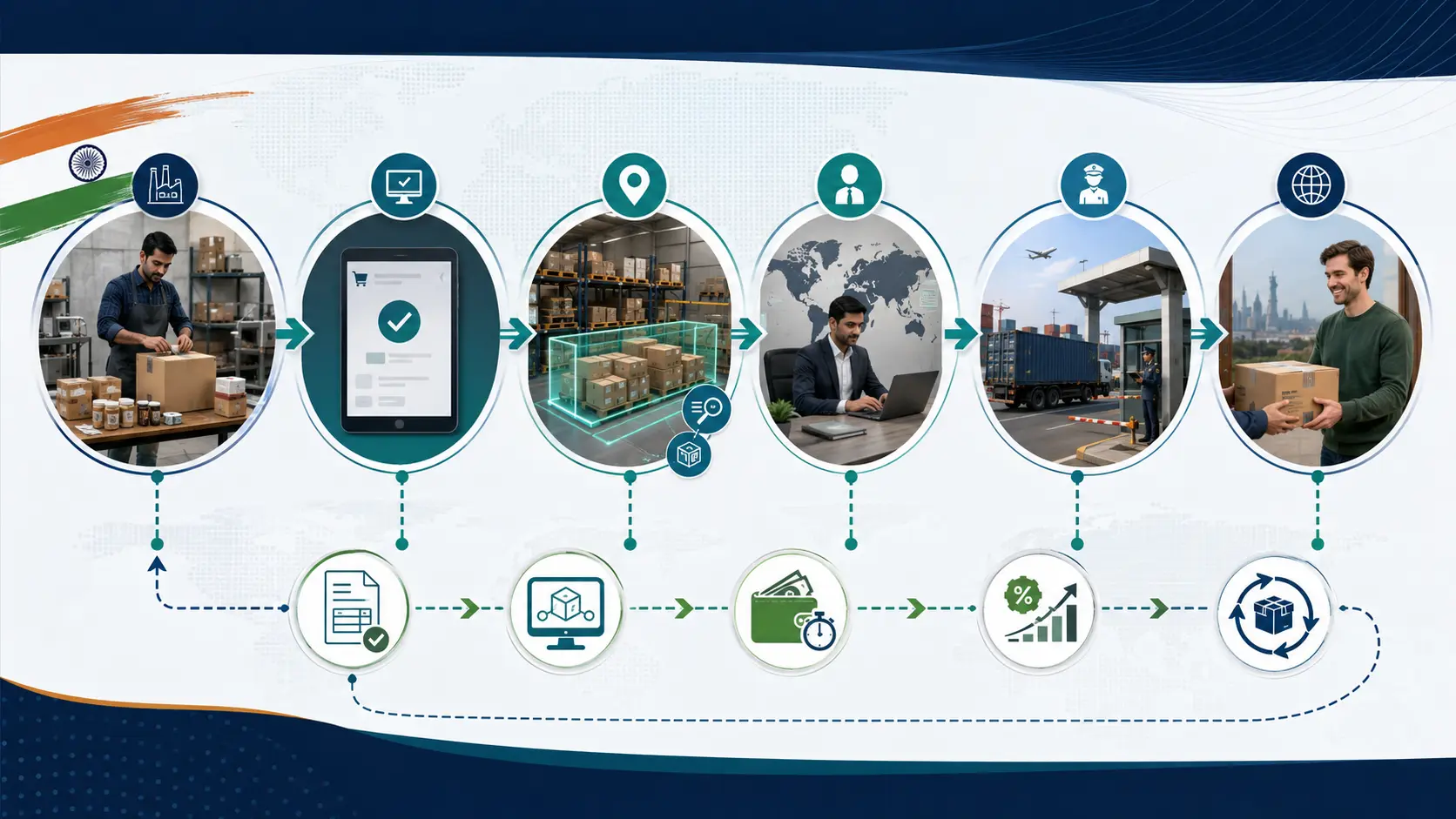
How the e-commerce export framework works
Confirmed overseas order
The process begins with a confirmed order from a buyer outside India. Speculative inventory build-up is prohibited.
Seller supplies Indian-origin goods
The Seller-on-Record supplies eligible goods produced in India against that confirmed export order.
Exporter acquires title
Title passes to the registered Exporter-on-Record only against the confirmed overseas order.
Inventory remains export-only
The goods must remain distinctly identified, segregated, recorded and digitally traceable.
Export and foreign sale
The Exporter-on-Record undertakes the export and remains responsible for the central compliance burden.
Returns stay controlled
Returned or rejected inventory must follow the prescribed return, re-export, destruction or lawful disposal route.
Exporter-on-Record vs Seller-on-Record
Exporter-on-Record
- Must hold a valid IEC and GSTIN.
- Must register with DGFT under the e-commerce export framework.
- Owns the export inventory.
- Undertakes the export and overseas sale.
- Manages reverse logistics.
- Claims eligible export rebates and refunds.
- Maintains the digital repository and compliance records.
Seller-on-Record
- Must be registered in India under applicable GST law.
- Supplies Indian-origin goods against confirmed overseas orders.
- Must declare the correct origin of the goods.
- Must receive payment within the prescribed period.
- May receive the seller-attributable share of export benefits.
- May use the DGFT dispute route where required.
The central policy change is not merely that a platform may own goods. It is that the e-commerce export framework now allocates ownership, seller payment, inventory segregation, export-benefit sharing, reverse logistics and recordkeeping across a defined Exporter-on-Record and Seller-on-Record structure.
Which goods qualify and how must inventory be controlled?
Indian origin
Only goods of Indian origin are eligible under the framework.
Confirmed order
Title may pass only against a confirmed order from an overseas buyer.
No speculative stock
Speculative transfer of title or inventory accumulation without a confirmed export order is prohibited.
The Exporter-on-Record must maintain a digital repository across all inventory locations. It must link procurement records, GST invoices, export documents, inventory status, each Seller-on-Record’s supplies and the corresponding confirmed overseas order.
The Exporter-on-Record must also ensure that the stored goods match the description, specifications and quality parameters declared by the seller.
When must sellers be paid and who receives export benefits?
A central seller protection in the e-commerce export framework is that payment cannot wait for the overseas buyer.
Seven-day seller payment
The Exporter-on-Record must pay the seller no later than seven days after acceptance or deemed acceptance of the goods.
No foreign-buyer dependency
Seller payment cannot be made contingent on the overseas buyer’s payment, a later return or another event outside the seller’s control.
Thirty-day benefit pass-through
The seller-attributable export benefit must be disbursed within 30 days after the Exporter-on-Record receives the corresponding rebate or refund.
The Exporter-on-Record may retain an administrative charge, but the HBP procedure caps that charge at 10% of the gross export rebates and refunds. The balance attributable to participating sellers must be apportioned in proportion to the free-on-board value attributable to each seller’s goods as declared in the shipping bill.
How are returns and rejected consignments handled?
| Situation | Required treatment | Deadline or responsibility |
|---|---|---|
| Goods fail description, specification or quality checks | Return the goods to the Seller-on-Record | Within seven days of acceptance or deemed acceptance |
| Overseas buyer returns or rejects the consignment | Re-export, return to seller, destroy or otherwise lawfully dispose | No later than 30 days after receipt in India |
| Reverse-logistics expenses | Borne by the Exporter-on-Record | Exporter-on-Record responsibility |
| Domestic resale of returned inventory | Not permitted under the framework | Prohibited |
The seller-platform agreement must clearly define cancellation, rejection, repair, return, re-export, destruction and disposal terms. Those terms must be fair, transparent and verifiable.
How does ANF-9A registration work?
ANF-9A is the current registration route specified for an entity seeking recognition as Exporter-on-Record under the e-commerce export framework.
Complete ANF-9A
Provide the legal identity, IEC, PAN, GSTIN and authorised-signatory details.
Disclose ownership structure
Disclose foreign investment and the relationship with any associated e-commerce entity.
List operating locations
Provide warehouse and inventory-location details, including GST registration, ownership or lease status, capacity and operator information.
Provide commercial disclosures
List proposed export countries, e-commerce platforms and applicable turnover details.
Attach supporting records
Attach the board authorisation, relationship evidence, warehouse documents and other documents required by DGFT.
Use the prescribed submission route
The published ANF-9A presently directs applicants to email the completed form and scanned supporting documents.
The reviewed official material does not establish that a dedicated online ANF-9A filing module is already active on the DGFT portal. Businesses should use the application route stated in the current form unless DGFT publishes a later update.
What annual compliance, recordkeeping and dispute rules apply?
Annual certification
The Exporter-on-Record must obtain an independent compliance certificate from a Chartered Accountant, Cost Accountant or another professional specified by DGFT.
Five-year records
Framework-related records must generally be preserved for five years from the end of the relevant financial year.
DGFT dispute route
A seller or Exporter-on-Record may refer a dispute to the jurisdictional DGFT Regional Authority.
The compliance certificate must address inventory segregation, domestic-diversion controls, seller visibility, payment deadlines, export-benefit allocation and treatment of returns. It must be filed within 90 days after the end of the financial year unless DGFT prescribes another interval.
The Regional Authority should provide both parties an opportunity to be heard and endeavour to facilitate resolution within 30 days. Micro and small enterprises retain their statutory rights, including access to the Micro and Small Enterprises Facilitation Council where applicable.
What should sellers and platforms check before using the framework?
Verify the legal entity
Confirm which entity is registered as Exporter-on-Record and whether its IEC, GSTIN and warehouse disclosures match the proposed arrangement.
Define acceptance clearly
The contract should define acceptance and deemed acceptance because the seven-day seller-payment clock depends on that event.
Check benefit allocation
Confirm how seller-wise FOB value, administrative charges and export-benefit pass-through will be calculated and recorded.
Map returns before export
Agree who handles return transport, testing, repair, re-export, destruction and documentation.
Official DGFT resources
Related ThePulseSignal guides
GSTAT appeal deadline and portal-filing rules
Related compliance guidance for businesses dealing with statutory filing and appeal workflows.
ITR filing deadline 2026 by taxpayer category
A separate guide explaining category-specific filing deadlines and post-deadline options.
How this was verified
ThePulseSignal reviewed DGFT Notification No. 27/2026-27, which introduced the inventory-based cross-border e-commerce facilitation framework into the Foreign Trade Policy, and DGFT Public Notice No. 25/2026-27, which added the operating procedure and ANF-9A to the Handbook of Procedures.
The DGFT notification register and customer portal were checked to confirm the official listing and the current public filing position. Official RBI and CBIC search surfaces were reviewed for a separate framework-specific implementation instrument. No separate current instrument specifically naming this framework was identified during the recorded check.
Secondary reporting was used only for corroboration and not as the controlling source for the article’s central claims.
Last verified: August 5, 2026, approximately 8:50 PM IST.
Limitations and unresolved facts
- The official documents reviewed do not establish that a dedicated online ANF-9A filing module is active.
- No separate framework-specific CBIC shipping-bill, courier or GST-refund circular was identified during the latest review.
- No separate current RBI instrument specifically naming this DGFT framework was identified during the latest review.
- Product eligibility remains subject to ITC(HS), export controls, Customs, GST, FEMA and destination-country law.
- The framework becoming operational does not establish commercial onboarding by any particular e-commerce company.
- This article does not determine tax, FDI, FEMA, Customs or contractual compliance for an individual business.
Frequently asked questions
Does the e-commerce export framework allow domestic inventory-led e-commerce?
No. It is an export-only model tied to confirmed overseas orders and controlled compliance conditions.
Can the Exporter-on-Record buy goods before receiving an overseas order?
No. Title may pass only against a confirmed overseas order, and speculative inventory build-up is prohibited.
Does the Seller-on-Record need an IEC?
The framework expressly requires the Exporter-on-Record to hold an IEC and GSTIN. The Seller-on-Record is defined as an India-registered GST entity. A seller may still need an IEC for separate export activity outside this arrangement.
How quickly must the seller be paid?
No later than seven days after acceptance or deemed acceptance of the goods.
Can seller payment wait until the overseas buyer pays?
No. Seller payment cannot be contingent on foreign-buyer payment, returns or another event outside the seller’s control.
Can returned export goods be sold in India?
No. Returned or rejected export inventory cannot be diverted into domestic sale under this framework.
How much may the Exporter-on-Record retain from export benefits?
The administrative charge may not exceed 10% of the gross export rebates and refunds.
Is ANF-9A available through a live online module?
The reviewed official material directs applicants to the submission route stated in the published form. A dedicated online module was not established during the latest verification.