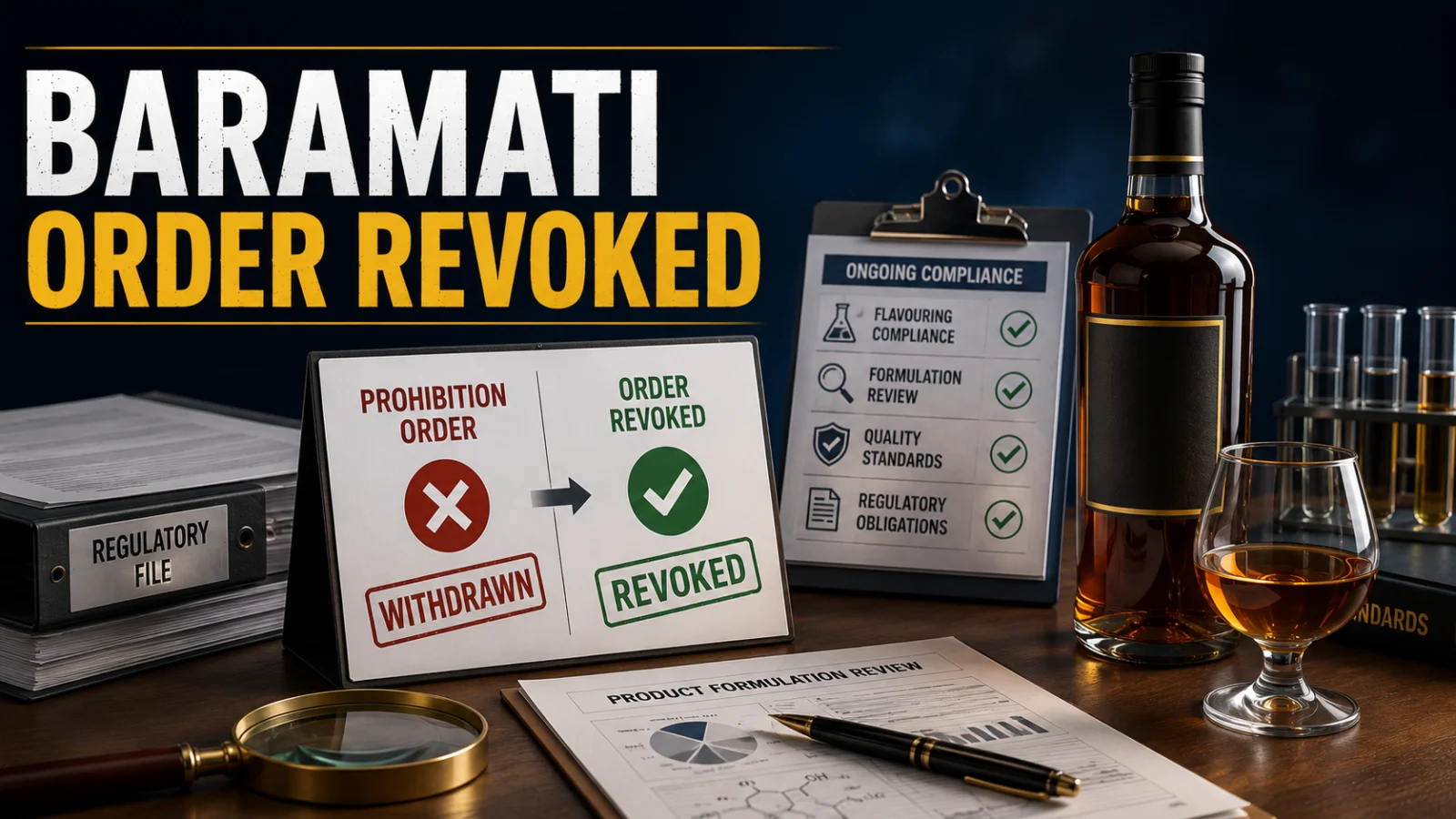





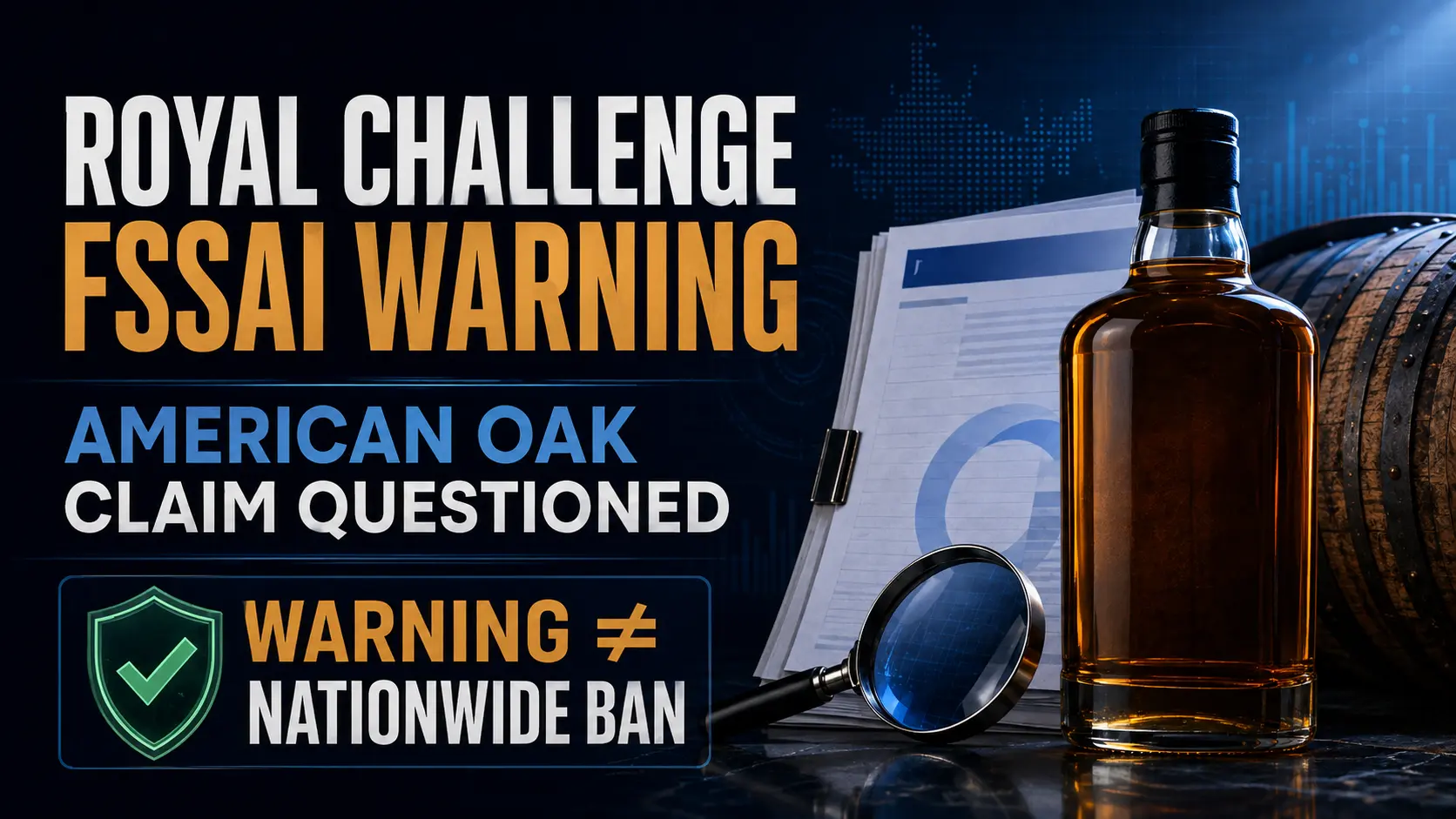
Royal Challenge is now part of two separate FSSAI regulatory issues, followed by a company compliance plan that changes the current picture. One issue is a July 20 notice that Reuters says questioned the whisky’s “matured in American oak casks” and “Scotch” label wording. The other concerns added whisky flavouring and led to restrictions on Royal Challenge made in Madhya Pradesh.
On August 17, Reuters reported that Diageo had agreed to change affected products, including Royal Challenge, after discussions with FSSAI. Government sources told Reuters that Diageo would stop adding disputed whisky or rum flavourings and apply the revised formulations across its Indian production. During the transition, clearer front-of-pack disclosure of added flavouring is also expected.
Direct answer: the July 20 Royal Challenge label warning is still not evidence of a new nationwide ban. Separately, the flavouring dispute has progressed: Diageo has agreed to reformulate affected products and clarify flavouring labels as part of a compliance path that could allow FSSAI restrictions to be withdrawn.
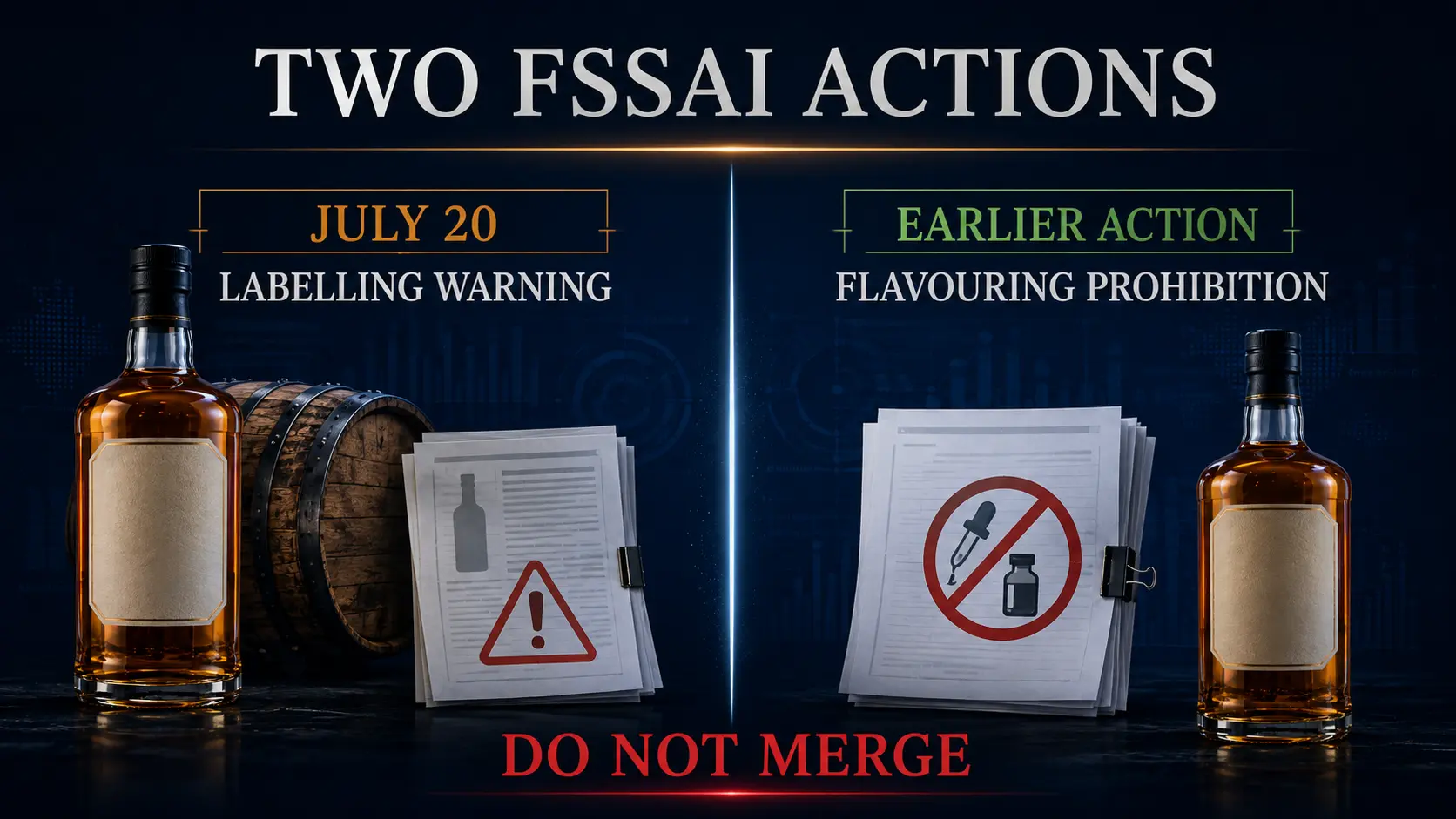
Do not merge three different states: a labelling warning, a flavouring-related restriction and a later compliance/reformulation agreement have different legal and practical meanings.
In this article
- What changed after the FSSAI action?
- What did the July 20 label notice reportedly say?
- What does the American-oak dispute mean?
- What was the separate flavouring action?
- What has Diageo agreed to change?
- Is Royal Challenge banned nationwide?
- Could Royal Challenge labels change?
- Confirmed, reported and unresolved
- Related FSSAI explainers
- Verification
- Limitations
- FAQs
What is the current Royal Challenge FSSAI status?
The most important new development is the compliance path reported on August 17.
Reuters reported, citing two government sources, that Diageo agreed to reformulate some whisky and rum products after FSSAI objected to added flavouring. Royal Challenge is among the affected brands.
The reported plan has two parts:
- Diageo will stop adding the disputed whisky or rum flavouring to affected products and use revised formulations across Indian production.
- During the transition, front-of-pack labels are expected to state added flavouring more clearly.
Reuters’ sources said FSSAI would agree to drop its restrictions on that understanding. This is evidence of a route toward resolving the flavouring dispute, but it should not be converted into a claim that every restriction has already been formally withdrawn everywhere unless the relevant order establishes that result.
Current practical state: Royal Challenge is not simply in a static “ban” state. The flavouring issue has moved into a compliance and reformulation phase, while the separate July 20 label-warning issue concerning maturation wording remains a distinct regulatory question.
What did the July 20 FSSAI label notice reportedly say?
Reuters reported on August 8 that it reviewed a confidential FSSAI notice dated July 20 concerning Royal Challenge whisky.
According to Reuters’ report, FSSAI questioned Royal Challenge’s claim that the whisky was “matured in American oak casks.”
Reuters said the regulator noted that grain neutral spirit was the second ingredient after demineralised water and that a major portion of the finished product was non-matured spirit. The regulator therefore reportedly considered the overall maturation representation misleading.
Reuters also reported that FSSAI questioned the use of the term “Scotch” because the label did not sufficiently explain the characteristics of the Scotch component in the blend.
Evidence status: REPORTED. A publicly accessible copy of the confidential July 20 notice has not been identified in the material reviewed. Its detailed contents therefore remain attributed to Reuters, which says it directly reviewed the document.
What does the “matured in American oak casks” dispute actually mean?
Diageo India’s current Royal Challenge brand page continues to describe the product using American-oak maturation language and identifies the blend as involving Scotch, Indian malts and grain spirits.
The regulatory question reported by Reuters concerns how that finished product is represented. If a substantial portion is non-matured spirit, FSSAI’s reported position is that language suggesting the whisky as a whole was matured in casks may create a misleading impression.
What this does not prove: the existence of matured components and the legality of the finished-product label are not the same question. The final regulatory determination depends on FSSAI’s applicable standards, the product composition, label wording and any later response or adjudication.
What was the separate flavouring-related action?
The maturation-label notice should be kept separate from FSSAI’s action over artificial or nature-identical flavouring in specified whisky and rum products.
Reuters reported on August 2 that FSSAI had restricted specified spirits, including Royal Challenge whisky produced in Madhya Pradesh, over the use of added whisky flavouring that the regulator considered non-compliant.
| Issue | What it concerns | Current interpretation |
|---|---|---|
| July 20 label warning | “Matured in American oak casks” and “Scotch” representation | A reported labelling dispute; not itself evidence of a nationwide prohibition. |
| Flavouring action | Added whisky or rum flavouring in specified spirits | Produced restrictions affecting specified products and manufacturing locations. |
| Reformulation/compliance plan | Removal of disputed flavourings plus clearer interim front-of-pack disclosure | A reported route toward compliance and withdrawal of flavouring-related restrictions. |
What has Diageo agreed to change?
Reuters reported on August 17 that Diageo agreed to reformulate Royal Challenge, Antiquity Blue and affected rum products following discussions over the flavouring issue.
Government sources told Reuters that the company would stop using disputed whisky flavouring in whisky and rum flavouring in rum. The revised approach would apply across Indian production, not only at facilities covered by the earlier restrictions.
During the transition, Diageo also agreed to make the presence of added flavouring clearer on the front of affected packs, according to the report.
Separate reporting from the Economic Times quoted a Diageo spokesperson saying the company had engaged with FSSAI and had taken measures to align its products with the regulator’s revised requirements.
Consumer implication: Royal Challenge sold in the future may not be compositionally or visually identical to stock sold before the transition. Reformulated production can remove the disputed flavouring, while transitional stock may carry clearer flavouring declarations.
Is Royal Challenge banned nationwide?
No current evidence reviewed supports the simple claim that all Royal Challenge whisky is banned throughout India.
The earlier flavouring restriction was reported for Royal Challenge made in Madhya Pradesh. The August 17 compliance development goes further in another direction: the planned formulation changes are expected to apply across Indian production, even though the original restrictions were not described as an all-India Royal Challenge ban.
That distinction matters. A nationwide product reformulation can be adopted as a compliance solution without proving that a nationwide sales prohibition previously existed.
Still not established: an all-India recall of every Royal Challenge bottle, a nationwide prohibition arising from the July 20 label warning, or a final nationwide legal finding that every existing Royal Challenge label is unlawful.
Could Royal Challenge labels change?
Yes. The August 17 reporting indicates that front-of-pack flavouring declarations are part of the transition arrangement for affected Diageo spirits.
That label change relates to the flavouring compliance issue. It should not automatically be treated as the final outcome of the separate July 20 dispute about the “matured in American oak casks” claim.
Diageo India’s current Royal Challenge webpage still uses American-oak maturation language. A future change to that page or to bottle labelling would therefore be relevant evidence for the separate maturation-claim issue, but no such change should be assumed before it is observed.
What is confirmed, reported and unresolved?
| Claim | Status | Evidence position |
|---|---|---|
| Reuters reviewed a July 20 FSSAI notice questioning Royal Challenge’s label claims. | REPORTED | Reuters, August 8. |
| FSSAI reportedly questioned “matured in American oak casks” and “Scotch” wording. | REPORTED | Reuters’ review of the confidential notice. |
| Royal Challenge made in Madhya Pradesh was affected by the separate flavouring-related action. | REPORTED | Reuters’ August 2 and August 17 reporting. |
| Diageo agreed to reformulate affected products and remove disputed flavourings. | REPORTED | Reuters, August 17; government sources. |
| The revised formulation is expected to apply across Diageo’s Indian production of affected brands. | REPORTED | Reuters, August 17. |
| Diageo says it has taken measures to align products with FSSAI requirements. | COMPANY STATEMENT | Diageo spokesperson quoted in current reporting. |
| Diageo’s Royal Challenge webpage still uses American-oak maturation language. | CONFIRMED | Current Diageo India brand page. |
| The July 20 label warning created a nationwide Royal Challenge ban. | NOT CONFIRMED | No reviewed evidence establishes this. |
| All flavouring-related restrictions have already been formally withdrawn everywhere. | NOT CONFIRMED | The reported agreement creates a route to dropping restrictions; final order-by-order status requires confirmation. |
Why this matters to consumers
“Warning”, “restriction”, “reformulation” and “recall” describe different regulatory states.
A regulator can challenge label wording without banning a product nationwide. A restriction can apply to specified production or jurisdictions rather than every bottle nationally. A company can then agree to reformulate or relabel products to resolve a compliance dispute.
For a broader explanation, see ThePulseSignal’s FSSAI ban vs recall guide.
Related ThePulseSignal FSSAI explainers
How the current Royal Challenge FSSAI status was verified
Sources reviewed
Reuters remains the direct evidence source for the confidential July 20 notice and for the August 17 agreement described by government sources. The FSSAI website was checked for regulator context, while Diageo India’s current brand page was checked for the continuing Royal Challenge product description.
Last verified: August 26, 2026.
Limitations and unresolved facts
- A public copy of the confidential July 20 FSSAI labelling notice was not located.
- The exact statutory provisions and corrective action specified in that notice remain unverified from the underlying document.
- The August 17 reformulation arrangement was reported by Reuters using government sources; a comprehensive public FSSAI order describing every implementation step was not identified.
- The exact effective date for reformulated Royal Challenge reaching all Indian markets is not established.
- The exact treatment of existing inventory can vary by product, manufacturing site and regulatory instruction.
- The reported compliance path does not by itself prove that every earlier restriction has already been formally withdrawn.
- No reviewed evidence establishes a nationwide Royal Challenge recall.
- The label-warning dispute and the flavouring-related compliance matter remain separate issues.
Royal Challenge FSSAI warning FAQs
What is the Royal Challenge FSSAI warning about?
Reuters says a July 20 FSSAI notice questioned Royal Challenge’s “matured in American oak casks” claim and its use of the term “Scotch”.
Is that the same issue as the Royal Challenge flavouring restriction?
No. The label-warning issue concerns how the whisky is represented, while the separate flavouring action concerned added whisky flavouring in specified products.
What has Diageo now agreed to do?
Reuters reported that Diageo agreed to remove disputed flavourings from affected formulations and use clearer front-of-pack flavouring declarations during the transition.
Will Royal Challenge be reformulated only in Madhya Pradesh?
Reuters reported that the formulation changes are expected to apply across Indian production of the affected Diageo brands, not only where the earlier restrictions applied.
Is Royal Challenge banned throughout India?
No reviewed evidence establishes a nationwide prohibition covering every Royal Challenge product or bottle in India.
Have all FSSAI restrictions already been lifted?
The August 17 reporting describes an agreement under which FSSAI would drop flavouring-related restrictions as Diageo complies. Final implementation and order-specific withdrawal should still be verified rather than assumed.
Does the reformulation resolve the American-oak label dispute?
Not necessarily. The reformulation agreement concerns the flavouring issue. The separate July 20 maturation-label dispute should be tracked independently.