






Can shops charge extra for UPI or tell you to pay cash instead? Right now, consumers are not being charged for ordinary UPI payments, and the Government says UPI will remain free for citizens. A future merchant-side charge may be introduced for some transactions, but the final rules have not yet been issued.
That means a shop asking you for an extra amount today cannot simply point to the 2026 Bill and say that a new ordinary-UPI customer fee has already started. At the same time, the final rules for any future merchant charge are still pending, so it would be premature to make a blanket claim about every form of future merchant pricing or payment refusal.
What is confirmed now
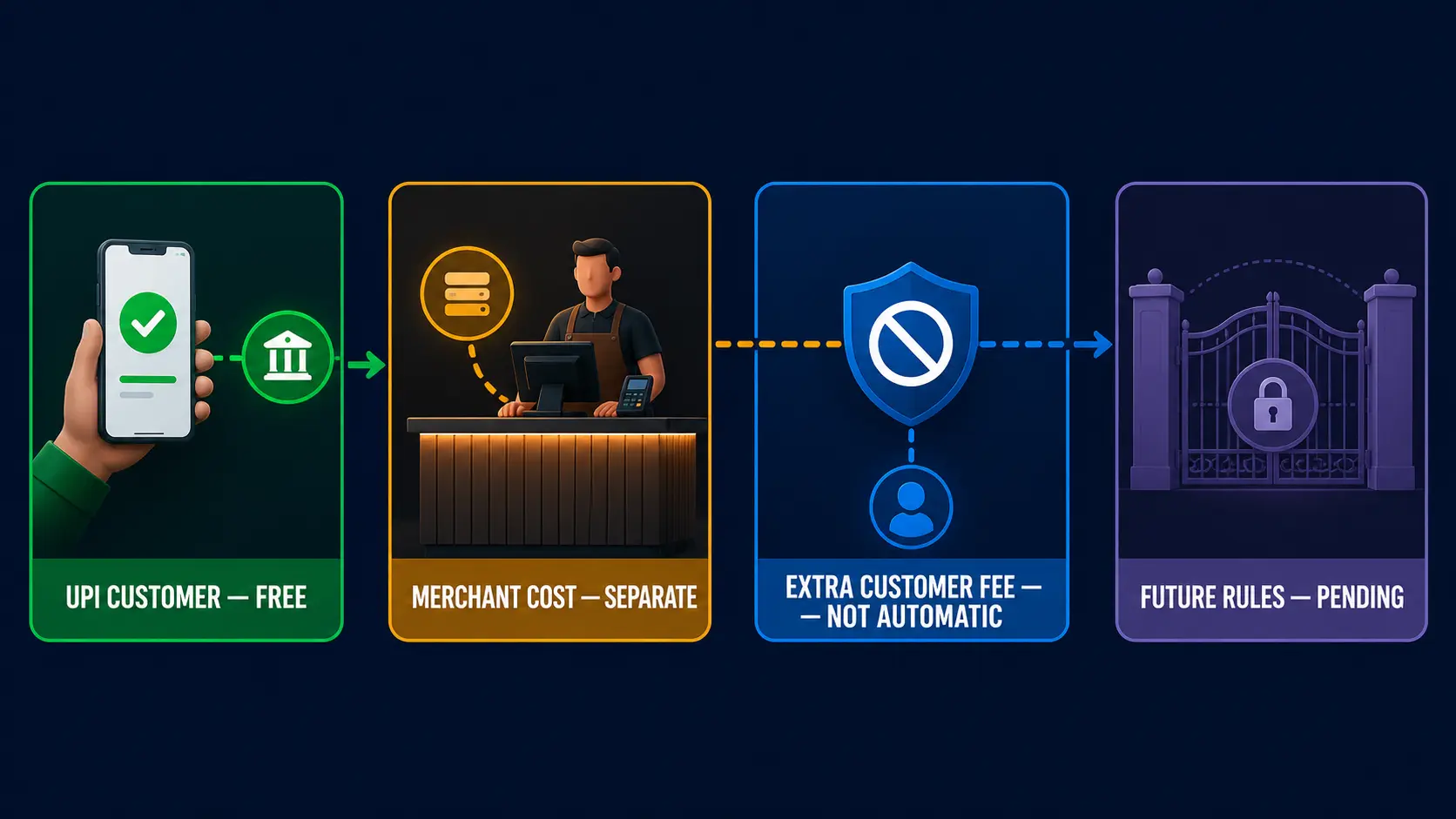
The Government is not charging consumers for ordinary UPI payments.
Person-to-person UPI transfers remain free, and any future merchant-side charge would apply only under a separate framework that has not yet been finalised.
What is not settled yet
Whether and how a merchant could recover a future UPI processing cost through pricing, an extra fee or payment restrictions will depend on the final framework and applicable consumer/payment rules.
No new ordinary-UPI transaction fee has started.
Remain free.
Possible for limited transactions, but rules are not final.
Different payment economics and should not be confused with ordinary bank-account UPI.
What this guide answers
- Can shops charge extra for UPI now?
- Can a shop ask you to pay cash instead?
- Is the Government charging UPI users?
- What changes if merchant fees return?
- Could merchants pass the cost to customers?
- What does RBI actually say about passing MDR?
- Why RuPay credit-card UPI is different
- What should you do if a shop asks for extra money?
- Related UPI guides
- Verification method
- Limitations
- FAQs
Can shops charge extra for UPI right now because of the 2026 Bill?
The 2026 Bill does not establish a new transaction charge that ordinary UPI users must pay.
The Ministry of Finance says consumers making UPI payments will not face transaction charges and that UPI will remain free for citizens.
It also says any future merchant-side charge, if introduced, will apply only to a limited set of merchant transactions above a threshold.
Practical answer: “The Government has started charging you for UPI” is not an accurate explanation for an extra amount demanded from a customer today.
Can a shop ask you to pay cash instead of UPI?
This is different from the question of whether the Government charges a UPI fee.
A merchant may have operational, commercial or payment-acceptance reasons for preferring one payment method over another. But the 2026 amendment itself does not establish a rule saying that customers must switch to cash.
Reddit discussion around the current policy debate shows users specifically worrying that merchants may respond to future processing costs by asking customers for cash or by discouraging UPI payments.
That concern is one reason this question deserves to be separated from the simpler “is UPI still free?” issue.
Is the Government charging customers for UPI?
No.
The Finance Ministry’s August 2026 clarification says:
- consumers will not face transaction charges;
- all person-to-person UPI transactions will remain free;
- the vast majority of merchant transactions will remain free;
- any future merchant charge will be limited and threshold-based rather than blanket.
Merchant cost and customer fee are not the same thing. A future payment-processing cost applied somewhere in the merchant ecosystem does not automatically mean the Government has imposed a consumer UPI fee.
What could change if merchant UPI charges return later?
The current framework allows a future Merchant Discount Rate, commonly called MDR, to be considered for a limited group of merchant transactions.
MDR is essentially a merchant-side payment-processing charge.
The Government has not yet announced the final:
- merchant eligibility rules;
- transaction threshold;
- MDR rate;
- implementation date;
- operational treatment of merchant pricing or customer pass-through.
TPS explains the threshold question separately in:
UPI MDR 2026: Is ₹2,000 the Final Threshold?
Could merchants eventually pass a UPI processing cost to customers?
This is where the issue becomes more nuanced.
Users discussing the proposed merchant charge on Reddit commonly predict that businesses may try to recover any future payment-processing cost by adding an extra amount, changing prices, or encouraging cash payments.
Those discussions show a real consumer concern, but they do not by themselves establish what merchants will legally be allowed to do under a future UPI framework.
Scenario 1: Merchant absorbs the cost
The processing cost becomes part of the business’s normal operating expense, similar to other payment or banking costs.
Scenario 2: Merchant changes overall pricing
A business could potentially change its general pricing economics. That is not necessarily the same thing as displaying a separate “UPI charge.”
Scenario 3: Merchant adds a separate payment fee
This raises a more specific payment and consumer-rule question. TPS should not assume that a future UPI framework automatically permits or prohibits such a fee before the controlling rules are issued.
Scenario 4: Merchant asks for cash
A merchant may prefer another payment method, but that does not transform the Government’s consumer UPI policy into a customer transaction fee.
Does RBI prohibit merchants from passing MDR to customers?
There is an important existing RBI rule, but it must be described accurately.
In its December 2017 direction on debit-card MDR, RBI advised banks to ensure that merchants onboarded by them do not pass MDR charges to customers while accepting debit-card payments.
That is useful evidence of how RBI has approached merchant pass-through in one payment category.
But it is not enough to claim that the exact same rule automatically governs a future ordinary-UPI MDR framework. The 2017 direction specifically concerns debit-card transactions.
Until the future UPI rules are issued, the safer conclusion is:
RBI has precedent for preventing debit-card MDR from being passed directly to customers, but TPS has not found a current final rule establishing the exact treatment of customer pass-through under the not-yet-final future UPI MDR framework.
Why are some people already seeing extra charges with RuPay credit card on UPI?
Because not every payment made through a UPI QR uses the same underlying funding instrument.
NPCI allows eligible RuPay credit cards to be linked to UPI and used for merchant payments.
That is different from ordinary bank-account-funded UPI.
Reddit discussions already contain examples of users saying merchants decline RuPay credit-card-on-UPI transactions or discuss additional merchant costs. These experiences should not be used as proof that ordinary bank-account UPI now carries the proposed 2026 merchant charge.
| Payment type | Funding source | Should it be treated as proof ordinary UPI has MDR? |
|---|---|---|
| Ordinary UPI | Eligible bank account | No. Government says consumers remain free and future merchant rules are still pending. |
| RuPay credit card on UPI | Linked RuPay credit card | No. This is a different payment product with different economics. |
| Debit-card payment | Debit card | No. RBI’s existing debit-card MDR rules apply to that payment category. |
What should you do if a shop asks for extra money for UPI?
First, ask what the extra amount is actually for.
That helps separate several very different situations:
- Ordinary bank-account UPI: ask why an extra payment-specific charge is being requested.
- RuPay credit card on UPI: confirm whether the payment is actually being funded through your linked credit card rather than bank-account UPI.
- General price increase: distinguish a product’s displayed price from a separate payment-method surcharge.
- Claim that “new Government UPI charges started”: the current Finance Ministry clarification does not support that statement for consumers.
Do not assume every extra amount mentioned by a shop is a Government UPI charge. Ask the merchant to identify the charge and the payment method involved.
If a merchant claims that a new Government-mandated ordinary-UPI customer fee has begun, you can compare that claim against the Ministry of Finance’s current clarification, which says consumers will not face UPI transaction charges.
Related TPS UPI guides
UPI charges cluster
-
UPI Charges After the 2026 Bill: Will Users Have to Pay?
— explains the broad consumer question and why Parliament’s amendment does not itself create a user transaction charge. -
UPI MDR 2026: Is ₹2,000 the Final Threshold?
— explains the merchant threshold, ₹2,000 confusion and what remains undecided. -
UPI in Maldives
— TPS’s existing international UPI guide covering availability outside India.
How this article was verified
Verification method
ThePulseSignal separated four issues that are frequently mixed together: the consumer UPI charge, the merchant’s future processing cost, a merchant asking the customer for extra money, and RuPay credit-card-on-UPI pricing.
The Ministry of Finance’s August 2026 clarification was treated as the controlling source for the current ordinary-UPI position.
It establishes that consumers will not face transaction charges, P2P transfers remain free, and any future merchant MDR will apply only to limited transactions under a threshold-based framework.
RBI’s December 2017 debit-card MDR direction was separately reviewed. RBI told banks to ensure merchants onboarded by them do not pass debit-card MDR charges to customers.
That debit-card direction was not automatically extended to future UPI MDR in this article because the future UPI operational framework has not yet been finalised.
NPCI primary material was used to confirm that RuPay credit cards can be linked to UPI and used for merchant payments, making them a distinct payment product from ordinary bank-account UPI.
Reddit discussions were used only as evidence of real reader confusion and reported behaviour — not as controlling evidence of law or policy.
Sources reviewed
Limitations and unresolved facts
- No final future UPI merchant MDR framework has been issued in the official material reviewed.
- No final UPI merchant MDR rate, threshold or implementation date has been established.
- This article does not claim that every merchant is legally prohibited from passing every future UPI-related business cost to customers.
- The RBI no-pass-through direction cited here specifically concerns debit-card MDR and should not automatically be extended to an unissued future UPI MDR framework.
- Reddit comments demonstrate reader confusion and anecdotal merchant behaviour, not nationwide prevalence or legal authority.
- RuPay credit-card-on-UPI payment economics should not be treated as evidence that ordinary bank-account UPI now carries a merchant fee.
- Future RBI, NPCI, Ministry of Finance or consumer-affairs rules may materially change the answer and should trigger an update.
Can shops charge extra for UPI? FAQs
Can a shop charge me extra for ordinary UPI today because of the 2026 Bill?
The Bill does not itself impose a new consumer UPI transaction fee. The Finance Ministry says consumers making UPI payments will not face transaction charges.
Can a shop say UPI is unavailable and ask for cash?
A merchant may prefer or accept different payment methods, but the 2026 amendment does not create a rule requiring customers to pay cash.
Will merchants eventually pay a UPI processing charge?
Possibly for a limited category of merchant transactions, but the final rate, threshold, merchant eligibility and implementation rules have not yet been announced.
If merchants pay a charge, will customers automatically have to pay it?
No automatic consumer fee follows from the current Government framework. How merchant pass-through would be treated under a future UPI MDR regime is not yet established in the final rules because those rules have not been issued.
Does RBI stop merchants from passing MDR to customers?
RBI’s 2017 debit-card MDR direction told banks to ensure merchants do not pass debit-card MDR to customers. That rule specifically concerns debit cards and should not automatically be described as the final rule for a future UPI MDR framework.
Why does a shop sometimes charge extra for RuPay credit-card UPI?
RuPay credit-card-on-UPI uses a linked credit card as the funding source and has different payment economics from ordinary bank-account UPI.
Is the Government charging UPI users now?
No. The Ministry of Finance says UPI will remain free for citizens and consumers will not face transaction charges.
Last verified: August 10, 2026.