






India officially lists Attari as an authorised e-Visa land entry point, but the Wagah-Attari crossing remains closed to regular passenger travel. The practical answer for an ordinary foreign traveller is therefore unchanged: having a valid Indian e-Visa does not currently make the Wagah-Attari route usable for normal cross-border travel.
Visa authorisation and border operation are separate. The Ministry of Home Affairs added Attari Road to India’s expanded e-Visa entry network on August 10, 2026. The Government of India e-Visa portal now also lists Attari among authorised e-Visa land-entry points. However, current travel-status evidence still states that the Wagah-Attari passenger crossing is closed.
Visa rule
Attari is officially designated for e-Visa entry.
Both the August 10 Government announcement and the current Government of India e-Visa portal list Attari among authorised land-entry points for eligible e-Visa holders.
Current travel reality
The Wagah-Attari crossing remains closed to regular passenger travel.
Do not build an overland itinerary around this crossing unless current authorities confirm that normal passenger movement has resumed.
Attari is now reflected on the Government’s authorised e-Visa land-entry list.
Still closed in current travel-status evidence.
Verify both immigration eligibility and the crossing’s operational status before travel.
What foreign travellers need to know
- Can you enter India through Wagah-Attari now?
- Authorised entry point vs open border
- What changed in August 2026?
- What does the current e-Visa portal show?
- Which land ports are listed?
- What about first entry versus re-entry?
- Can you use any land border?
- What should you carry?
- What should you verify?
- FAQs
Can I enter India with an e-Visa through the Wagah-Attari border now?
Not for ordinary cross-border travel while the Wagah-Attari passenger crossing remains closed.
The August 10 Ministry of Home Affairs announcement and the current Indian e-Visa portal both establish Attari as an authorised e-Visa land entry point. That answers the immigration-policy question, but it does not itself reopen the India-Pakistan border for regular passenger movement.
For a traveller planning the route today, the closure is the controlling practical issue. Do not assume that an authorised e-Visa checkpoint is physically available for your journey.
What is the difference between an authorised e-Visa entry point and an open border crossing?
| Question | Current answer |
|---|---|
| Is Attari designated for Indian e-Visa entry? | Yes. It is listed in the August 10 Government announcement and on the current e-Visa portal. |
| Is Wagah-Attari open for normal international passenger travel? | No, not according to the latest current travel-status evidence reviewed. |
| Does e-Visa designation automatically reopen a closed checkpoint? | No. Immigration authorisation and physical border operation are separate decisions. |
| Can a traveller rely on the designation alone when booking an overland trip? | No. Confirm that regular passenger movement has resumed before committing to the route. |
India closed the Attari Integrated Check Post to normal incoming and outgoing passenger movement in April 2025. Limited exceptions were subsequently allowed for certain Indian and Pakistani nationals, but those measures did not amount to a general reopening for ordinary foreign travellers.
Current UK government travel advice still states that the Wagah-Attari border crossing is closed. Pakistan travel advice from the same government also describes the Wagah crossing as currently closed.
What changed for India e-Visa entry points in August 2026?
The Government of India announced 11 additional international entry points for foreign e-Visa holders: nine land ports and two airports.
The Ministry of Home Affairs says the expansion takes the authorised network to 88 international ports, comprising 37 airports, 38 seaports and 13 land ports.
The two newly added airports are Bhopal and Tirupati. The August 10 announcement identifies the following land ports as newly added:
- Agartala
- Darranga
- Gede
- Ghojadanga
- Haridaspur
- Jaigaon
- Dawki
- Moreh
- Attari (Road)
Source-table caution: the August 10 Government table appears to show Darranga both among an earlier group and again as newly added. The Ministry nevertheless states that nine land ports and two airports were added, so use the current official portal list for practical checkpoint verification.
What does the current Indian e-Visa portal show?
The current Government of India e-Visa portal now lists authorised land entry points including Raxaul, Rupaidiha, Darranga, Jogbani, Agartala, Gede, Ghojadanga, Haridaspur, Jaigaon, Dawki, Moreh and Attari.
This resolves the earlier practical mismatch between the August 10 Ministry announcement and the visible portal list for Attari. The remaining problem is not immigration designation; it is the continued closure of ordinary passenger movement across Wagah-Attari.
Current rule: Attari is authorised for e-Visa entry, but a traveller still needs the border crossing itself to be open for passenger movement.
Which Indian land ports are listed for e-Visa entry?
The current Indian e-Visa portal lists the following land-entry points:
| Land port | Current portal status | Route context |
|---|---|---|
| Raxaul | Listed for e-Visa entry | India-Nepal |
| Rupaidiha | Listed for e-Visa entry | India-Nepal |
| Darranga | Listed for e-Visa entry | Use current official checkpoint guidance |
| Jogbani | Listed for e-Visa entry | India-Nepal |
| Agartala | Listed for e-Visa entry | India-Bangladesh |
| Gede | Listed for e-Visa entry | India-Bangladesh |
| Ghojadanga | Listed for e-Visa entry | India-Bangladesh |
| Haridaspur | Listed for e-Visa entry | India-Bangladesh |
| Jaigaon | Listed for e-Visa entry | India-Bhutan |
| Dawki | Listed for e-Visa entry | India-Bangladesh |
| Moreh | Listed for e-Visa entry | India-Myanmar |
| Attari | Listed for e-Visa entry | India-Pakistan; regular passenger crossing currently closed |
Does your first entry still have to be through an airport?
The current Government framework explicitly provides for e-Visa entry through designated land ports. That means an old blanket statement that an e-Visa holder must always make the first entry through an airport should not be treated as a universal current rule without checking the conditions attached to the traveller’s visa.
The practical checks are whether your e-Visa is valid, whether the intended checkpoint is authorised for e-Visa entry, whether the required number of entries remains available and whether that checkpoint is operational for passenger travel.
- Do not assume every e-Visa permits the same number of entries.
- Do not assume an authorised land checkpoint is currently open.
- Do not treat a traveller’s old border-crossing experience as proof of today’s operational status.
Can I enter India through any land border if I have an e-Visa?
No. Indian e-Visa holders must use authorised immigration entry points. The 2026 expansion increases the designated land-port network but does not turn every land border into an e-Visa entry route.
Think in two checks: is the checkpoint authorised for your visa, and is the checkpoint actually open for passenger movement?
What should an e-Visa traveller carry?
The official Indian e-Visa portal instructs approved travellers to obtain their Electronic Travel Authorization and present it at the Immigration Check Post, where immigration processing is completed.
Keep accessible:
- the passport linked to your e-Visa;
- your valid ETA/e-Visa documentation;
- a printed ETA copy where instructed;
- documents required by the country on the other side of the border;
- evidence that your visa remains valid for the intended entry.
If your passport changed after the ETA was issued, follow the current official portal instructions for travelling with the relevant old and new passports.
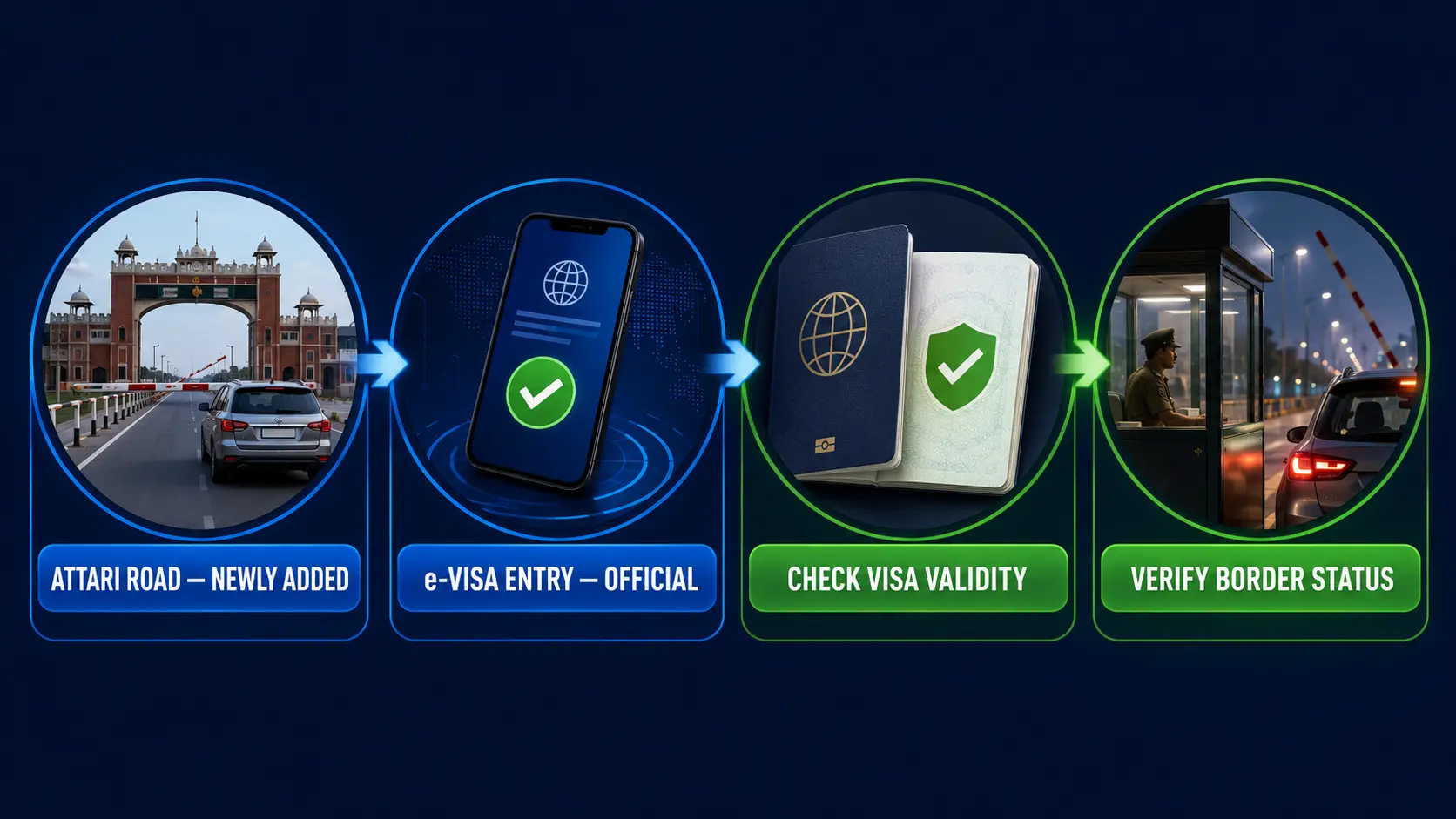
Five things to verify before planning a Wagah-Attari e-Visa crossing
Does this also matter for Nepal, Bangladesh, Bhutan and Myanmar routes?
Yes. The broader August 10 change expanded India’s e-Visa land-entry network. Travellers using any designated land crossing should still check both the visa designation and the operational status of the specific checkpoint.
Why this matters to foreign travellers
The Ministry of Home Affairs says India’s e-Visa facility is available to nationals of 172 countries and that electronic visas account for a large share of visas issued by India. Expanding designated land ports can materially change multi-country South Asia itineraries when the relevant borders are operational.
Attari remains a clear example of why a visa-policy change does not automatically create a usable route: it is designated for e-Visa entry while ordinary India-Pakistan passenger crossing remains unavailable.
Related ThePulseSignal guides
How this was verified
Verification method
The August 10, 2026 Ministry of Home Affairs announcement was checked for the expansion that added Attari Road to India’s e-Visa entry network.
The current Government of India e-Visa portal was checked separately and now lists Attari among authorised e-Visa land-entry points.
The Government of India’s April 2025 decision closing the Attari Integrated Check Post to normal passenger movement was rechecked against current travel-status guidance. Current UK government travel advice for both India and Pakistan continues to state that the Wagah-Attari crossing is closed.
Sources
- Ministry of Home Affairs / PIB — additional e-Visa international entry points
- Government of India — official e-Visa portal
- Government of India / MEA briefing — closure of Attari Integrated Check Post
- UK Government travel advice — current Wagah-Attari closure status
- UK Government Pakistan travel advice — current Wagah crossing status
Limitations
- Attari’s e-Visa designation and physical reopening of the India-Pakistan passenger crossing are separate government decisions.
- No general reopening order for ordinary passenger movement through Wagah-Attari was identified through September 8, 2026.
- The August 10 PIB table appears to duplicate Darranga, while the current e-Visa portal provides the practical authorised land-entry list.
- Visa validity, permitted number of entries, nationality restrictions and individual immigration decisions remain traveller-specific.
- Border operations can change quickly, so travellers should reconfirm immediately before travel.
India eVisa Wagah border FAQs
Can I enter India through Wagah with an e-Visa right now?
Attari is officially designated for e-Visa entry, but the Wagah-Attari crossing remains closed to regular passenger travel in the latest current evidence reviewed. Do not rely on the route until normal passenger movement is officially restored.
Does the August 2026 e-Visa announcement mean Wagah-Attari reopened?
No. The announcement changes the checkpoint’s e-Visa authorisation. It does not by itself reopen the India-Pakistan land border for ordinary passenger movement.
Is Attari now listed on the official Indian e-Visa portal?
Yes. The current Government of India e-Visa portal now includes Attari in its authorised land-entry list.
Is Wagah and Attari the same border crossing?
Wagah is the Pakistan side of the crossing and Attari is the Indian side. India’s immigration designation refers to Attari.
Can I return from Pakistan to India using an Indian e-Visa?
Not through Wagah-Attari while regular passenger crossing remains closed. If the route reopens, you would still need a valid e-Visa permitting the intended entry and must satisfy current immigration requirements.
Do I have to enter India by air first?
The current Government framework explicitly allows e-Visa entry through designated land ports. Check the conditions of your specific e-Visa rather than relying on an old blanket airport-first rule.
Can an e-Visa be used at any Indian land border?
No. Entry is limited to authorised immigration checkpoints, and the checkpoint must also be operational for passenger movement.
How many e-Visa entry points does India now have?
The Ministry of Home Affairs says the network has 88 international entry points: 37 airports, 38 seaports and 13 land ports.
Last verified: September 8, 2026.