






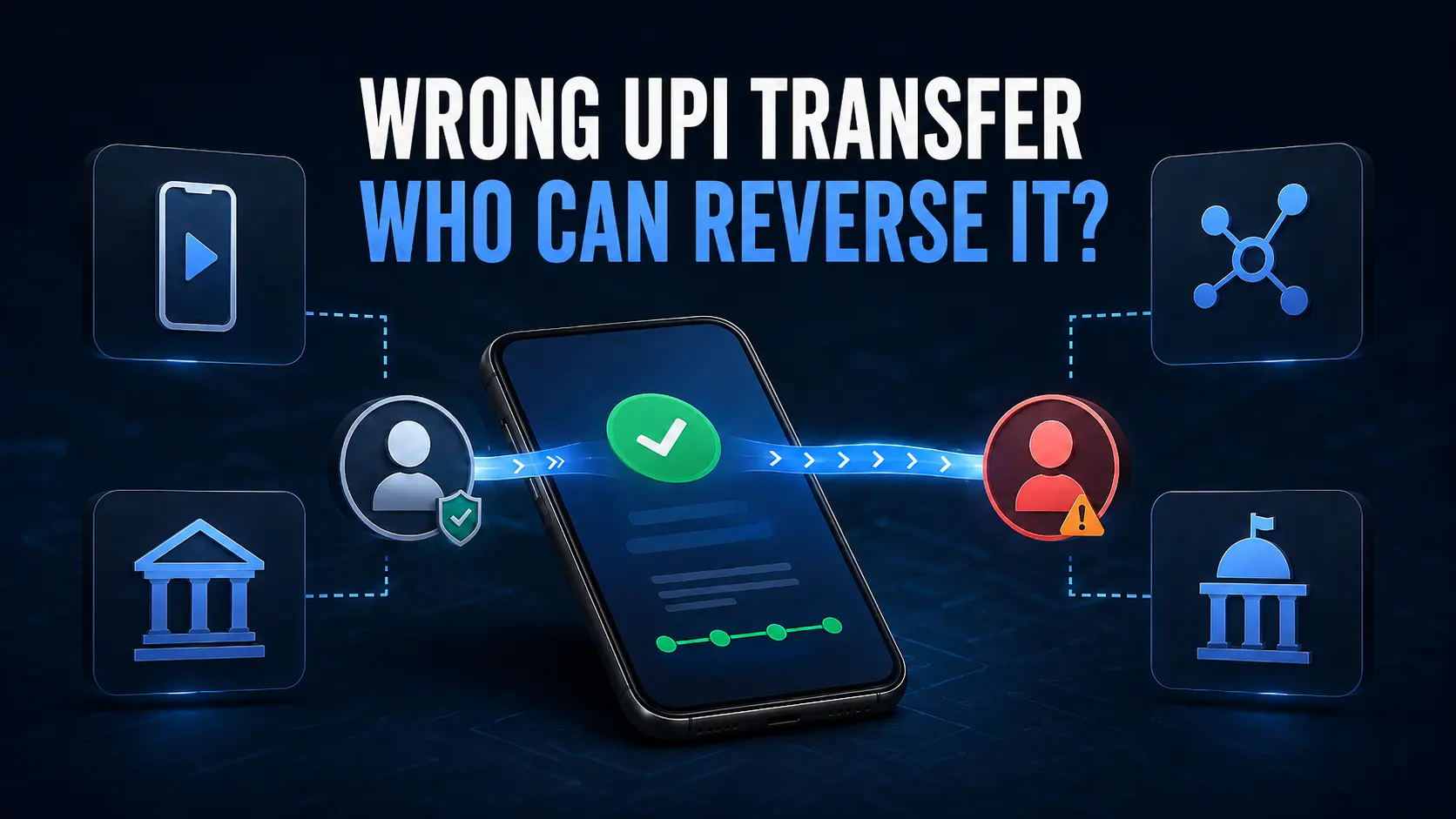
Wrong UPI transfer recovery becomes much harder when the payment already shows successful and the money has reached the wrong person. That situation is different from a failed UPI transaction where your account was debited but the beneficiary was never credited. Before expecting an automatic refund, first identify which type of transaction actually occurred.
A successful mistaken transfer does not automatically become reversible merely because the sender selected the wrong contact, typed the wrong UPI ID or paid an unintended recipient. The practical recovery path can involve the UPI app, the sender’s bank, the beneficiary-side institution, NPCI complaint infrastructure and, for an eligible unresolved service grievance, RBI’s Ombudsman framework.
Direct answer
Who can actually reverse a successful payment to the wrong person?
No universal NPCI or RBI rule reviewed for this guide guarantees that every successfully credited UPI payment sent to the wrong person can simply be pulled back on the sender’s request.
Your app can provide complaint tools. Your bank is a key formal complaint point. NPCI can facilitate complaint routing through its payment-system framework. An eligible unresolved deficiency-in-service complaint may later be escalated through RBI’s Ombudsman system.
Critical distinction
Successful wrong recipient is not the same as failed UPI
RBI’s failed-transaction auto-reversal framework covers situations such as the payer being debited while the beneficiary is not credited. It should not be presented as a guaranteed T+1 refund after a payment has already successfully reached the wrong beneficiary.
Confirmed from primary sources
- NPCI provides UPI complaint and grievance infrastructure.
- NPCI’s UPI guidance says a payment cannot simply be stopped after initiation.
- NPCI says relevant member institutions are responsible for resolving complaints routed through its complaint system.
- RBI’s failed-transaction TAT framework expressly distinguishes cases where the beneficiary was not credited.
Observed user problem
- Users report being redirected between their UPI app, payer bank, beneficiary bank, NPCI and RBI.
- A recurring community question is why a payment marked successful cannot simply be pulled back.
- Users also report difficulty where the unintended recipient cannot be contacted or refuses to return the money.
Not established
- A guaranteed universal refund period for successful wrong-recipient transfers.
- A universal rule that every such transfer can be reversed without recipient cooperation.
- A universal 24-hour, 48-hour or seven-day recovery guarantee.
- A rule that RBI Ombudsman directly debits the unintended recipient’s account.
In this wrong UPI transfer recovery guide
Wrong UPI transfer recovery starts with one question: was the beneficiary credited?
The word successful matters because several very different UPI problems are commonly described online as a “wrong payment” or “UPI refund problem”.
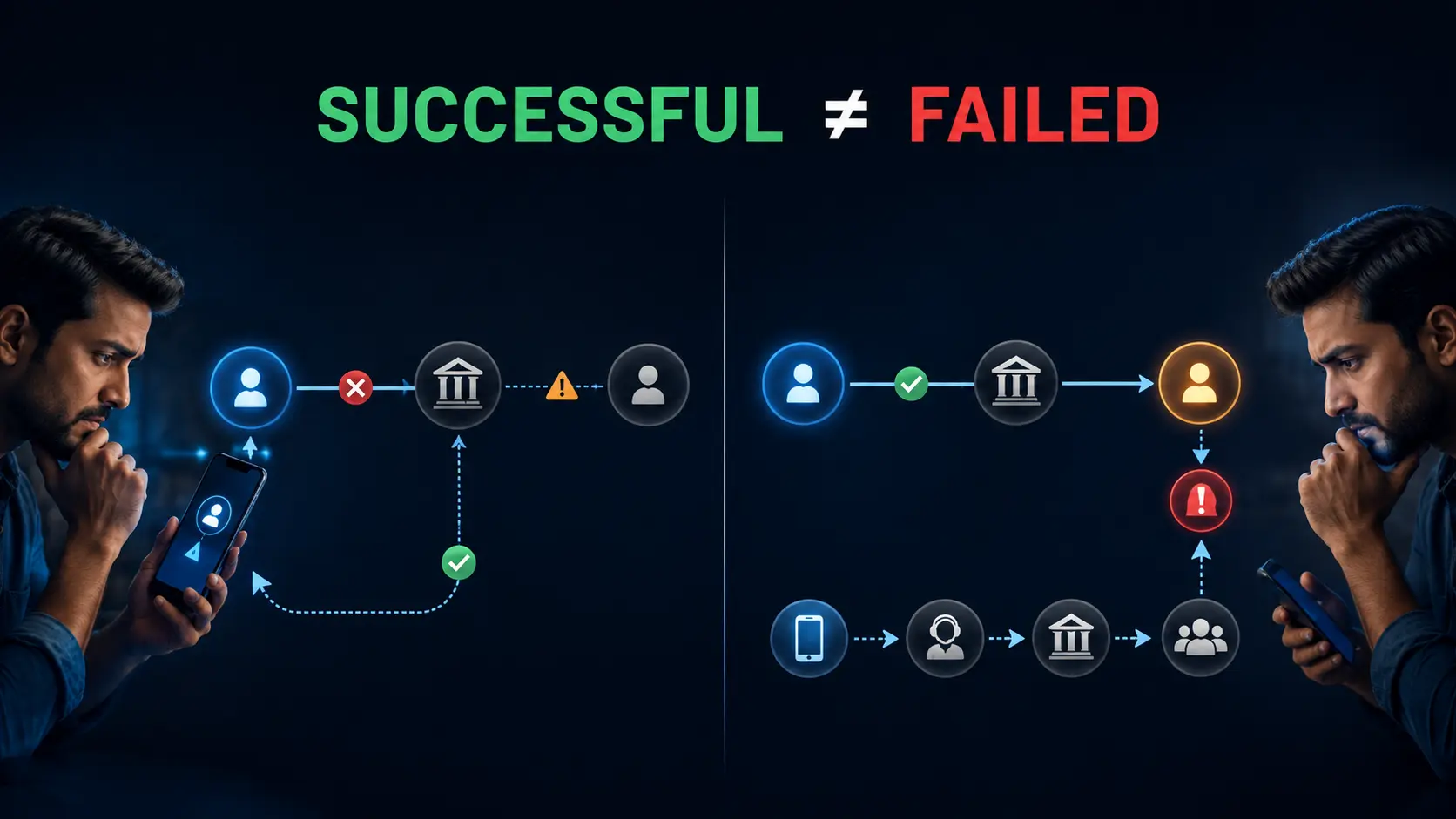
If your bank account was debited but the beneficiary did not receive the money, that can fall within the failed-transaction framework. If the payment successfully reached an unintended person, however, the transfer itself technically completed. Your problem is then recovery of a completed mistaken transfer rather than automatic reversal of an incomplete one.
| What happened | What it means | Main route |
|---|---|---|
| Payer debited, beneficiary not credited | The payment did not fully complete to the beneficiary. | Failed-transaction framework, app/bank complaint and applicable reversal timeline. |
| Payment successful but sent to wrong person | The payment completed, but the beneficiary was not the person you intended to pay. | Mistaken-transfer complaint and recovery process. |
| Transaction still pending | The transaction has not reached a final status. | Status check plus app/bank complaint if it remains unresolved. |
| You were tricked into authorising the payment | The transaction may involve fraud or social engineering rather than a simple mistake. | Bank complaint plus financial-cyber-fraud route where applicable. |
| You paid the correct merchant but have a product/service dispute | This is not a wrong-recipient transfer. | Merchant/payment dispute route depending on the facts. |
Do not apply the wrong refund rule. RBI’s UPI T+1 failed-transaction rule covers the situation where the payer is debited but the beneficiary is not credited. A transfer that successfully reached the wrong person should not automatically be described as entitled to the same T+1 reversal.
Who can actually reverse a successful UPI payment to the wrong person?
One reason wrong UPI transfer recovery feels confusing is that a single UPI payment can involve several different participants.
UPI app
The app can show the transaction, provide complaint tools and generate a support trail.
Do not assume: that the app itself has universal unilateral authority to debit another person’s bank account after a successful transfer.
Your bank
The sender’s bank is a key formal complaint point because it maintains your account and can investigate the transaction using the UPI reference details.
Always preserve the bank grievance or complaint number.
NPCI
NPCI operates the UPI framework and provides complaint-registration and tracking facilities.
Its complaint disclaimer says complaints are made available to the relevant member institution for necessary action and that the member institution remains responsible for resolving the complaint.
RBI Ombudsman
The Ombudsman route addresses eligible complaints involving deficiency in service by regulated entities after the required complaint stage.
It should not be described as an instant “reverse UPI payment” button.
Editorial interpretation: asking “Is my UPI app responsible, is my bank responsible, or is NPCI responsible?” can oversimplify the payment architecture. The more useful question is what each participant is authorised or positioned to do at each stage of the complaint.
7 steps to take after a successful UPI transfer goes to the wrong person
Preserve the transaction
Save the transaction ID or RRN, amount, date, time, status, recipient UPI ID or number shown and screenshots.
Check the final status
Confirm whether the transaction really shows successful rather than pending, failed or reversed.
Raise the in-app complaint
Use the payment-history help or dispute facility where available. Save the complaint reference.
Contact your bank formally
State clearly that the payment was successful but went to an unintended beneficiary. Provide the UPI transaction reference.
Use NPCI complaint support
If necessary, register or track the matter through NPCI’s official complaint facilities and preserve the CRN or other reference.
Preserve every reply
Keep emails, SMS messages, grievance responses and closure reasons. These matter if you later challenge complaint handling.
Escalate the correct problem
For an unresolved eligible service complaint, consider RBI Ombudsman requirements. If deception caused the payment, use the financial-cyber-fraud route instead of treating it only as a typing mistake.
Describe the problem precisely when complaining: “successful UPI payment sent to wrong beneficiary” is more useful than simply saying “UPI refund pending”. It helps separate your case from a failed or pending transaction.
Why do the UPI app, bank and NPCI appear to send users to one another?
UPI is a networked payment system. The app visible on your phone is not necessarily the same institution that holds your bank account, holds the recipient’s account or performs every part of the settlement and complaint process.
This is one reason community users repeatedly describe being redirected from an app to their bank, from their bank toward another institution, or from NPCI back to the relevant member institution.
That experience is frustrating, but it does not mean every participant performs the same function.
| Participant | What the user can reasonably expect | What should not be promised |
|---|---|---|
| UPI app | Transaction history, complaint initiation and support records. | Guaranteed unilateral recovery from another person’s account. |
| Sender’s bank | Formal grievance handling, transaction investigation and coordination through banking/payment channels. | A guaranteed refund in every mistaken-transfer case. |
| NPCI | Payment-system complaint infrastructure and routing to member institutions. | Automatic direct recovery of every successful wrong-recipient transfer. |
| RBI Ombudsman | Review of admissible complaints involving deficiency in service by covered regulated entities. | A guaranteed order directly debiting the unintended recipient. |
Do not stop at an informal chatbot conversation. If the amount matters, create a traceable complaint trail with transaction references and formal grievance numbers.
What if the wrong UPI recipient refuses to return the money?
This is one of the hardest parts of wrong UPI transfer recovery and one of the areas where online advice often becomes too confident.
The primary-source material reviewed for this article did not establish a simple nationwide rule saying that every successfully credited mistaken payment must automatically be removed from the recipient’s account whenever the sender reports an error.
That means this article does not promise that:
- your bank can always pull the amount back immediately;
- NPCI can directly remove the money from the recipient account;
- the money must return within 24 or 48 hours;
- an RBI complaint automatically results in repayment;
- recipient cooperation is legally irrelevant in every possible case.
Continue using traceable banking and grievance channels and preserve evidence of every recovery attempt.
Be careful with direct refund arrangements. The unintended recipient may also fear that the sender’s request is part of a scam. Neither side should share a UPI PIN, OTP, card details, account password or screen-sharing access to “complete” a refund.
If the matter develops into a dispute over retained money, the correct next step can depend heavily on the facts. Bank coordination, formal grievance escalation, legal remedies or law-enforcement involvement should not be treated as interchangeable.
When does RBI Ombudsman become relevant?
The RBI Ombudsman mechanism is not normally the first place to start a mistaken-payment complaint.
The complaint should first be made to the relevant regulated entity. RBI’s Ombudsman framework can become relevant when the regulated entity rejects the complaint, provides a response the complainant considers unsatisfactory, or does not respond within the applicable period, subject to the Scheme’s admissibility rules.
Frame the Ombudsman complaint around the service issue you can establish. The question may be whether your regulated entity properly handled, investigated or responded to the complaint. Do not assume that RBI CMS itself directly functions as a payment-reversal system.
Preserving your original bank complaint, dates, grievance reference numbers and responses is therefore important before escalation.
Sending money to the wrong person is different from being tricked into a UPI payment
A sender who chooses the wrong contact or mistypes a UPI ID has a different factual problem from someone who deliberately approves a transfer because a scammer impersonated a bank, government department, police officer, seller, employer or relative.
If deception, impersonation or social engineering caused the transaction, report the matter to the bank as a fraud-related issue and consider the national online financial-fraud reporting route, including helpline 1930.
Use the correct classification: mistaken recipient → recovery complaint. Beneficiary not credited → failed transaction. Deception or scam → financial cyber-fraud route. Merchant dispute → merchant/payment complaint. These situations should not be collapsed into one generic “UPI refund” process.
What evidence should you preserve for wrong UPI transfer recovery?
| Evidence | Why it matters |
|---|---|
| UPI transaction ID / RRN | Helps the bank or payment participant identify the specific transaction. |
| Screenshot showing SUCCESS | Helps establish that this is not merely a failed or pending transfer. |
| Amount, date and time | Identifies the disputed transaction precisely. |
| Recipient UPI ID, mobile number or identifier shown | Records which payment address or recipient was selected. |
| UPI app complaint reference | Shows when the complaint process began. |
| Bank complaint or grievance number | Creates the formal complaint chronology required for later escalation. |
| Bank/app emails and responses | Shows what was investigated, accepted, rejected or redirected. |
| Any communication with the unintended recipient | May help document attempted recovery, but preserve communications rather than escalating emotionally. |
Related ThePulseSignal UPI guides
Verification notes: what is confirmed, reported and interpreted
Confirmed
- NPCI provides complaint-registration and UPI grievance infrastructure.
- NPCI guidance states that an initiated UPI payment cannot simply be stopped.
- NPCI’s complaint-status material says complaints are made available to the relevant member institution for necessary action.
- The member institution remains responsible for resolving the complaint.
- RBI’s failed-transaction TAT framework covers the situation where the payer is debited but the beneficiary is not credited.
- RBI provides an Ombudsman framework for eligible unresolved complaints involving deficiency in service by regulated entities.
Reported / community-observed
- Users report being redirected between their UPI app, sender bank, beneficiary-side institution, NPCI and RBI.
- Users repeatedly ask why a successful payment cannot simply be pulled back if they reported the mistake immediately.
- Some users report unsuccessful recovery attempts where the unintended recipient was unreachable or would not cooperate.
- Some recipients of accidental payments report being reluctant to return money directly because they fear a refund scam.
These community reports establish user pain and confusion. They do not establish regulatory rules, recovery success rates or guaranteed outcomes.
Unresolved / not established
- No universal primary-source rule reviewed guarantees recovery of every successful mistaken UPI transfer.
- No universal 24-hour, 48-hour or seven-day recovery guarantee was established.
- No nationwide primary-source rule reviewed establishes that beneficiary consent is mandatory in every possible wrong-recipient recovery case.
- No nationwide official recovery-success percentage was located.
- No universal rule reviewed gives NPCI direct automatic power to debit every unintended recipient after a sender complaint.
Editorial interpretation: the most important practical dividing line is whether the transaction failed before the beneficiary was credited or whether it successfully reached an unintended beneficiary. The first situation can fall within RBI’s failed-transaction auto-reversal framework. The second becomes a completed-payment recovery problem and should not be described as automatically reversible.
Verification method
ThePulseSignal reviewed NPCI’s current UPI FAQs, NPCI complaint-registration and complaint-status material, RBI’s harmonised turnaround-time and compensation framework for failed transactions, RBI’s Integrated Ombudsman framework and the National Cyber Crime Reporting Portal.
The review specifically separated a successful wrong-beneficiary payment from a failed UPI transaction where the beneficiary was not credited.
Reddit and LinkedIn discussions were reviewed separately to identify recurring user pain, questions and terminology. Community posts were not used to establish legal rights, NPCI powers, RBI rules, refund deadlines or guaranteed recovery outcomes.
Where primary sources did not establish a nationwide rule — including universal beneficiary-consent requirements, guaranteed wrong-recipient reversal periods and national recovery rates — those points remain explicitly unresolved rather than being filled with secondary-media assumptions.
Sources checked
Official complaint-routing and resolution responsibility information.
Primary RBI framework used to distinguish failed UPI transactions from successful wrong-recipient payments.
Official grievance-escalation framework for eligible complaints against regulated entities.
Official financial-cyber-fraud reporting route, kept separate from an ordinary mistaken-recipient transfer.
Limitations and unresolved facts
Limitations: wrong UPI transfer recovery is not governed by one simple universal refund outcome. The actual result can depend on transaction status, participating banks and payment providers, recipient-account circumstances, complaint handling and the facts of the case.
- No current NPCI or RBI primary source reviewed guarantees recovery of every successful mistaken UPI transfer.
- No universal official 24-hour, 48-hour or seven-day refund deadline was established for payments successfully credited to the wrong person.
- The article does not claim that beneficiary consent is legally required in every possible case because a universal current primary-source rule establishing that proposition was not located.
- The article does not claim that recipient cooperation is never relevant. The available primary material does not establish one universal rule covering every recipient-account scenario.
- The article does not claim that a bank can never reverse or assist with such a transaction. It states only that no universal unilateral-reversal guarantee was established.
- RBI’s failed-transaction TAT framework should not automatically be applied to a completed payment merely because the sender wants the payment reversed.
- RBI Ombudsman admissibility depends on the complaint against the regulated entity, prior grievance handling and the Scheme’s eligibility conditions.
- The Ombudsman route should not be described as a mechanism that automatically debits the unintended recipient and returns the money.
- Fraud, coercion, impersonation, unauthorised transactions and self-authorised mistaken transfers can involve different complaint and legal pathways.
- Community posts establish recurring confusion and user pain but do not establish national complaint volume, search volume, legal precedent or recovery-success rates.
- Search demand for the exact focus keyword remains UNKNOWN because no reliable measured search-volume dataset was used for this article.
- The specific steps available to the payer bank, beneficiary bank or payment provider can depend on institution-specific processes and case facts.
- This guide provides general payment-system and complaint information. It does not guarantee recovery or replace case-specific legal advice where a dispute requires it.
Wrong UPI transfer recovery: frequently asked questions
Can I cancel a UPI transaction after it says successful?
There is no normal stop-payment function for a UPI transfer that has already been successfully initiated and completed. If the money went to the wrong person, raise a mistaken-transfer complaint rather than treating it as a transaction that can simply be cancelled.
Does RBI’s T+1 UPI auto-reversal rule apply if I paid the wrong person?
Not automatically. The RBI failed-transaction framework covers a UPI funds transfer where the payer is debited but the beneficiary is not credited. A successfully credited payment to an unintended beneficiary is a different situation.
Should I contact my UPI app or my bank first?
Use the app’s transaction complaint facility where available and preserve that reference. You should also create a formal complaint trail with your bank for a successful payment sent to the wrong beneficiary.
Can NPCI directly reverse a successful wrong UPI transfer?
NPCI provides complaint infrastructure, but its complaint-status material says complaints are made available to relevant member institutions for necessary action and the member institution is responsible for resolving them. No universal primary-source rule reviewed establishes automatic NPCI reversal of every successful mistaken payment.
Can my bank simply take the money back from the wrong recipient?
No universal primary-source rule reviewed guarantees unilateral recovery in every successfully credited mistaken-transfer case. The bank should still be contacted immediately and formally because it is a central participant in investigation and recovery attempts.
What if the wrong recipient refuses to return the money?
Continue through formal bank and complaint channels and preserve all evidence. This review did not identify a universal NPCI or RBI rule guaranteeing automatic recovery whenever a successfully credited recipient refuses to cooperate.
Will I definitely get the money back within 24 or 48 hours?
No universal official guarantee supporting that claim was established for successful wrong-recipient UPI transfers. Be cautious with articles or social-media posts promising a fixed recovery period for every case.
Can I complain directly to RBI?
The regulated entity should normally be approached first. RBI Ombudsman escalation may become available after an unsatisfactory response or no response within the applicable period, subject to admissibility requirements.
Should I call 1930 if I simply typed the wrong UPI ID?
1930 is the national helpline for online financial fraud. A simple recipient-selection or typing mistake is not automatically fraud. If deception, impersonation or a scam caused you to approve the payment, the cyber-fraud route becomes more relevant.
What if someone accidentally sends money to me and asks me to send it back?
Do not share a UPI PIN, OTP, password or remote-access permission. The sender may be genuine, but an unexpected refund request can also create scam concerns. Prefer traceable banking and complaint channels if you are unsure.
Is wrong UPI transfer recovery guaranteed?
No. The primary sources reviewed do not establish a universal guarantee for every successful mistaken transfer. Recovery depends on the facts and what action is possible through the participating institutions and applicable grievance process.
Last verified: August 12, 2026. NPCI UPI and complaint guidance, RBI failed-transaction and Ombudsman material, and the National Cyber Crime Reporting Portal were reviewed for this guide. Community discussions were used only to identify real-world confusion and were not treated as regulatory evidence.