






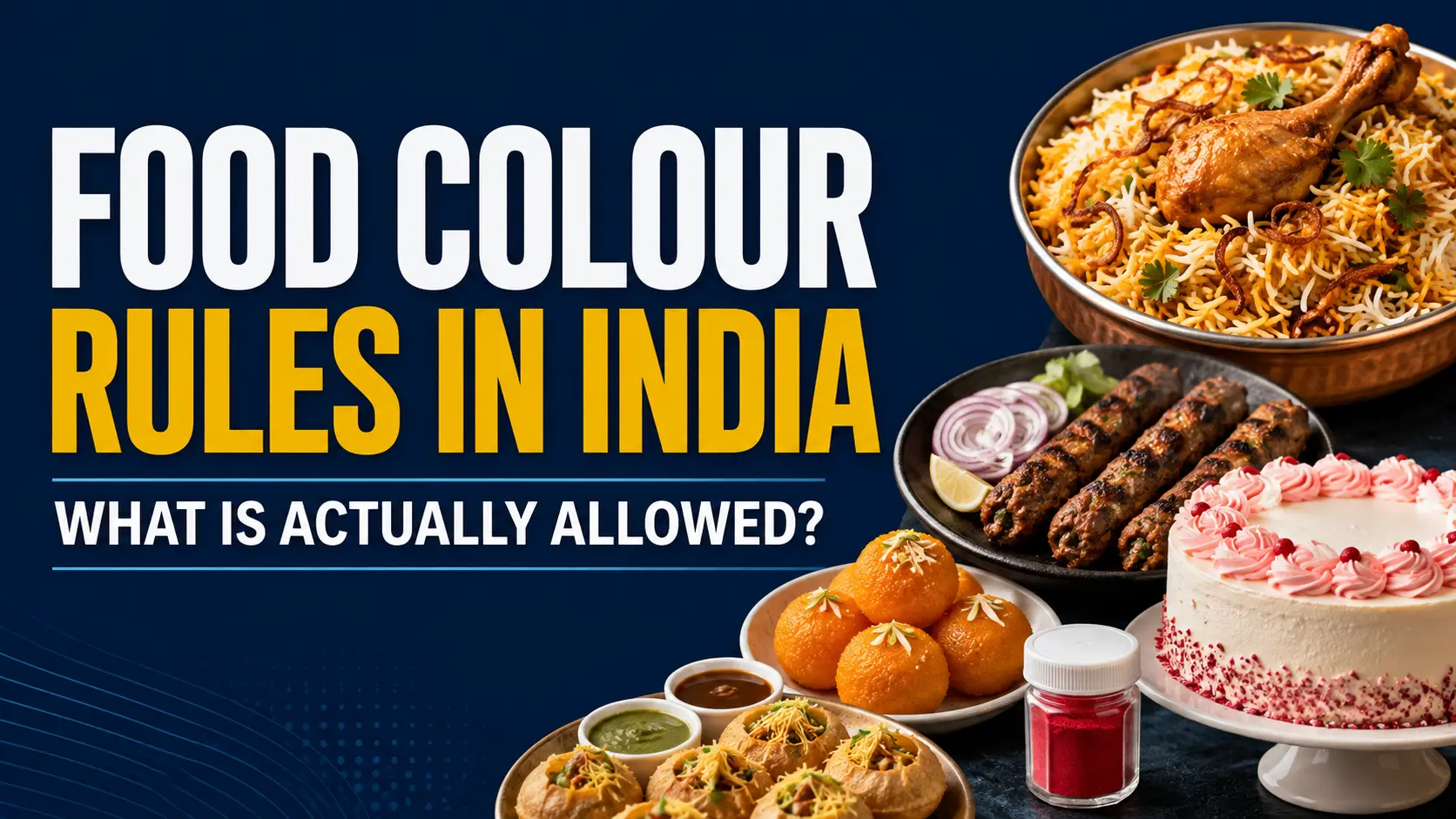
Food colour rules in India do not amount to a blanket ban on synthetic colour. FSSAI says synthetic colours can be used in food when the applicable Food Safety and Standards regulations permit them and when the specified conditions are followed.
For a restaurant, bakery, sweet shop or street-food business, that creates a more important question than simply asking whether a packet says “food colour”: is this particular colour legally permitted in this particular food and in the way the business is using it?
Food colour rules in India: what businesses should check first
FSSAI’s own FAQ states that synthetic colours may be used in food products in accordance with the conditions prescribed under the Food Safety and Standards (Food Product Standards and Food Additives) Regulations, 2011. FSSAI also maintains the underlying food-additive regulations and their amendments as the governing regulatory framework.
That means a restaurant owner should not make a compliance decision merely from the colour’s commercial name or from a supplier saying it is “food grade”. The business still needs to know whether its intended application is permitted. This product-specific approach is central to understanding food colour rules in India.
| Question | What the business should understand |
|---|---|
| Is every synthetic food colour banned? | No. FSSAI permits synthetic colours under specified regulatory conditions. |
| If a colour is permitted, can it be added to any food? | No. Permitted use depends on the applicable food category and regulatory conditions. |
| If food looks very bright, is it automatically illegal? | No. Appearance can justify concern or inspection, but legal non-compliance should not be assumed from colour intensity alone. |
| Can fruit or vegetables simply be coloured to improve appearance? | FSSAI specifically states that colouring fruits and vegetables is not permitted under the relevant restriction. |
| Does removing colour change the flavour of kebab, rice or another dish? | Removing a colouring ingredient primarily changes appearance unless that ingredient also performs another documented function. Colour itself should not be treated as the source of the dish’s flavour. |
Why “permitted colour” does not mean “permitted everywhere”
The food-additive framework is organised around permitted substances and the food categories or applications in which they may be used. FSSAI’s FoSCoS product system itself lists recognised food colours and synthetic food-colour preparations as regulated food-additive products.
That distinction matters in a commercial kitchen. A bakery, confectionery manufacturer and restaurant may be working with very different food categories even when all three purchase colour from the same supplier.
Food colour rules in India for biryani, kebabs and restaurant food
Businesses should be particularly careful about assuming that a colour commonly seen in one food can be transferred to another dish. State food-safety authorities may also issue or enforce specific restrictions where unsafe or non-permitted use is detected.
For restaurants, the compliance issue is therefore not whether diners expect biryani to look orange, kebabs to look red or a dessert to look unusually bright. The relevant question is what the food regulations permit in the specific product and whether the ingredient being used actually meets that standard.
If artificial colour is removed from a dish such as kebab, the obvious direct change is visual presentation. TPS has found no basis for treating removal of colour alone as equivalent to a loss of taste. Spices, cooking technique, ingredients and seasoning determine flavour independently of a colouring additive.
What bakeries, cake shops and sweet shops need to check
Bakery and confectionery businesses should not assume that all brightly coloured products are prohibited either. FSSAI specifically notes that permitted colours for chocolates and candies are prescribed in the applicable food-additive tables.
The correct compliance exercise is therefore product-specific. The colour used in icing, confectionery, a filling, a beverage or another processed food may be governed differently. That is why food colour rules in India cannot be reduced to a single list saying “legal” or “illegal” for every restaurant, sweet shop or bakery product.
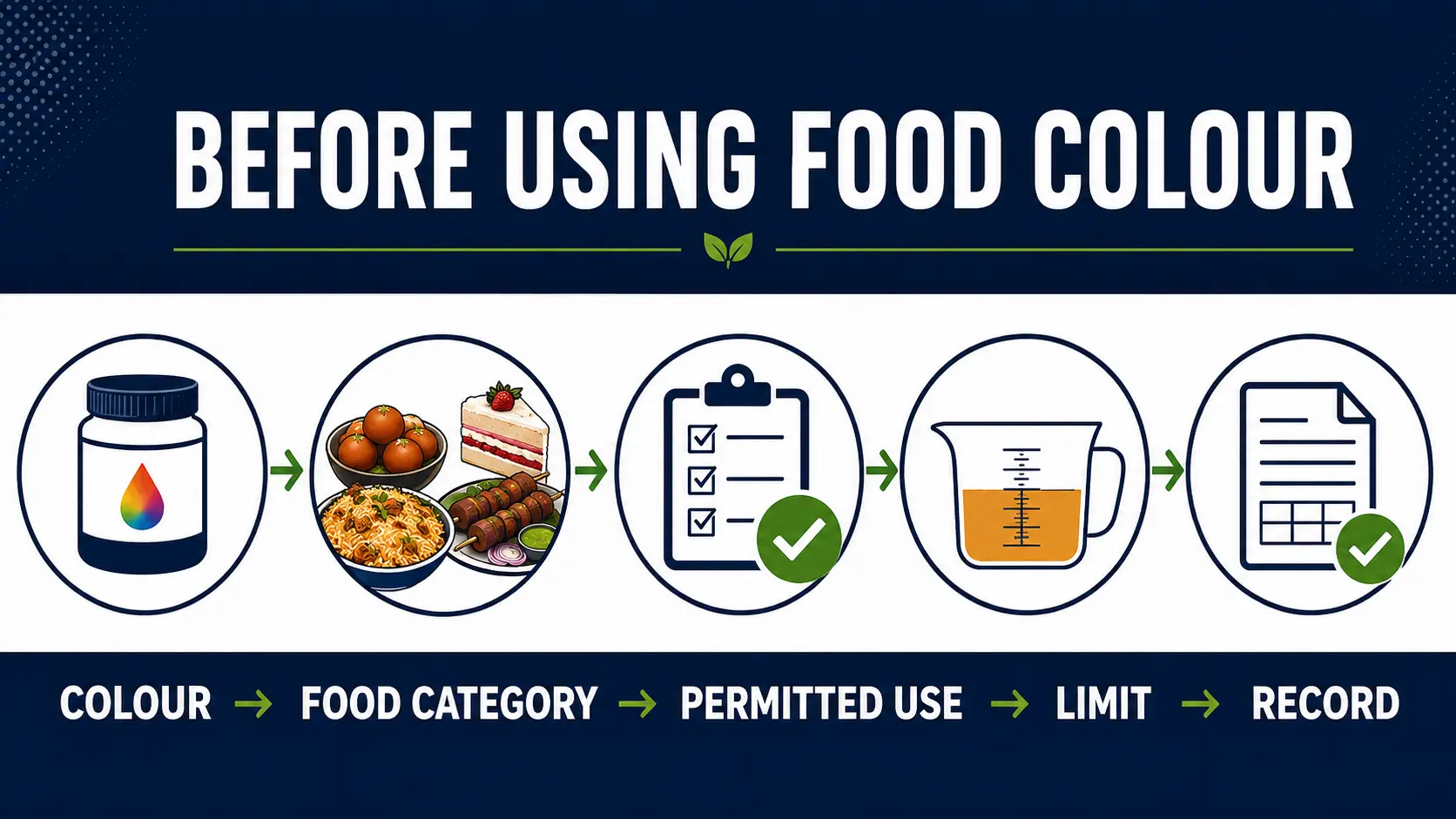
- What is the exact name of the colour or colour preparation?
- Who manufactured or supplied it?
- Is it sold as food-grade material rather than an industrial dye?
- Which FSSAI food category does the finished product fall under?
- Is this colour permitted in that category?
- What maximum level or use condition applies?
- Can the business retain invoice, batch and supplier details if inspected?
A raid is not proof that every coloured food is illegal
The Food Safety and Standards Act establishes a formal enforcement chain involving the State Commissioner of Food Safety, Designated Officers and Food Safety Officers. The Act provides mechanisms including improvement notices, prohibition orders, inspection, sampling, search, seizure, investigation and prosecution.
This matters because food-safety enforcement should distinguish suspicion from an established violation. An inspection can identify a product for sampling; the regulatory finding then depends on the applicable standard and evidence.
The distinction between a ban, a recall and an enforcement action also matters. TPS has a separate explainer on the difference between an FSSAI ban and a product recall, because those actions do not mean the same thing legally or operationally.
FSSAI also makes an unusually clear distinction elsewhere: colouring fruits and vegetables is not permitted. A business therefore cannot defend every use of colour merely by pointing to the existence of permitted synthetic colours elsewhere in the regulations.
Can authorities reduce illegal colouring without banning every legal colour?
Yes. Kerala’s Kozhikode district provides a useful example of a different enforcement model. Its Niramalla Ruchi campaign combined public awareness, restaurant and bakery participation, mobile food-testing demonstrations and statutory sampling rather than treating every coloured food as automatically illegal.
The Kerala Health Department says the campaign produced a 60% reduction in non-conforming samples associated with artificial colours. That figure should not be interpreted as evidence that all synthetic colours disappeared; it is evidence that compliance improved under a combined education-and-enforcement programme.
What happens to India’s food-colour industry if demand changes?
India also has businesses and workers upstream of restaurants and bakeries that manufacture food colours. TPS found established food-colour manufacturers in industrial locations including Surat in Gujarat and Roha in Maharashtra.
For example, Shree Arihant Dye Chem says it operates from Sachin GIDC in Surat and manufactures both natural and synthetic food colours. ROHA traces its origin to a colour-manufacturing facility in Roha, Maharashtra and today sells synthetic, natural and clean-label colour systems internationally.
That means a long-term shift in food-industry demand could affect manufacturers and workers in those industrial areas as product portfolios change. But TPS has not found reliable public evidence showing how many Indian jobs depend specifically on synthetic food-colour production or that recent state restrictions have caused a measurable number of colour-industry job losses.
What restaurants and shops should do instead of waiting for a raid
- Identify every added colour used in the kitchen or production area.
- Keep the original manufacturer packaging and purchase records.
- Do not use industrial dyes or unidentified powders merely because a supplier says they are suitable for food.
- Match each colour against the exact finished-food category and current FSSAI rule.
- Train cooks and production staff not to transfer colour practices from one dish to another without checking legality.
- When in doubt, obtain written regulatory or compliance advice rather than relying on visual custom in the market.
- If authorities take a sample, preserve the batch and supplier information relevant to that sample.
For restaurants, bakeries and sweet shops, following food colour rules in India therefore depends less on whether coloured food looks unusual and more on whether the business can demonstrate that the ingredient, food category, amount and sourcing are compliant.
What consumers should understand
Brightly coloured food is not automatically proof of an offence, and pale or “natural-looking” food is not automatically safe. Consumers should avoid treating appearance as a substitute for regulation or laboratory evidence.
The more defensible concern is when a food business cannot identify what colour it uses, the ingredient is sold without proper food-grade information, a prohibited use is suspected, or authorities find a non-compliant substance through sampling.
Food-colour compliance is also different from the separate debate over front-of-pack nutrition warnings. TPS explains what a high sugar, salt or fat warning on packaged food means for children, adults and people with diabetes.
Related TPS food-safety coverage
Food-colour compliance sits inside a wider set of FSSAI questions around bans, recalls, product warnings and claims that an entire food category has been prohibited. These TPS explainers cover those distinctions separately.
Verification method
TPS reviewed FSSAI’s current Food Safety and Standards regulations page, FSSAI’s official FAQ on synthetic food colours and permitted applications, FoSCoS food-additive listings, the Food Safety and Standards Act enforcement structure on India Code, and Kerala Health Department material on the Kozhikode synthetic-colour campaign. Company information was used only to establish examples of current food-colour manufacturing locations and product portfolios, not to estimate national employment or market share.
Sources checked
- FSSAI — FAQ on permitted food colours and synthetic colours
- FSSAI — Food Safety and Standards Regulations
- FSSAI — colouring of fruits and vegetables
- India Code — Food Safety and Standards Act, 2006
- Kerala Health Department — Niramalla Ruchi campaign
- Shree Arihant Dye Chem — Surat manufacturing information
- ROHA — company history and Roha manufacturing origin
Limitations and unresolved facts
Food-additive permissions are product-specific and may change through amendments, directions or state enforcement decisions. This article does not provide a universal list saying a named colour is lawful in every restaurant dish. Food businesses should verify the current standard for their exact product and intended use.
TPS has not found a reliable national dataset quantifying employment specifically in synthetic food-colour manufacturing or job losses caused by recent food-colour restrictions. No employment, closure or revenue-loss figure has been inferred.
Last verified: August 15, 2026, IST.