






ICEGATE’s Other Refund module includes a Shipping Bill-based workflow for exporters. The important point is that this is not a manual refund route for every export-related payment or tax claim. ICEGATE’s current Other Refund user manual, version 1.07 dated July 9, 2026, includes Shipping Bill as a document type and documents a refund ground involving exported goods that are returned to the exporter or re-imported into India within one year from the date of export, otherwise than by way of resale.
ICEGATE currently continues to state that its Custom Refund for Export facility is live and directs users to the Other Refund user manual. Its current Reassessment and Customs Refund listing still identifies Other Refund User Manual version 1.07 dated July 9, 2026. For exporters, the practical question is therefore not simply whether ICEGATE has a refund feature, but whether their Shipping Bill and return or re-import situation fits the documented Other Refund workflow.
Important: do not confuse this workflow with the usual IGST refund mechanism for exports of goods, duty drawback, RoDTEP or RoSCTL. Those processes have their own rules. A Shipping Bill appearing in this Other Refund module does not mean every refund connected to that Shipping Bill must be filed here.
What is the ICEGATE Other Refund Shipping Bill process?
The Other Refund facility is an ICEGATE 2.0 workflow through which eligible IEC holders can submit certain customs refund requests electronically and track their status.
The current user manual, version 1.07 dated July 9, 2026, includes Shipping Bill as a document type in the Other Refund process.
This means an exporter can create an Other Refund request against an eligible Shipping Bill where the applicable refund ground and transaction facts support that route.
Who is the Shipping Bill refund route for?
The official manual documents a Shipping Bill refund ground for a specific situation: goods exported from India are returned to the exporter or re-imported into India within one year from the date of export, otherwise than by way of resale.
That scope is materially narrower than a generic “export refund”.
An exporter should therefore first establish that the transaction fits the applicable customs refund ground before starting the application. Merely having an export Shipping Bill or a payment issue does not establish eligibility.
What does ‘returned or re-imported within one year’ mean for the filing?
The documented ground links the refund request to goods that were previously exported and later came back to India within one year from the export date, provided the return was otherwise than by resale.
Commercial situations can include rejected or returned consignments, but the legal eligibility of a particular shipment should be checked against the applicable customs provisions, assessment history and supporting documents. A commercial return does not automatically create a customs refund entitlement.
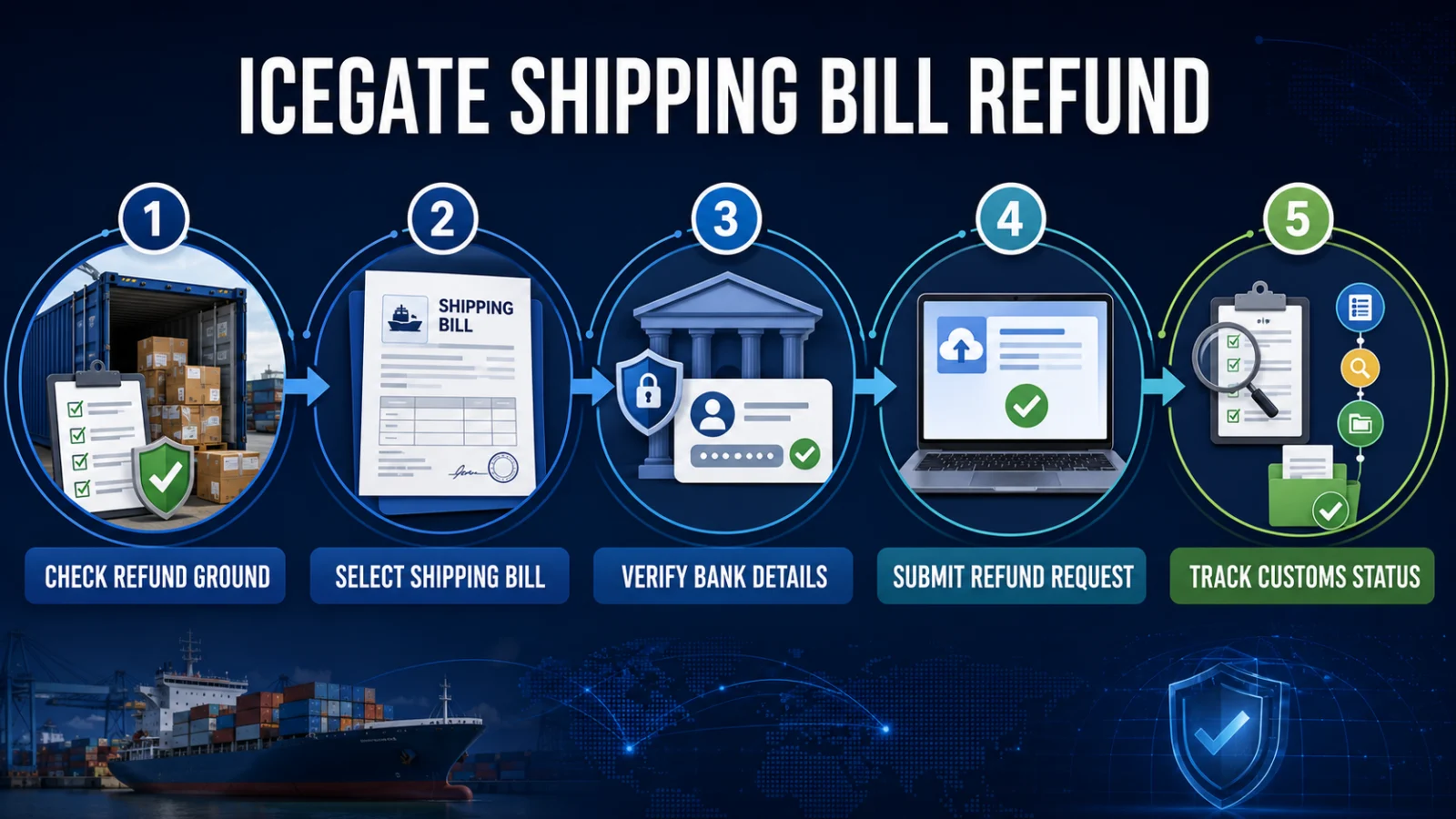
How to start an Other Refund request on ICEGATE
The refund functionality is available to registered users after login to ICEGATE.
The workflow is handled through ICEGATE’s refund services and Refund Dashboard. The user creates a new Other Refund request and selects the relevant document type.
For this exporter workflow, select:
Document Type: Shipping Bill
The applicant then proceeds with the Shipping Bill details and the relevant refund ground shown by the portal.
What should exporters have ready before filing?
Before beginning the request, exporters should keep the underlying export and return or re-import documentation aligned.
- Shipping Bill details for the original export.
- Documents showing that the goods were returned or re-imported into India.
- Relevant customs assessment or duty information supporting the refund claim.
- Commercial documents connecting the original export and returned goods.
- Supporting correspondence explaining why the goods were returned where relevant.
- An applicable bank account correctly registered on ICEGATE.
The exact documents required can depend on the claim and on any later query raised by Customs.
Exporters should also make sure their broader exporter registration and compliance records are in order. ThePulseSignal’s Exporter on Record registration guide explains ANF-9A documents, warehouses and compliance requirements.
If the issue is the registration process itself, see the separate ANF-9A registration guide for Exporter-on-Record in India.
Why the ICEGATE bank account matters
The Other Refund manual specifically addresses bank-account information.
An application cannot proceed if the user has no applicable bank account registered with ICEGATE. Exporters should therefore verify the account before starting the refund request.
If bank details or the IFSC have changed, ICEGATE advises users to update the information before filing. Incorrect or outdated details can create problems when the refund moves for payment and may result in a PFMS rejection.
Exporters receiving overseas proceeds in Indian rupees should treat payment realisation as a separate compliance issue. ThePulseSignal’s guide to the DGFT rupee export payment rules 2026 explains the current FTP treatment of INR export receipts and what exporters should verify with their authorised dealer bank.
What declarations are required?
The Other Refund workflow includes declarations relating to the claim and its procedural status.
The documented process asks the applicant to address matters such as:
- whether another refund request is pending against the same import or export document;
- whether the applicant wants a personal hearing;
- whether the relevant duty was paid under protest.
These are substantive declarations. Exporters should answer them based on the actual claim history rather than treating them as routine form fields.
How is the refund application submitted?
After the refund details and declarations are completed, the ICEGATE workflow validates the application before submission.
The Other Refund process uses verification against the user’s registered contact information, including OTP-based validation in the documented workflow.
Successful submission does not mean the refund has been sanctioned. It creates a customs refund request that can then move through review and adjudication.
What happens after submission?
The refund can be monitored through the ICEGATE Refund Dashboard.
The documented workflow can move through statuses such as:
- Submitted — the application has been filed.
- Assigned — Customs has assigned the request for processing.
- Deficiency Memo Issued — the officer requires correction, explanation or additional evidence.
- Acknowledgment Generated — the application has moved through the relevant acknowledgment stage.
- Further processing or adjudication — Customs evaluates eligibility and evidence.
- Refund Order Issued — the competent authority has issued the applicable order.
The exact sequence can vary depending on the application and Customs action.
What should you do if ICEGATE shows a Deficiency Memo?
A Deficiency Memo means the application requires a response before it can progress normally.
The exporter should open the memo from the Refund Dashboard, identify the deficiency and respond within the period specified by Customs.
Supporting documents can be uploaded with the response where required.
Do not simply file a second refund against the same Shipping Bill to bypass the deficiency. The Other Refund declarations specifically address whether another application is pending against the same document.
Is this the same as an IGST export refund?
No.
For exports of goods with payment of IGST, the established refund mechanism generally relies on the Shipping Bill as the refund application once the applicable GST and Customs conditions and data-matching requirements are met.
The ICEGATE Other Refund workflow is a separate customs refund application process.
The inclusion of Shipping Bill as a document type inside Other Refund does not convert ordinary IGST export refunds into Other Refund applications.
Does this replace duty drawback?
No. Nothing in the current ICEGATE material establishes that the Other Refund Shipping Bill workflow replaces duty drawback.
Duty drawback is governed by its own customs framework and Shipping Bill processing rules. Exporters should not use the Other Refund module merely because a drawback payment is delayed unless applicable ICEGATE or Customs instructions direct them to that route.
Does this replace RoDTEP or RoSCTL?
No.
RoDTEP and RoSCTL operate through separate export-remission mechanisms. The Other Refund workflow should not be treated as a substitute for those schemes.
How is Other Refund different from a re-assessment-based refund?
ICEGATE also operates a separate re-assessment-based refund workflow.
That process originates from the re-assessment of a Bill of Entry. When the re-assessment results in a finding that the importer is eligible for refund, ICEGATE can provide a pre-populated refund application based on the reassessment.
The Shipping Bill process discussed here sits inside Other Refund and begins from an eligible export-related Shipping Bill scenario. These should not be treated as the same workflow.
What about e-commerce exporters?
E-commerce exporters can face the same need to keep Shipping Bill, customs, banking and export-realisation records aligned, but this refund workflow does not replace the wider rules that apply to platform-based exports.
Businesses selling internationally through marketplaces or digital platforms can use ThePulseSignal’s India e-commerce export framework guide for the broader rules affecting platforms, sellers, shipping and export compliance.
Does filing through ICEGATE guarantee the refund?
No.
ICEGATE provides the electronic filing and workflow infrastructure. Customs still has to evaluate whether the statutory and documentary conditions for the refund are satisfied.
A claim can therefore receive a deficiency memo, require additional evidence or ultimately be rejected if the legal conditions are not met.
Exporter checklist before using the Shipping Bill refund route
- Confirm that the claim fits an applicable Shipping Bill refund ground offered through Other Refund.
- Check the original Shipping Bill number and export date.
- For the documented returned-goods ground, confirm that the goods were returned or re-imported within the applicable one-year period.
- Verify that the return was otherwise than by resale where that condition applies.
- Match the returned goods to the original export documentation.
- Check the applicable customs-duty and refund basis.
- Confirm that the correct bank account and IFSC are registered on ICEGATE.
- Check whether another refund is already pending against the same document.
- Keep supporting evidence ready in case Customs issues a Deficiency Memo.
- Do not use this workflow as a substitute for IGST refund, drawback, RoDTEP or RoSCTL without an applicable legal basis.
What the ICEGATE facility does not automatically mean
- It does not mean every export refund must be filed through Other Refund.
- It does not mean every Shipping Bill creates a refund entitlement.
- It does not replace the normal IGST export-refund mechanism.
- It does not replace duty drawback.
- It does not replace RoDTEP or RoSCTL.
- It does not guarantee that Customs will sanction a filed refund.
- It does not remove the need to prove the legal and documentary basis of the claim.
Related TPS export and trade compliance guides
- Exporter on Record Registration: ANF-9A Documents, Warehouses and Compliance
- ANF-9A Registration Guide for Exporter-on-Record in India
- DGFT Rupee Export Payment Rules 2026: What Changed for FTP Benefits?
- India’s E-Commerce Export Framework: Rules for Platforms and Sellers
Official sources
- ICEGATE — current portal notice stating that the Custom Refund for Export facility is live.
- ICEGATE Reassessment and Customs Refund — current listing showing Other Refund User Manual version 1.07 dated July 9, 2026.
- ICEGATE Other Refund User Manual v1.07 — official workflow manual containing the Shipping Bill process.
How the current workflow was verified
ThePulseSignal checked ICEGATE’s current portal and Reassessment and Customs Refund listing on August 27, 2026. ICEGATE continues to state that the Custom Refund for Export facility is live, and its current advisory listing continues to show Other Refund User Manual version 1.07 dated July 9, 2026.
No newer Other Refund manual was identified in the current ICEGATE refund listing. The current v1.07 manual remains the controlling workflow evidence reviewed for the Shipping Bill process, bank-account requirement and claim declarations.
Last verified: August 27, 2026.
Limitations and unresolved points
- The current manual documents the Shipping Bill workflow and a returned or re-imported export-goods refund ground but should not be treated as a complete statement of every statutory customs refund ground.
- Eligibility ultimately depends on the applicable Customs Act provisions, notification, assessment history and evidence for the particular transaction.
- The public ICEGATE pages do not expose an individual exporter’s post-login eligibility, application fields or Customs adjudication state.
- This workflow does not establish that IGST refunds, duty drawback, RoDTEP or RoSCTL should be routed through Other Refund.
- Customs may require additional documents or clarification depending on the claim.
- ICEGATE may subsequently revise the Other Refund manual or expand the Shipping Bill workflow.
Frequently asked questions
What is the ICEGATE Shipping Bill refund facility?
ICEGATE includes Shipping Bill as a document type within its Other Refund workflow. The current official manual documents a refund ground involving exported goods returned to the exporter or re-imported into India within one year from export, otherwise than by resale.
Can every exporter use the Other Refund Shipping Bill option?
No. The applicant must have a valid refund basis that fits the applicable customs rules and the workflow offered by ICEGATE. Merely having a Shipping Bill does not create refund eligibility.
Is this how I claim an IGST refund for exports?
Not ordinarily. The established IGST refund mechanism for exports of goods is separate. The Shipping Bill itself generally functions as the refund application under that mechanism once the required conditions are satisfied.
Do I need a bank account registered on ICEGATE?
Yes. The Other Refund manual states that the application cannot proceed without the relevant bank-account information. Exporters should also ensure the account and IFSC details are current to reduce the risk of payment rejection.
What happens if Customs finds something missing?
Customs can issue a Deficiency Memo through the refund workflow. The applicant should review the deficiency, respond within the stated time and upload requested supporting evidence where necessary.
Does submitting the application mean the refund is approved?
No. Submission starts the Customs review process. The claim still has to satisfy the applicable legal and documentary requirements before a refund order can be issued.