






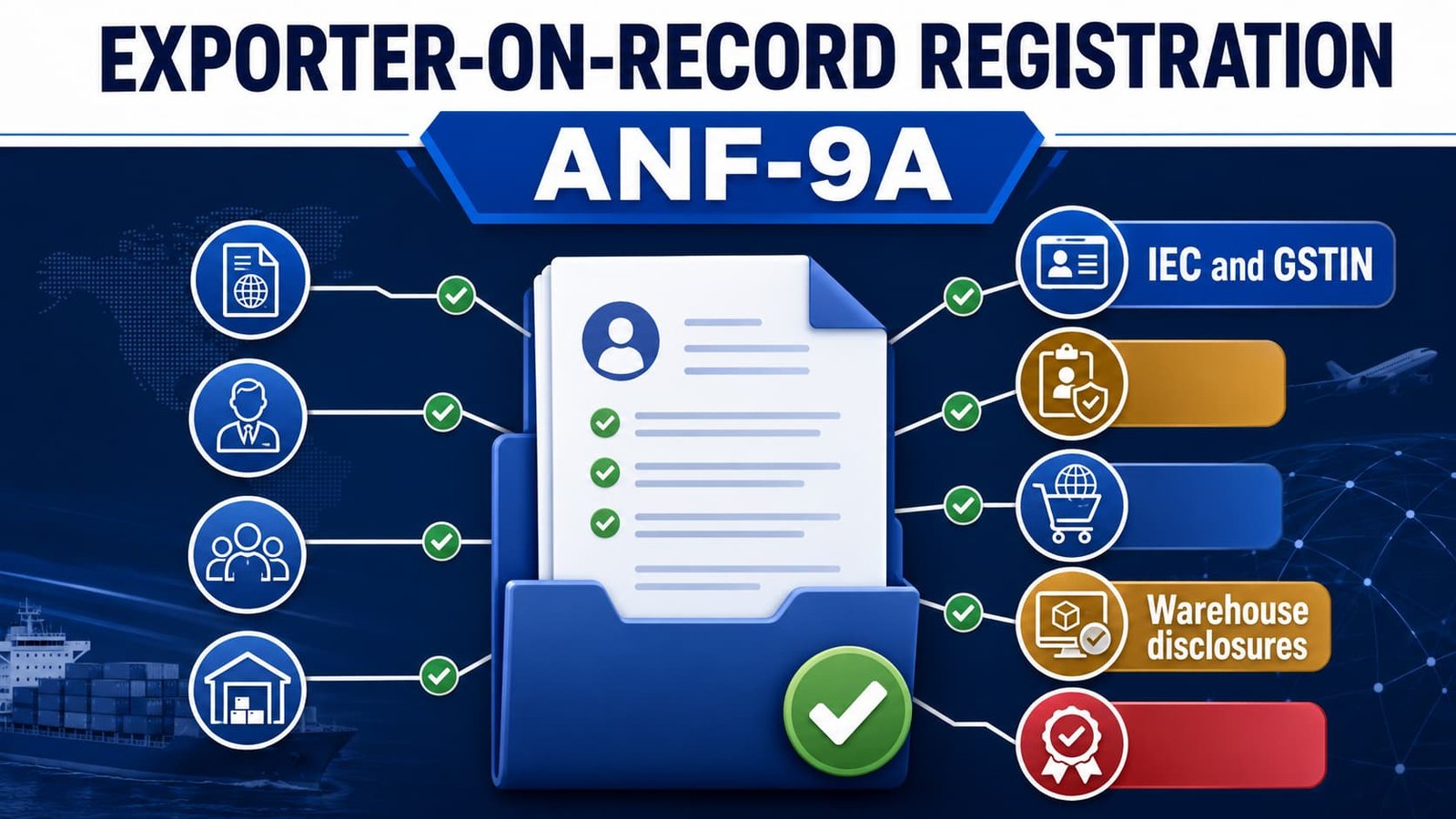
Exporter on Record registration under India’s new cross-border e-commerce framework is completed through ANF-9A, but the form is only the starting point. The applicant must also satisfy IEC and GSTIN conditions, disclose its ownership and e-commerce relationship, map every inventory location, establish digital traceability and accept ongoing payment, returns, certification and recordkeeping obligations.
The practical problem is that most current coverage explains what an Exporter-on-Record does, but not what a business must prepare before applying. This guide focuses on the registration file, documents, warehouse disclosures, post-registration changes and compliance controls that can cause an application or later operation to fail.
Direct answer
How Exporter on Record registration works
Complete ANF-9A, provide the prescribed legal, tax, ownership, platform, turnover and warehouse details, attach the required authorisation and relationship documents, and submit the application through the route stated in the current DGFT form.
Current status
What is operational now
DGFT Public Notice No. 25/2026-27 introduced ANF-9A with immediate effect. The published form presently directs applicants to send the completed application and scanned supporting documents to the DGFT email address stated in the form.
Confirmed
- The applicant must hold a valid IEC and GSTIN.
- ANF-9A is the prescribed registration form.
- Warehouse and inventory-location disclosures are mandatory.
- Material changes must be reported within 30 days through revised ANF-9A.
- Annual independent compliance certification is required.
Not confirmed
- A dedicated online ANF-9A filing module was not identified in the reviewed official material.
- No registration fee or standard approval timeline was stated in the reviewed form.
- Commercial approval by any named e-commerce platform is not part of DGFT registration.
- Registration does not replace Customs, GST, FEMA or destination-country compliance.
Table of contents
Who can apply for Exporter on Record registration?
The applicant must be the entity that will own the export inventory, export the goods in its own name and assume the framework’s compliance obligations.
IEC holder
The Exporter-on-Record must hold a valid Importer Exporter Code.
GST-registered entity
The applicant must hold a valid GSTIN and disclose the GST registrations connected to inventory locations.
Eligible legal structure
Where the FDI-policy exception is used, export operations must be carried out through the separate Indian legal entity required by the framework.
The applicant must disclose its shareholding pattern and the nature of its ownership or control relationship with the associated e-commerce entity. Registration is therefore not merely an IEC-based filing; DGFT is also being asked to assess the legal structure behind the export operation.
Important boundary
A Seller-on-Record supplying goods to an Exporter-on-Record is not automatically required to apply as an Exporter-on-Record. The registration belongs to the entity that will own the export inventory and undertake exports under the framework.
Documents required for Exporter on Record registration
ANF-9A requires supporting records that establish who is authorised to apply, how the applicant is connected to the e-commerce entity and where the export inventory will be held.
| Document or evidence | Why DGFT needs it | Common preparation risk |
|---|---|---|
| Board resolution or authorisation letter | Confirms authority of the signatory | Signatory name or designation does not match the form |
| IEC, PAN and GSTIN details | Identifies the registered exporting entity | Legal name or address differs across registrations |
| Shareholding or group-structure evidence | Shows ownership and control relationship with the e-commerce entity | Indirect holding or control rights are not explained |
| Board-composition or relationship documents | Supports the disclosed corporate relationship | Outdated board or ownership records |
| Warehouse ownership or lease records | Establishes control over each inventory location | Expired lease, missing address or inconsistent operator name |
| GST registration for inventory locations | Links the warehouse to the applicant’s tax footprint | Location appears in operations but not in the disclosure |
| Turnover and export-turnover records | Provides recent commercial history where applicable | Figures do not reconcile with audited or tax records |
| Any additional document requested by DGFT | Allows case-specific verification | Applicant treats the listed annexures as exhaustive |
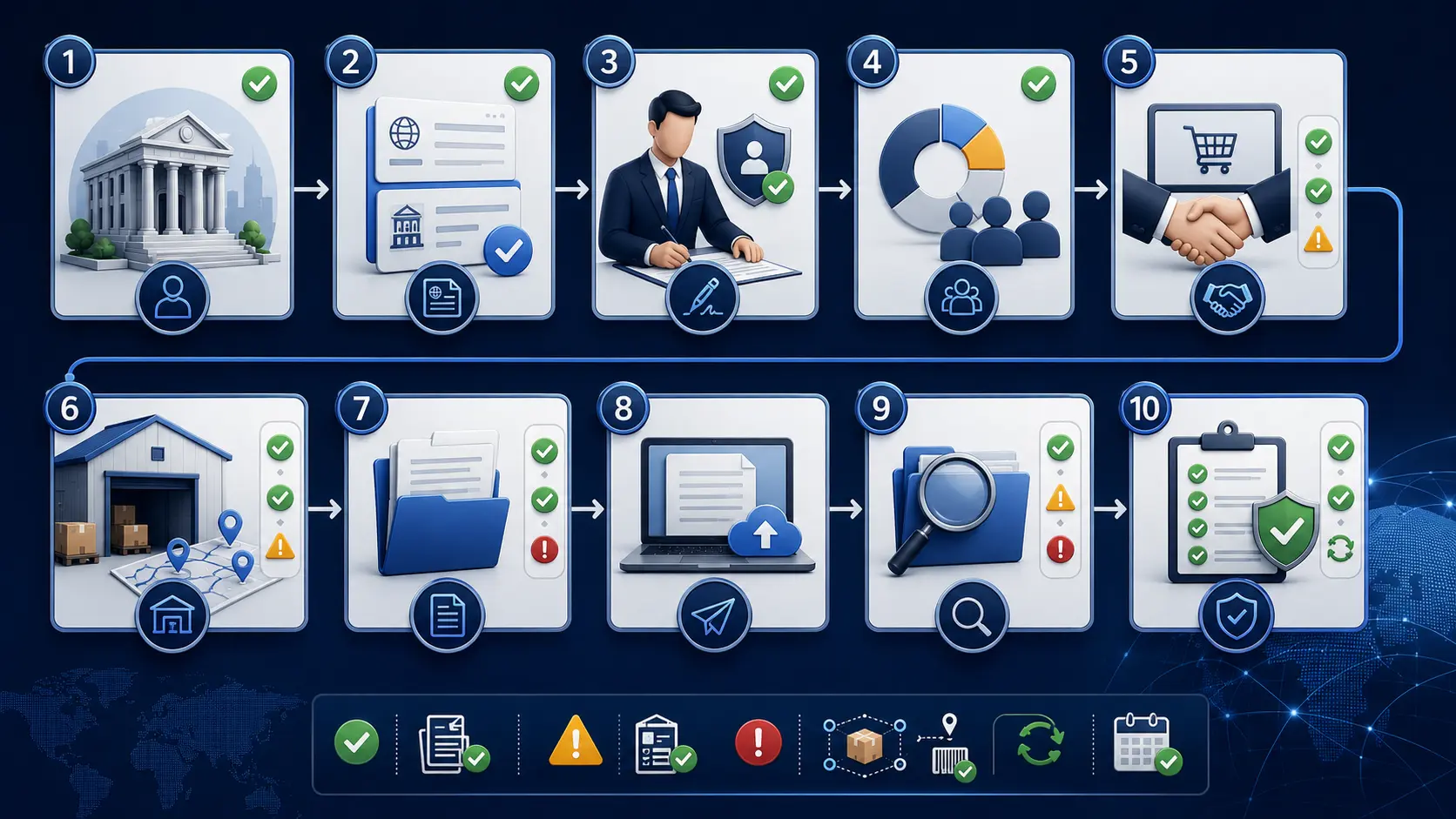
ANF-9A field guide: what the application asks for
Applicant identity
Legal name, constitution, registered office, IEC, PAN, GSTIN and authorised-signatory details.
Ownership and control
Foreign investment, shareholding and relationship with the associated e-commerce entity.
Commercial record
Turnover and export-turnover details for the previous three financial years, where applicable.
Planned export activity
Proposed destination countries and e-commerce platforms through which goods will be sold.
Inventory network
Every warehouse or inventory location, its GST registration, capacity, operator and ownership or lease status.
Declarations
Undertakings concerning truthful disclosure, compliance, domestic-diversion prohibition and consequences of non-compliance.
Editorial interpretation
The strongest application risk is likely to be inconsistency across records rather than a missing field alone. The entity name, signatory authority, ownership structure, GST registrations and warehouse documents should tell one coherent story.
How to prepare warehouse and inventory-location disclosures
ANF-9A requires the applicant to identify all locations where export inventory will be held. The post-registration framework then requires the digital repository to remain operational across the full location network.
For each location, prepare
- full address;
- applicable GST registration;
- whether the premises are owned or leased;
- lease or ownership evidence;
- storage capacity;
- warehouse or facility operator details;
- how export inventory will be physically segregated;
- how procurement, GST invoice, seller, order and export records will be linked.
Warehouse warning
Listing a location in ANF-9A is not enough. The operational framework requires export inventory to remain distinctly identified, segregated and digitally traceable. A warehouse that cannot support those controls may create a compliance failure after registration.
How is ANF-9A submitted?
The published ANF-9A directs the applicant to email the completed form and scanned supporting documents to the DGFT address stated in the form.
Before sending
- use the current form version;
- check every attachment reference;
- ensure the authorised signatory signs the required declarations;
- use readable scans;
- name attachments consistently;
- preserve the sent email and attachment set.
After sending
- preserve the delivery record;
- record any acknowledgement or reference number;
- respond only through verified DGFT channels;
- keep a dated copy of the submitted form;
- do not assume submission equals registration approval.
The reviewed official material did not establish a dedicated online ANF-9A module, an application fee or a standard processing timeline.
What must be reported after registration?
The Exporter-on-Record must notify DGFT within 30 days of a material change by submitting revised ANF-9A information.
Corporate changes
Legal name, constitution, registered office, authorised signatory, shareholding or FDI structure.
Relationship changes
Change in ownership or control relationship with the associated e-commerce entity.
Operational changes
Warehouse locations, inventory operators, platforms, business scope or voluntary surrender.
After receiving the change notice, DGFT may confirm, modify, suspend or cancel the registration depending on whether the entity continues to meet the framework’s conditions.
Operational controls required after registration
Exporter on Record registration creates continuing obligations. The registered entity must operate the system described in its application and maintain evidence that the controls work.
| Control area | Required position | Evidence to maintain |
|---|---|---|
| Confirmed export order | Inventory title may pass only against a confirmed overseas order | Order record linked to procurement and inventory |
| Inventory segregation | Export inventory must remain distinct and export-only | Warehouse records, location controls and stock identifiers |
| Digital repository | Must link seller, procurement, GST invoice and export documents | Searchable transaction-level records |
| Seller payment | No later than seven days after acceptance or deemed acceptance | Acceptance event and payment proof |
| Seller visibility | Seller access to sale price, order status, tracking and destination | Portal or report access logs |
| Export benefits | Seller-attributable amount passed through within 30 days of receipt | FOB apportionment and disbursement records |
| Returns | Re-export, return, destruction or lawful disposal within the framework | Reverse-logistics and disposal records |
Annual compliance certification and record retention
The Exporter-on-Record must obtain an independent certificate from a Chartered Accountant, Cost Accountant or another professional specified by DGFT.
The certificate must confirm compliance with inventory segregation, domestic-diversion prohibition, seller visibility, payment timelines, export-benefit allocation and return handling. It must be furnished within 90 days after the end of the financial year unless DGFT prescribes another interval.
Records must be preserved for five years from the end of the financial year in which the relevant inventory is finally exported, re-exported, returned, rejected, destroyed or otherwise disposed of. The recordkeeping obligation survives suspension, cancellation or voluntary surrender.
What can lead to suspension, recovery or penalties?
- false or misleading information in ANF-9A;
- failure to report material changes within 30 days;
- domestic diversion of export inventory;
- inventory acquired without confirmed overseas orders;
- late or contingent payment to Sellers-on-Record;
- incorrect export-benefit allocation;
- origin misrepresentation;
- inadequate digital traceability;
- non-compliant handling of returned goods;
- failure to file annual certification or preserve records.
ANF-9A warns that non-compliance may result in suspension or cancellation, IEC-related action, Denied Entity List consequences, recovery of rebates or refunds with applicable interest and penal or prosecution proceedings under applicable law.
Exporter on Record registration pre-filing checklist
Reconcile identity records
Match the legal name, address and signatory across IEC, PAN, GST, corporate and authorisation records.
Map ownership clearly
Prepare a simple ownership and control chart showing the relationship with the e-commerce entity.
Audit every warehouse
Check lease validity, GST linkage, operator details, capacity and export-inventory segregation.
Design the repository first
Confirm that each seller, order, invoice, stock unit and export document can be linked.
Define seller contracts
Document acceptance, seven-day payment, visibility, returns and export-benefit pass-through.
Preserve the filing package
Keep the exact signed form, attachments, email, acknowledgement and later DGFT correspondence.
Official resources
Related ThePulseSignal guides
India’s e-commerce export framework explained
The policy-level guide covering Exporter-on-Record, Seller-on-Record, seller payment, export benefits and returns.
India’s forced-labour import ban explained
A separate DGFT compliance guide covering import restrictions, evidence and business exposure.
How this was verified
ThePulseSignal reviewed DGFT Notification No. 27/2026-27, DGFT Public Notice No. 25/2026-27 and the notified ANF-9A application form. The official documents were used to verify eligibility, application disclosures, warehouse information, post-registration change reporting, operational obligations, annual certification, record retention and dispute handling.
The DGFT notification register, Aayaat Niryat Forms page and customer portal were checked for the current public filing position. A dedicated online ANF-9A filing module was not identified during the recorded check.
Competitor coverage from current legal, tax, MSME and business publishers was reviewed to identify unanswered procedural questions. Those sources were used only for competitor analysis, not as the controlling authority for the registration requirements.
Last verified: August 5, 2026, approximately 11:55 PM IST.
Limitations and unresolved facts
- The official material reviewed does not specify a registration fee or standard approval timeline.
- A dedicated online ANF-9A filing module was not identified.
- The exact DGFT scrutiny workflow, deficiency-notice format and approval communication process were not publicly detailed in the reviewed documents.
- No public register of approved Exporters-on-Record was identified.
- Product-specific Customs, GST, FEMA, ITC(HS), SCOMET and destination-country requirements remain separate.
- This article cannot determine whether a specific corporate structure, warehouse network or contract will be accepted by DGFT.
Frequently asked questions
What is Exporter on Record registration?
It is DGFT registration of the entity that will own export inventory, undertake exports in its own name and assume the framework’s operational and compliance obligations.
Which form is used for Exporter on Record registration?
ANF-9A is the notified application form.
Does the applicant need an IEC and GSTIN?
Yes. The Exporter-on-Record must hold both.
Is ANF-9A filed online?
The published form currently specifies email submission of the completed application and scanned documents. A dedicated online module was not identified during the latest check.
Is there an ANF-9A application fee?
No fee was stated in the official material reviewed for this article.
How long does approval take?
The reviewed documents do not state a standard processing timeline.
Must every warehouse be disclosed?
The application requires details of the locations where export inventory will be held, and the operating repository must work across the inventory network.
What changes must be reported after registration?
Material changes—including corporate, signatory, shareholding, relationship, warehouse and platform changes—must be reported within 30 days through revised ANF-9A information.
Does registration allow domestic sale of export inventory?
No. Export inventory and returned consignments cannot be diverted to domestic sale under the framework.
Can DGFT cancel the registration?
Yes. DGFT may confirm, modify, suspend or cancel registration if the entity no longer satisfies the framework or fails to comply.