




Why US opposes BRICS is more complicated than a simple America-versus-BRICS story. The historical record shows that Washington has not always treated the grouping as a direct threat. US officials were relatively cautious about BRICS and its New Development Bank during the Obama years, while Biden-era officials continued to describe BRICS membership as a sovereign choice. The sharpest explicitly anti-BRICS tariff rhetoric appeared later, when Donald Trump tied BRICS directly to the future of the US dollar.
Direct answer: what does the US actually object to?
The clearest Trump-era concern is the possibility that BRICS countries could reduce their dependence on the US dollar, expand alternative payment channels or weaken US financial leverage. Washington also watches the influence of China and Russia, challenges to Western-led institutions and trade arrangements that could reduce US economic influence. But that does not mean every American tariff on a BRICS country was imposed because it belonged to BRICS.
The September 2026 BRICS summit adds an important current fact. The New Delhi Declaration advanced work on cross-border payment interoperability and trade and investment using local currencies, while stopping short of creating a common BRICS currency. The declaration also criticised unilateral tariff and non-tariff measures. Those outcomes make payments and trade policy directly relevant to the US-BRICS relationship, but they still do not establish that BRICS has launched a single currency designed to replace the dollar.
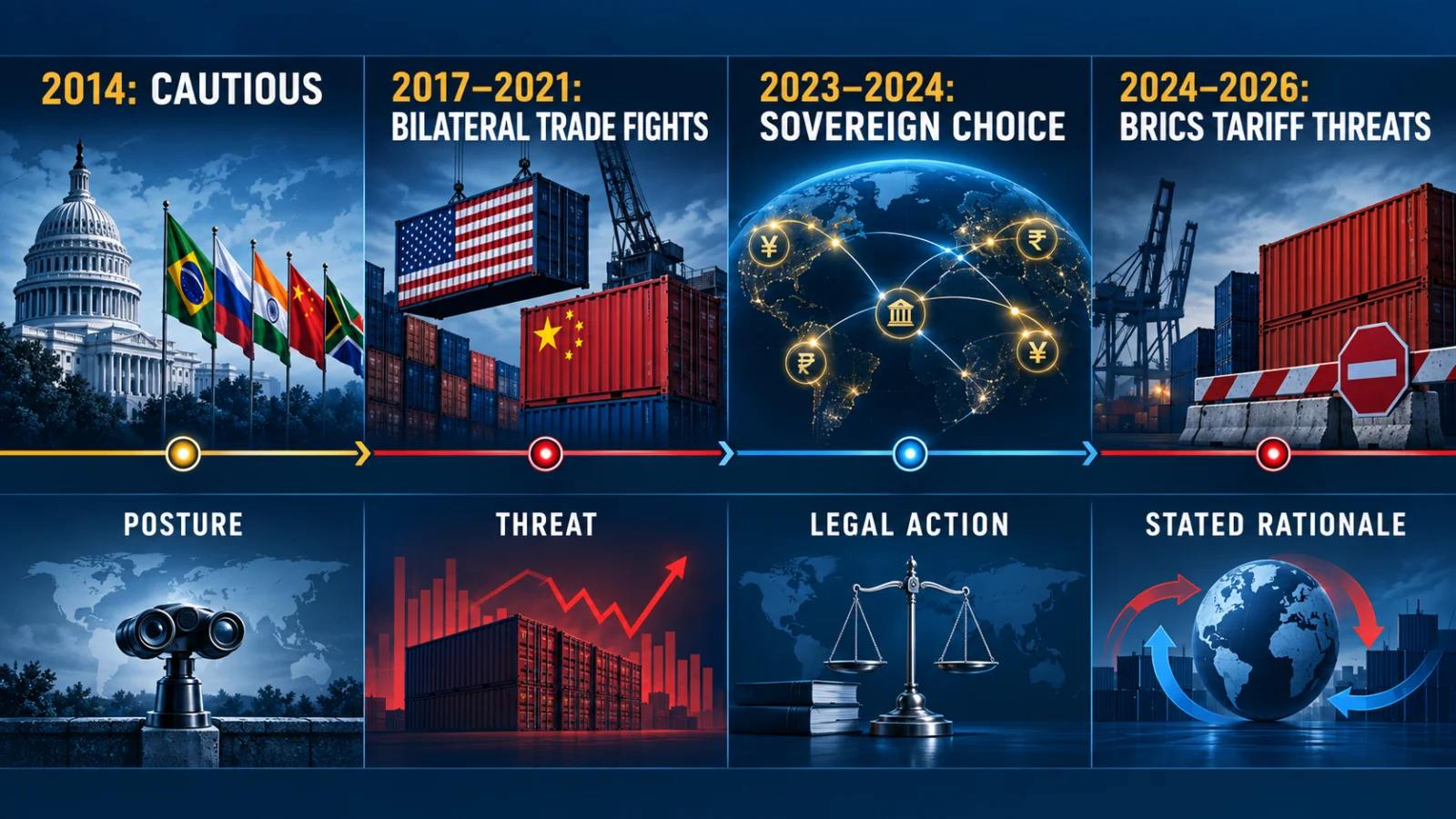
This distinction matters because the United States has had major trade disputes with China, India and Brazil for reasons that were often separate from BRICS membership. The evidence therefore needs to be divided into four states: what Washington said, what Trump threatened, what the US legally imposed and what rationale the government gave for the action.
This page complements ThePulseSignal’s broader BRICS Summit 2026 India-impact analysis. The question here is different: how did the American response to BRICS evolve, and when did rhetoric about the dollar become tariff policy?
2014: the United States was watching BRICS, not declaring it an enemy
During the Obama administration, official US comments on BRICS were notably restrained. When BRICS leaders moved forward with the New Development Bank in 2014, the State Department did not publicly treat the grouping itself as an immediate American threat.
The US position was closer to a wait-and-see approach. Officials wanted to understand how the new bank would be governed, what standards it would follow and how it would interact with existing international financial institutions.
That historical baseline contradicts the idea that Washington has always treated BRICS as an anti-American bloc. Concern existed around emerging-power influence and international institutions, but the reviewed official record did not show the openly punitive BRICS-specific tariff language that appeared a decade later.
Trump’s first presidency: trade wars with BRICS members, but not clearly a BRICS trade war
Donald Trump’s first presidency from 2017 to 2021 was highly aggressive on trade. Several founding BRICS countries were targeted by US trade measures, but the reviewed official rationales were generally country-specific rather than based on BRICS membership.
| Country | First-term US action | Stated or documented rationale | Was BRICS membership the established trigger? |
|---|---|---|---|
| China | Large Section 301 tariffs beginning in 2018 | Technology transfer, intellectual property and trade practices | No |
| India | GSP trade preference terminated in 2019 | US concerns over equitable and reasonable market access | No |
| Brazil | Steel/aluminium and currency-related tariff pressure | Country-specific metals and currency/trade disputes | No established BRICS trigger |
China: tariffs were enormous, but the official case was about trade practices
Trump imposed major tariffs on Chinese imports during his first term, beginning with duties linked to the Section 301 investigation into Chinese technology-transfer and intellectual-property practices.
China was a BRICS member, but that fact does not make those measures BRICS tariffs. The government’s legal and policy rationale focused on the bilateral US-China economic relationship.
India: GSP ended over market access
In 2019, the United States terminated India’s eligibility under the Generalized System of Preferences. The official US explanation centred on whether India had provided sufficient assurances of equitable and reasonable access to its markets.
India’s BRICS membership was not the stated basis for the action.
Brazil: Trump’s tariff diplomacy sometimes arrived through social media
In December 2019, Trump publicly accused Brazil and Argentina of allowing major currency devaluations and said he would restore steel and aluminium tariffs.
The episode illustrates Trump’s highly personalised tariff diplomacy, but it is not evidence that Brazil was being punished for BRICS membership.
The first-term conclusion: Trump targeted BRICS countries, not clearly BRICS itself
During Trump’s first presidency, the US fought serious trade battles with multiple BRICS economies. Yet the reviewed official record points mainly to intellectual property, technology transfer, market access, metals, currencies and bilateral trade balances.
That is different from explicitly saying a country will be tariffed because BRICS is challenging the dollar.
2023–2024: the Biden administration still treated BRICS membership as a sovereign choice
The Biden administration took a different public tone. When questions arose about Brazil and China settling some trade in their own currencies, State Department officials emphasised countries’ sovereign decisions while continuing to stress the value of US partnerships.
When other countries considered joining BRICS, the public response similarly avoided treating membership itself as grounds for punishment.
Washington continued to separate its relationships with individual members. India, Brazil and South Africa remained important partners; China was treated as a strategic competitor; and Russia was confronted primarily over its war against Ukraine.
This was not an endorsement of BRICS. It was a different model of response: deal with each bilateral relationship and strategic issue separately rather than automatically penalise participation in the group.
November 2024: Trump’s BRICS rhetoric changes the equation
The clearest shift came after Trump won the 2024 US presidential election.
On November 30, 2024, Trump threatened BRICS countries with 100% tariffs if they created a BRICS currency or supported another currency intended to replace the US dollar.
This was materially different from his first-term trade disputes because the threatened consequence was now explicitly linked to BRICS and dollar displacement.
Why this was a turning point
First Trump term: tariffs and trade restrictions were mostly justified through bilateral trade disputes.
After the 2024 election: Trump explicitly connected BRICS, reserve-currency competition and the threat of extremely high tariffs.
Did Trump actually impose the threatened 100% BRICS tariff?
A universal 100% tariff on all BRICS countries because of BRICS membership was not established in the reviewed controlling record.
The distinction between a presidential threat and a legally operative tariff is essential. Trump repeated the 100% warning after taking office in January 2025, but the existence of a threat does not by itself mean every BRICS import became subject to that tariff.
Readers should therefore be cautious when headlines compress the story into phrases such as “Trump puts 100% tariff on BRICS.” The evidence supports a 100% tariff threat linked to attempts to displace the dollar, not a blanket 100% duty universally imposed on BRICS trade.
February 2025: Trump said his tariff warning had effectively killed BRICS
Trump’s language escalated further in early 2025. During remarks on tariffs and reciprocal trade, he argued that his 100% warning had caused BRICS to retreat and described the grouping as effectively “dead.”
That was a presidential political assertion, not evidence that the organisation had dissolved. BRICS continued functioning, holding ministerial meetings and leaders’ summits.
The episode shows how Trump’s BRICS policy mixed economic leverage with highly public political signalling.
July 2025: another threat — an extra 10% for BRICS alignment
During the 2025 BRICS summit period, Trump threatened an additional 10% tariff on countries aligning with what he characterised as anti-American BRICS policies.
His public comments sometimes suggested the penalty could follow from alignment with BRICS. Contemporaneous reporting citing a Trump-administration source described the condition more narrowly: the extra tariff would depend on adoption of policies deemed anti-American, and no executive order implementing a universal BRICS surcharge had been issued at the time.
| Trump BRICS statement | Evidence state |
|---|---|
| 100% tariff if BRICS supports a currency replacing the dollar | Confirmed threat |
| Claim that BRICS was effectively dead after the warning | Political assertion |
| Additional 10% tariff for anti-American BRICS alignment | Confirmed threat / proposed condition |
| Universal BRICS-specific 10% tariff already legally imposed at announcement | Not established |
Can tariff threats affect markets even before they become law?
Yes. Markets, currencies and companies can react to the risk of a tariff before a final legal order exists.
The broader lesson is important: a political tariff threat can influence expectations even when the final tariff rule remains uncertain. A market move still should not be attributed entirely to BRICS rhetoric when dollar demand, bilateral negotiations and other macro factors are active at the same time.
India was later hit with high US tariffs — but was BRICS the reason?
India faced substantial US tariff pressure during 2025, including additional measures connected to its purchases of Russian oil.
That does not establish that India was tariffed simply because it was a BRICS member. The controlling rationale matters.
- A country can be a BRICS member;
- be subject to a Trump tariff;
- and still be targeted for a reason unrelated to BRICS membership.
Those facts should not be collapsed into a causal claim the controlling evidence does not support.
Brazil shows the same problem
Brazil also faced major US trade pressure under Trump. Some disputes were linked to Brazilian domestic political and judicial developments, while later US trade-law action identified specific economic and regulatory practices.
Brazil being a founding BRICS member is therefore not sufficient evidence that those measures were imposed because of BRICS.
What does the official tariff record show?
US government and Congressional tariff chronologies document major measures involving China, India and Brazil, but identify country-specific legal and policy rationales rather than one universal tariff category labelled as a BRICS-membership penalty.
That does not make Trump’s BRICS threats meaningless. It means the evidence needs to distinguish between bloc-level political threats and country-level legally implemented tariffs.
What did the 2026 BRICS summit actually change?
The September 12–13 BRICS summit in New Delhi produced a concrete financial-policy outcome, but not the common BRICS currency sometimes implied in political debate.
The New Delhi Declaration says the BRICS Payment Task Force is examining practical cross-border payment mechanisms, interoperability between payment and messaging channels, and greater use of BRICS local currencies for trade settlement and investment. It also says there is no one-size-fits-all approach.
The declaration therefore advances payment interoperability and local-currency settlement, not a newly launched single BRICS currency.
That distinction matters for understanding Trump’s dollar rhetoric. The bloc is developing mechanisms that could reduce friction in non-dollar transactions, but the reviewed summit record does not show BRICS unveiling one common reserve currency intended to replace the dollar.
The summit also challenged unilateral tariffs and sanctions
The New Delhi Declaration voiced concern about unilateral tariff and non-tariff measures that BRICS members say distort trade and conflict with WTO rules. It also opposed unilateral coercive measures and non-UN-authorised sanctions.
This creates a sharper political contrast with Washington’s use of tariffs and sanctions, but it does not itself create a new US tariff or prove that the United States will respond with a BRICS-wide measure.
Has Washington responded to the 2026 summit with a new BRICS tariff?
No new White House, State Department or USTR action explicitly imposing a universal tariff because of the September 2026 BRICS summit was established in the current review.
The summit’s payment and tariff language is directly relevant to the issues Trump has previously raised, so an eventual US response remains worth watching. But a BRICS declaration and an operative American tariff order are separate evidence states.
So why does Trump worry about BRICS?
1. The US dollar
This is the most explicit BRICS-specific concern in Trump’s public statements.
The dollar’s role in global trade, reserves and financial settlement gives the United States substantial economic and geopolitical influence. Trump has repeatedly warned against BRICS creating or supporting a currency that could challenge that position.
The 2026 summit reinforced local-currency settlement and payment interoperability, but did not establish a common BRICS currency.
2. Sanctions and financial leverage
Dollar-based finance and Western banking infrastructure give the United States powerful sanctions tools. Russia’s experience after the invasion of Ukraine increased interest among some BRICS members in reducing exposure to financial channels that can be restricted by the US and its allies.
Alternative settlement mechanisms could gradually reduce that exposure, although scale, interoperability, liquidity and national policy differences remain constraints.
3. China and Russia gaining influence
BRICS includes China and Russia, two countries central to US strategic competition and security policy.
Washington therefore watches whether BRICS becomes a vehicle for Chinese influence, Russian diplomatic legitimacy or coordinated positions that weaken US priorities.
But BRICS is not a perfectly unified anti-US alliance. India, Brazil, South Africa and other members maintain independent relationships with Washington and do not automatically align with China or Russia on every issue.
4. Alternative international institutions
The New Development Bank and broader BRICS demands for reform of global governance give emerging economies additional institutional options outside traditional Western-led structures.
That can dilute US influence over time. Yet the Obama-era response demonstrates that Washington did not initially treat the mere existence of another development bank as inherently hostile.
5. Trade and bargaining power
BRICS expansion brings together large commodity producers, energy exporters, manufacturers and major consumer markets. Greater cooperation can strengthen bargaining power in global trade and finance.
Trump’s foreign-economic strategy places heavy emphasis on tariffs and access to the US market as negotiating leverage, which makes any grouping seen as reducing US bargaining power more politically sensitive.
Was the US response to BRICS always the same?
| Period | Broad US posture supported by reviewed evidence |
|---|---|
| Obama era | Cautious / watch-and-evaluate — no blanket public hostility toward BRICS or the NDB |
| Trump first term | Aggressive bilateral trade policy — major disputes with BRICS members, but not clearly a BRICS-wide tariff programme |
| Biden era | Sovereign-choice / bilateral engagement — BRICS membership separated from individual US relationships |
| Trump after 2024 election | Explicit BRICS confrontation — dollar-linked 100% tariff threat and later additional tariff rhetoric |
| BRICS New Delhi 2026 | Local-currency and payment-system expansion — BRICS advanced cross-border payment interoperability and criticised unilateral tariffs, without launching a common currency |
What should readers verify when they see a new “US tariff on BRICS” headline?
Three questions resolve most of the confusion:
- Was it a political statement or a legally operative tariff order?
- Was BRICS membership, dollar policy or a BRICS mechanism actually the stated trigger?
- What legal authority and country-specific rationale does the controlling US document give?
If the answer to the second question is no, calling the measure a “BRICS tariff” may be misleading even if the affected country belongs to BRICS.
What should be watched next?
The most important future evidence would be a White House, State Department or USTR response explicitly addressing the New Delhi Declaration’s local-currency, payment-system, tariff or sanctions language.
An operative US tariff order explicitly tied to BRICS membership, a BRICS payment mechanism or a policy intended to displace the dollar would be a much larger historical change than another political warning.
Unexpected developments should be judged from the controlling US legal or policy document rather than inferred from rhetoric alone.
Verification method
ThePulseSignal compared archived US State Department positions, Trump presidential statements, USTR and US trade-policy records, Congressional tariff chronology, the September 2026 BRICS New Delhi Declaration and current reputable reporting. The analysis separates political rhetoric, announced threats, legally implemented tariffs, summit outcomes and the stated rationale behind country-specific actions.
Limitations & unresolved facts
No new White House, State Department or USTR action explicitly imposing a universal tariff because of the September 12–13, 2026 BRICS summit was established at the final source check. The summit advanced local-currency settlement and payment interoperability but did not establish a common BRICS currency. A universal 100% or 10% tariff legally imposed on all BRICS countries purely because of BRICS membership remains unestablished in the reviewed controlling record.
Bottom line
The United States has not always opposed BRICS in the same way. The historical shift runs from cautious observation under Obama, through country-specific trade confrontation during Trump’s first term and a more bilateral Biden-era posture, to explicit Trump threats against BRICS over the dollar after the 2024 election.
The 2026 New Delhi summit sharpened the underlying financial-policy issue by advancing local-currency settlement and cross-border payment interoperability while rejecting unilateral tariffs and sanctions. It did not establish a common BRICS currency, and the current record does not establish a new universal US tariff triggered simply by the summit or BRICS membership.
The key distinction remains the same: separate threat, legal action and stated motive.