





The NIXI APNIC MoU 2026 is scheduled to be signed on September 8 during APNIC 62 in Mumbai, with the government saying the agreement will support greater deployment of IPv6 and routing-security technologies in India. What is not yet clear is more important for network operators: the final MoU text, implementation targets, technologies covered, deadlines and whether anything changes operationally for Indian networks.
The agreement should therefore be treated as a new cooperation checkpoint, not as evidence that India has introduced a new IPv6 mandate, RPKI requirement or Route Origin Validation rule.
What is confirmed about the NIXI–APNIC MoU?
The Ministry of Electronics and Information Technology said NIXI and the Asia Pacific Network Information Centre will sign an MoU on September 8 during APNIC 62 in Mumbai. The stated purpose is to enhance deployment of IPv6 and routing-security technologies.
APNIC 62 is being held in Mumbai from September 4 to September 10. The September 8 signing is therefore a confirmed scheduled event, but the detailed terms of the new agreement had not been published at the final source check.
Is this the first NIXI–APNIC agreement?
No. APNIC already describes an existing cooperation relationship with NIXI. Its partnership information says the organisations previously signed an MoU covering areas including IPv6 adoption, resource certification, technical workshops and training, and participation in APNIC policy development.
That earlier relationship is important because the September 8 announcement should not be described as the first time NIXI and APNIC have worked together on IPv6 or routing security.
The key unanswered question is the delta: whether the new MoU renews the earlier arrangement, replaces it, expands it into additional routing-security controls or establishes measurable deployment work that did not exist before.
What could be different in the new agreement?
The government announcement specifically highlights IPv6 and routing-security deployment, but it does not publish enough detail to identify the exact implementation mechanisms.
After the signing, the most important points to verify will be whether the MoU includes:
- specific IPv6 deployment programmes or adoption targets;
- RPKI and Route Origin Authorization initiatives;
- Route Origin Validation deployment by Indian networks;
- technical training for ISPs, network operators or other autonomous-system operators;
- new tools, measurement programmes or technical-assistance arrangements;
- participation targets or implementation deadlines;
- new NIXI or IRINN operational processes;
- other routing-security mechanisms such as ASPA, if explicitly included in the signed text.
None of those should be presented as confirmed terms until the signed MoU or a sufficiently detailed official outcome is published.
Why does routing security matter?
The global Internet relies heavily on the Border Gateway Protocol, or BGP, to tell networks which paths can reach particular blocks of IP addresses. A routing mistake or malicious route announcement can cause traffic to follow an incorrect path.
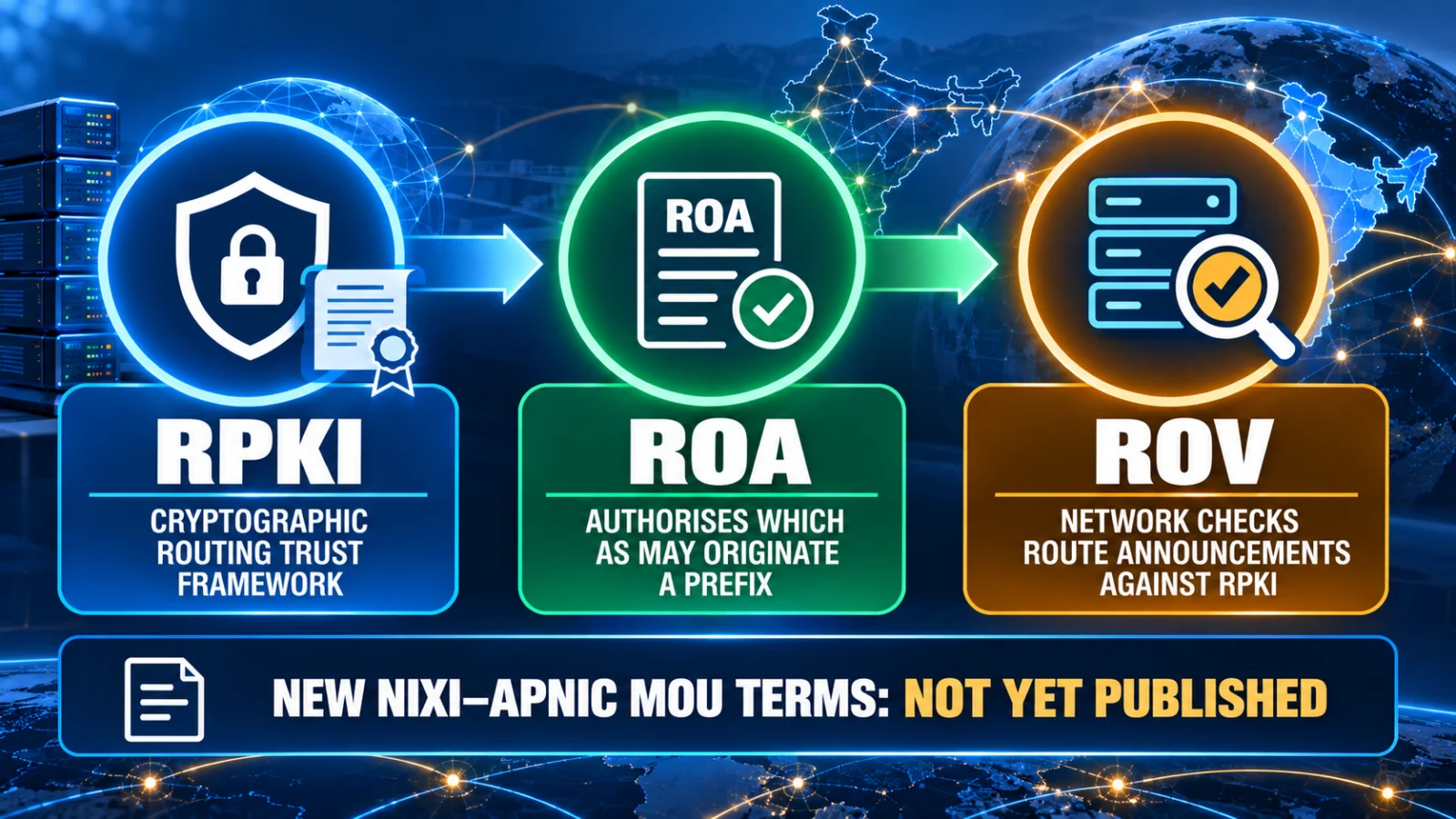
RPKI provides a cryptographic framework that helps a network confirm which autonomous system is authorised to originate a particular IP prefix. A Route Origin Authorization, or ROA, is the signed authorisation. Route Origin Validation, or ROV, is the process networks use to evaluate route announcements against that RPKI data.
That distinction matters because publishing ROAs and actually filtering invalid routes are not the same operational step.
What does current APNIC evidence say about India?
APNIC’s August 2026 review of India’s Internet ecosystem highlighted a notable difference between route-origin authorisation coverage and measured invalid-route filtering.
The APNIC analysis reported valid ROA coverage of about 88.04% for IPv4 and 97.91% for IPv6, while only about 0.99% of measured networks were filtering invalid routes as of July 29.
Those figures do not describe the new MoU and should not be interpreted as targets contained in the September 8 agreement. They are useful context for understanding why a routing-security cooperation programme could matter: creating signed route-origin information is different from networks actively using that information to reject invalid routes.
Does the new MoU make RPKI or ROV mandatory?
No such requirement was established in the material reviewed before publication.
The government announcement says the agreement will enhance deployment of IPv6 and routing-security technologies. It does not establish a mandatory RPKI deployment deadline, compulsory Route Origin Validation, a penalty for non-compliance or a new licence condition for Indian ISPs.
If any binding requirement later emerges, TPS will need a controlling regulatory, licensing or official implementation document rather than the MoU announcement alone.
Does this change IPv6 requirements for Indian ISPs?
No new universal IPv6 obligation was identified from the September 7 announcement. NIXI and APNIC have worked on IPv6 adoption before, and India already has a large IPv6 deployment footprint.
The new agreement may support further adoption, technical capacity or network-security work, but the actual implementation layer remains unknown until more details are released.
Who could be affected if the MoU leads to implementation programmes?
The most directly relevant groups would be:
- internet service providers;
- autonomous-system and network operators;
- Internet exchange and infrastructure operators;
- organisations managing IP address resources;
- network engineering and security teams;
- technical and policy stakeholders working on India’s IPv6 transition and BGP security.
There is no evidence yet that ordinary broadband users need to take any immediate action because of the September 8 MoU.
What is actually new today?
The confirmed information-state change is narrower than some readers may assume.
- NIXI and APNIC have a new MoU signing scheduled for September 8.
- The new agreement is explicitly framed around greater IPv6 and routing-security deployment.
- The organisations already had an earlier cooperation agreement, so this is not their first IPv6 or routing-security collaboration.
- The new MoU’s exact technical and implementation delta is not yet public.
That means the correct current answer is not “India has introduced new routing-security rules.” The correct answer is that a new cooperation agreement is about to be signed, and its operational significance still needs to be verified.
What should network operators watch after September 8?
For technical readers, the signed agreement becomes materially important if it moves from broad cooperation language to concrete implementation.
The strongest post-signing signals would include named technologies, operator programmes, deployment targets, participation requirements, implementation deadlines, technical-assistance mechanisms or measurable RPKI/ROV adoption goals.
A specific push toward Route Origin Validation would be particularly notable because current APNIC evidence suggests India’s route-origin authorisation coverage is far ahead of measured invalid-route filtering.
Verification note
ThePulseSignal reviewed the September 7 MeitY/PIB announcement, APNIC’s description of its existing partnership with NIXI and APNIC’s recent technical analysis of India’s IPv6 and routing-security state. That evidence confirms the scheduled signing and the existing cooperation history, but it does not establish the final terms of the new agreement.
Limitations and unresolved facts
The signed September 8 MoU was not available at the final source check. TPS therefore could not verify whether the agreement is a renewal, replacement or expansion of the earlier MoU; whether it contains RPKI, ROV, ASPA or other specific controls; whether it sets deadlines or measurable targets; whether operator participation is voluntary or required; or whether any NIXI/IRINN service or procedure changes.