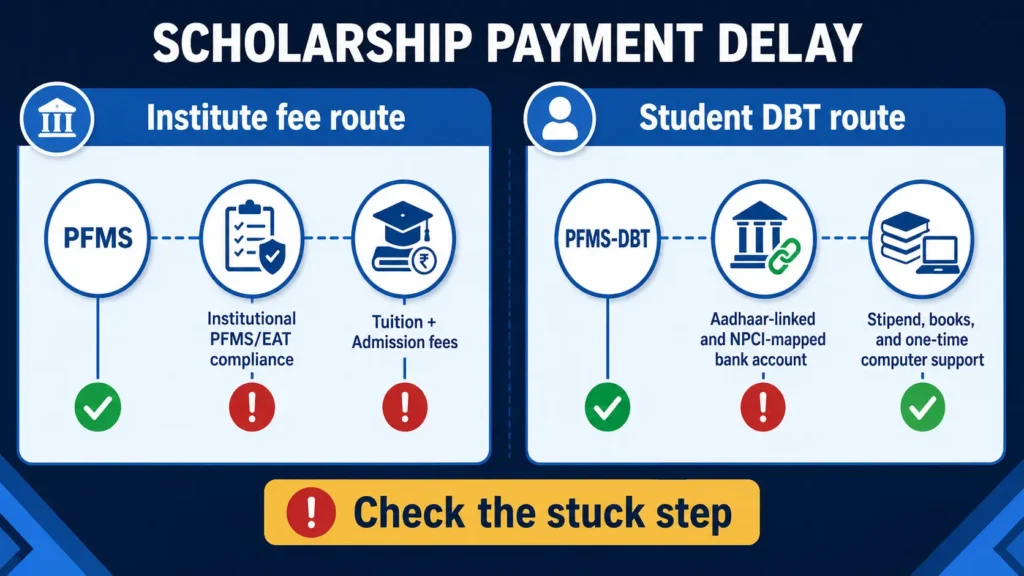






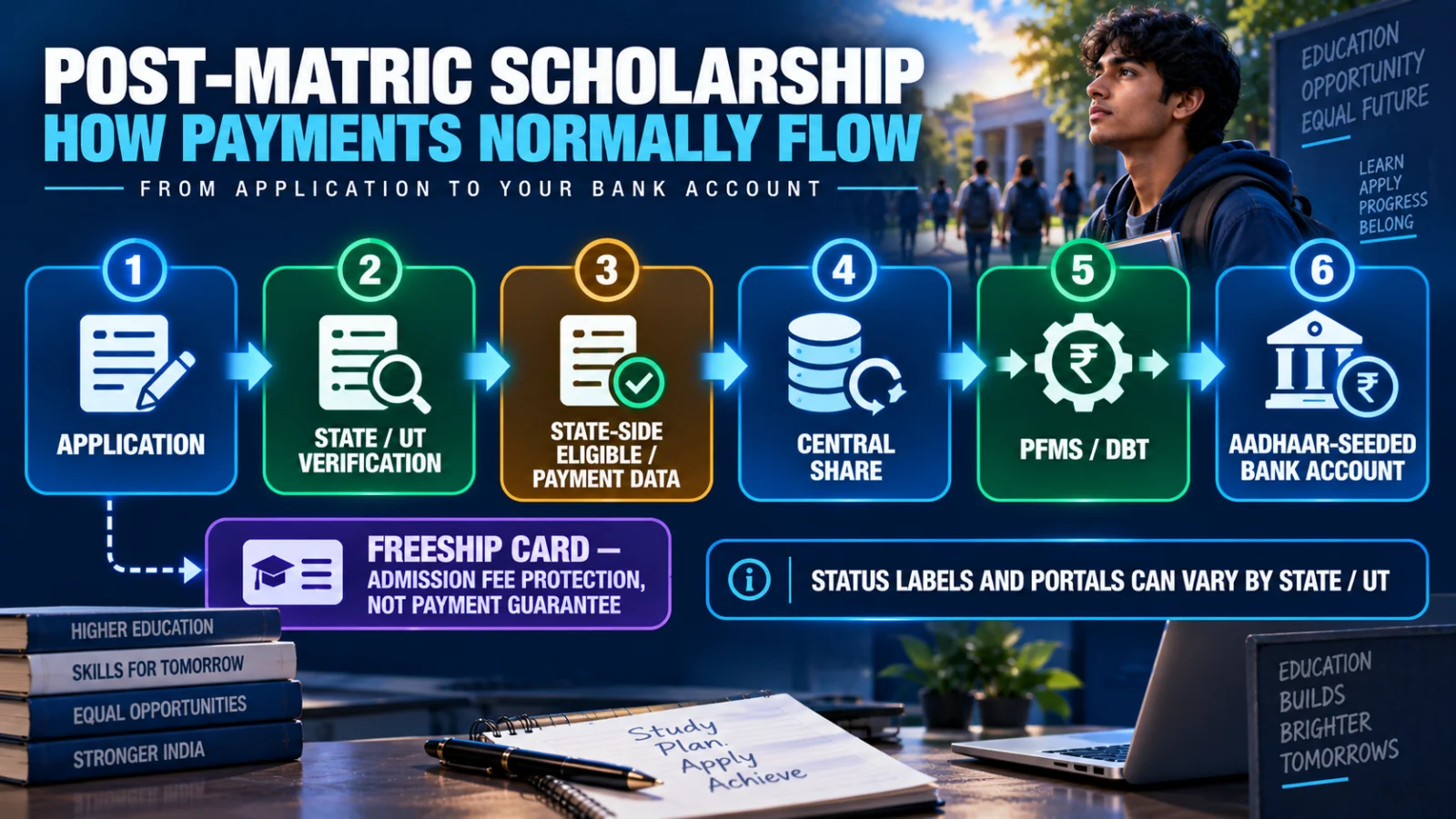
If your SC post matric scholarship payment is pending, the delay may not be at the Central Government payment stage. The Post-Matric Scholarship for Scheduled Caste students, or PMS-SC, is implemented through States and Union Territories, and an application can be waiting at State verification, State-side sanction or payment processing, national data transfer, Central-share release, PFMS/DBT processing or the Aadhaar-linked bank-account stage.
The most useful first step is to identify the exact state shown on the relevant State/UT scholarship portal and, where applicable, the National Scholarship Portal. Then check the authority that controls that stage instead of assuming every pending scholarship is waiting with the Centre.
Where is your SC Post-Matric Scholarship stuck?
1. Application or verification still pending
Your State or UT scholarship authority is a key processing authority under PMS-SC. If the application has not completed institute, district or State-side verification, the later payment chain may not have started.
2. State-side sanction or payment data is pending
Official parliamentary material shows that Central-share release is linked to the required beneficiary payment and State/UT data reaching the national system. A delay at this stage is therefore not the same as a PFMS bank-payment failure.
3. Central share has moved but payment is still processing
Check the current scholarship-payment state through the official National Scholarship Portal and PFMS surfaces where applicable. A processing or forwarded state does not by itself guarantee immediate credit.
4. PFMS shows payment activity but money is not in the bank
Check whether the beneficiary bank account is correctly linked for Aadhaar-based DBT and whether the account is active and capable of receiving the payment. Do not assume that a PFMS processing state equals completed bank credit.
5. College is demanding fees while scholarship is pending
Check whether you qualify for the PMS-SC Freeship Card route under the applicable State process. The Freeship Card is intended to protect eligible students from having to pre-pay covered tuition or hostel fees at admission, but it is not itself a guarantee that the final scholarship payment has been sanctioned.
Who actually processes the PMS-SC application?
PMS-SC is a centrally supported scheme implemented through State Governments and Union Territory Administrations. That distinction matters because the State-side process controls important stages such as application scrutiny, verification, eligibility processing and the beneficiary data that feeds later funding and payment stages.
So if your application still shows a State or institute verification state, contacting only a Central authority may not resolve the problem. The next useful action depends on which authority currently owns the application state.
Why can the Central share remain pending?
Parliamentary material on PMS-SC explains that the Central share is linked to State/UT-side processing and beneficiary payment information being supplied through the national system. In practical terms, this means the payment chain is sequential rather than one single Centre-to-student transaction.
A student can therefore be eligible for the scheme while the application is still waiting at an earlier administrative stage. Eligibility alone does not prove that every verification, sanction and DBT step has completed.
Where should you check your application status?
Start with the portal used by your State or UT for PMS-SC. Some States run their own scholarship portal or integrated workflow, while national scholarship services also expose application-status functions.
Do not assume that every PMS-SC applicant follows one identical national screen or status label. State-specific portals can use different terminology and can place institute, district, State and payment checks in different parts of the workflow.
Where should you check payment status?
The National Scholarship Portal provides student-facing scholarship services and a route to track payments through PFMS. When a scholarship has progressed beyond the application-verification stages, the PFMS/payment state becomes more relevant to diagnosing whether the payment has moved toward the beneficiary bank account.
A useful distinction is:
- Application pending — usually an administrative or verification state.
- Sanction or State-side processing pending — the application may be verified but the funding/payment chain is not complete.
- PFMS/payment processing — payment execution is in progress or has been forwarded into the payment system.
- Bank credit not received — the issue may involve DBT execution, bank-account readiness, Aadhaar linkage or another payment-layer problem.
Can Aadhaar or bank configuration block the payment?
Yes. Current government material describes PMS-SC payments through DBT into Aadhaar-seeded bank accounts. State scholarship portals also commonly instruct beneficiaries to ensure that the correct bank account is Aadhaar-linked and DBT-enabled.
If the scholarship has reached the payment stage but money has not arrived, verify:
- whether the bank account recorded for the scholarship is active;
- whether Aadhaar is seeded with the intended account for DBT;
- whether the name and beneficiary information are consistent across the scholarship and bank records;
- whether PFMS shows the payment as processing, failed, rejected or completed, where that information is available.
TPS cannot determine an individual student’s bank or PFMS state from the general scheme records, so the current official status surface controls the case-specific answer.
What is the PMS-SC Freeship Card?
The Freeship Card is a separate part of the PMS-SC framework intended to help eligible students take admission without first paying eligible tuition and hostel fees that are covered under the scholarship arrangement.
Scheme guidance directs States and UTs to operate the Freeship Card mechanism and sets an administrative verification expectation for eligible applications. However, that should not be interpreted as a universal guarantee that every scholarship payment will reach the bank within the same period.
Does a Freeship Card guarantee final scholarship payment?
No. A Freeship Card and final scholarship sanction/payment are different states. The card is designed around admission and fee protection, while the scholarship application still has to complete the relevant verification, sanction and payment workflow.
This distinction matters for students who have been admitted under the Freeship Card route but later see their scholarship application or payment remain pending.
What if State verification is still pending?
If the application is still at an institute, district or State verification stage, follow the grievance or nodal route provided by the relevant State/UT scholarship authority. Preserve evidence such as the application ID, current status, submission acknowledgement and any verification messages.
Do not submit a duplicate application merely because the first application has not moved unless the controlling authority explicitly instructs you to do so.
What if the application is verified but payment has not arrived?
Once verification is complete, determine whether the delay is still at State-side sanction/payment processing, Central-share processing, PFMS or the beneficiary bank.
That distinction prevents a common troubleshooting mistake: escalating a bank problem to the scholarship verification authority, or escalating a State-verification problem to PFMS before a payment instruction exists.
What if PFMS shows payment processing but the bank has not credited it?
Check the latest PFMS/payment status and confirm that the Aadhaar-seeded account intended for DBT is active. A processing state is not the same as completed credit, and TPS found no national rule guaranteeing that every processing state resolves within a fixed number of days.
If the payment shows failure or rejection, use the current official grievance route and preserve the payment reference or status evidence shown to you.
Where can you raise a grievance?
The National Scholarship Portal provides grievance registration and grievance-status functions, while States and UTs may operate their own scholarship helplines, nodal officers or grievance systems.
The right escalation route therefore depends on the stage:
- Institute/State verification problem: use the State/UT scholarship authority or designated nodal route.
- NSP application problem: use the current NSP support/grievance route where applicable.
- PFMS/payment execution problem: use the payment-status evidence and the official escalation route linked to that payment stage.
- Bank/Aadhaar DBT problem: verify the beneficiary bank and Aadhaar-seeding state before assuming the scholarship authority can directly fix the bank-side issue.
Did the September 7 government release create a new payment guarantee?
No new universal payment guarantee, beneficiary entitlement, national application deadline or fixed payment SLA was verified from the September 7 communication. The release reinforces the government’s focus on transparency and timely scholarship delivery, but the core PMS-SC workflow already included digital processing, State/UT verification, DBT and monitoring mechanisms.
The practical value for students is therefore not a new promise of immediate payment. It is understanding which part of the existing delivery chain controls the current pending state.
What to keep before escalating a pending scholarship
- application or registration number;
- current portal status screenshot or saved acknowledgement;
- institute and State verification status, if shown;
- PFMS/payment reference, if generated;
- bank-account details used in the application;
- evidence that the intended account is Aadhaar-seeded and DBT-ready;
- Freeship Card details, if applicable;
- previous grievance number or communication with the scholarship authority.
Verification note
ThePulseSignal reviewed the PMS-SC scheme framework and guidelines, parliamentary explanations of the State/Centre funding and payment chain, current National Scholarship Portal and PFMS-facing services, current State-level implementation examples and recent government material on scholarship delivery. The evidence supports a multi-stage diagnostic rather than treating every pending payment as one Central-payment failure.
Limitations and unresolved facts
PMS-SC execution is State/UT-specific. Status labels, application deadlines, institute or district verification stages, grievance contacts and portal workflows can differ. TPS also cannot verify an individual student’s scholarship or bank-payment state from general scheme records. Use the current controlling State/UT portal, NSP, PFMS and bank/DBT information for your own application.