







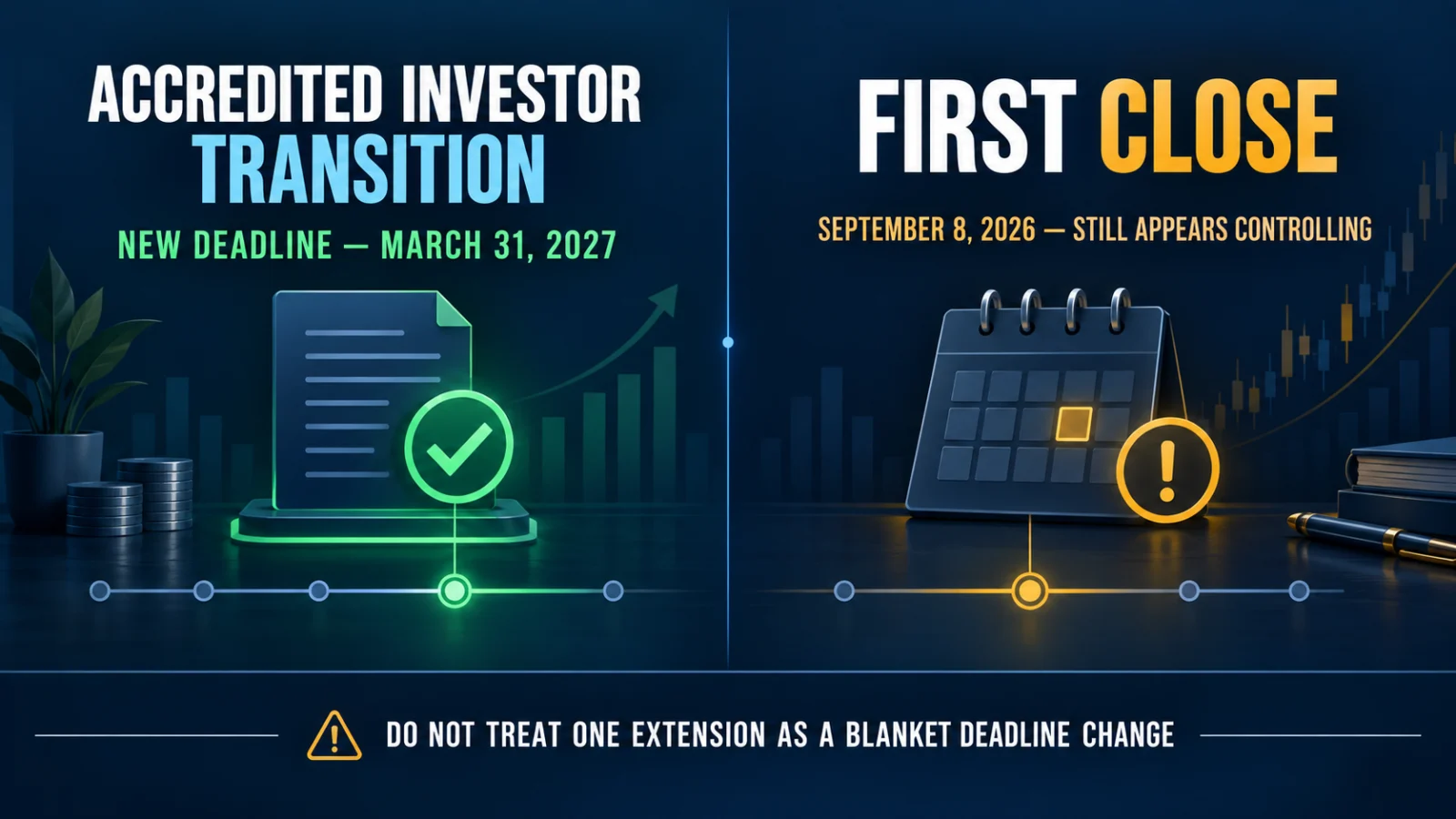
The SEBI Angel Fund deadline for complying with the Accredited Investor transition has been extended from September 8, 2026 to March 31, 2027 for Angel Funds registered on or before September 10, 2025. But the September 7 relaxation should not be read as moving every September 8 obligation under the Angel Fund framework.
The important distinction is between the Accredited Investor transition deadline and the separate first-close deadline in Chapter 8 of SEBI’s AIF Master Circular. The first one has moved to March 31, 2027. The second still appears as September 8, 2026 in the controlling Master Circular, and TPS found no evidence in the reviewed September 7 relaxation that this separate first-close date was extended.
Which Angel Funds get until March 31, 2027?
The extension applies to Angel Funds that were registered on or before September 10, 2025 and were operating under the transition framework for the Accredited Investor mandate.
Angel Funds registered after September 10, 2025 are not part of that legacy transition cohort. They remain under the newer Accredited-Investor-only framework applicable to funds registered after that date.
What can existing Angel Funds do during the extended transition?
During the transition period, an eligible existing Angel Fund may continue offering investment opportunities to non-Accredited Investors, subject to the existing ceiling of no more than 200 non-Accredited Investors.
The extension therefore gives qualifying older Angel Funds more time to complete the transition. It does not remove the Accredited Investor mandate itself.
What changes after March 31, 2027?
After March 31, 2027, an affected Angel Fund cannot accept contribution from a non-Accredited Investor for investment in an investee company under the transition framework.
Existing investments already made by such investors are not automatically cancelled or required to be exited merely because the transition period ends. Their existing investments continue according to the fund’s Private Placement Memorandum and other applicable fund documents.
Does the September 8 first-close deadline also move to March 31, 2027?
TPS found no evidence that it does.
Chapter 8 of SEBI’s June 3, 2026 AIF Master Circular separately requires existing Angel Funds that had not declared first close to do so by September 8, 2026.
The September 7 circular is specifically a relaxation in the timeline for the Accredited Investor mandate. The current evidence reviewed does not establish an extension of the separate first-close requirement.
What should Angel Fund managers check now?
What did SEBI not change?
The September 7 relaxation should not be interpreted as a blanket suspension of the Angel Fund framework. The available evidence does not support the following conclusions:
- that every Angel Fund deadline has moved to March 31, 2027;
- that Angel Funds registered after September 10, 2025 may freely onboard non-Accredited Investors;
- that the 200 non-Accredited-Investor ceiling has been removed;
- that existing non-Accredited Investors must exit investments already made; or
- that the separate first-close deadline has been formally extended.
What happens next?
If SEBI issues a further clarification, FAQ or another Angel Fund circular, the controlling position may change again and this page should be re-checked.
Verification method
ThePulseSignal reviewed SEBI’s September 7, 2026 circular page on relaxation of the Accredited Investor mandate timeline, the June 3, 2026 AIF Master Circular containing the Angel Fund transition and first-close provisions, and current same-day reporting that describes the revised March 31, 2027 cutoff and the treatment of existing and newer Angel Funds.
Limitations and unresolved facts
The exact number of Angel Funds or investors relying on the transition was not established. TPS did not identify a separate September 7 SEBI clarification extending the first-close deadline. A newer SEBI circular, FAQ or implementation instruction could still alter the current position, so affected fund managers should check the latest official material before acting.