





The Supreme Court teacher qualification order is an interim direction about prescribed qualifications for teacher appointment or absorption. It should not be read as a blanket rule that every existing teacher in India without TET has automatically lost their job.
Who is actually affected by the Supreme Court teacher qualification order?
The September 8, 2026 matter arose from litigation concerning Assam’s provincialisation framework, under which teachers and other employees of certain institutions may be absorbed into government service. Current legal reporting says the Supreme Court issued an interim restraint against covered appointment or absorption where the required statutory teacher qualifications are absent.
The qualification that matters depends on the particular post and governing framework. Current reporting refers to requirements under the Right to Education framework, NCTE rules and UGC requirements. That is different from saying that one credential, such as TET, applies identically to every school and college teaching post.
What did the Supreme Court change?
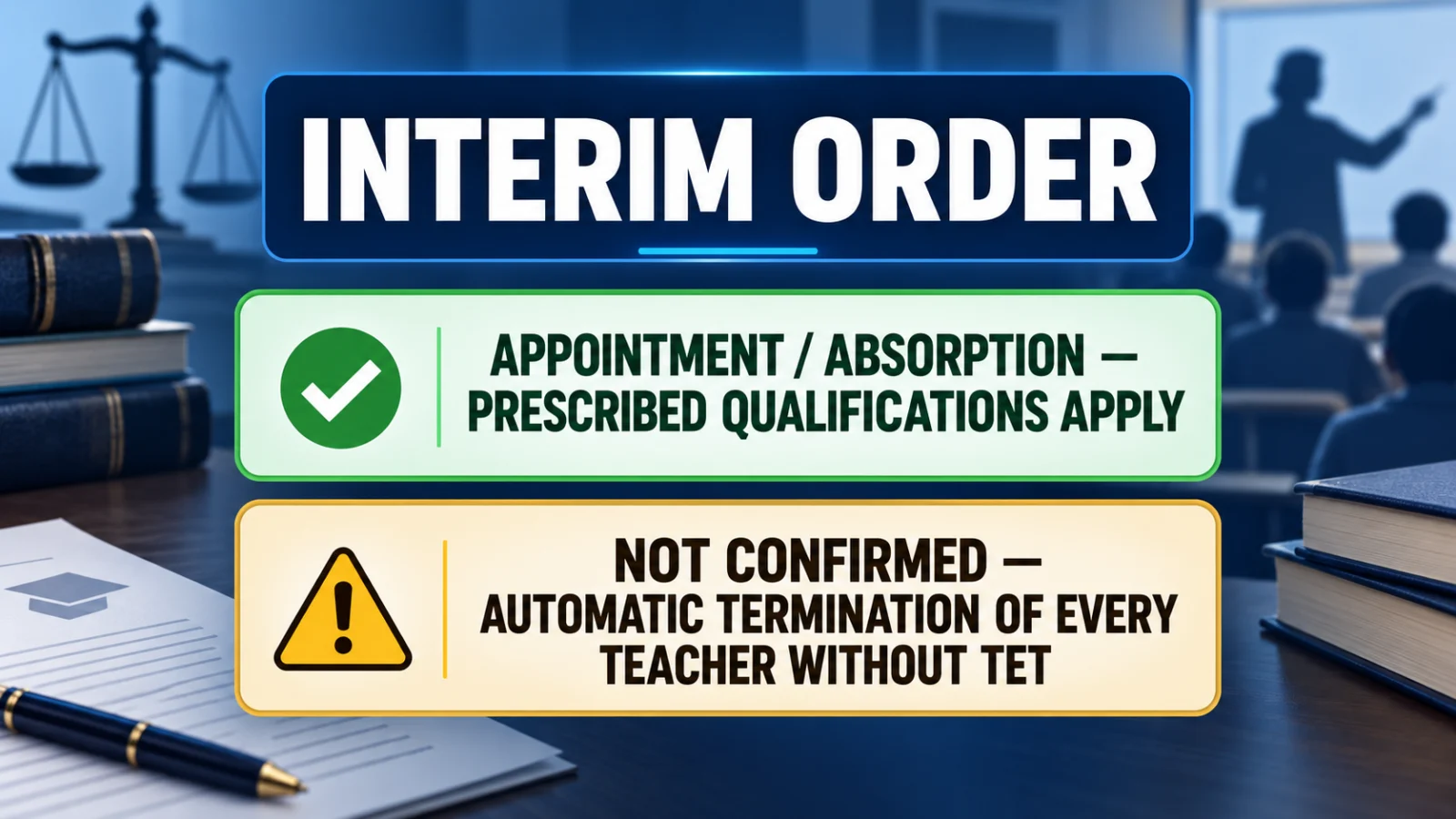
The immediate change is that a provincialisation or appointment route cannot safely be treated as a way to bypass qualifications prescribed under the applicable statutory framework. For an affected appointment or absorption, the teacher’s required qualifications remain legally material even where a state scheme provides a route into substantive government service.
The order is interim. The underlying challenge has not been finally decided, and later Supreme Court directions can clarify, narrow, modify or replace the current state.
Is this a nationwide rule that every teacher must have TET?
No such universal conclusion is supported by the evidence TPS reviewed. TET can be an important qualification in particular school-teacher contexts, but the September 8 order is being reported with reference to the qualifications prescribed under the applicable RTE, NCTE and UGC frameworks.
That matters because different posts and institutions can be governed by different qualification rules. A college-teaching post, a school-teaching post and an appointment being absorbed under a provincialisation scheme should not automatically be treated as the same legal situation.
Are existing teachers without TET automatically removed?
TPS has not verified any basis for saying that every existing teacher without TET is automatically terminated by this interim order. Current reporting focuses on appointment, absorption or continuation language, but the precise effect on teachers who were already appointed or absorbed before the order requires the controlling court text and any subsequent implementation instructions.
Readers should therefore distinguish an eligibility restriction for appointment or absorption from an automatic cancellation of an already-existing service relationship.
What does “prescribed qualification” mean?
It means the qualifications legally required for the particular post under the framework governing that appointment. In current coverage of this case, the Supreme Court direction has been described with reference to RTE, NCTE and UGC requirements.
The practical question is not simply, “Does the teacher have TET?” It is, “Which statutory qualification framework controls this post, and does the teacher satisfy it?”
Why Assam provincialisation matters in this case
The underlying petition challenges aspects of Assam’s provincialisation system, which can bring employees of certain educational institutions into government service. The legal concern reported in the case is whether such a route can result in substantive public-service appointments where ordinary statutory teacher-qualification requirements are not satisfied.
That Assam origin is important because headlines that remove the provincialisation context can make the interim order appear broader and simpler than the underlying dispute.
Does this change the separate Supreme Court TET promotion rule?
No evidence reviewed by TPS shows that the September 8 interim order replaces the separate legal question of whether an already-serving teacher needs TET for promotion.
TPS covers that distinct reader job separately in its TET mandatory for promotion explainer. Promotion and initial appointment or absorption should not be merged merely because both involve teacher qualifications.
What should affected teachers and applicants check?
- Whether the issue concerns a new appointment, provincialisation or absorption, rather than promotion.
- Which statutory qualification framework governs the exact school, college and teaching post.
- Whether the teacher already satisfies the prescribed qualifications for that post.
- Whether the state education department or institution has issued implementation instructions after the Supreme Court order.
- Whether a later Supreme Court order clarifies the treatment of existing appointees.
What remains unresolved?
TPS has not yet established the exact treatment of teachers who were already absorbed before the interim direction, the precise nationwide versus respondent-specific reach of the order or the final wording where current reports differ between terms such as appointment, absorption and continuation.
The case is still pending, so the interim state should not be presented as a final determination of the validity of Assam’s provincialisation framework.
What happens next?
The next material changes could come from a further Supreme Court order, a clarification of the interim direction or implementation instructions from Assam or other affected education authorities. TPS will update this same URL when those developments materially change who is affected or what action is required.
Verification note
TPS verified the Supreme Court case and September 8 order listing for W.P.(C) No. 1102/2026 and compared the current legal reporting on Assam provincialisation, teacher appointment or absorption and the referenced RTE, NCTE and UGC qualification frameworks. The interim-order state is established, while some operative scope and existing-appointee questions remain unresolved.