




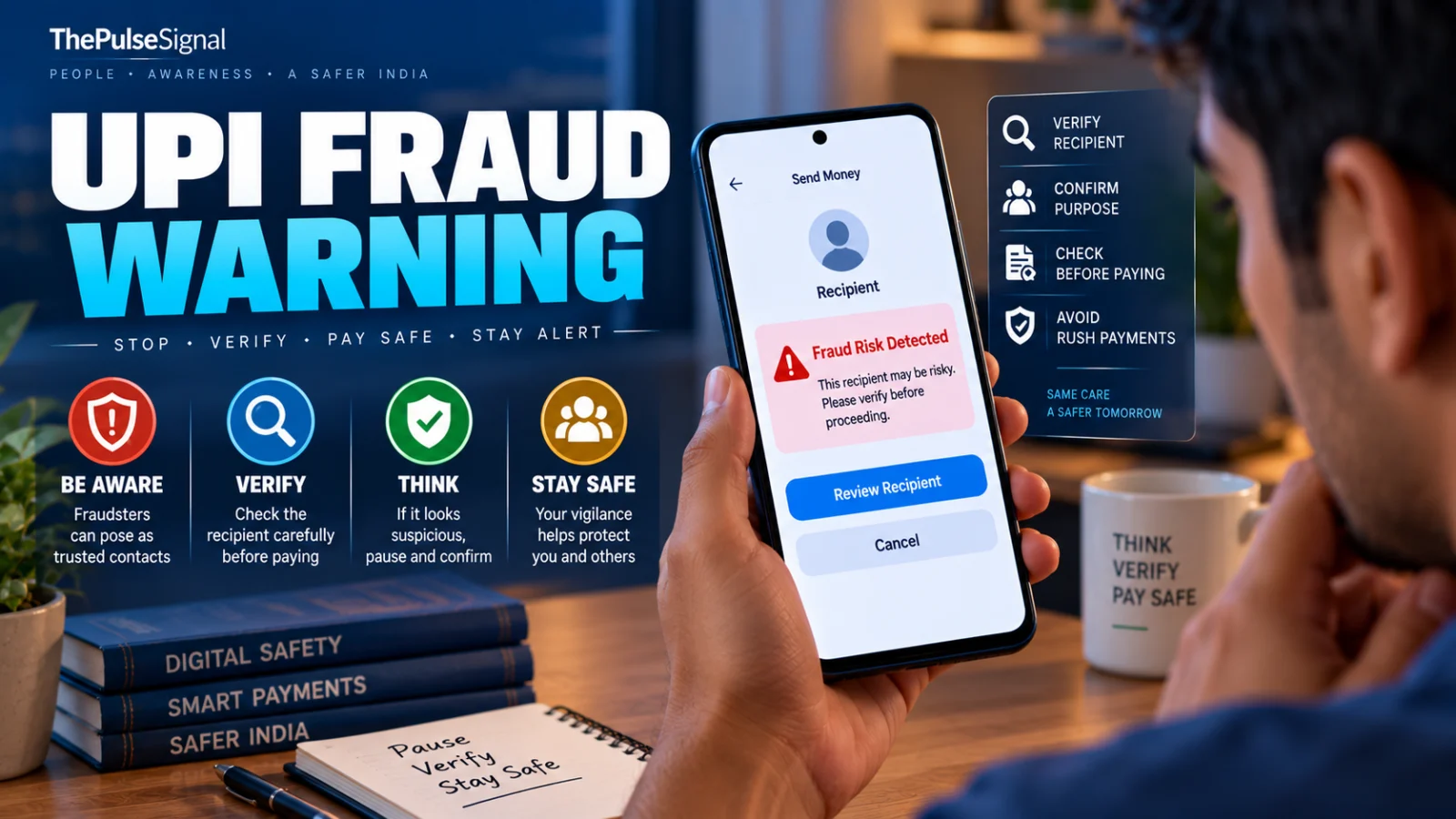
A UPI fraud warning about a recipient should make you pause before sending money. It does not by itself prove that the person or business is a fraudster, but it means your bank or payment provider has received or generated risk information serious enough to warn, delay or sometimes decline the transaction.
What does a UPI fraud warning mean?
India’s Department of Telecommunications uses the Financial Fraud Risk Indicator, or FRI, to classify mobile numbers associated with financial-fraud risk. The risk intelligence can be shared with banks, NBFCs and payment platforms so they can apply safeguards during a transaction.
The important distinction is that an FRI warning is a risk signal. It is not a court finding or final proof that the recipient committed fraud. You should still take the warning seriously because the number or payment destination may be associated with suspicious activity, misuse or other fraud intelligence.
Why might a bank or UPI app warn, delay or decline the payment?
FRI can classify numbers into Medium, High and Very High financial-fraud risk categories. Financial institutions can use that signal as part of their own fraud controls.
That can produce different user experiences. A payment app may show an on-screen warning, ask the payer to reconsider, introduce additional checks or delay the transaction. In higher-risk situations, a provider may decline the payment altogether.
Implementation is not necessarily identical across every bank and UPI app, so one provider’s warning text or threshold should not be assumed to represent the entire system.
Does the warning mean the recipient is definitely a scammer?
No. The evidence reviewed by TPS supports treating FRI as a fraud-risk indicator rather than a final fraud determination.
A warning may be associated with prior fraud reports, suspicious communications, banking intelligence or other risk signals connected to a mobile number. It tells you that proceeding without verification carries additional risk; it does not establish guilt by itself.
What should you do before proceeding with the payment?
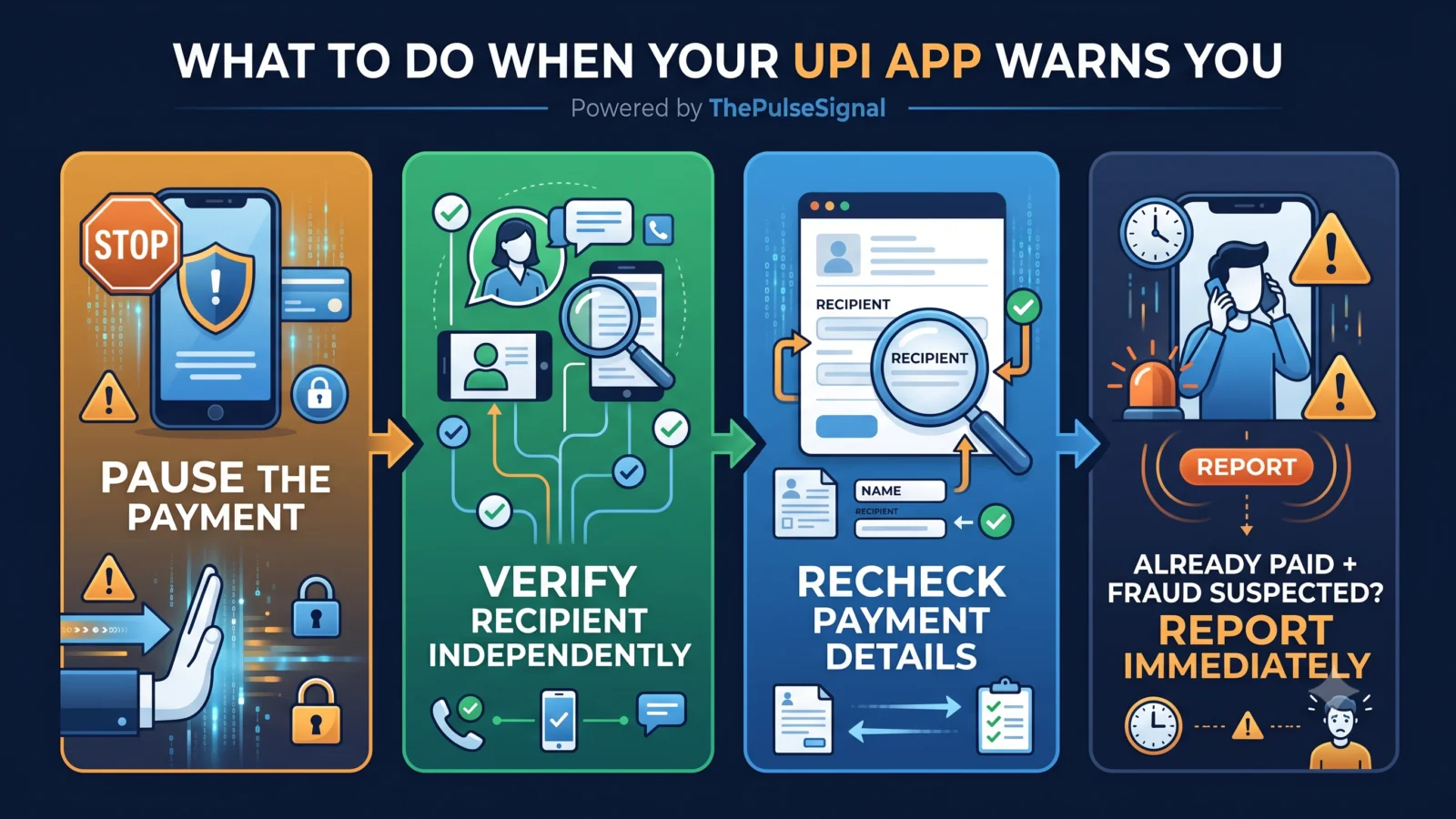
1. Pause the transaction
Do not dismiss the warning automatically or continue simply because you are in a hurry.
2. Verify the recipient independently
Contact the intended recipient through a trusted channel you already know. Do not use only the phone number, link or callback details supplied in the suspicious message or payment request.
3. Recheck the payment details
Confirm the UPI ID, mobile number, account details, recipient name and purpose of payment independently before retrying.
4. Decide only after verification
If the details do not match, the recipient cannot be independently verified or the payment story changes under questioning, do not proceed.
What if you personally know the recipient?
Knowing the person is useful context, but it is not enough to ignore the warning. A familiar person’s phone number, messaging account or payment identity can potentially be compromised or misused, and payment details can also be entered incorrectly.
The safer approach is to contact the person through a separate trusted channel and confirm that they actually requested the payment and that the displayed payment destination belongs to them.
Does the warning mean your own bank account is hacked?
Not necessarily. An FRI-driven warning can relate to risk associated with the recipient’s mobile number or payment destination rather than compromise of the payer’s own account.
If your bank separately reports suspicious login activity, unauthorised transactions or account compromise, that is a different problem and should be handled through the bank’s security and recovery process.
Why can one app warn while another behaves differently?
DoT supplies fraud-risk intelligence, but participating banks and payment providers can apply their own controls within the regulatory and risk-management framework.
For example, PhonePe has publicly described a system in which a Medium FRI signal can generate a proactive warning and a Very High signal can result in the transaction being declined. TPS has not verified that every bank or UPI provider uses the same thresholds, wording or action.
What if the transaction was declined even though the recipient is legitimate?
Do not try to defeat or bypass fraud controls through repeated alternative transfers without first resolving the warning. Reconfirm the recipient and payment details and use the payment provider or bank’s current customer-support route if a legitimate payment remains blocked.
TPS did not identify one uniform consumer-facing FRI false-positive appeal process that applies across every institution, so the exact review route can depend on the bank or payment provider.
What if you already sent the money and now suspect fraud?
If the payment has already been completed and you believe it was fraudulent, the problem has moved from pre-payment verification to fraud recovery. DoT’s current guidance directs victims of financial cyber fraud to report immediately through the national financial-cyber-fraud response system, including helpline 1930 and the National Cybercrime Reporting Portal.
Speed matters after a suspected fraudulent transfer because banks and authorities may need to attempt transaction tracing, freezing or other recovery action.
What is Chakshu used for?
Chakshu, available through Sanchar Saathi, is intended for reporting suspected fraudulent communications such as suspicious calls, SMS or messaging activity.
It should not be confused with the post-loss financial-fraud reporting route. If money has already been lost in a cyber-fraud transaction, the current financial-fraud reporting route such as 1930 or the National Cybercrime Reporting Portal is the relevant escalation path.
What does the ₹5,043.73 crore FRI figure actually mean?
On September 8, 2026, DoT reported that FRI-linked interventions had prevented suspected cyber-fraud transactions representing more than ₹5,000 crore in potential losses, with the cumulative figure reaching ₹5,043.73 crore by August 2026.
This is a DoT-reported prevention outcome. TPS did not identify a public transaction-level audit, false-positive rate or independent methodology that would justify describing the entire amount as independently proven fraud loss that certainly would otherwise have occurred.
What should you remember when a UPI fraud warning appears?
- A warning is a risk signal, not proof of guilt.
- Do not override it merely because the recipient looks familiar.
- Verify the person and payment details independently.
- Different banks and apps may apply different controls.
- If money has already been lost, move immediately to the official fraud-reporting and recovery route.
Verification note
TPS reviewed DoT’s original FRI launch material, subsequent RBI/DoT integration guidance, the September 8, 2026 FRI outcome update and PhonePe’s documented consumer-facing implementation. These sources establish the risk-classification mechanism and warning, delay or decline use cases, while institution-level thresholds, false-positive rates and a uniform consumer appeal route remain unresolved.