




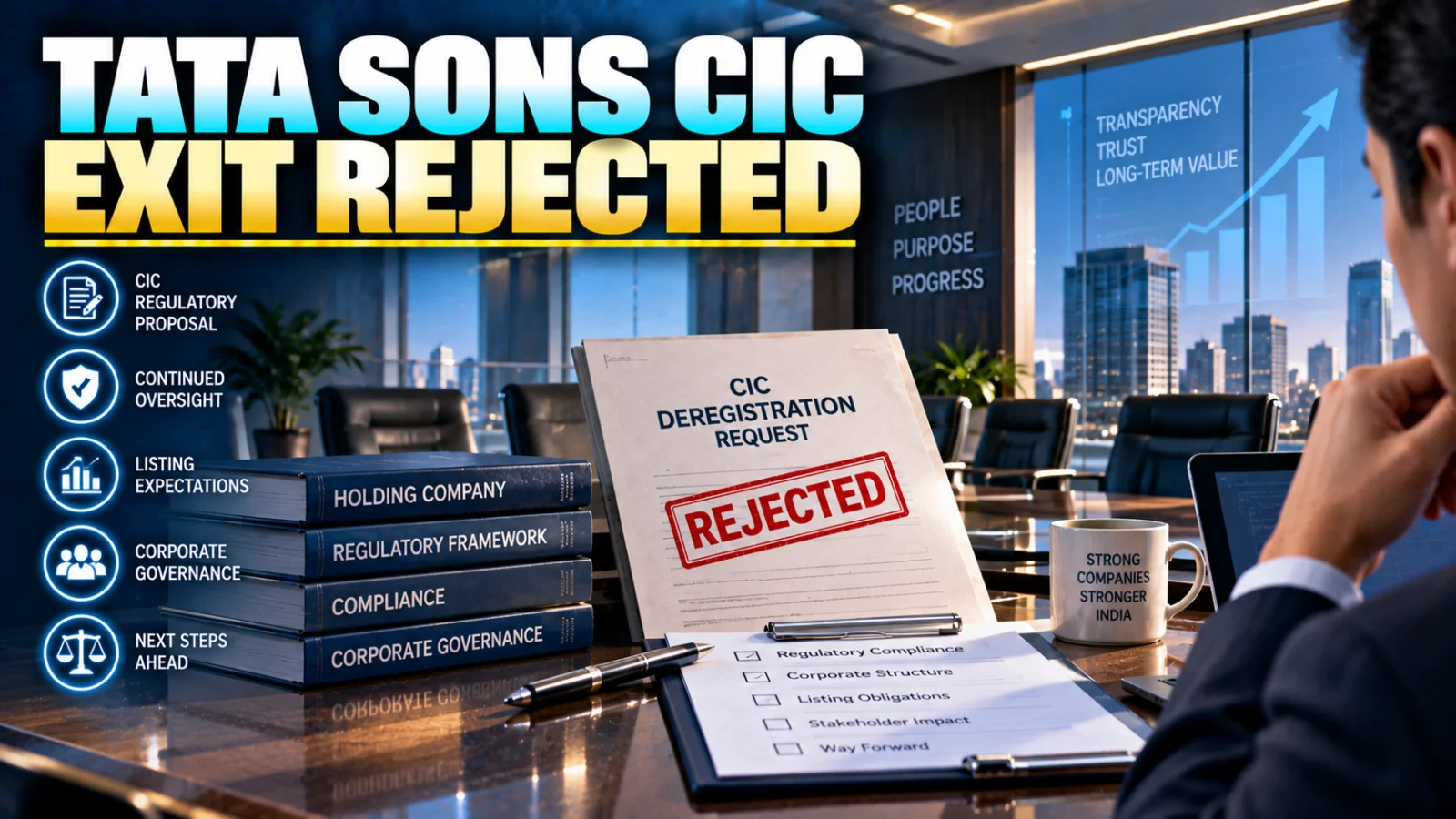
Credible current reporting says the Reserve Bank of India has rejected Tata Sons’ request to surrender its Core Investment Company registration. That is a material change because the application had remained under consideration while Tata Sons continued to sit within the NBFC-Upper Layer framework. The strongest current interpretation is that the reported rejection preserves regulatory and listing pressure. It does not establish a new Tata Sons IPO deadline or show that an IPO filing has begun.
What does the RBI rejection mean for Tata Sons?
Reuters and multiple Indian financial publications report that RBI rejected Tata Sons’ CIC deregistration request. If that reported decision stands, the deregistration route Tata Sons had been pursuing no longer provides an obvious way out of its NBFC-Upper Layer obligations. RBI’s scale-based regulatory framework includes enhanced requirements for Upper Layer NBFCs, including a listing requirement. However, the September 11 rejection letter itself has not been recovered by ThePulseSignal from a public RBI surface, so the company-specific decision remains a reported state rather than a directly reviewed primary document.
What changed from the previous Tata Sons position?
Before this development, the central question was whether RBI would allow Tata Sons to surrender its CIC registration. RBI had previously identified Tata Sons as an Upper Layer NBFC, while its deregistration request remained under examination.
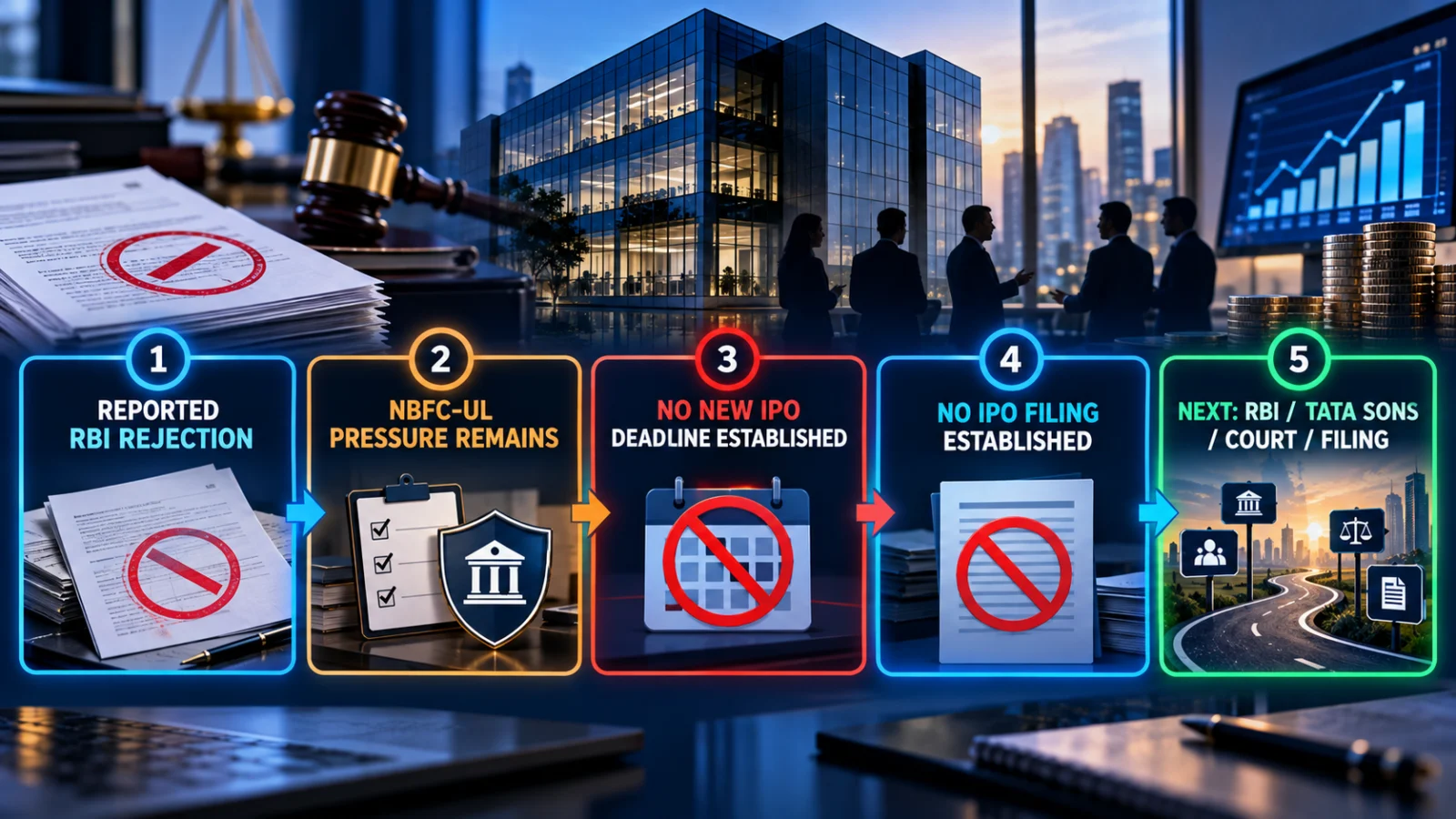
The reported September decision changes that answer. Instead of an unresolved deregistration application, multiple current reports now say the request was rejected and that Tata Sons remains subject to the requirements applicable to NBFC-UL entities.
Does this mean Tata Sons must launch an IPO immediately?
No immediate IPO launch is established by the reviewed evidence.
The important distinction is between a regulatory listing obligation and an actual public-offer transaction. RBI’s framework can create a requirement for an Upper Layer NBFC to be listed, but an IPO itself involves additional company decisions, securities filings, issue documentation, regulatory processes and market execution.
No DRHP, offer timetable, issue price, valuation, subscription date or other transaction-stage evidence was established in the completed research.
Did RBI give Tata Sons a new IPO deadline?
No fresh IPO or listing deadline was established in the reviewed evidence.
The RBI framework contains an existing listing rule for NBFC-UL entities. That historical regulatory requirement should not be converted into a newly announced September 2026 deadline simply because Tata Sons’ deregistration request has reportedly been rejected.
Any fresh company-specific timetable should be treated as unresolved unless it appears in a public RBI communication, a Tata Sons disclosure, a court filing or a formal securities-market document.
Why does NBFC-Upper Layer status matter?
RBI’s scale-based regulation places the largest and most systemically significant non-bank financial companies into an Upper Layer with enhanced regulatory requirements. The framework includes mandatory listing within the prescribed regulatory period for NBFC-UL entities.
Tata Sons had previously been included by RBI as a Core Investment Company in the Upper Layer. That is why its attempt to surrender its CIC registration mattered: deregistration could have materially changed the regulatory route that produced listing pressure.
What did Tata Sons try to change?
Tata Sons had sought voluntary surrender of its CIC registration. The application remained under RBI consideration for an extended period, making deregistration one of the central unresolved questions around whether the holding company would continue to face the Upper Layer framework.
According to Reuters and other current reporting, RBI has now rejected that request. Economic and financial publications also report that the regulator told Tata Sons to comply with requirements applicable to NBFC-UL entities.
What is confirmed, reported and still unresolved?
| Question | Current evidence state |
|---|---|
| Was Tata Sons previously classified as an NBFC-UL Core Investment Company? | Confirmed. RBI has publicly included Tata Sons in its Upper Layer NBFC list. |
| Does RBI’s framework impose enhanced requirements and a listing rule on NBFC-UL entities? | Confirmed. This comes from RBI’s scale-based regulatory framework. |
| Did RBI reject Tata Sons’ CIC deregistration request? | Reported by Reuters and multiple Indian financial publications. TPS has not recovered the September 11 rejection letter itself from a public RBI source. |
| Did RBI announce a new Tata Sons IPO deadline? | Not established. |
| Has Tata Sons filed an IPO or DRHP? | Not established in the reviewed evidence. |
| Will Tata Sons challenge, restructure or seek another regulatory route? | Unknown. These remain possible future paths, not settled actions. |
What options could Tata Sons have next?
The next company-specific step is not yet established. Possible future states include engagement with RBI over compliance, reconsideration or legal challenge, corporate restructuring, or movement toward a formal listing process.
Those are scenarios rather than confirmed decisions. A useful next-state signal would be a formal Tata Sons response, a public RBI communication, a court filing, a restructuring announcement or a securities filing that actually starts a listing transaction.
Why does this matter to investors and Tata group stakeholders?
Tata Sons is the principal holding company of the Tata group, so a change in its regulatory path has implications for governance, shareholder liquidity, capital structure and market expectations.
But those implications should not be confused with confirmed transaction terms. The reported rejection increases the importance of the listing question; it does not establish an issue size, valuation, dilution level or investment opportunity.
What should readers watch next?
- A public RBI copy or fuller official account of the September 11 decision.
- A formal Tata Sons statement describing how it intends to respond.
- Any regulator-issued company-specific compliance timetable.
- Any judicial or reconsideration proceeding.
- Corporate restructuring that changes Tata Sons’ CIC or NBFC-UL position.
- A DRHP or other formal securities-market filing if an actual listing process begins.
Verification method
ThePulseSignal reviewed RBI’s scale-based regulatory framework and its earlier official Tata Sons NBFC-UL classification, then reconciled those primary materials with current Reuters, Economic Times and Financial Express reporting on the reported rejection. The September 11 rejection letter itself was not recovered from a public RBI surface.
Limitations & unresolved facts
The exact wording and legal reasoning of RBI’s September 11 letter remain unavailable to TPS from a public primary source. No fresh IPO deadline, DRHP, issue timetable or confirmed Tata Sons response was established. Future regulatory engagement, litigation, restructuring or listing steps remain unresolved.
Bottom line
The reported RBI decision materially changes Tata Sons’ regulatory position by closing, at least for now, the CIC deregistration route it had pursued. That leaves NBFC-Upper Layer compliance and listing pressure in place. The evidence does not support turning that pressure into a newly invented IPO deadline or treating an actual public offering as already underway.