




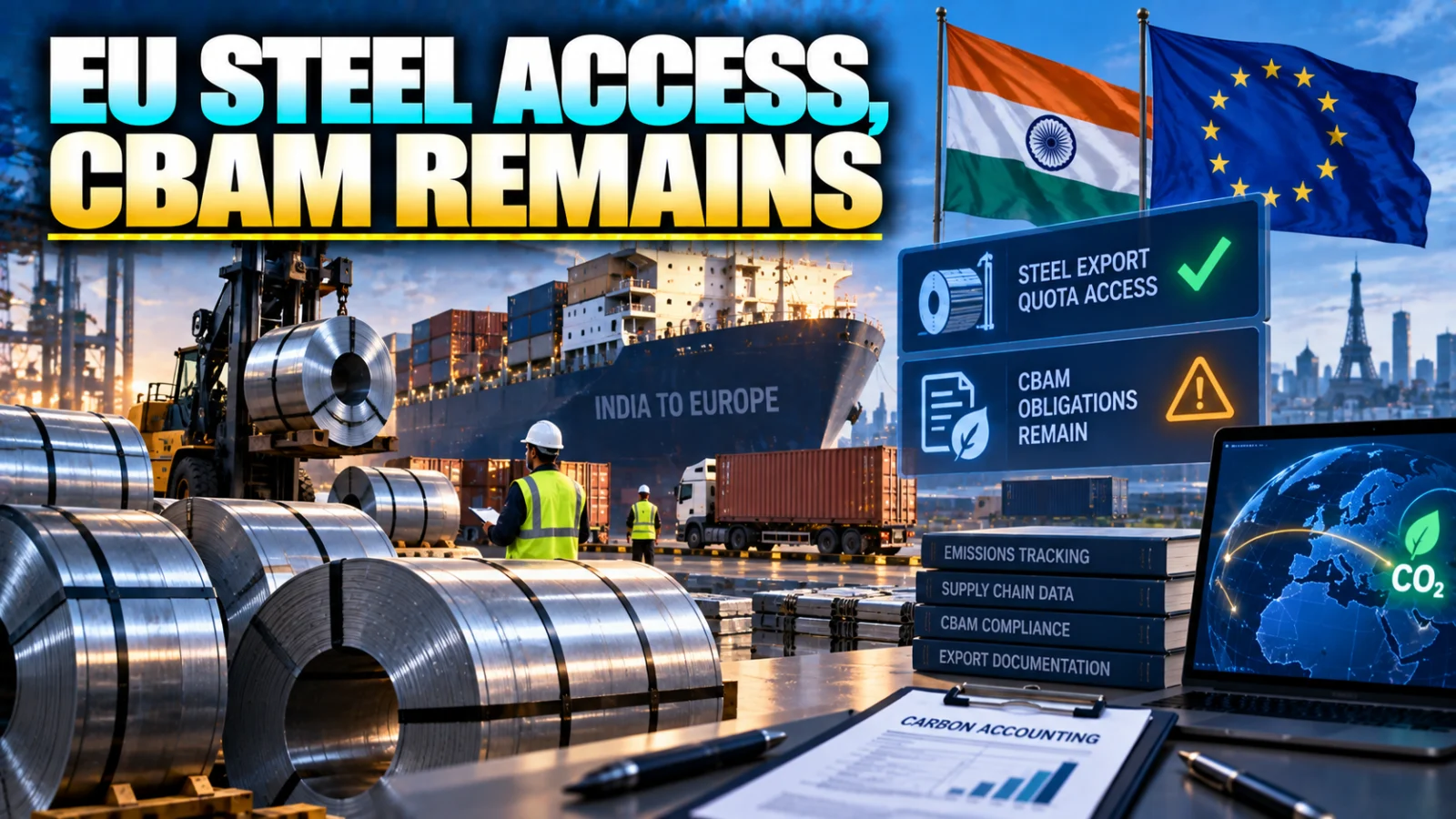
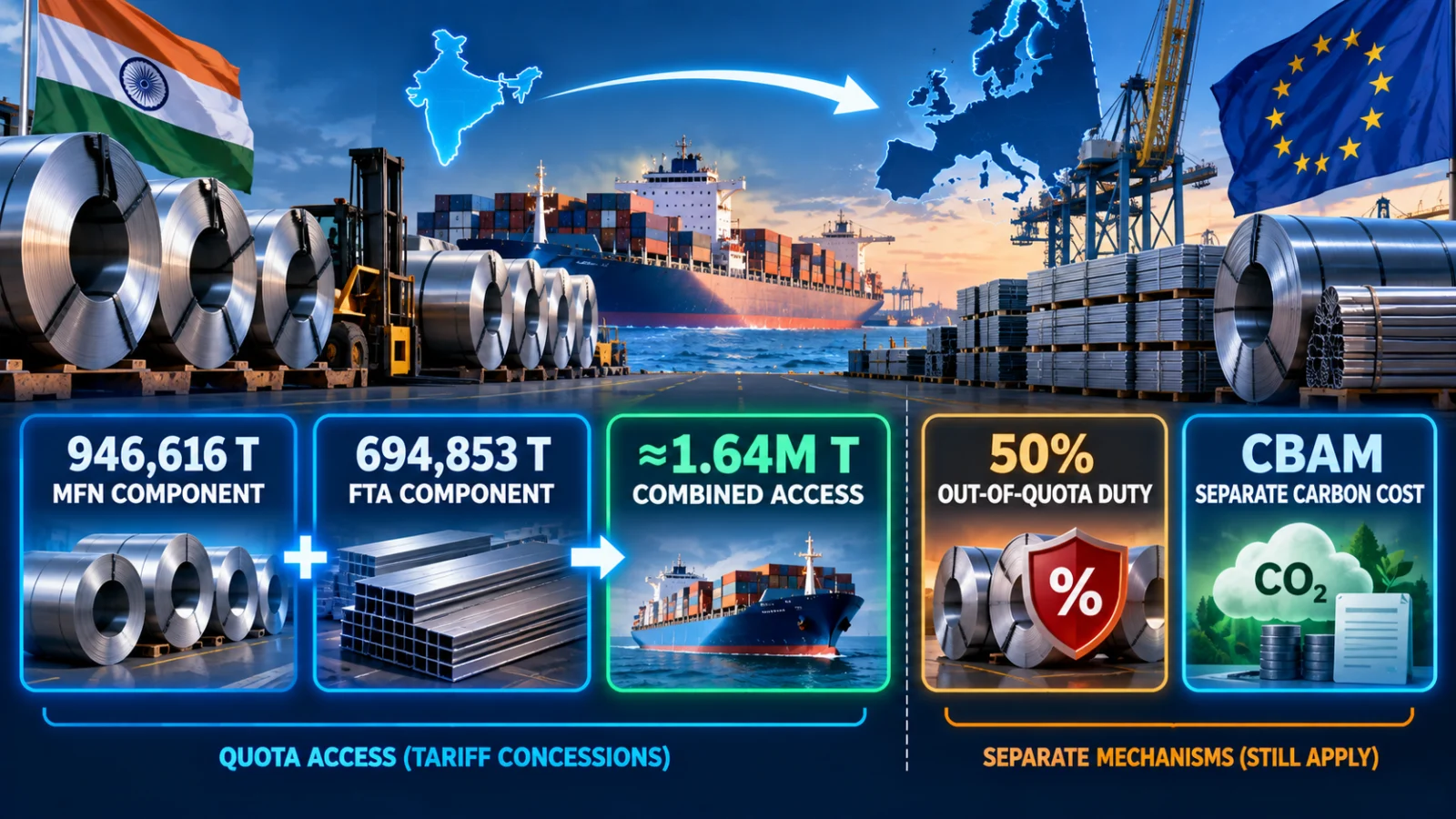
The India EU steel quota now being discussed is about 1.64 million tonnes of annual India-specific access, but that headline number should not be read as a 1.64-million-tonne FTA-only concession. Current legal-text reporting breaks the total into roughly 946,616 tonnes under the MFN component and about 694,853 tonnes under the FTA component.
There is a second distinction that matters commercially: better quota access does not remove the European Union’s Carbon Border Adjustment Mechanism, or CBAM. Indian steel exporters may therefore receive improved market access while still facing carbon-related compliance and certificate costs on covered products.
Direct answer: India is set to receive about 1.64 million tonnes of annual EU steel quota access under the new framework, but only around 694,853 tonnes are currently identified as the FTA-specific component. The remainder is associated with the MFN quota component. Separately, the EU’s steel out-of-quota duty regime and CBAM continue to operate as different cost mechanisms.
What does the 1.64-million-tonne India EU steel quota actually mean?
The most important correction is that the full 1.64-million-tonne figure is a combined India-specific access number, not an entirely new FTA quota.
Current reporting based on the trade text and EU quota framework identifies approximately:
- 946,616 tonnes under the MFN component; and
- 694,853 tonnes under the India–EU FTA component.
Together, those components produce total annual India-specific access of roughly 1.64 million tonnes.
This distinction matters because describing all 1.64 million tonnes as an FTA concession would overstate what the bilateral trade agreement itself adds.
Does the India–EU FTA remove CBAM for Indian steel?
No. The reviewed India–EU FTA carbon-border annex does not grant Indian steel a blanket exemption from CBAM.
Instead, the annex establishes cooperation around carbon-border measures, technical dialogue, possible recognition of carbon prices, verification arrangements and a most-favoured-nation principle for certain flexibilities that the EU may later grant to third countries.
That means Indian exporters can benefit from wider quota-based market access while still remaining inside the EU’s separate carbon-border regime.
Is the 50% steel duty the same as CBAM?
No. They are different mechanisms.
The EU’s steel import regime uses tariff-rate quotas. For covered steel imported outside the applicable quota, the current EU regulation provides for a 50% out-of-quota duty.
CBAM, by contrast, is linked to the embedded greenhouse-gas emissions of covered imports. It is a climate-policy mechanism rather than the same trade-protection instrument as the steel quota duty.
An exporter can therefore face several separate questions:
- Is the steel product eligible for the India-specific quota?
- Is quota volume still available when the shipment enters the EU?
- Would an out-of-quota steel duty apply?
- What CBAM obligation applies to the product’s embedded emissions?
Why can the quota still matter if CBAM remains?
The quota can improve market access because qualifying Indian steel can enter within a country-specific allocation rather than immediately falling into the higher out-of-quota duty treatment.
But the commercial benefit cannot be measured from quota volume alone. An exporter’s realised advantage can depend on product eligibility, available quota at the time of entry, EU selling prices, logistics, embedded emissions, recognised carbon costs and the applicable CBAM methodology.
That is why the 1.64-million-tonne headline should be read as an access improvement, not as proof of an equivalent increase in exporter profit.
Which steel products are covered?
Current reporting indicates that the India-specific steel access spans several product groups, including categories of flat steel, stainless steel, bars, rods, pipes and tubes.
However, product-specific eligibility should ultimately be checked against the controlling EU quota schedule and the final legally operative India–EU FTA annexes. TPS did not recover a clean final standalone Annex 2-B schedule during this review, and the FTA text itself is still subject to legal revision before becoming binding.
Is the India–EU FTA already legally in force?
No. The European Commission states that the published agreement text remains subject to legal revision and is made available for information.
The agreement becomes legally binding only after signature and completion of the necessary internal procedures on both sides. The current steel-access figures therefore describe the negotiated framework and related EU quota architecture, not an already completed first year of FTA operation.
What changes for Indian steel exporters?
The practical impact is best understood as four separate layers:
- MFN quota access: around 946,616 tonnes in the currently reported India allocation.
- FTA-specific quota access: around 694,853 tonnes currently attributed to the bilateral agreement.
- Out-of-quota steel duty: covered steel outside the applicable quota can face the EU’s 50% duty regime.
- CBAM: qualifying steel imports remain subject to the EU’s carbon-border rules based on embedded emissions and applicable carbon-cost adjustments.
These layers should not be collapsed into one claim that the FTA simply makes 1.64 million tonnes of Indian steel duty-free or carbon-cost-free.
Could CBAM offset some of the FTA benefit?
Yes, depending on the exporter and product, but there is no single universal figure. A carbon-intensive producer may face a larger CBAM burden than a producer with lower embedded emissions or recognised domestic carbon costs.
The actual commercial outcome also depends on EU prices, quota utilisation and whether the shipment would otherwise have faced the out-of-quota steel duty.
TPS therefore cannot responsibly convert the quota announcement into a universal margin or earnings estimate for Indian steel producers.
What does the FTA say about future CBAM treatment?
The carbon-border annex creates a formal cooperation channel rather than an exemption. It provides for dialogue on implementation, recognition of carbon pricing where relevant, cooperation on verification and treatment of future flexibilities.
One potentially important provision is the most-favoured-nation treatment principle for certain CBAM flexibilities granted to third countries. If the EU later provides a qualifying flexibility elsewhere, India could have a basis to seek equivalent treatment under the agreed framework.
That does not mean such a future flexibility already exists.
Can the India-specific steel quota change later?
Current reporting says the FTA-specific quota arrangements provide for a review after the agreement has been in force for one year and then at five-year intervals, taking account of factors such as market conditions and quota utilisation.
That means the current figures should be treated as the negotiated starting framework rather than an unchangeable permanent volume.
What should exporters monitor next?
- the final legally scrubbed India–EU FTA text;
- the signature and entry-into-force dates;
- the final product-by-product steel quota schedule;
- EU guidance on administration of India’s FTA-specific allocation;
- actual quota utilisation after implementation;
- CBAM benchmark, default-value or methodology changes;
- recognition of Indian carbon prices or verifier arrangements; and
- the first formal review of the steel quota after entry into force.
Verification method
ThePulseSignal reviewed the European Commission’s published India–EU FTA text page, India’s official FTA factsheet, the dedicated carbon-border annex and current EU steel quota regulation. TPS then reconciled those primary materials with current reporting on the approximately 1.64-million-tonne India allocation and its reported MFN and FTA components.
Limitations & unresolved facts
The exact final signed Annex 2-B product schedule has not yet been independently recovered by TPS in a clean final operative form. The FTA is not yet legally in force, actual quota utilisation is unknown, and exporter-specific CBAM costs cannot be calculated without product, installation, emissions and recognised-carbon-price data. Final legal revision or implementation guidance may change operational details.
Bottom line
India’s wider EU steel access is commercially meaningful, but the headline number needs careful reading. The approximately 1.64 million tonnes currently identified for India combines an MFN component and a smaller FTA-specific component. The FTA also does not cancel CBAM, and steel shipped outside the applicable quota can face a separate 50% out-of-quota duty. For exporters, the real benefit will depend on quota eligibility, utilisation and carbon intensity rather than the headline tonnage alone.