






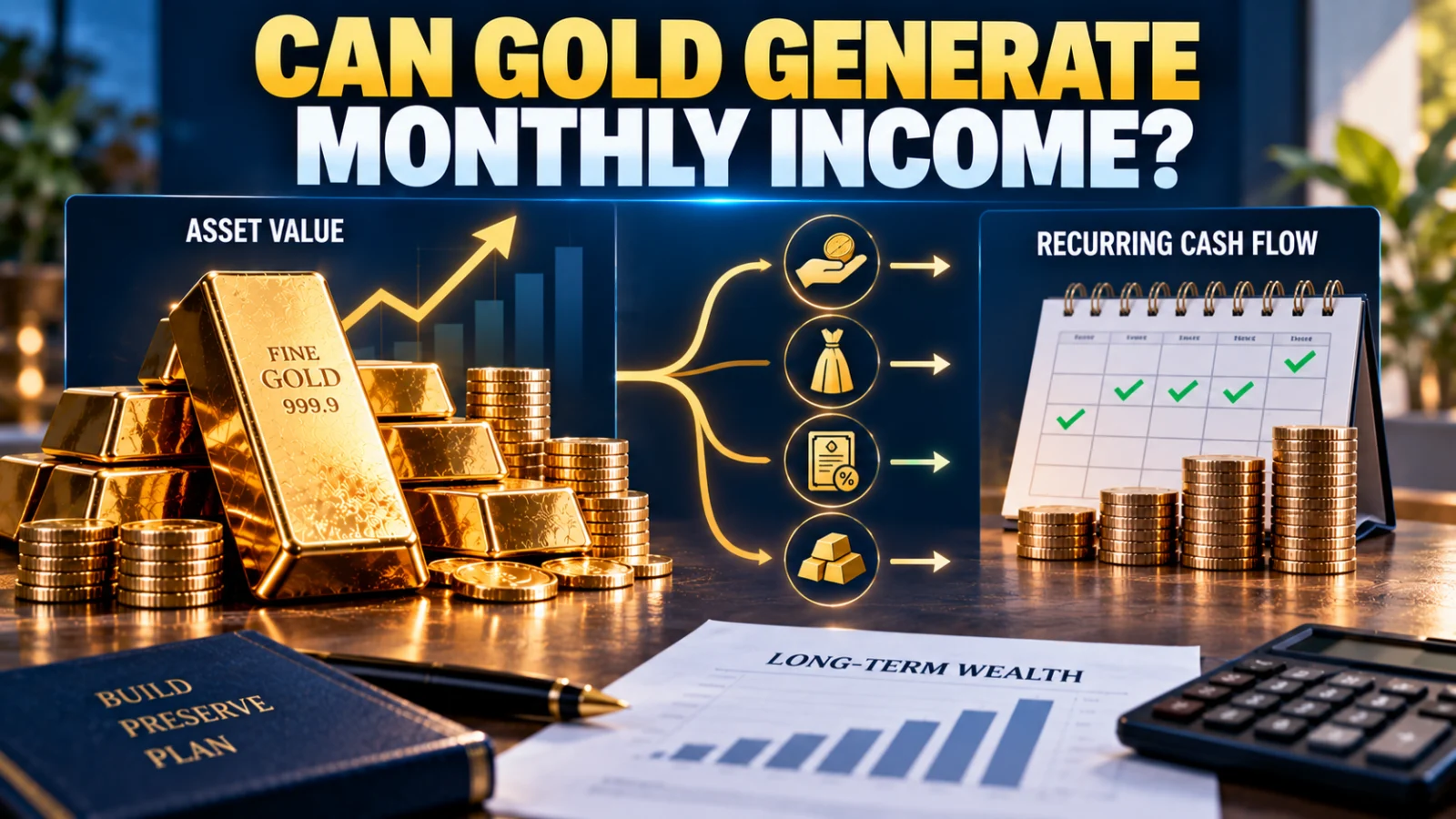
Can gold generate monthly income? Gold itself does not normally pay recurring income in the way a bank deposit pays interest, a bond pays a coupon, a property can produce rent or some shares distribute dividends. Gold can rise in market value, but that increase is capital appreciation, not cash income.
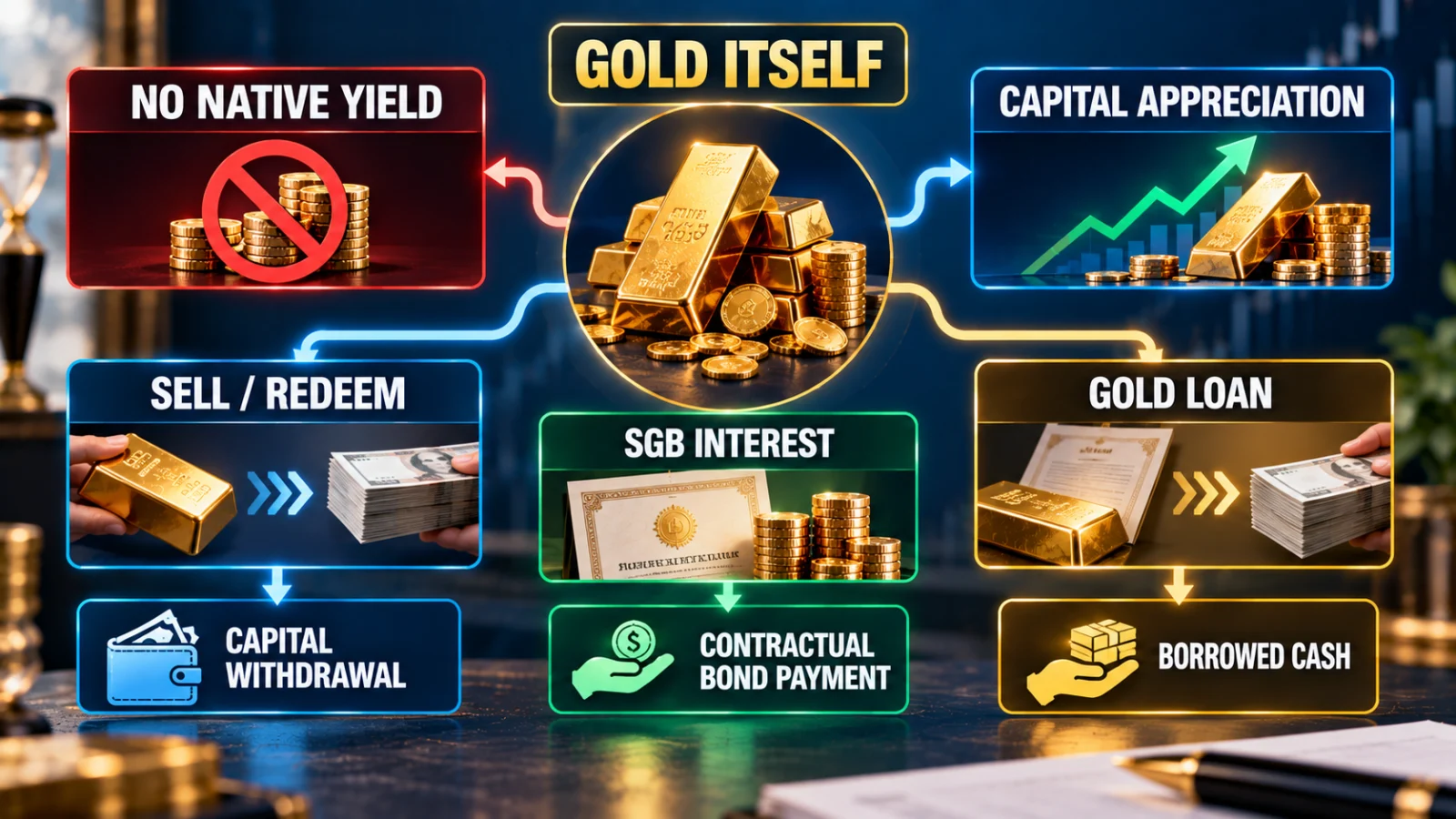
If you want regular cash from a gold holding, the money usually has to come from somewhere else: selling part of the gold, redeeming investment units, receiving a contractual payment from a separate financial structure, or borrowing against the asset. Those mechanisms can all put money into a bank account, but economically they are not the same thing.
Gold income, appreciation and withdrawals are different
| Cash-flow route | What actually creates the cash? | Is gold itself producing income? |
|---|---|---|
| Gold price rises | The market value of the holding increases | No. This is capital appreciation until value is realised. |
| Sell physical gold | Part of the asset is converted into cash | No. Capital is being sold. |
| Sell or redeem Gold ETF or gold-fund units | Investment units are sold or redeemed | No. The investor is withdrawing value from the holding. |
| Legacy Sovereign Gold Bond interest | The government bond contract pays interest | No. The cash flow comes from the bond structure, not from gold itself. |
| Gold loan | A lender advances money against gold collateral | No. The cash is borrowed and creates a repayment obligation. |
Why gold does not have a native yield
World Gold Council research identifies the absence of regular cash flow as one of gold’s investment drawbacks. A gold bar, coin or jewellery item does not operate a business, collect rent or owe the owner contractual interest.
The financial benefit from owning bare gold therefore comes mainly from changes in its market price. If gold appreciates, the owner’s wealth can rise. But no spendable cash appears automatically simply because the quoted gold price increased.
This distinction is important because investment return and income are not interchangeable. An asset can create substantial wealth without sending its owner a periodic payment.
TPS explains that broader wealth mechanism separately in Can Gold Make You Rich? How Wealth Actually Builds with Gold Over Time.
If gold appreciates, is that income?
No. Appreciation means the asset has become more valuable in the market. It becomes spendable cash only after value is realised.
Suppose a gold holding rises substantially over several years. The owner is wealthier on paper because the holding is worth more. But unless some gold is sold, redeemed or used in another transaction, the owner has not received recurring cash from the asset.
This is the key difference between capital appreciation and income generation.
Can physical gold provide monthly cash?
Physical gold can be converted into cash, but the most direct route is to sell some of the holding.
An owner could theoretically sell a small quantity every month. That may create a regular cash stream in practical terms, but economically it is a sequence of asset sales. The remaining quantity of gold falls as pieces, coins or bullion are sold.
If the gold price rises faster than the value being withdrawn, the remaining corpus may still hold up or grow. If prices stagnate or fall while withdrawals continue, the holding can shrink more quickly.
There is therefore no guaranteed monthly income rate that physical gold can support indefinitely.
Does a Gold ETF generate monthly income?
A Gold ETF can make gold exposure easier to buy and sell, but wrapping gold exposure inside an exchange-traded fund does not make the underlying metal start producing interest or dividends.
If an investor wants cash from a Gold ETF, the usual mechanism is to sell some ETF units. That converts part of the investment into money.
The distinction is the same as with physical gold: the investor may be realising gains, recovering original capital, or doing both. The cash is not automatically a yield generated by gold.
What about a gold mutual fund or Gold ETF fund of funds?
Gold mutual funds and Gold ETF fund-of-funds structures can provide operational features that physical gold does not. Some mutual-fund schemes support a Systematic Withdrawal Plan, commonly called an SWP.
An SWP can transfer a chosen amount to the investor at regular intervals. But current scheme documents describe this as a withdrawal or redemption mechanism. Units or their value are being redeemed to create the cash.
That distinction matters. A ₹10,000 monthly transfer can look like income when it arrives in a bank account, but if the scheme is redeeming investment units to fund it, part of the investor’s corpus is being converted into cash.
TPS compares Gold ETFs and gold mutual-fund structures separately in Gold ETF vs Gold Mutual Fund in India: Which Structure Are You Actually Buying?.
Can an SWP reduce the gold corpus?
Yes.
Consider the economic logic rather than the bank transfer. Every withdrawal reduces the value remaining in the investment unless market appreciation offsets it.
If the portfolio rises by less than the amount withdrawn, capital is being consumed. If gold prices fall while withdrawals continue, more units may need to be redeemed to produce the same rupee amount.
That does not make an SWP inherently wrong. It simply means an SWP is a withdrawal strategy, not proof that the underlying gold is producing monthly income.
Do Sovereign Gold Bonds generate income?
Legacy Sovereign Gold Bonds are an important exception to the simple statement that every gold-linked investment produces no cash flow.
RBI’s documented SGB terms provide a fixed annual interest rate of 2.50% on nominal value, paid half-yearly. That means an SGB holder can receive contractual cash payments without selling the bond.
But the source of that payment must be described correctly.
The interest is produced by the government bond contract, not by gold itself. The security combines gold-linked value exposure with a separate sovereign interest obligation.
It is also not monthly income under the standard legacy terms because the coupon is paid semi-annually.
Why the SGB distinction matters
If a reader says, “Gold pays interest because my SGB pays interest,” two different economic layers are being combined.
- The gold-linked component determines exposure to the price of gold.
- The bond component creates the contractual coupon.
This is similar to other financial wrappers: a product can add contractual features around an underlying asset without changing the underlying asset’s own economic characteristics.
Is selling a little gold every month the same as earning income?
It can create the same practical outcome—a monthly cash deposit—but it is not the same economically.
Income generated by an asset can arrive without necessarily requiring the investor to dispose of part of the asset. Selling gold or redeeming units, by contrast, converts part of the holding into cash.
This distinction becomes especially important in retirement planning. If monthly living expenses are funded by recurring gold sales, the sustainability of that strategy depends on:
- the starting corpus;
- the amount being withdrawn;
- future gold-price performance;
- tax and transaction costs;
- the timing of price declines and recoveries;
- other available sources of income.
No single withdrawal rate can be assumed safe for every investor.
What happens if gold falls while you keep withdrawing?
Gold can experience significant drawdowns and multi-year periods of weak performance. If an investor continues taking the same rupee amount during a decline, more of the holding may need to be sold or more fund units redeemed.
This creates a basic sequencing problem: withdrawals made during weak markets can leave fewer assets available to benefit if prices later recover.
That is one reason recurring cash-flow planning should not be based on an assumption that gold appreciation will automatically replace every withdrawal.
Does a gold loan create income?
No.
A gold loan can create liquidity because the owner pledges gold as collateral and receives borrowed money. But that cash comes with a liability, repayment terms and interest costs.
The owner has not earned income from gold; the owner has borrowed against an asset.
That distinction is important because borrowing can preserve ownership of the gold temporarily, but it introduces credit and repayment risk that an ordinary asset sale does not.
Why own gold if it does not generate income?
Lack of native cash flow does not mean gold has no investment role.
Gold can still provide capital appreciation, liquidity, diversification and wealth-storage characteristics. WGC’s strategic-asset research evaluates gold partly in those roles rather than as an income-producing asset.
The right question is therefore not “Does every useful investment pay income?” Different assets perform different jobs.
An income-oriented asset may help fund current spending. Gold may instead contribute diversification, liquidity or stored purchasing power while depending on market appreciation for financial return.
A simple way to classify any ‘income from gold’ claim
When money arrives from a gold-related holding, ask where the cash actually came from:
- Native income: Did the asset itself owe interest, rent or dividends? Bare gold does not.
- Capital appreciation: Did the gold merely become more valuable without any cash being paid?
- Capital withdrawal: Were physical gold or investment units sold or redeemed?
- Wrapper payment: Did a separate contract, such as a legacy SGB coupon, create the cash?
- Borrowing: Was money advanced against gold collateral and therefore required to be repaid?
Those categories prevent very different cash-flow mechanisms from all being described as “gold income.”
Bottom line
Gold itself does not normally generate monthly income. Its investment return comes primarily from changes in market value.
You can create monthly cash from a gold holding by selling physical gold, selling or redeeming Gold ETF units, or using a fund withdrawal facility. But that cash comes from realising or withdrawing capital, not from gold paying interest or dividends.
Legacy SGBs are different because their government-bond structure includes contractual interest, paid half-yearly under the documented terms. That payment is a feature of the bond wrapper rather than income generated by gold.
So before treating any regular payment as “income from gold,” identify whether the cash was earned, realised, withdrawn or borrowed. That distinction tells you what is actually happening to your wealth.