






Gold vs debt mutual fund India comparisons are often reduced to whichever asset recently produced the higher return. For a goal that is roughly three to five years away, that is the wrong starting point. Gold and debt mutual funds are both market-linked, but the risks that move their value are fundamentally different.
Gold exposes the goal mainly to changes in the gold price, currency movements, real interest rates and investor demand. A debt mutual fund holds bonds and other debt securities, so its NAV can be affected by underlying yields, interest-rate and duration risk, credit quality, liquidity and fund expenses.
There is therefore no evidence-backed universal winner for a 3–5 year goal. The useful question is: which type of uncertainty can this goal tolerate, and how much uncertainty can remain as the spending date gets closer?
| Dimension | Investment gold | Debt mutual fund |
|---|---|---|
| Main return engine | Changes in the market price of gold | Income from portfolio debt securities plus changes in their market value, net of fund costs |
| Principal guarantee | No | No |
| Interest-rate / duration risk | Not bond-duration risk; real rates can still influence gold prices | Yes; sensitivity depends materially on portfolio duration |
| Credit risk | No issuer credit risk in gold itself | Depends on the issuers and securities held by the scheme |
| Currency sensitivity | Indian gold prices are affected by global gold prices and the rupee | Depends on the specific debt portfolio; ordinary domestic debt funds are driven primarily by their underlying securities |
| Goal-date value certainty | No contractual maturity value | No guaranteed NAV or maturity amount for an ordinary open-ended debt fund |
| Category selection | Holding form matters | Critical: debt schemes can have materially different duration and credit mandates |
| Liquidity | Generally high at the gold-market level; holding form matters | Usually redeemable subject to scheme terms, market conditions and any applicable exit provisions |
Debt mutual funds are not the same as fixed deposits
The first distinction is essential. A bank fixed deposit normally gives the depositor a contractual rate and maturity framework when it is booked, subject to the bank’s terms. A debt mutual fund does not promise a fixed maturity value merely because it invests in debt securities.
The fund’s NAV changes with the value of the securities it owns. That means an investor can experience gains or losses even when the underlying instruments are bonds rather than shares.
SEBI’s mutual-fund risk framework explicitly recognises risks including interest-rate risk and credit risk. This is why calling debt mutual funds “safe debt” can mislead a reader who is funding a goal with a fixed spending date.
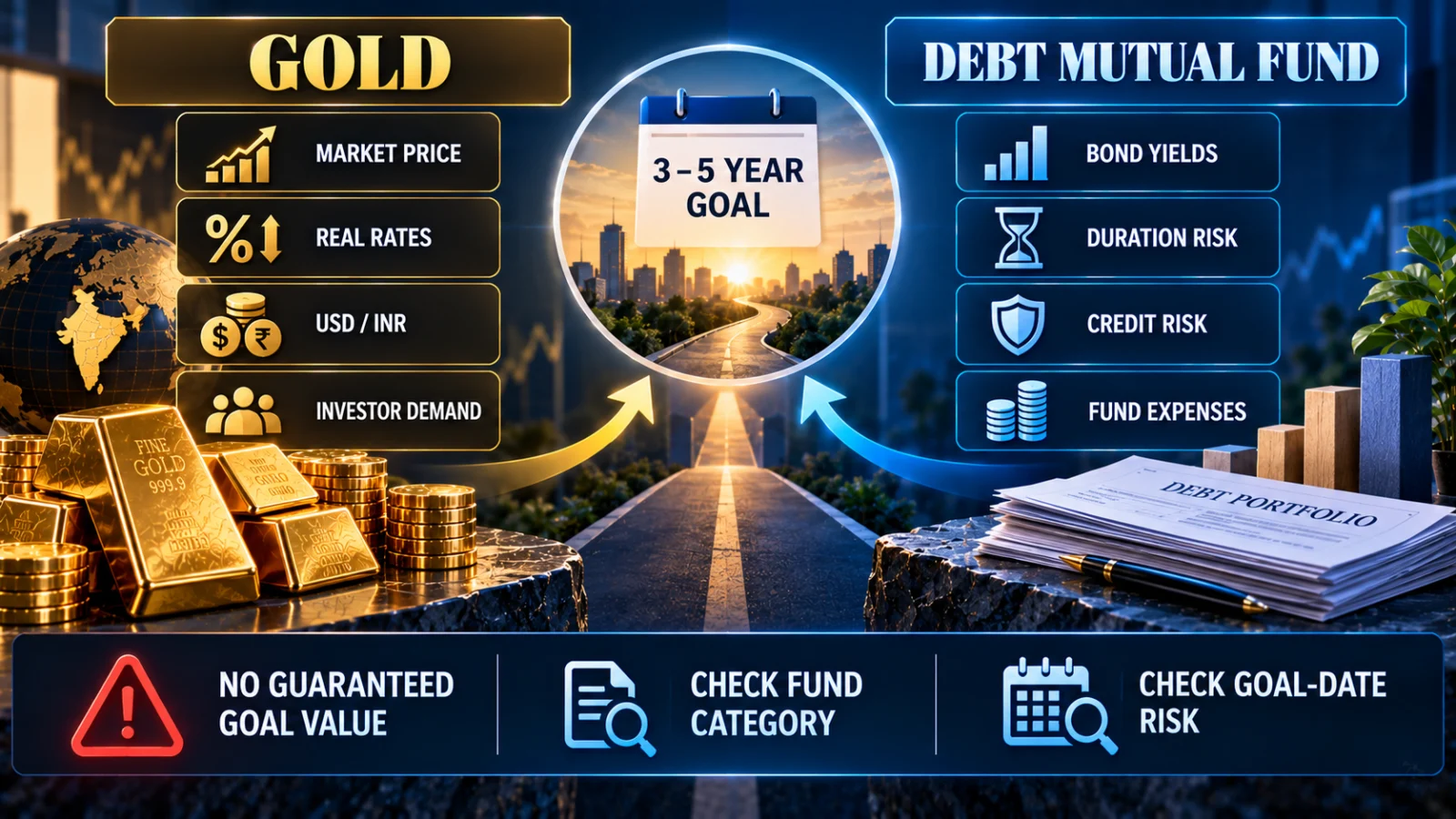
Gold and debt funds have different risk engines
Gold does not have a bond issuer promising coupon and principal payments. Its investment return comes mainly through changes in its market price. Those prices can be influenced by global demand, monetary conditions, real rates, risk sentiment and currency movements, including changes in the rupee against the US dollar.
A debt mutual fund works differently. Its portfolio contains debt securities whose prices and income are linked to interest rates, yields, issuer credit quality, liquidity and maturity structure. Expenses also reduce the return ultimately experienced by investors.
The two assets can therefore lose value for very different reasons. That difference matters more for goal planning than asking which asset happened to lead over the previous year.
Why duration matters in a debt mutual fund
When market interest rates or yields change, existing bond prices can move in the opposite direction. The sensitivity of a debt portfolio to those changes is closely related to its duration.
As a general bond-pricing principle, a higher-duration portfolio can experience a larger price movement for a given change in yields than a lower-duration portfolio. This does not mean lower duration is always better; it means the investor needs to understand which risk is being accepted.
SEBI’s framework uses Macaulay duration in the classification and risk analysis of several debt-fund categories. That makes duration a core part of the comparison for investors with a known spending date.
Why credit risk matters
Debt funds also depend on the ability and credit quality of the issuers whose securities they own. If an issuer’s perceived ability to repay deteriorates, the value of its bonds can fall. A default or restructuring can create more severe losses.
Different debt schemes can deliberately hold very different credit profiles. A portfolio dominated by high-quality sovereign or top-rated debt does not have the same credit-risk engine as a scheme that accepts substantially more lower-rated exposure in pursuit of yield.
That is why “debt fund” is too broad a label for deciding whether a scheme fits a 3–5 year goal.
Not every debt-fund category fits the same goal
SEBI categorises debt schemes partly by portfolio maturity and duration characteristics. Short Duration Funds, Medium Duration Funds, Dynamic Bond Funds, Corporate Bond Funds, Credit Risk Funds, gilt funds and other categories can therefore behave differently.
A particularly important mistake is to assume that a Medium Duration Fund is automatically the correct choice simply because the investor’s goal is three to five years away.
A fund category describes how the portfolio is managed. It does not guarantee that the investor will receive a known amount at the end of their personal goal horizon.
For example, a Medium Duration Fund is associated with a portfolio Macaulay-duration range under SEBI’s categorisation framework, but its NAV can still respond to interest-rate movements, credit conditions and portfolio changes. The portfolio’s duration is not a promise that a four-year investor cannot lose money.
Gold also has meaningful 3–5 year risk
Gold is sometimes treated as the safer side of the comparison because it has no issuer credit risk. That is only one dimension of risk.
World Gold Council research acknowledges that gold can experience substantial annual gains and losses and can underperform over medium-term periods. A reader whose goal has a fixed spending date therefore cannot assume that today’s gold value will be preserved three or five years later.
Gold’s absence of issuer credit risk does not remove market-price risk.
Liquidity does not guarantee the amount available at the goal date
Both investment gold and many debt-fund structures can offer practical liquidity. But liquidity answers whether an investment can be converted into cash; it does not guarantee the amount that will be available when the investor needs to spend it.
A liquid gold holding can still be worth less after an adverse price move. A redeemable debt fund can still have a lower NAV after a rise in yields or a deterioration in credit conditions.
For a goal with a firm spending date, the amount of acceptable value uncertainty is therefore a separate question from liquidity.
Gold has no bond credit risk, but that does not make it risk-free
Gold itself does not depend on a company or government issuer making coupon or principal payments. In that narrow sense, it does not carry the issuer-credit risk that exists inside debt portfolios.
But the trade-off is that gold’s future market value is uncertain. Its price can rise or fall significantly, and there is no contractual maturity amount aligned to the reader’s spending date.
A correct comparison therefore separates credit risk from market-price risk instead of collapsing both into a vague label such as “safe” or “risky.”
Do not use one historical CAGR to choose
A historical return comparison can change dramatically when the start and end dates change. A strong gold cycle may make gold appear dominant over one period, while a favourable bond-rate cycle may make a debt-fund category look stronger over another.
That does not tell the reader which risk is acceptable for a future expenditure with a known date.
Historical returns can provide context, but the decision should begin with the structure of the goal and the specific source of risk in each option.
Tax can change the net outcome, but it needs vehicle-specific analysis
Indian tax treatment should not be summarised with one generic “gold tax” and one generic “debt-fund tax.”
Section 50AA of the Income-tax Act creates specific treatment for defined specified mutual funds, with applicability depending on statutory conditions and acquisition dates. Gold taxation can also differ depending on whether the exposure is physical gold, an exchange-traded product or another structure.
The tax section should therefore be used to compare the actual investment vehicles being considered, not as a shortcut for declaring one asset universally superior.
A 3–5 year goal needs a deadline-risk framework
1. How fixed is the spending date?
If the expense cannot be delayed, tolerance for a large loss near that date should usually be lower than for an open-ended wealth goal.
2. How much shortfall can the goal tolerate?
Do not ask only how much upside you want. Ask what happens if the investment is below expectations when the money is required.
3. If considering a debt fund, which category is it?
Identify the scheme’s duration profile, credit-quality mandate, Riskometer and Potential Risk Class information where applicable. “Debt fund” alone is not enough.
4. If considering gold, which form is it?
ETF, fund, bullion and other gold exposures can have different costs, liquidity and tax treatment.
5. Which risk engine can you tolerate?
Gold brings market-price and currency/macro exposure. Debt funds bring bond-market, duration and potentially credit risk.
6. What happens as the goal date gets closer?
Reassess how much market-value uncertainty can remain as spending becomes imminent rather than assuming today’s risk level should continue unchanged until the final day.
When gold may fit the goal better
Gold may be more aligned when the investor deliberately wants gold exposure, values diversification away from conventional financial assets, accepts material market-price variation and does not need a predictable amount at the end of the horizon.
That is a suitability statement, not a claim that gold will outperform debt funds.
When a debt mutual fund may fit the goal better
A debt mutual fund may be more aligned when the investor wants exposure to a bond portfolio whose duration and credit characteristics can be selected deliberately and monitored against the goal’s risk tolerance.
But the category and underlying risk matter. A fund with a substantially different duration or credit profile can behave very differently from another fund that also carries the “debt” label.
Bottom line
There is no universal winner in gold vs debt mutual fund India comparisons for a 3–5 year goal. Gold exposes the goal mainly to gold-price and currency/macro movements. Debt mutual funds expose it to the behaviour of the underlying bond portfolio, including interest-rate, duration and credit risk.
The most important distinction is that debt mutual funds are not fixed deposits and gold is not a guaranteed store of value at a particular future date. Start with the goal deadline and acceptable shortfall risk, identify the exact debt-fund category or gold vehicle, and compare the risks that could affect the amount available when the money is actually needed.
Verification note
TPS reviewed SEBI material on debt-scheme categorisation, the Riskometer and the Potential Risk Class framework, including the separation of interest-rate and credit risk. TPS also reviewed World Gold Council evidence on gold liquidity and medium-term price risk and current Income Tax Department material relevant to specified mutual-fund and capital-gains treatment.
Limitations and unresolved facts
Future gold prices, bond yields, interest-rate paths, credit events and debt-fund returns are unknown. No debt-fund category is automatically appropriate solely because a goal is three to five years away. Tax treatment depends on the exact vehicle, statutory definition, acquisition date and taxpayer facts. This article does not establish a universal allocation or recommend a specific scheme.