






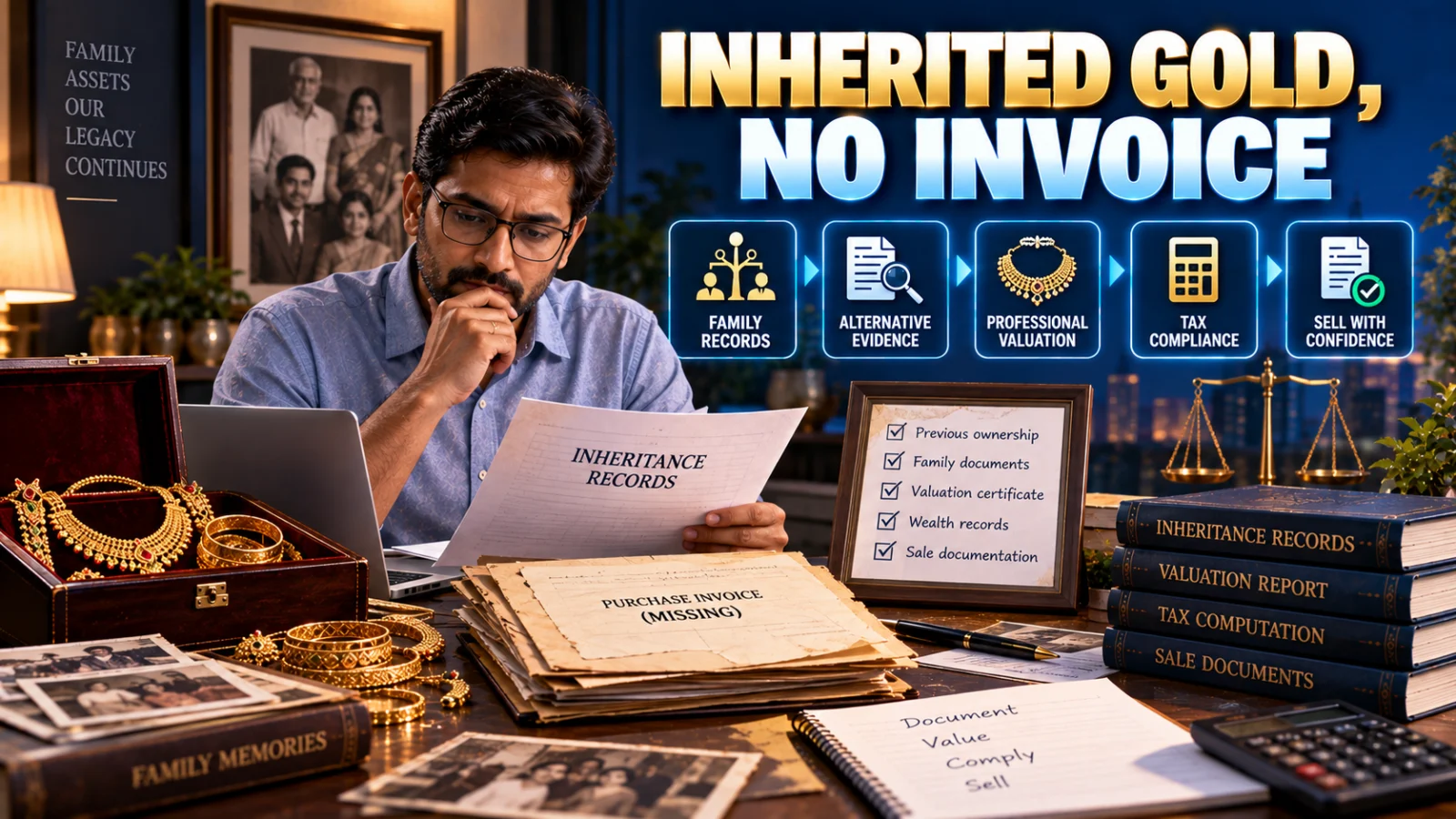
Selling inherited gold without invoice India questions often start with the wrong assumption: if the old purchase bill is missing, the tax cost must be zero and the entire sale value becomes taxable. Current tax law does not create that automatic rule. The real job is to identify which statutory cost provision applies and then establish enough evidence to support the facts behind that calculation.
For the current post-1-April-2026 framework, the inherited-cost rule is found in Section 73 of the Income-tax Act, 2025, not the old Section 49 reference from the Income-tax Act, 1961. Section 73 generally traces the cost of inherited property back to the relevant previous owner’s acquisition cost. Section 90 then provides additional rules where the previous owner acquired the asset before 1 April 2001 or where that earlier cost genuinely cannot be ascertained.
1. Confirm inheritance first
Establish that the gold came to you through inheritance, succession or will and identify the relevant previous owner.
2. Ask whether the previous owner’s cost is known
If reliable records establish what the previous owner paid, Section 73 generally carries that acquisition cost forward.
3. Check whether the asset is pre-1 April 2001
If the relevant previous owner acquired it before 1 April 2001, the special Section 90 rule can bring the 1-April-2001 fair-market-value option into the calculation.
4. If historical cost truly cannot be ascertained
Section 90 contains a separate fallback based on fair market value when the asset became the previous owner’s property. Losing one invoice is not automatically the same as proving that cost cannot be ascertained.
5. Build the evidence file before sale
Preserve inheritance records, surviving acquisition evidence, old valuations, financial records and the eventual sale documents. No one substitute document is guaranteed to resolve every case.
Inheritance itself and selling inherited gold are different tax events
Property received under a will or inheritance is excluded from the relevant Section 92 property-receipt charge. That means the inheritance itself should not be confused with the later capital-gains calculation when the heir eventually sells the gold.
Once the gold is sold, the tax question becomes: what sale consideration applies, what cost of acquisition can be used, how long has the asset been held, and which current capital-gains rule applies?
TPS separately explains gold inheritance, wills, nomination and transfer after death in India. This article begins after that ownership question has already been resolved.
Section 73 is now the current inherited-cost rule
Older articles and tax discussions often refer to Section 49 of the Income-tax Act, 1961. Under the current Income-tax Act, 2025 framework, the corresponding inherited-cost rule is now in Section 73.
For property acquired through inheritance, succession, gift or will, Section 73 generally points to the cost for which the previous owner acquired the asset, subject to the other statutory rules that can modify that cost.
This is why a missing invoice should not automatically be translated into a cost of zero. The statute first asks what the previous-owner cost rule produces.
No invoice does not automatically mean the whole sale amount is taxable
Capital gains are not normally calculated by simply treating the full sale proceeds as taxable income. The computation uses the applicable sale consideration and then applies the statutory deductions, including the relevant cost of acquisition and qualifying transfer-related amounts.
If the previous owner’s invoice has disappeared, the evidence problem becomes harder, but the legal structure does not disappear with the document.
There is therefore an important distinction between:
- the invoice is missing;
- the previous owner’s cost can still be established through other reliable evidence; and
- the previous owner’s acquisition cost genuinely cannot be ascertained.
Those are not automatically the same state.
If the previous owner’s cost is known, that is generally the starting point
Suppose the inherited jewellery belonged to a parent and reliable records establish what that parent originally paid. Section 73 generally uses that previous-owner acquisition cost for the inherited asset, subject to other statutory adjustments that may apply.
The evidence does not have to be discussed as though only one paper invoice can ever establish the historical fact. But TPS cannot promise that any particular alternative document will be accepted in every assessment.
Useful evidence may include surviving purchase records, bank statements, wealth or tax records, insurance schedules, old valuation reports, estate papers or other contemporaneous material that helps establish when and how the previous owner acquired the gold.
Very old family gold can trigger the 1 April 2001 rule
Old family jewellery frequently predates modern invoices. Current Section 90 contains a specific rule for assets that the relevant previous owner acquired before 1 April 2001.
For that branch, the statutory framework can allow the higher of the previous owner’s actual acquisition cost and the fair market value as on 1 April 2001 to be used, subject to the provision’s conditions.
This is very different from saying that the value on the date you inherited the gold automatically becomes your cost.
A reader should therefore establish when the previous owner acquired the asset before selecting a valuation date.
What if nobody can establish what the previous owner actually paid?
Section 90 also contains a separate rule for cases where the cost for which the previous owner acquired the property cannot be ascertained.
Under that provision, the previous owner’s cost is deemed to be the fair market value on the date when the asset became the property of the previous owner.
This is a crucial distinction. The law does not say that merely losing the invoice automatically activates this fallback. The underlying historical cost must genuinely be incapable of being ascertained on the facts.
That is why high-value or disputed cases can require professional tax advice and a defensible evidence file rather than a generic online estimate.
Do not automatically use the value on the inheritance date
Some current online guidance states or implies that the market value when the heir received the gold becomes the cost of acquisition. That is not the general rule under Section 73.
The current statutory structure starts with the relevant previous-owner cost and then applies the specific Section 90 rules where applicable.
Inheritance-date value may matter for other factual or evidentiary purposes, but TPS should not present it as the universal capital-gains cost for inherited gold.
The previous owner’s holding period also matters
Inherited property does not start a completely new holding-period clock on the date of inheritance. The current tax framework includes the relevant previous owner’s holding period when determining whether the inherited asset is short-term or long-term.
For physical gold, the current general long-term threshold is more than 24 months. In an inherited case, the combined qualifying period can therefore matter rather than only the heir’s own period of possession.
How the gain is worked out after the cost is established
Once the correct cost branch and holding period are identified, the later sale can be analysed under the current capital-gains framework.
For physical gold that qualifies as a long-term capital asset under the current rules, the present general long-term capital-gains rate is 12.5% without indexation, subject to the taxpayer’s facts, applicable surcharge or cess and whatever law is in force on the actual transfer date.
That current rate should not be treated as permanent. If the inherited gold is sold years from now, the law in force at that future sale must be checked again.
TPS separately covers the broader current taxation of physical gold, ETFs, mutual funds and Sovereign Gold Bonds in its gold tax in India guide.
What evidence can help if the original bill is missing?
TPS did not find a controlling tax rule that guarantees one replacement document will always be accepted instead of the original invoice. Evidence remains fact-specific.
Depending on the history, potentially useful records can include:
- the death certificate and succession, will or inheritance documents;
- surviving invoices or purchase records;
- old bank statements or payment records;
- earlier income-tax or wealth records where relevant;
- insurance schedules describing the jewellery;
- old valuation or appraisal records;
- family settlement or estate records;
- photographs or inventories that help establish historical ownership;
- other contemporaneous records supporting when and how the previous owner acquired the asset.
These should be described as supporting evidence, not guaranteed substitutes.
Can you simply obtain a retrospective valuation certificate?
A valuation can be useful when a statutory FMV rule actually requires a historical market value, such as the relevant pre-2001 branch or a case where Section 90’s unascertainable-cost rule applies.
But TPS did not establish a universal rule saying that a retrospective valuation certificate automatically cures every missing-invoice problem or will always be accepted by the tax authority.
The valuation date must come from the applicable statutory rule, not from whichever historical date is easiest to document.
Keep the sale records as well
When the gold is eventually sold, preserve the transaction evidence created at that stage. That can include the buyer’s sale invoice or receipt, description of the items, weight, purity, consideration paid and traceable payment records.
Buyer-specific KYC and documentation requirements can differ. They should not be confused with the separate income-tax rules governing cost of acquisition.
A practical evidence sequence before selling
- Prove how the gold came to you. Keep the inheritance, will or succession evidence.
- Identify the previous owner relevant to Section 73.
- Search for historical acquisition evidence. Do not stop merely because one invoice cannot be found.
- Establish the acquisition period. Determine whether the pre-1-April-2001 rule may apply.
- Use the statutory fallback only when its conditions are met. Missing paperwork and genuinely unascertainable cost are not automatically identical.
- Document the eventual sale. Preserve the buyer’s transaction records and payment trail.
- Re-check current tax law at sale. Rates and holding-period rules can change.
Bottom line
Selling inherited gold without invoice India does not automatically mean the tax cost is zero or that the entire sale amount becomes taxable. Under the current Income-tax Act, 2025, Section 73 generally traces inherited-property cost to the previous owner.
If the relevant previous owner acquired the asset before 1 April 2001, Section 90 provides a specific historical-FMV option. If the previous owner’s cost genuinely cannot be ascertained, Section 90 contains another fair-market-value rule.
The missing invoice therefore creates an evidence and cost-reconstruction problem. The correct approach is to identify the statutory branch first and then assemble the strongest available evidence supporting the facts behind that branch.
Verification note
TPS reviewed the current Income-tax Act, 2025 provisions governing inherited cost, unavailable previous-owner cost and inherited-property holding period, together with current Income Tax Department capital-gains guidance. Current 2026 competitor and community coverage was used to identify recurring confusion and conflicting interpretations, not to override the statute.
Limitations and unresolved facts
TPS did not establish a universal official checklist guaranteeing which substitute documents will prove historical acquisition cost in every assessment, or that a retrospective valuation will always be accepted. The correct result depends on the actual previous-owner history, acquisition date, surviving evidence and law in force when the heir sells. High-value or disputed cases may require professional tax advice.