







Yes, you can buy gold with cash in India, but two different ₹2 lakh rules are often mixed together. One rule deals with PAN, Aadhaar or other prescribed documentation for a high-value goods transaction. A separate rule restricts a jeweller or other recipient from accepting ₹2 lakh or more through prohibited cash modes.
Under the current law in force from April 1, 2026, the relevant references are no longer simply the old Rule 114B and Section 269ST that still appear on many websites. The current framework uses Rule 159 of the Income-tax Rules, 2026 for prescribed transaction documentation and Section 186 of the Income-tax Act, 2025 for the ₹2 lakh receipt restriction.
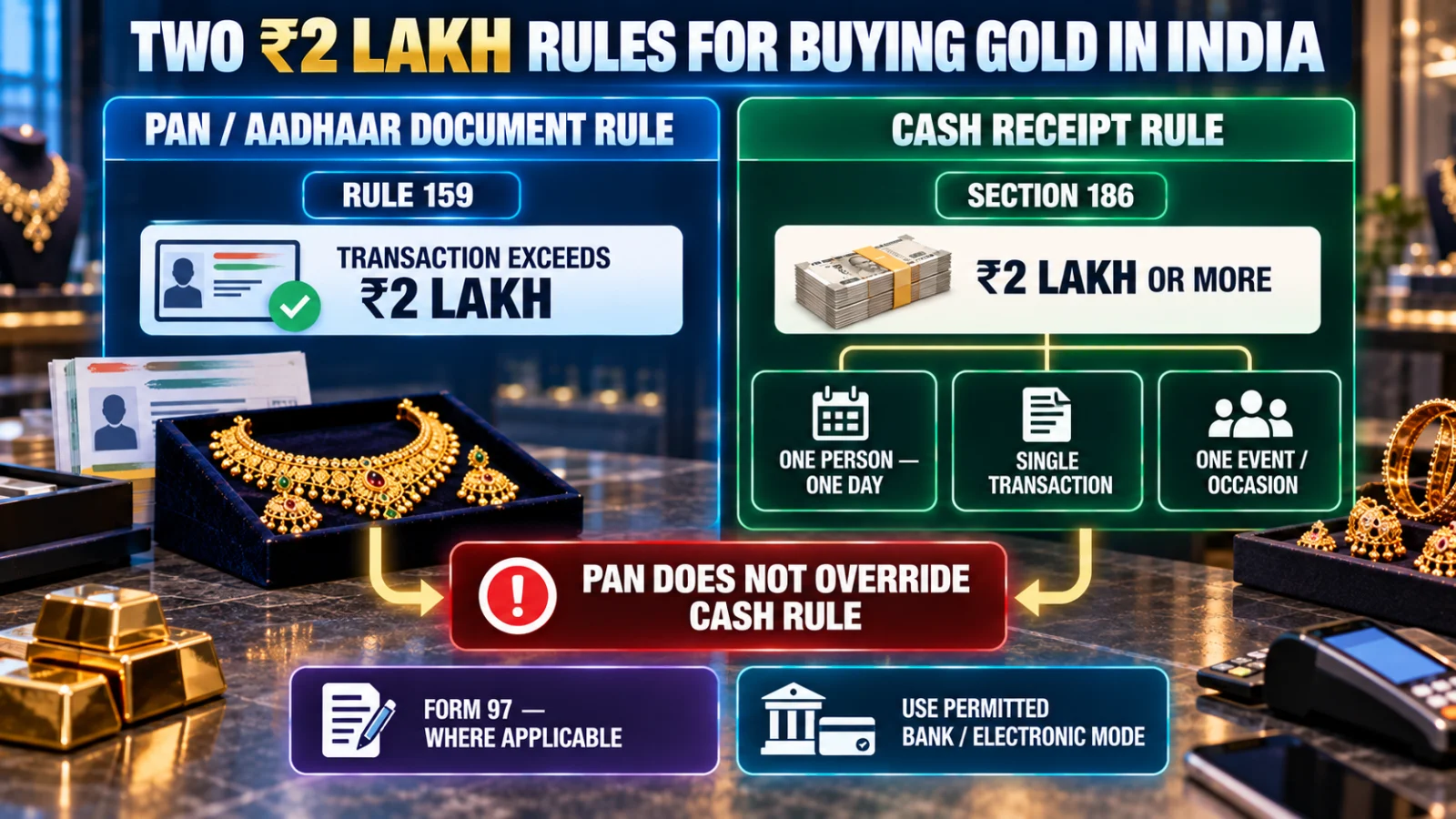
The two ₹2 lakh rules are not the same
PAN / Aadhaar documentation rule: Rule 159 covers sale or purchase of goods or services where the transaction amount exceeds ₹2 lakh.
Cash-receipt rule: Section 186 restricts receipt of ₹2 lakh or more through prohibited cash modes when any of its aggregation tests applies.
Providing PAN or Aadhaar does not cancel the cash-receipt restriction. A transaction can satisfy the documentation rule and still fail the separate cash-payment rule.
Can you buy gold with cash below ₹2 lakh?
Section 186 does not create a blanket ban on every cash purchase of gold. The restriction is triggered when a person receives ₹2 lakh or more in the circumstances covered by the section, subject to its statutory exceptions.
That means a genuinely separate gold purchase below the statutory cash threshold can in principle be paid in cash. But that does not mean the buyer has a legal right to complete every sub-₹2 lakh purchase anonymously. Separate KYC, anti-money-laundering obligations or a jeweller’s own compliance policy can still require identification or a non-cash payment route.
When does PAN or Aadhaar documentation apply?
Rule 159 of the Income-tax Rules, 2026 includes sale or purchase of goods or services where the amount exceeds ₹2,00,000 per transaction.
That rule is not limited to cash purchases. A high-value transaction can enter the PAN or Aadhaar documentation framework even when the payment itself is made through a bank or electronic mode.
The practical sequence is therefore:
- Check the total value of the transaction.
- Determine what PAN, Aadhaar or prescribed declaration requirement applies.
- Separately check whether the proposed payment mode is permitted under Section 186.
What happens at exactly ₹2,00,000?
This is where the wording difference matters most.
| Question | Current threshold wording | Practical meaning |
|---|---|---|
| PAN / Aadhaar transaction documentation | Transaction amount exceeds ₹2 lakh | Rule 159 item 16 uses an above-₹2-lakh transaction threshold. |
| Cash receipt restriction | ₹2 lakh or more | Exactly ₹2 lakh can already fall inside Section 186. |
So a reader should not treat the two thresholds as interchangeable. At exactly ₹2 lakh, the cash-receipt restriction can already matter even though the goods-transaction wording in Rule 159 says the amount must exceed ₹2 lakh.
That distinction also does not guarantee that no identity document can be requested at exactly ₹2 lakh. Other compliance requirements and jeweller policies can still apply.
Does giving PAN make a ₹2 lakh-plus cash payment legal?
No.
PAN or Aadhaar documentation and the cash-receipt restriction perform different jobs.
A buyer may fully satisfy the documentation requirement for a high-value transaction and still be unable to pay the prohibited amount in cash because Section 186 separately controls what the recipient may accept.
The safer way to think about it is:
Identity documentation answers who is making the transaction. Section 186 answers whether the recipient may accept the money through that payment mode.
What does Section 186 check?
Section 186 does not look only at one printed invoice. It contains separate tests intended to prevent the ₹2 lakh restriction from being avoided merely by changing how the payment is divided.
The restriction can apply to receipt of ₹2 lakh or more:
- from one person in one day;
- for a single transaction; or
- for transactions relating to one event or occasion from a person.
These are important because a payment plan that appears below the threshold when each instalment is viewed alone can still be caught by another test.
Can you split a ₹4 lakh gold purchase into smaller cash payments?
Splitting the payment does not automatically solve the problem.
If the payments relate to one ₹4 lakh transaction, Section 186’s single-transaction test remains relevant even if the buyer attempts to make smaller payments on different dates.
Likewise, making several payments to the same recipient on the same day can be caught by the one-person-per-day aggregation test.
TPS should not describe invoice splitting, instalment splitting or payment-date splitting as a lawful workaround to the cash restriction.
What about several jewellery purchases for one wedding or occasion?
Section 186 also covers receipts relating to transactions connected with one event or occasion from a person.
That does not mean TPS can declare every wedding-season purchase to be automatically one transaction. Whether purchases relate to one legally relevant event or occasion can depend on the facts.
The safe rule for readers is not to assume that separate bills automatically remove the aggregation issue. For a high-value purchase plan, use permitted banking or electronic modes rather than relying on bill splitting.
What if you do not have PAN?
The current 2026 framework uses Form 97 for specified eligible transactions where the person does not have a PAN. This replaces the old Form 60 reference that readers may still see in pre-April-2026 articles.
Form 97 is not a universal substitute that every person can use without checking the applicable conditions. A buyer without PAN should verify the current Income Tax Department requirements and the jeweller’s process before attempting the transaction.
Can Aadhaar be quoted instead of PAN?
Section 262 of the Income-tax Act, 2025 provides for Aadhaar to be quoted in lieu of PAN in the prescribed framework.
This does not change the Section 186 cash rule. Aadhaar may address the identity-document side of the transaction where permitted, but it does not turn an otherwise prohibited ₹2 lakh-plus cash receipt into a permitted one.
Why older articles mention Rule 114B and Section 269ST
Those references come from the predecessor Income-tax Act, 1961 and its rules.
The Income-tax Act, 2025 and Income-tax Rules, 2026 came into force on April 1, 2026. For a new transaction made now, TPS should use the current statutory references rather than presenting the old numbering as though it still controls the transaction.
Readers may therefore see the following mapping in older material:
| Older reference commonly seen online | Current 2026 reference used for this article |
|---|---|
| Rule 114B | Rule 159 transaction-documentation framework |
| Section 269ST | Section 186 cash-receipt restriction |
| Form 60 | Form 97 for applicable current non-PAN declarations |
Who faces the penalty for a prohibited cash receipt?
The Section 186 rule is written as a restriction on the person receiving the money.
Section 451 provides for a penalty that may equal the amount received in contravention of Section 186, subject to the statutory process.
For a normal jewellery purchase, that means the jeweller or other recipient accepting the prohibited receipt is the person directly exposed under that provision. A buyer should nevertheless avoid participating in a payment structure presented as a way to bypass the statutory restriction.
What is the practical way to pay for gold above ₹2 lakh?
For a purchase above the threshold, the cleanest approach is to separate the two compliance questions:
Check the transaction value
Determine whether the purchase exceeds the Rule 159 goods-and-services threshold.
Prepare PAN or Aadhaar documentation
Use the current prescribed identity-document route that applies to the transaction.
Use Form 97 only when applicable
If PAN is unavailable, verify that the current Form 97 conditions actually apply to you.
Avoid prohibited cash receipt
Use a permitted banking or electronic payment mode instead of assuming PAN makes a large cash payment lawful.
Do not rely on split payments
Section 186 separately tests one-person-per-day, single-transaction and same-event or occasion receipts.
Keep the invoice and payment trail
Retain the purchase invoice and banking or electronic payment evidence for the completed transaction.
TPS separately explains what the jewellery invoice itself should contain in Gold Jewellery Bill in India: What Your Invoice Should Contain.
Bottom line
You can buy gold with cash in India, but the legal question is not answered by one ₹2 lakh number.
Under the current 2026 framework, Rule 159 deals with PAN, Aadhaar or prescribed documentation when the goods or services transaction exceeds ₹2 lakh. Section 186 separately restricts receipt of ₹2 lakh or more through prohibited cash modes under its one-person-per-day, single-transaction and one-event-or-occasion tests.
Providing PAN does not override the cash restriction, and splitting one purchase into smaller payments does not automatically avoid it. For a high-value gold purchase, verify the documentation requirement and use a permitted banking or electronic payment mode rather than relying on an old Rule 114B, Section 269ST or Form 60 explainer.
Verification method
TPS reviewed the Income-tax Act, 2025 as currently applicable, the notified Income-tax Rules, 2026, the April 2026 transition guidance and current Income Tax Department form guidance. The research separately verified the transaction-documentation threshold, the cash-receipt threshold, Aadhaar framework, current non-PAN declaration and receipt-side penalty.
Limitations and unresolved facts
Individual Form 97 eligibility, jeweller-specific KYC policies, anti-money-laundering checks and whether several purchases legally relate to one event or occasion can depend on the transaction facts. This article explains the reviewed general statutory framework and does not determine the treatment of a specific buyer’s payment arrangement.