






A gold jewellery bill in India should do more than show a final amount. For a sale of hallmarked precious-metal jewellery, the Bureau of Indian Standards says the bill or invoice should identify each article, the net weight of the precious metal, purity in carat and fineness, and hallmarking charges.
That BIS list is one layer of the invoice. If a GST-registered seller is issuing a tax invoice, GST rules add a separate set of tax-invoice particulars such as the supplier’s GSTIN, invoice number and date, description and quantity, taxable value, tax rate and tax amount.
There is also an important myth to correct: BIS currently says mentioning the HUID number on the invoice is voluntary. HUID is part of the physical hallmark on the jewellery and can be verified separately. A guide that says every valid gold bill must print the HUID is therefore overstating the current BIS invoice requirement.
Two different checks apply to a gold jewellery invoice
BIS hallmarking layer: proves what hallmarked precious-metal article was sold and records its net precious-metal weight, purity and hallmarking charge.
GST tax-invoice layer: records the supplier, invoice identity, taxable supply and tax particulars when a GST tax invoice is applicable.
A complete purchase document can contain both layers, but they come from different regulatory requirements and should not be mixed together.
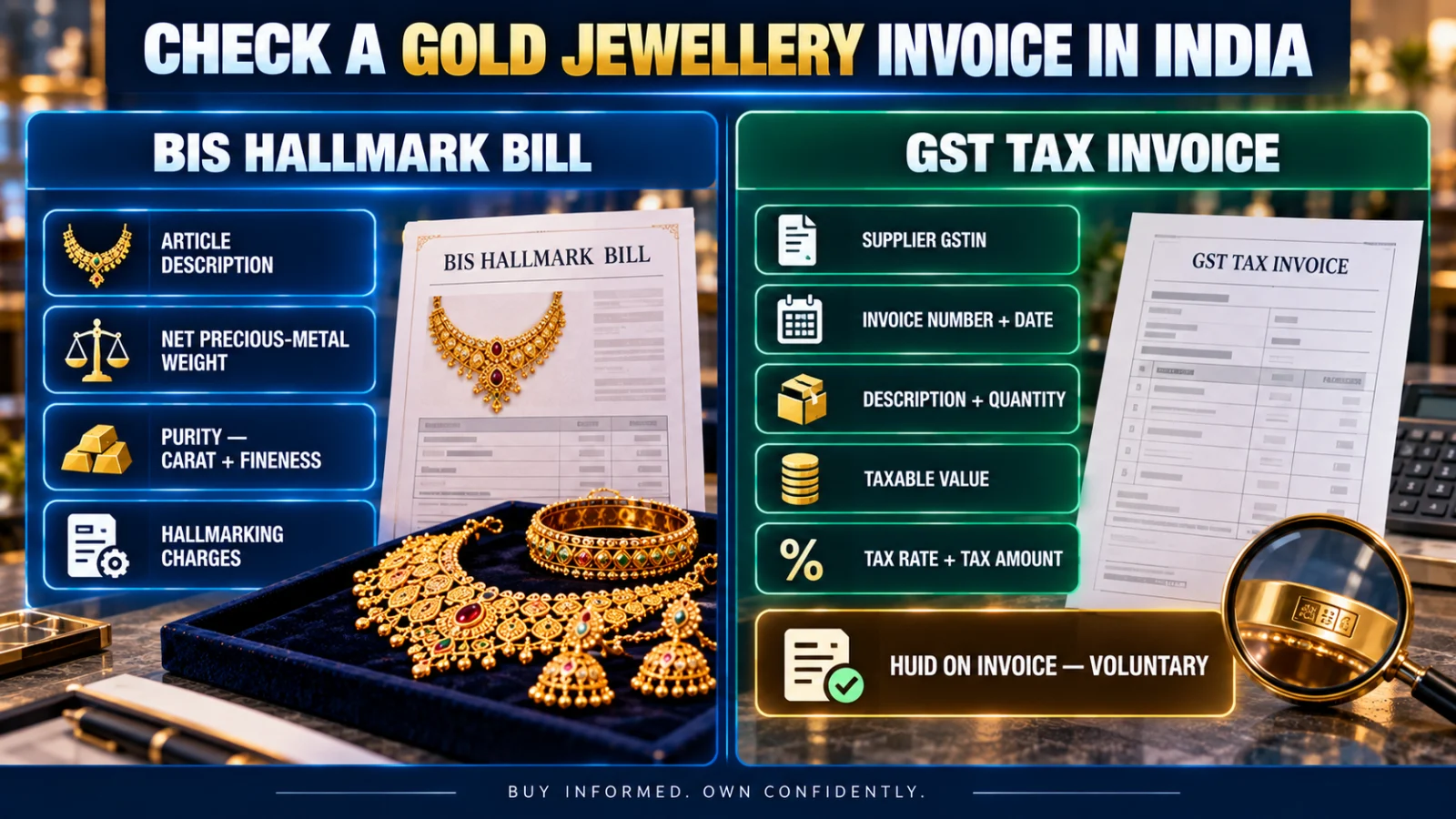
What BIS says a hallmarked jewellery bill should contain
BIS’s current consumer and jeweller guidance identifies four core article-level details for the bill or invoice of sale of hallmarked precious-metal articles.
| Invoice detail | Why it matters | What to check |
|---|---|---|
| Description of each article | Connects the invoice to the jewellery actually purchased. | Each relevant item should be identifiable rather than hidden inside one unexplained total. |
| Net weight of precious metal | Shows the precious-metal weight used for the hallmarked article rather than relying only on the ornament’s overall weight. | Look specifically for net precious-metal weight, especially where stones or other non-precious components are present. |
| Purity in carat and fineness | Records the purity represented at sale in both forms used by the hallmarking system. | The invoice purity should be consistent with the purity marked on the physical article. |
| Hallmarking charges | Separates the hallmarking charge from other commercial charges. | Do not assume hallmarking charges include making or wastage charges; BIS treats those as different things. |
BIS guidance also says consumers can get the purity of hallmarked jewellery or artefacts verified through a BIS-recognised Assaying and Hallmarking Centre. The consumer-facing invoice guidance points buyers toward that independent verification route.
Why net precious-metal weight matters
The phrase net weight of precious metal is more precise than simply printing the total weight of the finished ornament.
A piece of jewellery can contain diamonds, gemstones, beads, enamel or other non-precious components. The total physical weight of the ornament is therefore not automatically the precious-metal weight represented by the invoice.
BIS specifically requires the net precious-metal weight for hallmarked articles. If the bill displays only a gross ornament weight and does not make the relevant net precious-metal weight clear, ask the jeweller to explain and correct the document before completing the purchase.
Do not confuse net precious-metal weight with the amount of pure gold inside the alloy. A 22K article is not 100% fine gold. The separate carat and fineness disclosure tells you the purity of that precious-metal weight.
Why both carat and fineness should appear
BIS says the invoice should state purity in carat and fineness. These are two ways of expressing the same underlying purity specification.
For the buyer, the practical check is consistency. The purity represented on the invoice should agree with the purity marking on the physical hallmarked article.
TPS separately explains how to inspect and verify the physical hallmark in How to Check Gold Purity and HUID in India Before You Buy.
Does the HUID number have to be printed on the invoice?
No, not under the current BIS invoice rule.
BIS’s jeweller FAQ explicitly says that mentioning HUID numbers on invoices is voluntary at present.
This is different from the physical hallmark itself. BIS says the current hallmark on gold jewellery consists of the BIS logo, the purity of the article in caratage and fineness, and a six-digit alphanumeric HUID.
The HUID can be checked using the BIS Care app’s Verify HUID function. A jeweller may also choose to print the HUID on the bill, which can be useful for matching documentation to a particular article, but the absence of a printed HUID alone should not be described as a violation of the current BIS invoice requirement.
Hallmarking charges are not making charges
The invoice requirement to show hallmarking charges does not make hallmarking, making charges and wastage the same thing.
BIS specifically states that hallmarking charges do not include making charges or wastage charges. Hallmarking is part of the purity-certification process, while making and other commercial charges relate to manufacturing, design or the jeweller’s pricing structure.
If the commercial pricing part of the bill is confusing, TPS covers that separately in Gold Making Charges and Wastage Charges: What You Are Actually Paying For.
What GST adds to the invoice
The BIS hallmarking list is not the complete GST tax-invoice checklist.
Under the GST invoice rules, a registered person issuing a tax invoice for taxable goods must include prescribed particulars. For a consumer checking a jewellery invoice, important fields include the supplier’s name, address and GSTIN; a unique invoice serial number; date of issue; HSN and description of the goods; quantity; total and taxable value; the applicable tax rate; and the tax amount charged. Recipient, delivery and place-of-supply details apply where required by the GST rules and transaction circumstances.
This means a document can have the correct BIS purity information but still deserve a separate tax-invoice check. Conversely, a GST invoice containing tax fields does not replace the BIS hallmarked-article disclosures.
TPS keeps the tax calculation itself separate in GST on Gold in India: Jewellery, Coins, Bars and Making Charges Explained.
Do gold rate and making charges have to appear because BIS says so?
Do not attribute every useful jewellery-bill field to BIS.
The specific BIS hallmark-invoice list verified for this article is: article description, net precious-metal weight, purity in carat and fineness, and hallmarking charges. GST rules separately govern the tax-invoice particulars where applicable.
Retailers commonly provide additional commercial fields such as the gold rate used, metal value, making charges, discounts, stone value, payment details, exchange adjustments or return-policy references. These can make the bill much easier to audit, but TPS should not label every retailer-specific or commercially useful field as a BIS-mandated hallmarking disclosure unless the controlling rule says so.
Why you should take and preserve the authentic invoice
BIS expressly tells consumers to take an authentic bill or invoice for hallmarked articles and says it is necessary for dispute, misuse or complaint redressal.
That makes the invoice more than a payment receipt. It records what the jeweller represented about the article at the time of sale: what the item was, how much precious metal it contained and what purity was represented.
Keep the original document safely and retain a clear digital copy. If a later purity complaint arises, the invoice can help establish what was sold and what was represented at purchase.
What to check on the physical jewellery as well
The invoice should not be checked in isolation.
BIS says the physical hallmark on current gold jewellery includes three components: the BIS logo, purity in caratage/fineness and the six-digit HUID. BIS also says registered jewellers should display their BIS registration certificate and make a minimum 10X magnifying glass available so customers can inspect hallmark details.
So a buyer should reconcile the document with the actual article: the description and purity on the bill should make sense for the jewellery in hand, and the physical HUID should verify through the BIS system.
Article description
Confirm that each hallmarked article is identifiable on the invoice.
Net precious-metal weight
Do not rely on gross ornament weight alone where non-precious components are present.
Carat and fineness
Check that the invoice purity is consistent with the hallmark on the jewellery.
Hallmarking charges
Make sure the hallmarking charge is identifiable rather than confused with making or wastage charges.
Physical HUID
Verify the HUID on the jewellery through BIS Care. Printing that HUID on the invoice is currently voluntary.
GST tax-invoice fields
Where a GST tax invoice applies, check supplier GSTIN, invoice identity, values and tax particulars separately from BIS hallmarking fields.
If the invoice is incomplete or the purity does not match
If a required hallmarked-article detail is missing, ask for the invoice to be corrected before leaving the store. Do not rely only on a verbal explanation for the weight or purity of a high-value purchase.
If there is a later doubt about purity, BIS provides a route for consumers to get hallmarked jewellery or artefacts tested through recognised Assaying and Hallmarking Centres. BIS also maintains a complaint-redressal process for hallmarked articles.
The appropriate response depends on the problem: an invoice-format issue, a GST issue, a HUID verification failure and an actual purity shortfall are different states and should not be treated as the same complaint.
Bottom line
For hallmarked gold jewellery, the core BIS invoice check is straightforward: description of each article → net precious-metal weight → purity in carat and fineness → hallmarking charges.
Then perform a second check for the applicable GST tax-invoice particulars and a third check on the physical article itself.
Most importantly, do not reject an otherwise valid invoice merely because it does not print the HUID. Under current BIS guidance, HUID on the invoice is voluntary. What must be verified is that the physical hallmarked article carries the required hallmark components and that the invoice contains the mandatory hallmarked-article details.
Verification method
TPS reviewed the current BIS consumer hallmarking FAQ, BIS jeweller guidance, BIS general hallmarking guidance and CBIC tax-invoice rules. The BIS invoice requirement was separated from GST tax-invoice requirements and from retailer-specific optional fields.
Limitations and unresolved facts
Retail invoice layouts vary, and GST particulars can depend on the seller, recipient and supply context. BIS pages reviewed for this article do not expose one reliable current publication date for every FAQ item. Retailers can also print extra fields beyond the minimum BIS hallmarking disclosures. Readers should verify current BIS and GST guidance if a specific transaction or dispute depends on a particular invoice field.