




Gold jewellery with diamonds resale value is easy to miscalculate if you start with the ornament’s total weight. A stone-studded ring, necklace or bangle can contain gold plus diamonds, gemstones, pearls or other non-metal components. For hallmarked precious-metal jewellery, BIS requires the invoice to state the net weight of precious metal. That is the key figure for understanding the metal component; the gross weight of the whole ornament should not automatically be treated as gold weight.
The second distinction is just as important: the amount paid for diamonds or other stones does not follow one universal resale formula. Current jeweller policies value stones differently depending on the retailer, product category, documentation, condition and whether the transaction is an exchange or a cash buyback.
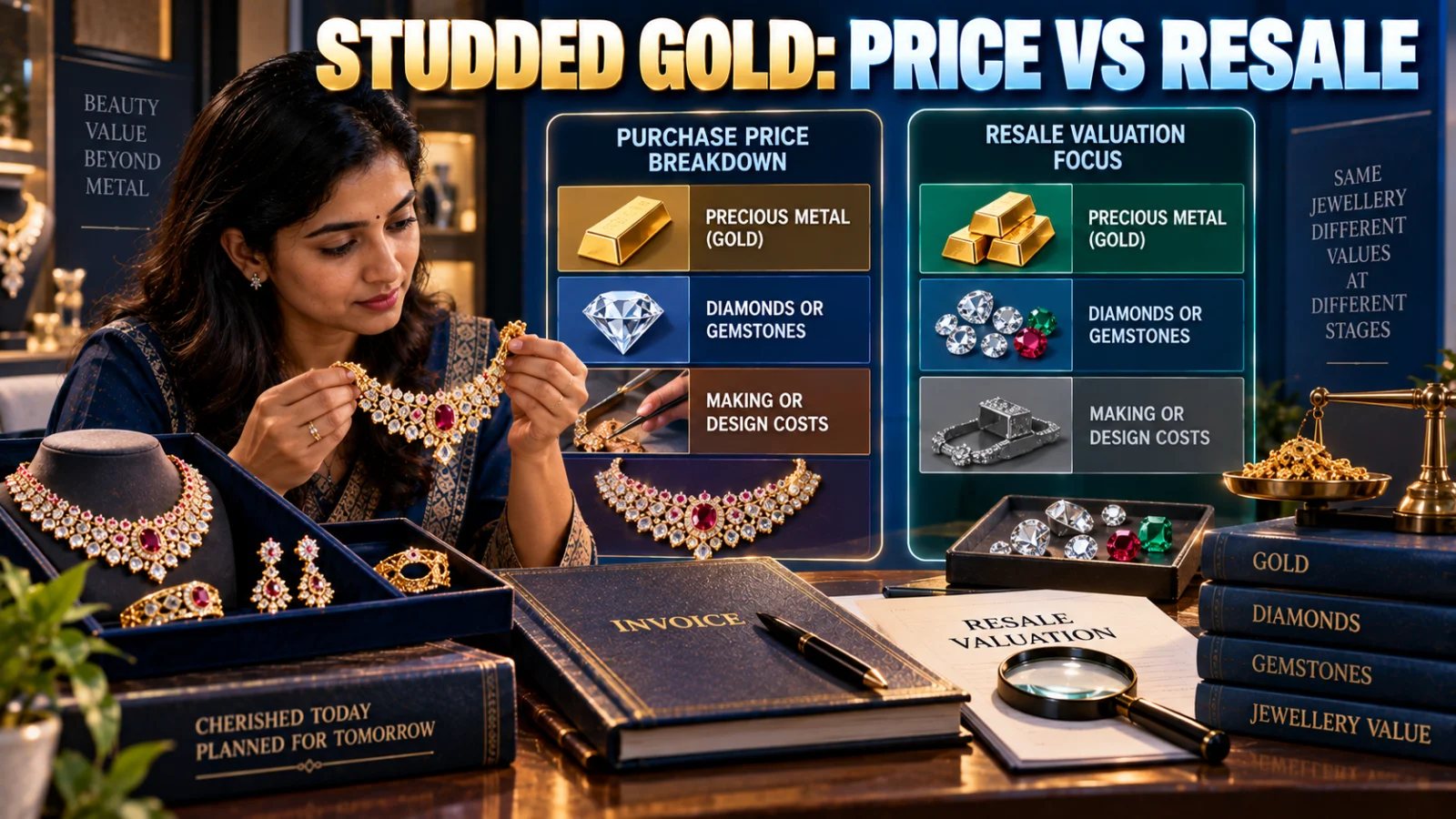
| Component | At purchase | At resale or exchange |
|---|---|---|
| Precious metal | Priced using the jewellery’s net precious-metal weight, purity and the seller’s applicable metal rate | Usually revalued using accepted weight, purity and the buyer’s current metal-rate policy |
| Diamonds | Priced separately from the gold component under the retailer’s product pricing | May receive a separate value, but the basis and percentage are retailer- and product-specific |
| Other stones | Can form a separate part of the retail value | Treatment varies; some qualifying stones may receive value while others may be excluded |
| Making or design charges | Part of the purchase cost | Do not assume they will be recovered; many policies exclude them |
| Tax | Part of the final transaction amount | It is not a separate asset value that is automatically recovered later |
Gross jewellery weight is not the same as net precious-metal weight
Gross weight is the weight of the complete ornament. In a studded piece, that total can include gold plus diamonds, gemstones and other materials used in the design.
BIS requires the invoice for a hallmarked precious-metal article to include the description of the article, the net weight of precious metal, purity in carat and fineness, and hallmarking charges. BIS also addresses Polki and Kundan jewellery specifically and requires the net precious-metal weight to be shown separately.
This means a 20 gram ornament containing stones should not automatically be valued as 20 grams of gold. The invoice’s net precious-metal figure is the correct starting point for the metal portion.
Net precious-metal weight is not the same as pure-gold equivalent weight
Net precious-metal weight tells you how much of the article’s recorded weight is precious metal rather than stones or other components. Purity is a separate field.
For example, an article can have a stated net precious-metal weight and also carry a purity such as 22K or 18K. Those two pieces of information work together when understanding the gold component. TPS should not convert the BIS term into an invented label such as “net pure gold weight.”
What are you actually paying for when you buy studded jewellery?
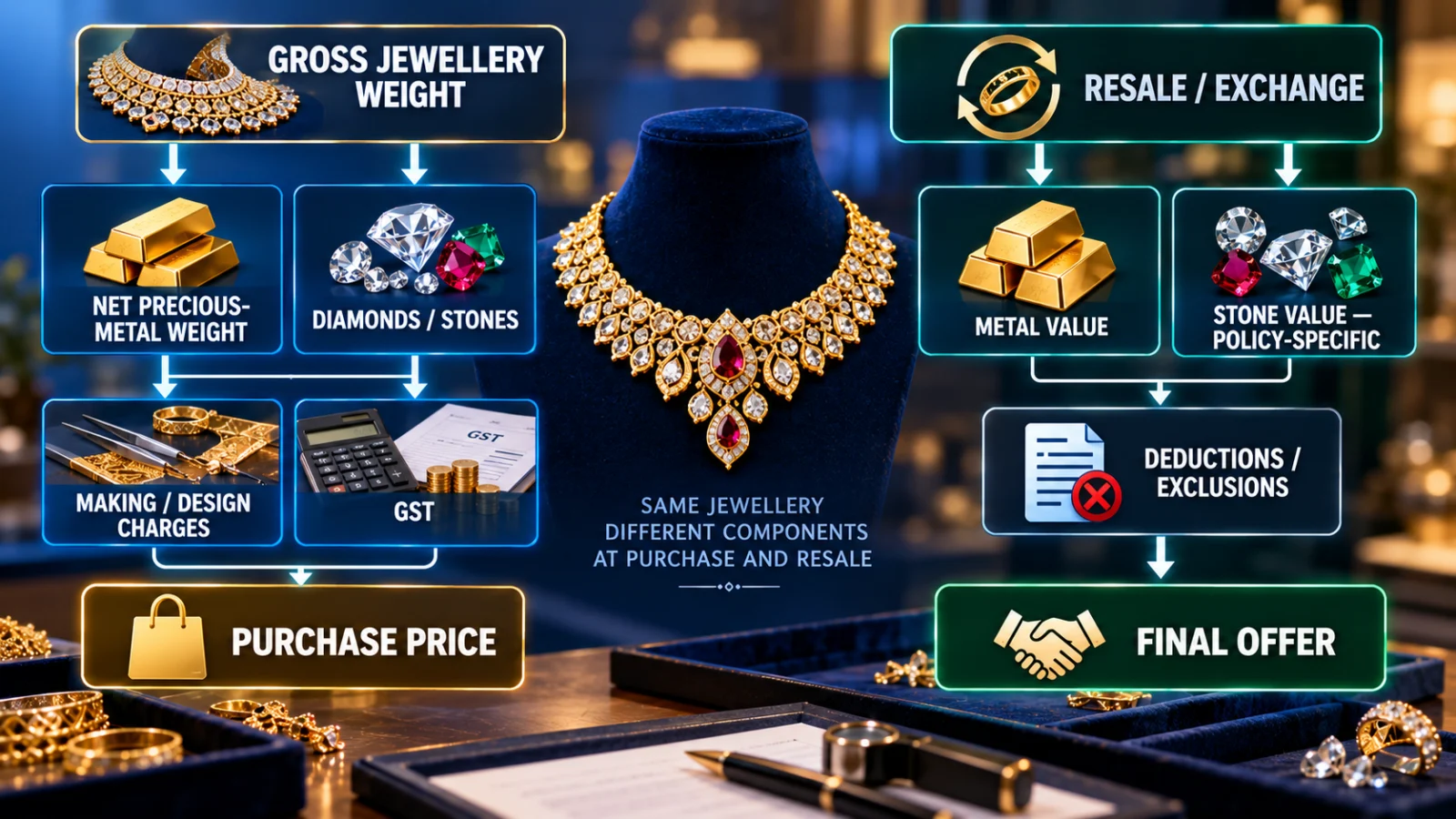
A useful purchase-side model separates four economic layers rather than treating the final bill as one block.
- Precious-metal component: based on the accepted net precious-metal weight, purity and applicable retailer rate.
- Diamond or gemstone component: priced separately according to the stones and the retailer’s product pricing.
- Making, design or value-add component: the cost associated with manufacturing, setting, finishing and design.
- Tax: CBIC states that GST on jewellery is charged at 3% of the total transaction value, whether making charges are shown separately or not.
The exact commercial calculation can vary by retailer. This is therefore a mental model for understanding the bill, not a statutory universal pricing formula.
Does BIS hallmarking tell you what the diamond or stone is worth?
No. BIS hallmarking establishes the fineness or purity of the precious-metal component. It should not be presented as a certification of a diamond’s grade, gemstone quality or future resale value.
Stone details can instead depend on the jeweller’s documentation and, where supplied, a separate stone or diamond certificate. The existence of a certificate can help identify the stone and may matter under a retailer’s exchange policy, but it does not guarantee one resale percentage.
Why diamond resale value cannot be reduced to one percentage
Current retailer policies demonstrate materially different approaches. Some policies value qualifying diamonds using a prevailing stone rate. Others use a percentage of an invoice-linked or current assessed value. Some distinguish between exchange and cash buyback, while documentation and product eligibility can also change the treatment.
That is why statements such as “diamonds always recover 80%” or “diamonds always recover 100%” are unsafe as market-wide guidance. A percentage from one jeweller’s policy describes that jeweller’s current terms, not a universal Indian resale rule.
What happens to rubies, emeralds, sapphires and other stones?
The same caution applies to non-diamond stones. Current retailer policies can distinguish precious stones, uncut diamonds, synthetic stones, semi-precious stones and other materials. Some categories may receive a recognised exchange or buyback value while others may receive none under that specific policy.
Therefore, “stones have no resale value” is also too broad. The correct answer is that stone treatment depends on the stone category and the buyer’s current written terms.
Why the original bill can be much higher than the later gold value
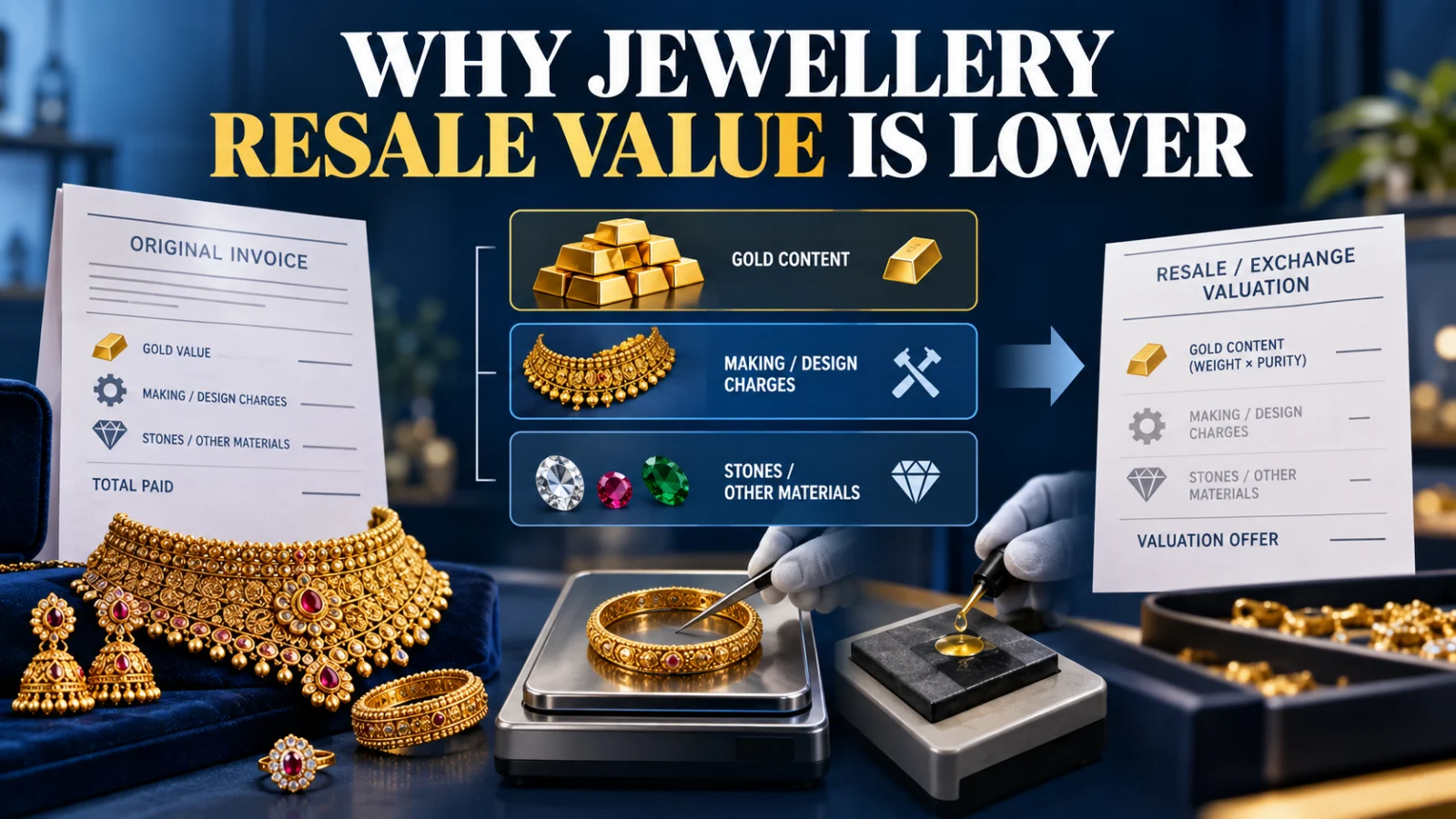
The purchase invoice can include metal value, stone value, making or design charges and tax. At resale, the buyer may revalue only the recoverable components under its current policy.
If you compare the future offer only with the original total invoice, the gap can appear surprisingly large. Part of that difference may come from making or design costs and tax that are not treated as recoverable assets. Another part may come from a different valuation of the stones.
Making charges should not be assumed to come back
Making charges compensate for manufacturing, craftsmanship and design. Current jeweller policies commonly exclude them from exchange or buyback value, although promotions and product-specific policies can differ.
For that reason, a high making charge can increase what you pay without automatically increasing what another buyer will recognise later.
Exchange value and cash buyback are not the same thing
This is an important source of confusion. A jeweller may offer one treatment when the customer exchanges old jewellery for a new purchase and another treatment when the customer asks for cash.
Current retailer policies explicitly show different exchange and buyback percentages or eligibility rules for some categories. When comparing offers, ask whether the quoted amount is an exchange value or a cash buyback value.
Does the original invoice determine today’s stone value?
Not universally. Current policies use different bases. Depending on the retailer, a stone may be assessed using a prevailing stone rate, an invoice-linked amount, a current evaluated value or another disclosed policy method.
The original invoice is still important because it records what was sold and what was charged, and BIS identifies an authentic invoice as important for consumer complaint or dispute redressal. Some studded-jewellery exchange policies may also require the original bill or stone certificate.
How to estimate a resale or exchange offer without inventing a universal formula
A safe resale-side mental model is:
current accepted value of the precious-metal component + current accepted value, if any, for qualifying diamonds or stones − policy-specific deductions or excluded components = the buyer’s offer.
This is not a statutory calculation formula. It is a way to make sure each economic component is accounted for separately before accepting an offer.
Why two jewellers can quote different values for the same piece
Two buyers may use different gold rates, testing methods, stone eligibility rules, documentation requirements, exchange incentives, cash-buyback policies and deductions. One may recognise a qualifying diamond category that another buyer discounts or excludes.
That difference does not automatically prove one quote is wrong. The useful comparison is whether each buyer clearly explains the metal weight, purity, stone treatment and deductions used to reach the final offer.
What to check before buying stone-studded gold jewellery
Confirm the BIS-required net precious-metal weight rather than relying on gross ornament weight.
Check the carat and fineness of the hallmarked precious-metal component.
Ask what diamonds or gemstones are included and what documentation is supplied.
Check whether the invoice separately identifies the stone component or provides enough detail to understand it.
Understand what part of the bill represents craftsmanship rather than metal or stone value.
Ask for the current written policy for this exact product category, including whether cash buyback differs from exchange.
What to check before selling or exchanging it
Ask what net metal weight and purity the buyer has accepted for valuation.
Ask which current rate and deductions are being applied to the precious-metal component.
Ask what value, if any, is assigned to qualifying diamonds and how that value was determined.
Ask which gemstone categories receive value and which are excluded.
Confirm whether the quote is for exchange or cash buyback.
Check whether the invoice or stone certificate changes eligibility or valuation.
Bottom line
Gold jewellery with diamonds resale value cannot be calculated safely from gross weight or from one universal stone-recovery percentage. Start with the BIS-required net precious-metal weight to understand the metal component. Treat diamonds and other stones as a separate economic component, then check the actual exchange or buyback policy that applies to the piece.
The safest purchase-to-resale comparison is therefore: separate the metal, stones, making or design charges and tax when buying, then ask the future buyer to show how the metal, stones and deductions were treated when quoting a resale or exchange value.
Verification note
TPS reviewed BIS consumer and jeweller hallmarking guidance for the net precious-metal invoice requirement, CBIC jewellery GST guidance, and current retailer exchange or buyback policies to verify that diamond and gemstone treatment differs materially between buyers.
Limitations and unresolved facts
The future resale value of an individual piece cannot be known from its original bill alone. Stone grade, type, condition, certification, buyer demand, retailer eligibility rules and future policies can change the amount offered. Current brand-specific exchange or buyback percentages must not be treated as permanent industry-wide recovery rates.