







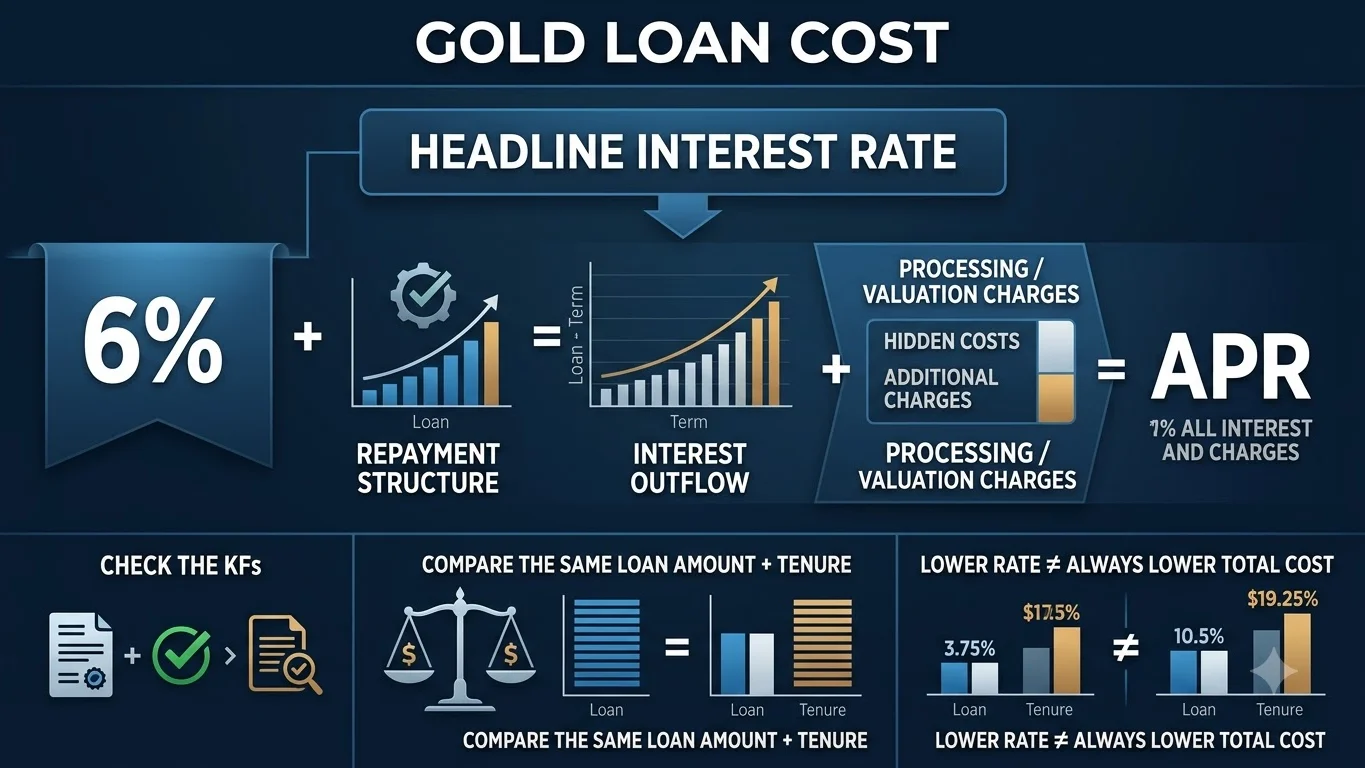
Gold loan interest calculation should not stop at the advertised annual interest rate. The real borrowing cost depends on the amount borrowed, the way interest is calculated, the repayment structure and the fees or charges attached to the loan. For covered retail and MSME term loans, the RBI Key Facts Statement framework also requires an annual percentage rate, or APR, that gives borrowers a broader annualised view of credit cost.
The practical rule is simple: compare the headline interest rate, expected rupee interest, APR and applicable charges separately. A lower advertised rate does not automatically mean the cheaper loan if another product has lower fees, a different repayment structure or a lower all-in annualised cost.
The stated rate used under the lender’s applicable interest-calculation method. It does not by itself show every cost of the loan.
The actual rupee interest depends on principal outstanding, tenure and how the loan is repaid.
For covered term loans, RBI defines APR as the annual cost of credit including the interest rate and applicable charges associated with the credit facility.
Some charges depend on later borrower actions or events and should be checked separately in the KFS, sanction terms and schedule of charges.
Gold loan interest calculation: start with the loan structure
Before using any formula, identify how the lender expects you to repay the loan. Gold-loan products can use bullet repayment, periodic interest servicing, EMI-style repayment or other lender-specific structures. The repayment method changes how long the principal remains outstanding and therefore changes the interest outflow.
For a simple bullet-loan illustration, a common estimate is:
Interest = Principal × Annual Interest Rate × Time
If ₹2,00,000 remains outstanding for one full year at 10% a year, a simple estimate would produce ₹20,000 of interest before considering fees or product-specific calculation rules. This is only an illustration. The exact lender method, day-count basis, compounding or rest convention must come from the current loan documents.
Why EMI and bullet repayment can produce different interest outflows
With a bullet structure, principal can remain outstanding for most or all of the tenure, so interest may continue to accrue against the full principal balance until repayment. With an EMI or reducing-balance structure, part of the principal is repaid over time, so later interest is generally calculated on a smaller outstanding balance.
This does not mean one structure is automatically better for every borrower. The separate decision is whether the repayment pattern fits the borrower’s cash flow. For this page, the important point is that repayment structure changes the rupee cost even when two loans advertise the same nominal annual rate.
What is APR on a gold loan?
APR stands for annual percentage rate. RBI defines APR as the annual cost of credit to the borrower, including the interest rate and other charges associated with the credit facility.
For covered retail and MSME term loans, the Key Facts Statement must disclose the APR and include an APR computation sheet and repayment or amortisation schedule. This gives the borrower a better comparison surface than the advertised interest rate alone.
| Number | What it tells you | What it may miss |
|---|---|---|
| Interest rate | The nominal rate applied under the product terms | Fees and other credit costs |
| Interest amount | Estimated rupee interest for your balance and tenure | Processing, valuation and other charges |
| APR | Annualised credit cost including applicable charges under the RBI framework | Some contingent future costs may still require separate inspection |
| Total amount paid | Your eventual cash outflow if the loan follows the assumed repayment path | Future default, delay, renewal or other conditional costs unless they occur |
Does the RBI KFS rule apply to every gold loan?
The RBI’s harmonised KFS framework applies to all retail and MSME term loan products offered by regulated entities under the applicable framework. A gold loan structured as a covered retail term loan therefore falls within that disclosure regime.
Do not automatically assume that every gold-loan overdraft, cash-credit or other non-term structure follows the identical harmonised KFS treatment. The exact product classification and disclosure documents should be checked with the lender.
Which gold loan charges should you inspect?
Current lender schedules show that gold-loan charges can vary materially. Depending on the product and lender, borrowers may encounter processing fees, valuation or appraisal charges, renewal charges, stamp or statutory costs, foreclosure or prepayment conditions, third-party charges and penal charges for specific default states.
Check whether it is a flat amount, a percentage of the loan or subject to minimum and maximum limits.
Check whether gold assessment costs are charged separately and whether the charge varies by loan amount or branch process.
For covered KFS loans, qualifying third-party charges collected through the regulated entity must be separately disclosed and form part of the applicable APR framework.
If the product allows renewal or extension, check whether a fresh fee or valuation charge applies.
Check whether closing the loan early creates any charge under the specific product terms.
Do not treat these as the normal expected borrowing cost, but understand when they can arise and how the lender discloses them.
Does APR include processing and other fees?
Under the RBI KFS framework, charges levied by the regulated entity are reflected in APR. Charges recovered from the borrower by the regulated entity on behalf of third-party service providers must also form part of APR and be separately disclosed where the rule applies.
However, borrowers should not assume that every possible future charge is automatically represented in the headline APR in the same way. A charge that depends on a later event, such as an overdue state, renewal, early closure or another conditional action, should be checked separately in the KFS and loan documents.
Can a lender add a charge that was not disclosed in the KFS?
For loans covered by the RBI KFS framework, fees and charges that are not mentioned in the KFS cannot simply be imposed later during the loan term without the borrower’s explicit consent.
This makes the KFS more than a summary page. Preserve it with the sanction letter, repayment schedule and schedule of charges so you can compare what was disclosed with what is later debited.
What should you compare between two gold-loan offers?
Use the same loan amount and broadly comparable tenure, then compare the offers on the same dimensions rather than looking only at the lowest advertised percentage.
Check whether the quoted rate is fixed, floating or linked to a product slab and whether it is annual or expressed in another form.
Determine whether principal stays outstanding until maturity or reduces progressively.
For a covered term loan, use the KFS APR as an annualised comparison aid alongside the nominal rate.
Check whether fees are deducted upfront so the cash actually received is lower than the sanctioned amount.
Review the expected interest and principal cash flow rather than assuming the advertised rate tells the whole story.
Read renewal, foreclosure, overdue and other product-specific terms separately.
Why the lowest interest rate may not be the cheapest loan
Suppose one lender advertises a slightly lower annual rate but charges a larger processing fee and valuation fee, while another lender quotes a slightly higher rate with lower upfront charges. The cheaper option depends on the actual loan amount, tenure, repayment path and fee structure.
This is why APR can be useful for covered term loans: it expresses applicable credit cost on an annualised basis. But even APR should be read together with the repayment schedule and any conditional charges that could matter to the borrower’s actual behaviour.
Do not compare monthly and annual rates without converting them
A monthly percentage can look deceptively small. If a lender or advertisement presents a monthly rate, identify the corresponding annualised rate and then check the official KFS or loan documentation rather than multiplying or comparing percentages casually.
The contractual calculation method controls the borrower’s real obligation. TPS does not convert an advertised monthly rate into an assumed APR without the lender’s applicable terms.
What to check before signing a gold loan
For a covered term loan, ask for the KFS and read it before executing the loan contract. Check the sanctioned amount, rate, tenure, repayment method, APR, repayment schedule, charges and the net amount that will actually reach you after any upfront deductions.
If a fee shown verbally or in marketing material does not match the KFS or sanction documents, ask the lender to explain the difference before proceeding.
Verification method
ThePulseSignal reviewed RBI’s harmonised Key Facts Statement framework defining APR and charge disclosure for retail and MSME term loans, then checked current gold-loan rate and charge disclosures from multiple regulated lenders and current borrower-facing interest-cost material to distinguish nominal rate, repayment structure, APR and lender-specific charges.
Limitations and unresolved facts
There is no single universal gold-loan interest formula or fee schedule across lenders and product structures. Exact borrower cost depends on the current lender KFS, sanction terms, repayment method and charge schedule. The harmonised RBI KFS rule discussed here is specifically framed for retail and MSME term loans and should not be automatically extended to every overdraft or other non-term gold-loan structure without product-specific verification.