




Maersk Gulf booking restrictions currently vary sharply by cargo type, origin, destination and shipment state. Maersk’s Middle East Operational Update 48, dated September 17, shows that selected Gulf routes remain open through contingency arrangements while other ocean and landside bookings are suspended.
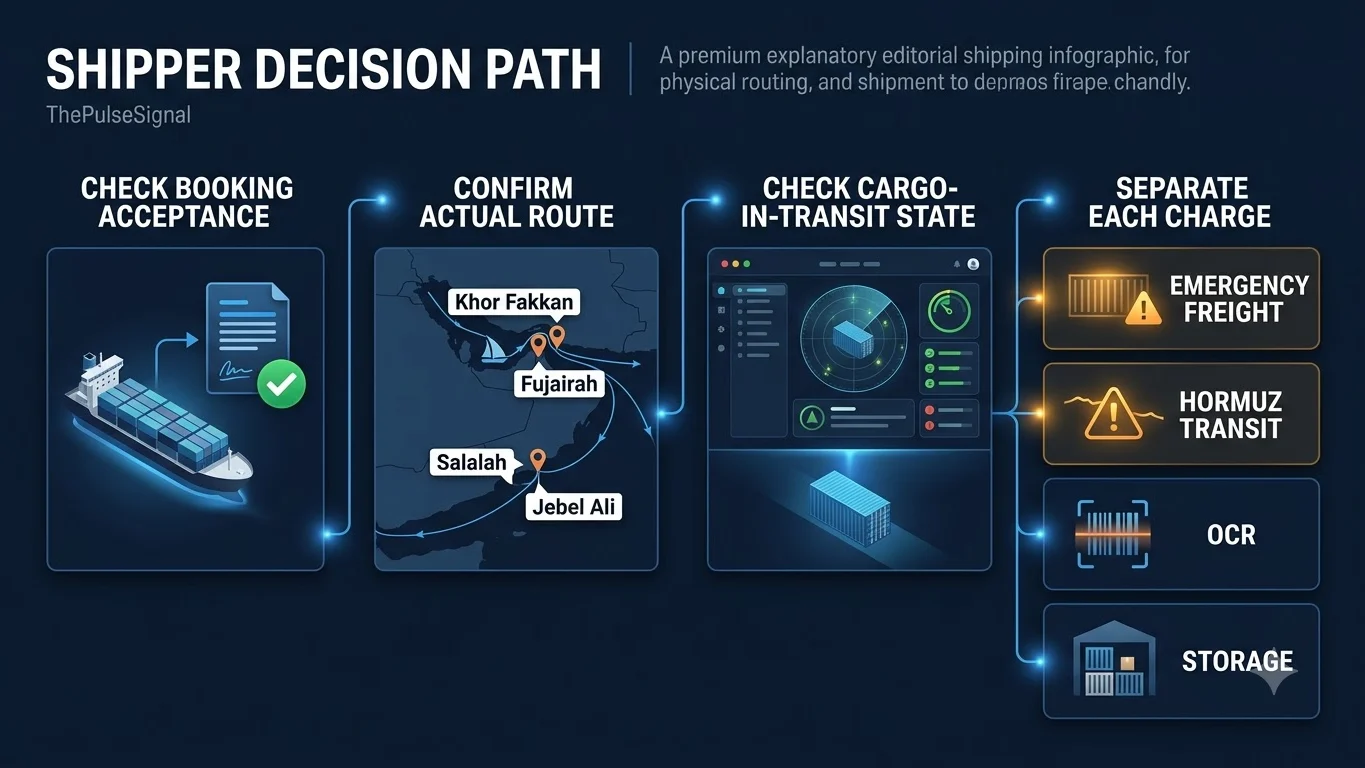
The practical answer for shippers is not simply whether the Gulf is open or closed. You need to check the cargo category, origin and destination, the route Maersk is currently using, whether the container is already in transit, and which disruption-related charges apply to that specific movement.
Direct answer: Use Maersk’s current booking matrix and shipment-specific quotation before committing or rerouting cargo. Update 48 materially expands In-Gauge acceptance across several Gulf markets, keeps a limited Saudi-Jeddah dangerous-goods exception, and continues Emergency Freight plus an additional USD 1,000 per container when a vessel transits the Strait of Hormuz.
Maersk Gulf booking restrictions in Update 48
Maersk continues to treat reefer, dangerous goods, out-of-gauge, In-Gauge and dry cargo differently. A route that is open for one container category may still be suspended for another.
On the landside network, Maersk says bookings remain temporarily paused for cargo moving from the UAE and Qatar via Jeddah or Oman ports, from Jeddah to the UAE, Oman and Qatar, and from Salalah or Sohar to the UAE, Saudi Arabia, Kuwait, Bahrain and Qatar.
Available carrier-haulage landbridge solutions include exports from Kuwait, Qatar, Bahrain and the UAE through Salalah and Khor Fakkan, and from Iraq through Aqaba. Maersk says these landside solutions currently accept dry and frozen cargo subject to capacity and applicable rules.
In-Gauge acceptance has widened
Update 48 shows a materially broader In-Gauge booking state than the more restrictive matrix immediately before it. Maersk now lists suspension of In-Gauge bookings to and from Iraq, while accepting In-Gauge bookings to and from Bahrain, Jordan through Aqaba, Kuwait, Oman through Salalah and Sohar, Qatar, Saudi Arabia through Jeddah, King Abdullah Port, Dammam and Al Jubail, and the UAE through Khor Fakkan.
This does not mean every Gulf cargo flow is restored. The acceptance applies to the In-Gauge category and remains subject to Maersk’s current operating conditions and capacity.
Dangerous-goods bookings: Saudi Jeddah exception remains
For dangerous goods, Maersk says bookings remain suspended to and from the UAE including Khor Fakkan, Salalah in Oman, Iraq, Kuwait, Qatar, Bahrain and Jordan.
Update 48 nevertheless lists an exception for Saudi Arabia: dangerous-goods bookings are accepted for Jeddah for local consignees only, with an Emergency Freight rate of USD 3,800 per container. Bookings are also accepted to and from Sohar in Oman except for IMO 5.1 cargo.
Maersk also says dangerous-goods restrictions at Haifa and Ashdod in Israel have been lifted, with bookings accepted in line with local regulations.
Reefer, OOG and dry cargo still have separate rules
Reefer bookings remain suspended across a broad Upper Gulf scope including Iraq, Kuwait, Qatar, Bahrain and selected Saudi ports, with restrictions for Jordan and the UAE subject to the exceptions listed by Maersk. Acceptance continues for specified flows involving Lebanon, Israel, Oman and Khor Fakkan, while critical foodstuff, medicines and perishables may receive special operational attention.
Out-of-gauge bookings remain much more restricted. Maersk lists suspensions involving the UAE, Iraq, Kuwait, Qatar, Bahrain, Aqaba, Saudi ports and Oman, while transshipment through Salalah to non-Upper-Gulf countries can remain open.
For dry cargo, bookings remain suspended to and from Iraq, Dammam and Al Jubail, and most UAE flows. Maersk continues to accept specified dry bookings involving Jeddah, King Abdullah Port, Jordan, Salalah, Sohar, Khor Fakkan imports, Jebel Ali via landbridge, Lebanon, Kuwait, Qatar, Bahrain and Israel.
Jebel Ali bookings through Khor Fakkan may be repriced
Maersk says it is updating Jebel Ali contract rates for movements routed through Khor Fakkan. Contract rates displayed at booking may therefore change before the Price Calculation Date. Maersk says this does not affect SPOT bookings where the relevant rates have already been updated.
Maersk has also stopped accepting Flex Hub or Flex Route sales-on-water requests for the Salalah hub until further notice. Alternative hub acceptance remains subject to operational feasibility.
Current Maersk Emergency Freight rates
For cargo loading from or destined to the affected Upper Gulf scope, Maersk lists these Emergency Freight rates:
| Equipment | Emergency Freight |
|---|---|
| 20-foot dry | USD 1,800 per container |
| 40-foot dry | USD 3,000 per container |
| Reefer / Special / DG | USD 3,800 per container |
| Vessel transiting Strait of Hormuz | Additional USD 1,000 per container |
The additional USD 1,000 applies when the vessel transits the Strait of Hormuz. Maersk says it is charged on top of the applicable Emergency Freight rate and is intended to cover added costs such as insurance premiums and crew-risk compensation. Maersk also says this fee replaces separately charged costs for its current landbridge solution.
Because operating conditions remain fluid, Maersk says Emergency Freight may be adjusted again.
Emergency Freight and OCR are separate cost layers
Emergency Freight should not be confused with Maersk’s Emergency Operational Cost Recovery surcharge, or OCR.
For contract bookings to the UAE from worldwide origins excluding Far East Asia, Maersk has announced OCR of USD 500 per container. The UAE OCR is effective from September 15, 2026 for non-regulated countries and October 9, 2026 for the listed regulated markets.
For contract bookings to Bahrain, Qatar, Kuwait and Iraq from worldwide origins excluding Far East Asia, Maersk also lists OCR of USD 500 per container. That Upper Gulf OCR is effective from September 17, 2026 for non-regulated countries and October 11, 2026 for the listed regulated markets.
OCR is therefore a separate commercial charge with its own scope, effective dates and contract conditions. Shippers should not combine it automatically with Emergency Freight, the Hormuz-transit fee, storage, demurrage, detention or local handling charges.
How Maersk is routing Upper Gulf cargo
Maersk’s contingency network continues to use hubs and landbridges rather than one standard Upper Gulf routing pattern. Export landbridge solutions include movements from Kuwait, Qatar, Bahrain and the UAE through Salalah and Khor Fakkan, while Iraqi cargo can use Aqaba.
For imports, Maersk lists domestic services from Jeddah to Riyadh and Dammam, from Khor Fakkan, Fujairah, Jebel Ali and Abu Dhabi to other UAE destinations, and from Salalah to inland destinations across Oman. Import landbridge options include Khor Fakkan and Fujairah into the UAE and Aqaba into Iraq.
Saudi import and export cargo with a Saudi port of discharge or place of delivery continues to move through Jeddah, including cargo destined for Riyadh and Dammam through the established Jeddah landbridge.
What if your cargo is already in transit?
Maersk’s contingency framework includes options for completing the planned voyage with temporary storage, returning cargo to origin or requesting a change of destination, subject to operational feasibility and applicable costs.
For cargo completing the planned voyage with temporary storage, Maersk says the applicable Strait of Hormuz Emergency Freight arrangement covers 14 days of storage in transit. Beyond that period, storage is listed at USD 25 per TEU per day, with reefer monitoring and plug-in charges where applicable.
Maersk warns that additional rerouting charges may also apply and says impacted customers receive shipment-specific details separately.
Empty-container return instructions have also changed
Maersk says usual empty-container return locations are temporarily unavailable for existing and new import shipments into the UAE, Qatar, Bahrain, Kuwait, Saudi Arabia at Jubail, Iraq and Oman at Duqm. The carrier lists Salalah in Oman and Jeddah in Saudi Arabia as designated return depots, while some other locations remain available subject to specific drop-off conditions and charges.
If a Delivery Order names a return location that is accepting empties when the container is gated in, the container can be returned there. If that location is not accepting empties at the time of return, Maersk says it will issue an updated instruction to an available designated depot.
Reefer, DG, OOG, In-Gauge and dry cargo currently have different acceptance rules.
A country or port can be open for one cargo type and suspended for another.
Use Maersk’s shipment-specific instruction or tracking state rather than assuming every Upper Gulf shipment follows one contingency route.
Check Emergency Freight, the USD 1,000 Hormuz-transit fee, OCR, storage, demurrage, detention and empty-return charges separately.
Jebel Ali contract rates routed through Khor Fakkan can be updated before the Price Calculation Date, while Maersk says relevant SPOT rates are already updated.
Booking and routing conditions are changing rapidly, so the newest carrier guidance and shipment quotation should control over older copies.
Does this apply to every shipping line?
No. These are Maersk-specific booking, routing and pricing conditions. Other carriers use their own Gulf contingency routes, acceptance rules and commercial terms. Do not apply Maersk’s Emergency Freight, OCR or routing matrix to another carrier without checking that carrier’s current advisory.
What could change next?
A newer Maersk Middle East operational update could reopen or suspend additional bookings, revise the In-Gauge or dangerous-goods matrix, change Khor Fakkan, Fujairah, Salalah or Jeddah routing, revise Emergency Freight or OCR, alter empty-container instructions or change how vessels and cargo are handled around the Strait of Hormuz.
Verification method
ThePulseSignal reviewed Maersk Middle East Operational Update 48, Maersk’s current Strait of Hormuz operating page, the UAE OCR advisory and the Upper Gulf OCR advisory, and reconciled those sources against the current booking, routing and disruption-cost questions that matter to shippers.
Limitations and unresolved facts
TPS cannot determine the final route, acceptance decision or total charge for an individual shipment without the current booking, contract terms, Price Calculation Date, quotation and shipment-specific Maersk instruction. Capacity can also change by corridor, and the timing of broader Gulf service restoration remains unknown.